

Securing tax evasion whistleblower rewards isn’t simply a matter of filing a form; it’s about building a forensic investigation that the IRS cannot ignore. You’ve likely uncovered evidence of significant tax non-compliance, yet the fear of career-ending retaliation often outweighs the prospect of a payout. It’s natural to feel hesitant when the stakes involve complex legal thresholds and the potential for professional exposure. If the tax, penalties, and interest in your case exceed $2 million, the law mandates a reward between 15% and 30% of the collected proceeds, provided your evidence meets the strict original information standard.
We understand the gravity of your situation and the necessity of absolute discretion. This guide will teach you how to navigate the IRS Whistleblower Program to maximize your potential recovery while shielding your identity from those you’re reporting. We’ll break down the 2026 procedural updates, including the impact of the Taxpayer First Act and the latest IRS operating plans. By the end of this article, you’ll know exactly how to transform your internal knowledge into a validated claim that commands the attention of federal investigators.
Key Takeaways
- Grasp the legal distinction between mandatory and discretionary awards to ensure your claim meets the statutory requirements for a guaranteed payout.
- Learn how tax evasion whistleblower rewards are calculated as a percentage of the total proceeds recovered, including penalties and interest.
- Master the art of evidence gathering by creating a forensic roadmap that guides IRS investigators through complex non-compliance schemes.
- Protect your professional future by utilizing strategic legal counsel that serves as a shield against retaliation during the investigative process.
- Understand why a contingency-based legal partnership aligns your advocate’s interests with your goal of maximizing the final recovery amount.
Navigating the IRS Whistleblower Reward Program in 2026
The IRS Whistleblower Program operates as a sophisticated statutory framework designed to close the national “Tax Gap” by incentivizing those with inside knowledge of financial misconduct. Under Internal Revenue Code (IRC) Section 7623, the federal government provides a clear legal path for individuals to secure tax evasion whistleblower rewards when they provide high-value, actionable intelligence. In 2026, the IRS Whistleblower Office has sharpened its focus on high-net-worth non-compliance and aggressive corporate tax avoidance schemes. This isn’t a program for casual tips or speculation. It requires “original information” that the agency couldn’t uncover through its standard audit protocols or existing data streams.
The program’s success relies on individuals who can provide a forensic roadmap to hidden assets. By offering a guaranteed percentage of the recovery, the government acknowledges the significant personal and professional risks involved in Whistleblowing. However, the IRS rejects the majority of claims that lack specific, credible evidence. To succeed, a submission must do more than allege wrongdoing; it must prove it through documentation that demonstrates a clear violation of the tax code. Partnering with an experienced IRS whistleblower lawyer is one of the most effective ways to ensure your submission meets these demanding evidentiary standards.
What Qualifies as Tax Evasion for a Reward?
The IRS prioritizes cases where the complexity of the fraud makes detection nearly impossible without an insider’s perspective. Successful tax evasion whistleblower rewards typically stem from the following types of misconduct:
- The use of offshore tax havens and undeclared foreign bank accounts to shield assets from domestic taxation.
- Sophisticated transfer pricing manipulations where multinational corporations shift profits to low-tax jurisdictions through artificial intercompany charges.
- The systematic underreporting of gross income or the fabrication of business deductions to offset taxable gains.
- Large-scale failure to remit employment taxes or the maintenance of “off-the-books” payroll systems that bypass federal withholding requirements.
The Crucial $2 Million Threshold
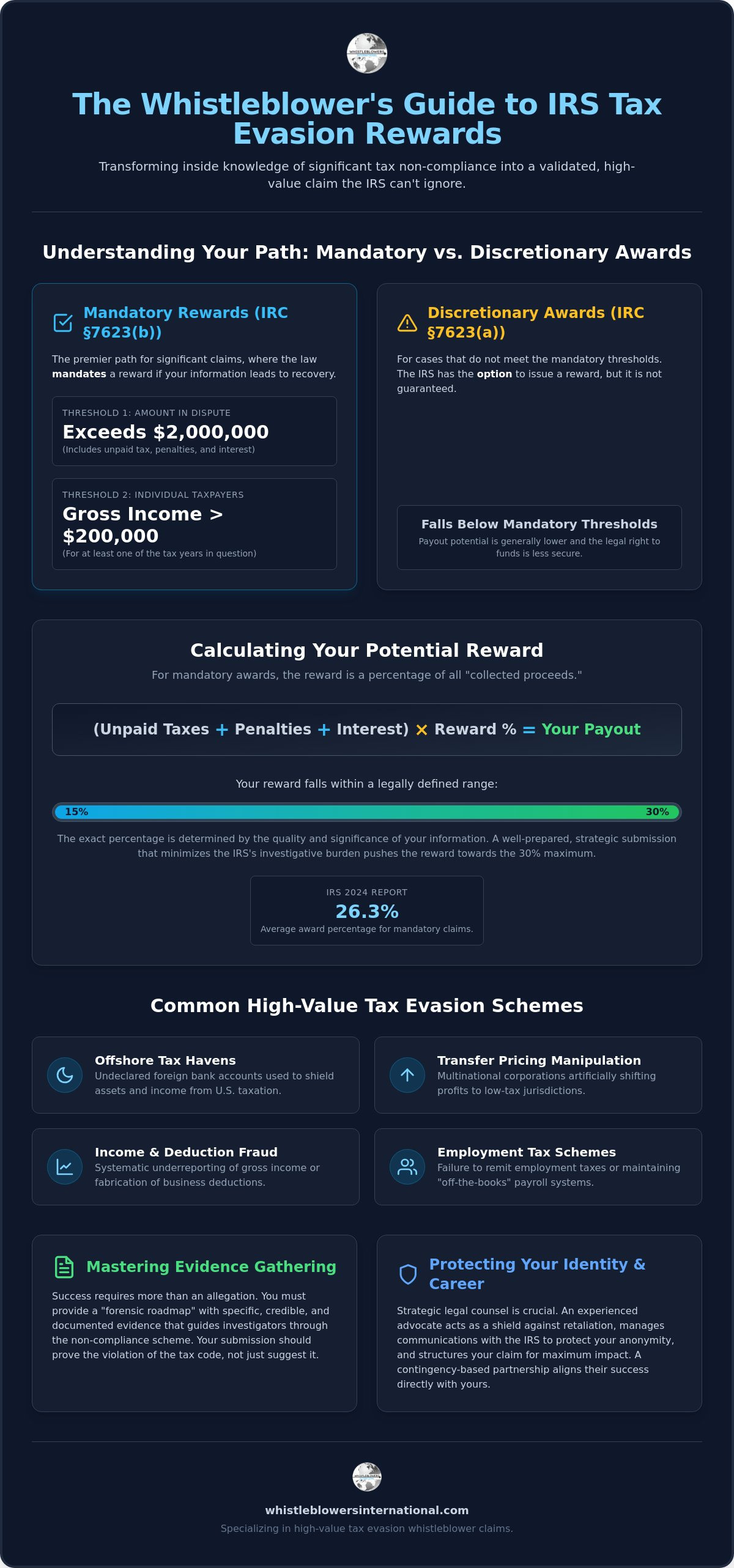
The distinction between a mandatory award and a discretionary one hinges on specific financial benchmarks that dictate the IRS’s legal obligations. To qualify for a mandatory award under IRC 7623(b), the total amount in dispute, encompassing taxes, penalties, and interest, must exceed $2 million. This is a hard floor. If your evidence doesn’t point to a recovery of at least this magnitude, the IRS isn’t legally compelled to pay a specific percentage.
Additionally, if the claim involves an individual taxpayer rather than a corporation, their gross income must exceed $200,000 for at least one of the tax years in question. Cases that fall below these markers are categorized as discretionary under Section 7623(a). In these instances, the IRS retains the authority to provide a reward, but the payout potential is often lower and the legal right to the funds is less secure. Understanding where your evidence sits on this divide is the first step in evaluating the viability of your claim. Providing a clear roadmap that demonstrates how the $2 million threshold is met ensures your submission receives the level of scrutiny it deserves.
Calculating Potential Rewards: The 15% to 30% Framework
The financial incentive for coming forward is structured to reflect the value of the intelligence provided. When a case meets the mandatory requirements discussed previously, the IRS is legally bound to pay between 15% and 30% of the “collected proceeds.” It’s a common misconception that this percentage applies only to the unpaid taxes. In reality, the recovery includes the base tax debt, all accrued interest, and the substantial civil penalties levied against the non-compliant taxpayer. For high-value cases, these additions often double the initial tax liability, significantly increasing the pool for tax evasion whistleblower rewards.
The specific percentage awarded isn’t arbitrary. The IRS Whistleblower Office employs a multi-factor analysis to determine where a claim sits within the 15% to 30% range. According to the IRS 2024 Annual Report, the average award percentage for mandatory claims was 26.3%, indicating that well-prepared submissions frequently reach the higher end of the spectrum. Moving the needle toward the 30% maximum requires more than just raw data; it demands a strategic presentation that minimizes the government’s investigative burden.
Factors That Increase Your Reward Percentage
To secure a higher payout, your submission must provide what the IRS considers “exceptional assistance.” This involves identifying specific assets, accounts, or complex accounting maneuvers that the agency couldn’t have detected through routine scrutiny. If your documentation is high-quality and organized into a forensic “roadmap,” you reduce the time and resources the government must expend. Providing information that leads to a swift resolution, such as a signed closing agreement or a prompt payment by the taxpayer, serves as a primary driver for maximizing your percentage. If you’re unsure how to structure your evidence for maximum impact, seeking an evaluation of your claim’s forensic strength can be a vital first step.
Factors That May Decrease Your Award
Certain variables can suppress the final award percentage or, in extreme cases, lead to a complete denial. Delays in reporting are a significant concern; if you wait years after discovering the fraud to come forward, the IRS may reduce your reward. Additionally, the government examines your level of involvement in the scheme. While being a participant doesn’t automatically disqualify you, the law states that if you “planned and initiated” the tax evasion, you’re ineligible for a reward. Finally, if the IRS already possessed partial knowledge of the non-compliance through other sources, such as news reports or ongoing audits, they may categorize your contribution as “less than original,” which often results in a lower payout tier.
Qualifying for Mandatory vs. Discretionary Awards
Understanding the statutory divide between mandatory and discretionary awards is the most critical step in evaluating the potential value of your claim. While any individual who provides information on tax non-compliance meets the broad legal definition of a whistleblower, the specific path your case follows within the Internal Revenue Code (IRC) dictates your level of legal leverage. The distinction isn’t merely a matter of terminology; it determines whether the government has a legal obligation to pay you or if your reward is a matter of administrative grace. At Piacentile & Associates LLP, we focus our investigative resources on mandatory cases to ensure our clients possess the strongest possible standing when pursuing tax evasion whistleblower rewards.
The IRS Whistleblower Office operates under two distinct sections of the law. Section 7623(b) covers mandatory awards, which provide a guaranteed payout if the IRS successfully collects proceeds based on your information. Conversely, Section 7623(a) governs discretionary awards, where the IRS retains the authority to decide whether a reward is appropriate at all. This lack of certainty makes discretionary claims significantly more difficult to manage from a strategic perspective. Leverage is everything in these proceedings. Without a mandatory statutory trigger, a whistleblower lacks the primary tool used to hold the agency accountable for timely and fair payments.
The 7623(b) Mandatory Award Criteria
To secure a mandatory award, your case must cross specific financial and procedural thresholds. The total amount in dispute-including the unpaid taxes, penalties, and interest-must exceed $2 million. If the target of your claim is an individual taxpayer, their gross income must also exceed $200,000 for at least one of the tax years involved. Crossing these markers changes the fundamental nature of your relationship with the IRS. Under Section 7623(b), whistleblowers gain a statutory right to an award between 15% and 30% of the collected proceeds. Most importantly, if you disagree with the IRS’s final award determination, you have the legal right to appeal that decision to the U.S. Tax Court. This judicial oversight serves as a vital check against arbitrary reductions in your reward percentage.
The 7623(a) Discretionary Award Realities
Cases that fail to meet the $2 million threshold fall into the discretionary category. While the IRS still processes these claims, the landscape is far less favorable for the informant. The maximum reward in a discretionary case is typically capped at 15%, and it’s not uncommon for payouts to be as low as 1%. Because these awards are not mandated by law, the IRS isn’t required to follow the strict 15% to 30% framework. Perhaps the most significant disadvantage is the lack of recourse; whistleblowers in discretionary cases generally have no right to appeal the IRS’s decision to the U.S. Tax Court. This leaves the final outcome entirely at the whim of the agency, making it difficult to guarantee a specific financial result regardless of the quality of the evidence provided.
Strategic Evidence Gathering: Transforming Information into Actionable Claims
The IRS rejects the vast majority of whistleblower claims because they lack the granular detail required to initiate a formal investigation. In fiscal year 2024, the IRS received 5,660 new submissions, yet only a fraction of these possessed the forensic weight necessary to trigger an audit. To secure tax evasion whistleblower rewards, your submission must move beyond vague allegations of “tax cheating.” It requires a structured roadmap that guides federal investigators through the non-compliance step-by-step. The IRS isn’t looking for a data dump; they need a narrative that connects the dots between disparate financial records, effectively doing the heavy lifting for the agents assigned to the case.
Central to this process is the concept of “original information.” Original information is data derived from independent knowledge or independent evaluation. This means your evidence shouldn’t just be a collection of public records or news clippings. It must reflect an insider’s perspective or a unique analysis that the government couldn’t have performed on its own. While gathering this data, you must exercise extreme caution. There’s a fine legal line between documenting fraud and the “theft” of company property. We help our clients identify which documents are legally permissible to share, ensuring that the evidence remains admissible in court without exposing the informant to avoidable legal risks. If you have questions about the legality of your evidence, you should consult with an experienced whistleblower advocate before taking further action.
The Anatomy of a Winning Form 211 Submission
A successful Form 211 submission acts as a comprehensive indictment of the taxpayer’s misconduct. You must identify every specific entity, subsidiary, and tax year involved in the evasion scheme. Providing internal ledgers, emails, or spreadsheets is vital, but these documents must be used to prove “scienter,” or the specific intent to defraud the government. You need to explain the “how”-the precise accounting or legal mechanism used to hide income or inflate deductions. Whether it involves complex offshore structures or simple “off-the-books” payroll, the mechanics must be described with enough clarity that a revenue agent can verify the claim through targeted document requests.
Protecting Your Anonymity and Career
The fear of professional fallout is often the greatest barrier to reporting high-stakes fraud. However, the IRS Whistleblower Office is legally required to protect informant confidentiality to the fullest extent of the law. One of the most effective ways to shield your identity is to have a whistleblower attorney file on your behalf. By acting as a buffer, your legal counsel can communicate with the IRS while keeping your name out of the initial investigative files. Furthermore, the Taxpayer First Act of 2019 provides robust legal protections against employer retaliation. If an employer takes adverse action against you for reporting tax evasion, you have the right to seek reinstatement, back pay, and other damages. This protective shield, combined with strategic anonymity, allows you to pursue tax evasion whistleblower rewards without sacrificing your career stability.
Securing Elite Legal Advocacy for Tax Evasion Claims
Securing tax evasion whistleblower rewards requires a rare combination of legal acumen and forensic accounting expertise. The IRS Whistleblower Office deals with thousands of submissions annually; however, cases backed by elite advocacy often receive the priority they deserve. At Whistleblowers International, our investigative team is led by a former whistleblower who understands the gravity of the personal and professional risks you’re taking. We don’t just file forms. We build a comprehensive, battle-tested shield between you and the government, ensuring that your information is presented in a manner that maximizes its investigative utility while keeping your identity protected.
While the IRS provides the necessary forms for individuals to file on their own, the complexity of federal tax law makes self-representation a significant risk. A single procedural error or a failure to properly articulate the “Tax Gap” (the difference between what is owed and what is paid) can result in a summary rejection. Our firm acts as a formidable ally, leveraging our insider’s perspective to navigate the labyrinthine requirements of the Internal Revenue Code. We prioritize transparency and integrity throughout the process, providing a steady hand to lead you through what can often be a multi-year investigative cycle. To understand the full scope of what the program offers and how an IRS whistleblower lawyer can help you navigate its complexities, reviewing a comprehensive overview of the program’s requirements is an essential step.
The Value of a Contingency-Based Partnership
We operate on a contingency fee basis, which aligns our success entirely with yours. We invest the substantial resources required to investigate, validate, and develop your case at no upfront cost to you. Because our fee is a percentage of the final award, we’re deeply committed to maximizing the recovery. If the government doesn’t collect proceeds and you don’t receive an award, we don’t get paid for our time or expenses. This structure ensures that we only accept cases we believe have a high probability of success, allowing us to focus our elite resources on claims with significant forensic merit.
- Elimination of financial risk through zero upfront costs.
- Incentivized focus on maximizing the “collected proceeds” (taxes, penalties, and interest).
- Rigorous case selection that ensures your claim receives our full attention.
Next Steps: Evaluating Your Potential Case
The path toward a reward begins with a rigorous, confidential evaluation of your evidence. We’ll assess whether your claim meets the mandatory $2 million threshold and the individual income requirements (if applicable) discussed in previous sections. We’ll also review your documentation to ensure it qualifies as “original information” that the IRS cannot ignore. If you’ve uncovered evidence of high-stakes tax fraud, Contact our elite whistleblower advocates for a confidential case evaluation. We’ll help you determine the best strategic path forward to protect your career while securing the compensation you deserve.
Building Your Path to a Successful Recovery
The transition from uncovering financial misconduct to securing a mandatory award requires a disciplined, strategic approach. Crossing the $2 million threshold is only the beginning of a complex legal journey. Success depends on your ability to present original information through a forensic roadmap that the IRS can act upon immediately. Protecting your career while pursuing tax evasion whistleblower rewards is a high-stakes endeavor that demands more than just a standard legal filing; it requires a protective shield and an advocate who has stood exactly where you are today.
Whistleblowers International, led by Dr. Joseph Piacentile, a former whistleblower and attorney, provides the elite investigative support necessary to handle multi-billion dollar fraud cases on a global scale. We operate on a contingency basis, which means there are zero upfront costs for our clients; we only get paid when the government recovers proceeds and you receive your reward. You’ve already taken the first step by informing yourself of the risks and requirements. Now, let us handle the heavy lifting of the investigative and legal process. Secure your confidential consultation with Whistleblowers International today to evaluate the strength of your evidence and begin the process of holding non-compliant taxpayers accountable.
Frequently Asked Questions
How much is the average IRS whistleblower reward?
The average mandatory award percentage in fiscal year 2024 was 26.3% of the total proceeds collected by the government. During that fiscal year, the IRS disbursed $123.5 million to 105 whistleblowers, which results in an average payment of approximately $1.17 million per successful claimant. These significant payouts are typically reserved for high-value cases where the total taxes, penalties, and interest recovered exceed the $2 million mandatory threshold.
Can I report tax evasion anonymously?
You can maintain your anonymity during the investigative process by filing your claim through legal counsel. While Form 211 requires you to provide your identity to the IRS, your attorney serves as a confidential buffer between you and the taxpayer. This ensures that the target of the investigation remains unaware of your identity while the IRS conducts its audit and collection activities.
What happens if the IRS already knew about the tax fraud?
If the government already possessed the information through routine audits or public sources, your reward may be significantly reduced or denied. The program is specifically designed to incentivize “original information” that the IRS couldn’t have discovered on its own. However, if your independent evaluation of existing data provides a new roadmap that leads to a recovery, you may still qualify for tax evasion whistleblower rewards.
How long does it take to receive a tax whistleblower award?
The timeline for receiving a reward typically spans several years because the payout is contingent on the actual collection of funds. The IRS must first conduct a thorough investigation, finalize the audit, and collect the unpaid taxes and penalties. Furthermore, the agency must wait for all statutory taxpayer appeal periods to expire before the Whistleblower Office can issue a final award determination and disburse the funds.
Will I be protected from retaliation if I report my employer for tax fraud?
Yes, the Taxpayer First Act of 2019 provides robust legal protections for whistleblowers who face retaliation from their employers. If you’re terminated, demoted, or harassed for reporting tax non-compliance, you have the right to seek significant remedies. These may include reinstatement to your position, double back pay with interest, and compensation for any legal fees or emotional distress caused by the employer’s adverse actions.
Do I have to pay taxes on my whistleblower award?
Whistleblower awards are considered taxable gross income and must be reported on your federal income tax return. The IRS typically treats these payments as ordinary income for the year in which you receive the funds. It’s also common for the government to perform federal tax withholding on the award amount at the time of disbursement to ensure the tax liability is covered.
What if I was involved in the tax evasion scheme myself?
Participation in a tax scheme doesn’t automatically disqualify you from receiving a reward, though it may result in a lower percentage. However, the law is clear that if you “planned and initiated” the evasion scheme, you’re legally ineligible for any payout. It’s vital to have a seasoned advocate evaluate your specific role to determine if your level of involvement allows for a viable claim.
Can foreign nationals receive IRS whistleblower rewards?
Foreign nationals are fully eligible to receive tax evasion whistleblower rewards regardless of their citizenship or residency status. The IRS program has a global reach and actively seeks information on international tax evasion schemes that impact U.S. tax revenue. As long as the information leads to the recovery of taxes owed to the U.S. Treasury and meets the financial thresholds, the informant is entitled to a reward.