
If you’re holding evidence of a multi-million dollar fraud, the greatest risk isn’t the legal fee; it’s the cost of a legal partner who doesn’t have skin in the game. Most whistleblowers feel a paralyzing anxiety when they realize that exposing corporate or government misconduct could lead to personal financial ruin through traditional hourly billing. You shouldn’t have to mortgage your future to protect the public interest or hold powerful entities accountable. This guide explains exactly how a whistleblower lawyer contingency fee structure protects you by shifting every dollar of financial risk from your shoulders to the law firm.
You’ll learn the precise mechanics of the “No Win, No Fee” model and what percentages to expect under 2026 regulations, including the 15% to 30% ranges typical for False Claims Act and IRS recoveries. We clarify the distinction between contingency percentages and statutory fee-shifting, ensuring you understand who pays for expensive expert witnesses and data forensics. By the end of this guide, you’ll have a clear framework to evaluate law firms and the confidence that your legal team is financially incentivized to maximize your award. With over $6.8 billion recovered by the DOJ in 2025 alone, the stakes are too high to enter a partnership without total transparency.
Key Takeaways
- Master the “No Win, No Fee” model to ensure your legal team is financially invested in your success without requiring any upfront costs.
- Identify the specific reward percentages for federal programs, such as the 15% to 30% range typical for False Claims Act and IRS recoveries.
- Distinguish between a whistleblower lawyer contingency fee and out-of-pocket litigation expenses to avoid unexpected bills for expert witnesses or data forensics.
- Apply a professional framework to evaluate fee agreements, ensuring they align with 2026 industry standards of 33% to 40%.
- Recognize the importance of selecting a legal partner with the investigative depth and financial stability required to sustain multi-year litigation against massive corporate entities.
Understanding the Whistleblower Lawyer Contingency Fee Model
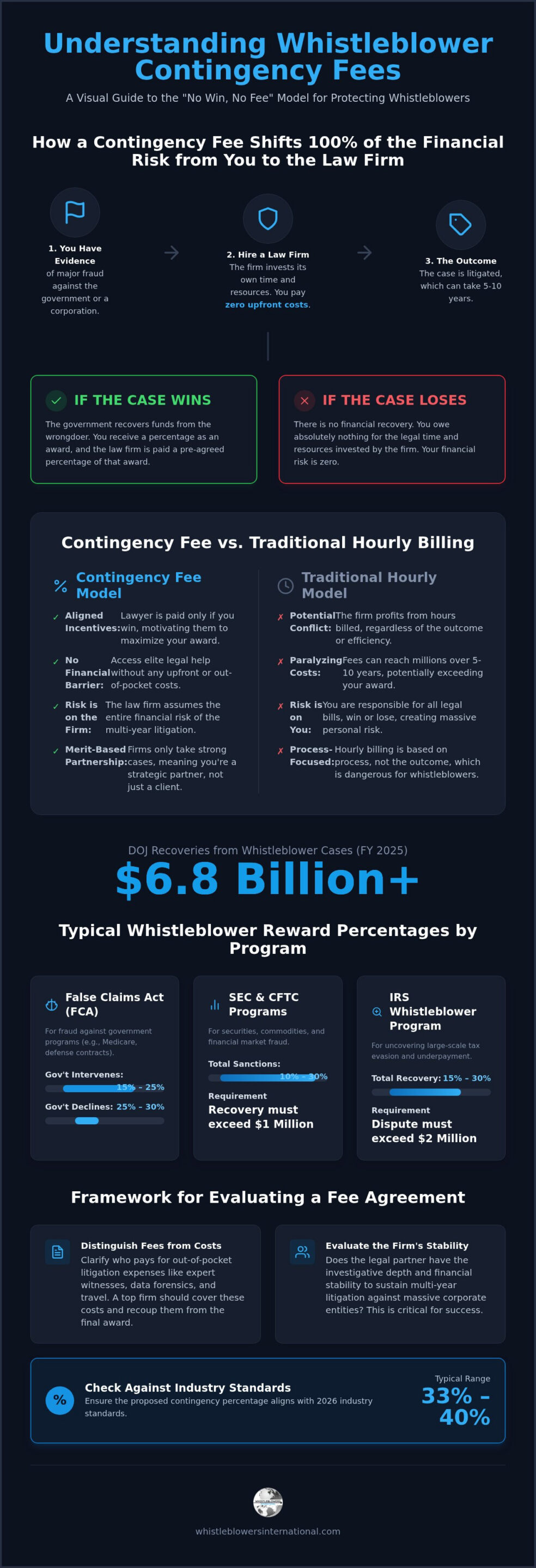
A contingency fee is a structured legal arrangement where the attorney’s compensation is derived exclusively as a percentage of the final monetary award recovered. In the context of high-stakes federal fraud, this “No Win, No Fee” structure isn’t just a convenience; it’s the industry standard for protecting individuals who possess sensitive information. It operates on a strict “if-then” framework: if the government successfully recovers funds based on your disclosure, then the law firm receives a predetermined portion of that recovery. If the case doesn’t result in a financial award, the client owes nothing for the legal time invested.
This model is designed to eliminate the massive financial barrier that typically prevents private citizens from challenging multi-billion dollar corporations. By utilizing a whistleblower lawyer contingency fee, you gain access to elite legal representation and investigative resources without the need for upfront capital. It allows individuals to initiate qui tam lawsuits (legal actions brought by private citizens on behalf of the government) with the backing of a firm that has the financial stability to sustain a long-term battle. Since the DOJ secured over $5.3 billion from whistleblower-initiated cases in FY 2025, the impact of this risk-sharing model is clear.
Contingency vs. Hourly Billing: Which is Better?
Traditional hourly billing is often a dangerous path for whistleblowers because these cases are endurance tests rather than sprints. Many federal fraud investigations take five to ten years to resolve. If a client were billed hundreds of dollars per hour over such a duration, the legal costs would likely exceed the eventual award. Contingency fees resolve this conflict of interest by aligning the lawyer’s incentives directly with your goal of maximizing the recovery. Elite firms rarely offer hourly services for False Claims Act or SEC filings because they prefer to be financially invested in the outcome rather than the process. You don’t carry the burden of monthly invoices while waiting for a case to reach its conclusion.
The Risk-Sharing Partnership
Before a firm agrees to work on a contingency basis, they must perform a rigorous evaluation of your evidence to ensure the case meets high standards of merit. A contingency fee is a merit-based commitment by the firm to invest its own labor and resources into your success. This creates a profound sense of protective reassurance for the whistleblower. You aren’t just a client; you’re a strategic partner in a high-stakes mission. Knowing your legal team is “all in” on your case provides the steady, guiding hand needed during high-risk litigation. They aren’t just providing advice; they are sharing the professional and financial risks of uncovering the truth.
Breaking Down the Percentages: Relator Shares and Fee-Shifting
Whistleblower rewards are not arbitrary figures determined by a firm; they are governed by specific statutory ranges established by federal law. Under the False Claims Act, the “relator share” is divided into two primary tiers based on government involvement. If the Department of Justice intervenes in the case, the whistleblower is entitled to 15% to 25% of the recovery. If the government declines to intervene and the whistleblower proceeds with their own counsel, this range increases to 25% to 30%. These percentages are applied to the total settlement or judgment amount. Official False Claims Act recoveries exceeded $6.8 billion in fiscal year 2025, with over $5.3 billion originating from whistleblower-led actions.
While many discussions focus solely on healthcare or defense fraud, other federal programs offer robust incentives with different mechanics. The SEC and CFTC programs provide 10% to 30% of collected sanctions, provided the total recovery exceeds $1 million. For those uncovering large-scale tax evasion, the IRS Whistleblower Program offers 15% to 30% for disputes exceeding $2 million. Understanding how these programs differ is essential for anyone considering a whistleblower lawyer contingency fee arrangement, as the complexity of the filing often dictates the level of legal expertise required.
Statutory Reward Ranges by Program
The specific percentage you receive within these ranges depends on the value of your “original information” and the level of “substantial assistance” provided during the investigation. In SEC cases, there is often a presumption for the maximum 30% award if the sanctions are $5 million or less. Conversely, the DOJ exercises broader discretion in False Claims Act cases, evaluating how much the relator’s counsel contributed to the final outcome. If you’re preparing a filing, it’s wise to speak with an experienced advocate to ensure your disclosure is positioned for the highest possible tier.
What is Statutory Fee-Shifting?
A unique advantage of the False Claims Act is the “fee-shifting” provision. This requires a losing defendant to pay the whistleblower’s “reasonable” attorney fees and costs on top of the government’s recovery. In successful cases, these court-ordered fees can significantly offset the contingency percentage, effectively increasing the whistleblower’s net take-home award. It ensures that the wrongdoer, rather than the whistleblower, bears the primary financial burden of the litigation. Recognizing the importance of the whistleblower lawyer contingency fee guide is vital for understanding how these offsets protect your final payout.
Hidden Costs vs. Legal Fees: What Every Whistleblower Must Ask
Understanding the financial landscape of a whistleblower case requires a precise distinction between professional labor and operational overhead. While a whistleblower lawyer contingency fee covers the intellectual capital and strategic management of your case, it doesn’t encompass the out-of-pocket expenses required to sustain a federal investigation. These “litigation costs” include the $405 federal filing fee required in 2026, the price of deposition transcripts, and the travel necessary for witness interviews. In high-stakes fraud matters, these expenses can climb rapidly, making it vital to recognize that legal fees and litigation costs are two distinct categories on your final settlement statement.
Most reputable firms operate on a “net” recovery basis, meaning costs are deducted from the gross settlement before the attorney’s percentage is applied. You should be wary of any agreement that requires you to pay these expenses monthly or upfront. A true partnership means the law firm carries the financial burden of the battle while you provide the evidence. If a case doesn’t result in a recovery, you shouldn’t be left holding a bill for the firm’s investigative efforts or administrative time. This risk-shifting is the core benefit of the contingency model.
Who Advances the Costs of Investigation?
Proving fraud within the SEC Whistleblower Program often requires the involvement of forensic accountants and industry-specific subject matter experts to validate complex financial data. Piacentile & Associates LLP advances all these investigative costs on behalf of our clients to ensure no stone is left unturned during the evidence-gathering phase. This level of investment is necessary to build a case that can withstand the scrutiny of corporate defense teams and federal prosecutors. If the case is ultimately unsuccessful, our firm absorbs these losses entirely, protecting you from the financial fallout of a failed litigation and ensuring your personal assets remain untouched.
Transparency in the Retainer Agreement
You need to scrutinize the retainer agreement for how “costs” are defined to avoid unexpected deductions. A professional contract will distinguish between direct litigation expenses, such as expert witness fees, and the firm’s general administrative overhead. You don’t want to be surprised by charges for internal photocopying or basic research database access that should be covered by the firm’s standard operations. Demand a clear, methodical explanation of how expenses are tracked and reported before you sign. This level of transparency builds the trust necessary for a relationship that may last several years as the case moves through the federal court system.
How to Evaluate a Whistleblower Law Firm’s Fee Agreement
Evaluating a legal contract is the final hurdle before committing to a high-stakes partnership. You must ensure the document reflects a true alignment of interests. A standard whistleblower lawyer contingency fee typically ranges between 33% and 40%, depending on the complexity and stage of the case. If a firm proposes a “hybrid” model, requesting an upfront retainer in addition to a percentage, you should proceed with extreme caution. This often indicates the firm lacks the financial stability to carry the case’s risk or lacks full confidence in the evidence’s merit. A firm’s willingness to work on a pure contingency basis is the ultimate validation of your case’s potential.
The agreement must also explicitly state that the firm possesses the capital to litigate against global corporations for several years. Since the DOJ reported a record 1,297 new qui tam lawsuits in FY 2025, the competition for government attention is fierce. Your firm needs the resources to stay the course. You should verify that the contract covers all phases of litigation, including potential appeals and any related retaliation claims. This ensures you aren’t left without representation if the case becomes more complex or if the defendant attempts to strike back professionally.
The Importance of Specialization
Choosing a specialized False Claims Act attorney is fundamentally different from hiring a general practice lawyer. Whistleblower law requires navigating intricate agency programs like the SEC or FinCEN, where a single procedural error can disqualify a claim. A specialized firm understands how to document corporate fraud with surgical precision, protecting your identity while maximizing the evidence’s impact. This insider perspective, often bolstered by having former government investigators on staff, accelerates the recovery process by speaking the language of federal prosecutors from day one.
Questions to Ask During Your Initial Consultation
A transparent consultation serves as a litmus test for the firm’s integrity. You should ask direct questions to uncover any hidden financial liabilities. If the firm’s responses feel evasive or overly transactional, they may not be the protective mentor you need. Consider these specific inquiries:
- “Will I ever receive a bill for your time if we lose?”
- “How do you handle the costs of expert witnesses and forensic data?”
- “What is your specific track record with the agency overseeing my disclosure?”
A reputable firm will answer these with clarity and confidence. If you’re ready to partner with a team that carries the full weight of the financial risk, request a confidential case evaluation to discuss your options under a 100% contingency model.
Why a Contingency Partnership with Piacentile & Associates LLP Protects Your Interests
Piacentile & Associates LLP operates with a perspective that traditional law firms simply cannot replicate. Our firm was built by a former whistleblower who understands the psychological and professional weight of coming forward. This personal history dictates our 100% contingency model; we refuse to let financial barriers silence those who witness corporate wrongdoing. When you engage our team, you aren’t just hiring a service provider. You’re entering a strategic partnership where our success is entirely dependent on your award. We leverage an insider’s understanding of the investigative process to uncover evidence that others might miss, ensuring your disclosure is as robust as possible before it reaches a federal agent’s desk.
By removing the burden of hourly fees, we allow you to focus on the accuracy of your information. Our firm assumes 100% of the financial risk because we believe in the merit of the cases we select. This alignment of interests is the most ethical way to practice whistleblower law. It ensures that your legal team is just as motivated as you are to achieve a successful outcome. We don’t just provide a service; we provide a formidable defense against the massive legal departments of multi-billion dollar corporations without any upfront cost to our clients. Utilizing a whistleblower lawyer contingency fee structure means our firm is financially “all in” on your success from the moment the retainer is signed.
Elite Advocacy for Global Whistleblowers
Our firm provides elite advocacy for individuals regardless of their geographic location. We represent whistleblowers globally, helping foreign nationals navigate the complexities of U.S. reward programs through the FCPA whistleblower lawyer process. This international reach is vital for those reporting foreign bribery or customs fraud in 2026. You gain a battle-tested mentor who anticipates the specific challenges of cross-border litigation. Our goal is always to maximize the tier of your recovery by providing the meticulous case development that government agencies demand. We understand the nuances of international law and how they intersect with U.S. federal programs, ensuring your filing is positioned for maximum impact.
Confidentiality and Protection
Protecting your identity is a foundational priority in every case we accept. Our fee structure is designed to support anonymous filing procedures whenever the law allows, providing a layer of security for your ongoing career. We recognize that the decision to report fraud is often a high-stakes mission for integrity, and we treat it with the gravity it deserves. Piacentile & Associates LLP treats every case as a high-stakes mission for integrity. Your privacy is protected with the same rigor as your financial interests. This specialized focus on confidentiality ensures that your professional reputation remains intact while we pursue the recovery you deserve. We provide a steady, guiding hand through the labyrinthine process of federal oversight.
Securing Your Financial Future Through Strategic Partnership
Choosing the right legal partner is the most critical decision you’ll make after deciding to report fraud. A transparent whistleblower lawyer contingency fee structure ensures that you aren’t just a client but a partner in a high-stakes mission where the law firm assumes all financial risks. By understanding the statutory reward ranges and the protective power of fee-shifting, you can move forward with the confidence that your personal assets are shielded while you pursue justice. Transparency in litigation costs and investigative depth are the hallmarks of a firm that is truly “all in” on your success.
Piacentile & Associates LLP offers the unique advantage of being led by a former whistleblower who understands your professional risks firsthand. We operate on a 100% contingency basis with zero upfront costs, leveraging decades of experience in False Claims Act and SEC recoveries to maximize your award. If you’re ready to hold powerful entities accountable with a battle-tested mentor by your side, request a confidential, no-cost case evaluation with Piacentile & Associates LLP. Your integrity is your greatest asset; don’t let the fear of legal costs stand in the way of the truth.
Frequently Asked Questions
Is a whistleblower lawyer contingency fee the same as “No Win, No Fee”?
A whistleblower lawyer contingency fee is the formal legal term for a “No Win, No Fee” arrangement. This structure ensures that your legal counsel only receives payment if they successfully secure a financial recovery from the government on your behalf. If the case is dismissed or fails to result in an award, you owe no attorney fees. This model ensures that high-level legal representation remains accessible to individuals regardless of their current financial standing or personal liquidity.
What is the standard percentage for a whistleblower attorney fee in 2026?
In 2026, the industry standard for a whistleblower attorney fee typically ranges from 33.3% to 40% of the final award. This percentage reflects the significant financial risk and labor-intensive nature of federal fraud investigations, which often span several years. The specific rate depends on the complexity of the case and whether the firm must litigate the matter independently. Always ensure your retainer agreement clearly defines this percentage before you proceed with a formal filing.
Who pays the court costs and expert witness fees in a Qui Tam case?
Reputable whistleblower firms advance all necessary litigation expenses, including court filing fees, expert witness fees, and forensic data analysis costs. These out-of-pocket expenses are typically reimbursed to the firm from the gross settlement before the final award is distributed to the whistleblower. If the case is unsuccessful, elite firms like Piacentile & Associates LLP absorb these costs entirely. This ensures the whistleblower faces no personal financial liability for the investigation’s expenses, even if the case fails to recover funds.
Can I be charged an hourly rate if my whistleblower case is unsuccessful?
You cannot be charged an hourly rate for legal services in a pure contingency model if your case is unsuccessful. The “No Win, No Fee” structure is designed specifically to shield you from the crushing costs of multi-year litigation against major corporations. If a firm attempts to bill you for their time after a case dismissal, they are not operating on a standard contingency basis. Professional whistleblower advocates accept the risk of failure as a commitment to the case’s merit.
Does the government pay for my whistleblower lawyer?
The government does not directly pay for your private counsel; however, statutory fee-shifting provisions often require the losing defendant to pay your “reasonable” attorney fees. This court-ordered payment is separate from the whistleblower’s award and serves to offset the impact of the whistleblower lawyer contingency fee on your net recovery. In many successful False Claims Act cases, these defendant-paid fees significantly reduce the legal costs for the whistleblower, maximizing their final take-home amount after the settlement is finalized.
What happens to the contingency fee if the government declines to intervene?
If the government declines to intervene, your legal team must litigate the case independently, which significantly increases the firm’s workload and financial risk. While the contingency fee percentage usually remains consistent with your initial agreement, the whistleblower’s statutory share of the recovery increases to a range of 25% to 30%. This higher reward tier is designed to compensate the whistleblower and their counsel for the additional burden of pursuing the case without direct government assistance or investigative resources.
Are whistleblower rewards and legal fees taxable?
Whistleblower awards are generally considered taxable income by the IRS and must be reported accordingly. However, tax laws regarding the deductibility of legal fees have evolved to protect the whistleblower. In many federal actions, you may be eligible for an “above-the-line” deduction for the attorney fees paid, which prevents you from being taxed on the portion of the award that went to your lawyer. You should consult a tax professional specializing in high-value settlements to evaluate your specific 2026 tax obligations.
Why do some lawyers charge a “hybrid” fee for whistleblower cases?
Some firms propose “hybrid” fees, which combine a reduced contingency percentage with an upfront retainer or monthly billing. This model is often used by firms that lack the financial resources to sustain a long-term federal investigation on their own. You should proceed with extreme caution if a firm requests any upfront payment, as it may indicate they aren’t fully committed to the case’s merit. A pure contingency model remains the most ethical way to align a lawyer’s incentives with your own.