

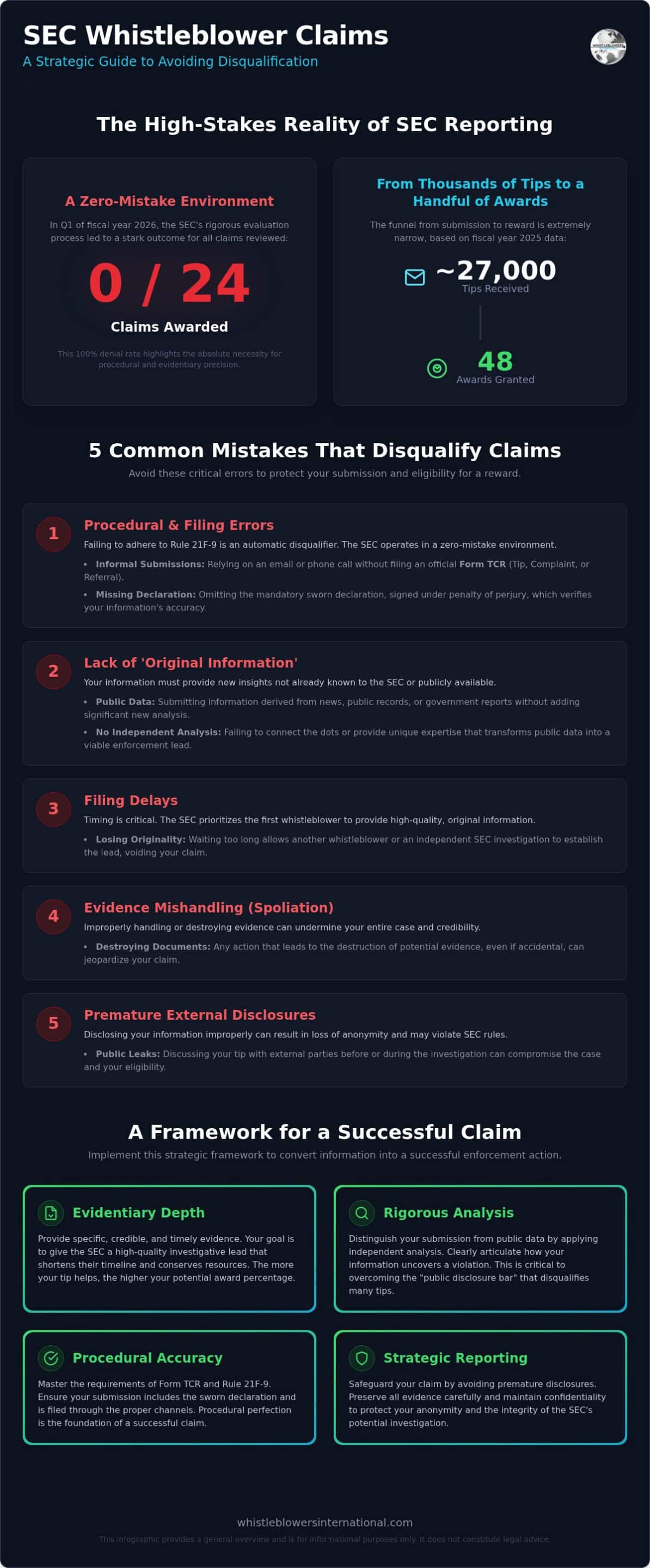
In the first quarter of fiscal year 2026, the SEC denied every single one of the 24 whistleblower award claims it reviewed. While the program has historically issued massive payouts, including a $50 million award as recently as April 2026, the current regulatory environment has become significantly more rigorous. You likely feel the weight of this high-stakes process, balancing the fear of career-ending retaliation against the hope of a life-changing reward. It’s natural to feel overwhelmed by the complexities of SEC Form TCR requirements or to worry that your evidence might not meet the strict independent analysis standard.
This guide identifies the common mistakes in SEC whistleblower claims that lead to disqualification, providing you with a clear roadmap to protect your professional standing and secure the maximum 30% reward. If you understand the procedural traps before you file, you can ensure your information leads to a successful enforcement action rather than a silent denial. We’ll examine the critical 90-day filing deadlines, the nuances of the 2022 rule amendments, and the specific evidentiary standards that distinguish a successful tip from a rejected claim.
Key Takeaways
- Ensure you meet the $1 million threshold and procedural standards by mastering the specific requirements of Form TCR and the ‘Original Information’ declaration.
- Distinguish your submission from public data by applying rigorous independent analysis, a critical step to overcoming the “public disclosure bar” that disqualifies many tips.
- Safeguard your claim by avoiding common mistakes in SEC whistleblower claims, particularly the risk of spoliation or loss of anonymity caused by premature external disclosures.
- Navigate the 10-step investigative arc with a clear understanding of how the SEC evaluates contributions to maximize your award percentage toward the 30% limit.
- Implement a strategic framework for reporting that prioritizes evidentiary depth and procedural accuracy to convert high-level information into a successful enforcement action.
The High Stakes of SEC Reporting: Why Precision Matters
The SEC Whistleblower Program is designed to incentivize the disclosure of high-level securities fraud, but it operates under a rigid set of criteria that leaves no room for error. Since the SEC Whistleblower Program history began following the Dodd-Frank Act, the Commission has recovered billions of dollars. However, thousands of submissions are rejected annually because they fail to meet specific procedural or evidentiary standards. To qualify for a reward, the resulting enforcement action must lead to monetary sanctions exceeding $1 million. If your submission contains technical errors, you risk losing an award that typically ranges between 10% and 30% of the total collected sanctions.
Understanding the common mistakes in SEC whistleblower claims is essential because the Commission views the program as a zero-mistake environment. In fiscal year 2025, the SEC received approximately 27,000 tips, yet only 48 individuals received awards. This vast disparity highlights the intense scrutiny placed on every filing. In 2026, the Commission has intensified its evaluation of original information standards. This aggressive posture is evidenced by the fact that in the first quarter of fiscal year 2026, the SEC denied all 24 award claims it reviewed. Avoiding procedural missteps is now a prerequisite for any potential payout.
Defining the ‘Eligible Whistleblower’ in 2026
Under current rules, only individuals can qualify as whistleblowers; entities such as corporations or law firms are generally ineligible for rewards. For your information to be considered voluntary, you must provide it before a request from the SEC or another regulatory body. Compliance officers and auditors face stricter hurdles. They are typically excluded from rewards unless they can prove they waited 120 days after reporting the violation internally, or that the firm’s leadership was already aware of the fraud and failed to act. These nuances require careful evaluation before any filing occurs.
The Reality of SEC Enforcement Actions
A successful claim requires more than just identifying fraud; it must lead to a successful enforcement action. The SEC evaluates the significance of your information based on its reliability and the degree to which it assisted in uncovering complex schemes. If your evidence shortens the investigative timeline or allows the SEC to conserve resources, it significantly increases the likelihood of a higher award percentage. Conversely, if your reporting is deemed redundant or lacks specific detail, the Commission may deny the claim entirely. The SEC doesn’t reward effort. It rewards results that yield high-quality investigative leads.
Procedural Pitfalls: Filing Errors That Disqualify Claims
Precision isn’t just a preference in securities litigation; it’s a structural requirement. Many individuals assume that providing high-quality evidence is enough to secure a payout, but the SEC follows a strict procedural code. One of the most common mistakes in SEC whistleblower claims is failing to adhere to Rule 21F-9, which dictates exactly how and when a tip must be submitted to be eligible for a reward. If you submit information via email or a phone call without following up with a formal Form TCR (Tip, Complaint, or Referral), the Commission may treat your contribution as a mere tip rather than a reward-eligible claim.
The official SEC whistleblower rules require every submission to include a sworn declaration. This statement, signed under penalty of perjury, verifies that your information is true and correct to the best of your knowledge. Omitting this step or failing to update a previous informal submission with a formal TCR can lead to an automatic denial of your award application, regardless of how much money the SEC eventually recovers. Time is also a factor. While there’s no traditional statute of limitations for filing a tip, the SEC prioritizes the first whistleblower to provide high-quality information. Delaying your filing allows other whistleblowers or independent agency investigations to claim the “originality” of the lead, effectively killing your eligibility. Understanding the precise SEC whistleblower statute of limitations and how it interacts with filing deadlines is critical to preserving your claim.
Mastering Form TCR and Rule 21F-9
The ‘Source of Information’ section is where many claims falter. You must clearly articulate whether your information comes from direct observation, internal company documents, or an independent analysis of public data. Vague descriptions often fail to capture the interest of investigators who are managing thousands of tips. To maximize your chances, your narrative should pinpoint specific violations of federal securities laws, identifying the individuals involved and the timeline of the misconduct. If you’re unsure how to structure your narrative to meet these evidentiary standards, consulting with an experienced SEC whistleblower attorney can help bridge the gap between raw data and a compelling legal filing.
The Anonymity Trap: Filing Pro Se vs. With Counsel
Maintaining your professional reputation is a primary concern for most whistleblowers. However, a critical procedural nuance exists: you cannot remain anonymous to the SEC unless you are represented by counsel. Individuals filing “pro se” (on their own behalf) must disclose their identity directly on Form TCR. Even if you attempt to hide your name in the supporting documents, the SEC’s intake process is not designed to shield unrepresented individuals from the record.
Counsel acts as a vital firewall, submitting the TCR on your behalf while keeping your identity confidential from the Commission until the award stage. This protection is essential in preventing accidental disclosure. A single unredacted email chain or a metadata-heavy PDF can inadvertently reveal your identity to the target of the investigation, leading to the very retaliation you seek to avoid. Professional representation ensures that every document is scrutinized for markers before it ever reaches a government server.
Evidentiary Blunders: Mismanaging Data and ‘Original Information’
The strength of an SEC claim rests entirely on the quality of the evidence provided, yet many individuals fail to understand what constitutes “original information.” One of the primary common mistakes in SEC whistleblower claims is the submission of data that is already in the public domain without adding significant value. Under the “Public Disclosure Bar,” the SEC is generally prohibited from paying an award if the information is derived from news media, government reports, or judicial hearings, unless the whistleblower is the original source of that information. Simply forwarding a news article or citing a viral social media thread about corporate misconduct will not suffice for a multi-million dollar reward.
Beyond the source, the SEC demands evidence that is specific, timely, and credible. Vague allegations of “fraud” without supporting documentation, ledger entries, or specific dates of misconduct are often disregarded during the initial triage process. The method of acquisition is equally critical. If evidence is obtained through illegal means, such as unauthorized hacking or the physical theft of corporate property, the Commission may disqualify the claim entirely. This is done to prevent the use of tainted materials that could jeopardize the integrity of a future enforcement action. High-quality evidence must be “clean” and obtained through legitimate access to avoid these evidentiary traps.
Independent Knowledge vs. Independent Analysis
While independent knowledge refers to facts known to the whistleblower that are not available to the public, independent analysis allows you to use public data to uncover hidden patterns of fraud. This pathway is particularly valuable for financial analysts or industry experts who can connect disparate pieces of information to reveal a larger scheme. Under the SEC’s 2026 standards, independent analysis is defined as the application of a whistleblower’s unique expertise or evaluation to publicly available information to reveal insights that are not reasonably apparent to the Commission.
The Danger of Privileged Information
Attorney-client privilege represents a significant “poison pill” in the whistleblower process. If your submission includes documents protected by this privilege, such as memos from the company’s general counsel, it can result in the entire evidentiary chain being deemed inadmissible. In 2026, the SEC has maintained an aggressive stance on ensuring its investigations remain untainted by privileged material. You must carefully filter all communications involving legal counsel before submission to ensure your evidence is “clean.” If you are handling sensitive internal documents, seeking guidance from a firm like Piacentile & Associates can help you navigate these complexities, ensuring your submission remains within legal boundaries while maximizing its investigative value.
Conduct Mistakes: How Whistleblowers Undermine Their Own Cases
Beyond procedural filing errors, your personal conduct throughout the lifecycle of a tip can introduce fatal vulnerabilities to your case. One of the most common mistakes in SEC whistleblower claims involves the urge to go public or confront the target of the investigation directly. While the desire for immediate accountability is understandable, tipping off a corporation before the SEC can secure evidence often results in the spoliation of critical data. When a target is alerted, documents are shredded and servers are wiped, effectively neutralizing the investigative value of your information and potentially disqualifying you from a reward. The SEC values the element of surprise; once that is lost, the viability of an enforcement action drops significantly.
Credibility is the currency of the whistleblower program. If there’s an inconsistency between your internal reports to company HR and your formal SEC filing, investigators may question the reliability of your evidence. This is why meticulous record-keeping is vital from day one. You must ensure that every date, dollar amount, and communication you cite remains consistent across all platforms. Any perceived deception, even if it’s a simple memory lapse, can be used by the defense to undermine your testimony and reduce your potential award percentage.
The Media Silence Requirement
Silence is a strategic asset in securities litigation. The SEC operates with a high degree of confidentiality to ensure that enforcement actions remain effective and untainted by public opinion. If you discuss your findings with the media or post details on social platforms, you risk triggering the Public Disclosure Bar. This legal hurdle can strip away your status as the original source of the information. The Commission frequently reduces award percentages for whistleblowers whose public disclosures interfere with an ongoing investigation or alert the target prematurely. A quiet, methodical approach is always the preferred path for elite investigators.
Internal Compliance and Reporting Strategy
Submitting an internal report before going to the SEC is a tactical decision with significant consequences. Under the 120-day rule, compliance and audit personnel generally become eligible for an award only after 120 days have passed since they reported the violation internally, unless they have a reasonable belief that reporting would result in evidence destruction or physical harm. For other employees, reporting through company channels first can actually increase your final award percentage. The SEC views internal reporting as a sign of a whistleblower’s commitment to corporate integrity. However, if you’ve been involved in the misconduct, you must navigate the Culpability Bar. While participation doesn’t always disqualify you, your award will be reduced based on your level of responsibility. To protect your interests and ensure your conduct remains beyond reproach, you should speak with a qualified SEC whistleblower lawyer before taking any public or internal action.
Navigating the SEC Claim Process: A Framework for Success
Success within the SEC Whistleblower Program is rarely the result of chance; it’s the product of a disciplined, multi-stage strategy. Once your initial submission is processed, your claim enters a 10-step investigative arc that begins with the filing of Form TCR and concludes with a Final Order of the Commission. During this period, the SEC’s Division of Enforcement conducts a rigorous validation of your evidence, a process that can span several years. Avoiding the common mistakes in SEC whistleblower claims during this long-term engagement is critical, as any procedural lapse during the investigation phase can provide the Commission with grounds for an award denial.
An elite whistleblower firm acts as more than just a legal representative; it serves as a strategic investigative partner. By utilizing advanced investigative techniques to verify your tip before it reaches the Commission, counsel ensures that the SEC receives a “trial-ready” package that demands immediate attention. This level of preparation is typically provided on a contingency fee basis. This arrangement aligns your attorney’s goals directly with your own, as the firm only receives payment if they successfully secure a reward for you. This model removes the financial barrier to high-level legal advocacy, allowing you to challenge massive corporate entities without personal financial risk.
The SEC’s Award Determination Process
If the SEC’s enforcement action results in monetary sanctions exceeding $1 million, the Commission will post a “Notice of Covered Action” (NoCA) on its website. You must remain vigilant during this stage, as you have only 90 calendar days from the posting date to file Form WB-APP to apply for your award. The SEC then evaluates several factors to determine your final percentage, which ranges from 10% to 30%. Factors that increase your award include the significance of your information, the degree of assistance you provided, and whether you reported the fraud through internal compliance channels first. Conversely, the SEC may decrease your award if you unreasonably delayed reporting or if you were a participant in the misconduct you uncovered. For a comprehensive breakdown of how these timelines and eligibility thresholds interact, reviewing the SEC whistleblower reward eligibility and statute of limitations rules for 2026 can help you avoid costly miscalculations.
Why Piacentile & Associates LLP is Your Strategic Ally
Piacentile & Associates LLP provides the sophisticated, battle-tested mentorship required to navigate these high-stakes proceedings. Led by Dr. Joseph Piacentile, a former whistleblower with an insider’s perspective on the complexities of fraud reporting, our firm understands the professional and personal risks you face. We don’t merely file paperwork; we conduct deep-dive investigations to ensure your evidence meets the SEC’s increasingly high “original information” standards. In an era where the SEC awarded over $60 million in FY2025 while simultaneously increasing its scrutiny of claims, having a formidable ally is essential to protecting your reward and your anonymity. If you possess information regarding securities fraud, contact our team for a confidential case review to discuss your options and secure your professional future.
Securing Your Legacy and Your Reward
The 2026 regulatory landscape for securities reporting is more demanding than ever. We’ve explored how a single procedural oversight or an evidentiary gap can lead to a silent denial of your claim. By avoiding the common mistakes in SEC whistleblower claims, such as failing to file a sworn Form TCR or violating the Public Disclosure Bar, you position yourself for a successful enforcement action. Your information has the power to stop corporate misconduct and protect investors, but only if it’s presented with the precision the SEC requires.
Piacentile & Associates LLP offers the national representation and investigative depth necessary to handle these massive complexities. Our firm is led by a former whistleblower who understands the nuances of the field from an insider’s perspective. Because we work on a contingency fee basis, we only win if you win; this ensures our interests are perfectly aligned with your success. You don’t have to navigate this labyrinth alone. Secure your claim with a confidential consultation from Piacentile & Associates LLP today. Your courage deserves the protection of a battle-tested advocate.
Frequently Asked Questions
What is the most common reason the SEC rejects a whistleblower claim?
The most frequent cause for rejection is the failure to provide “original information” that leads to a successful enforcement action. Many applicants submit common mistakes in SEC whistleblower claims by providing data already known to the Commission or derived entirely from public news reports. If your tip doesn’t offer a unique perspective or independent analysis that advances an investigation, the SEC will likely deny the award application during the initial triage phase.
Can I still get a reward if I was partially involved in the fraud?
You can still be eligible for an award if you were involved in the misconduct, provided you weren’t the mastermind and haven’t been criminally convicted for that specific conduct. However, the SEC will typically reduce your award percentage based on your level of culpability. It’s a balancing act where the Commission weighs the value of your cooperation against your role in the securities violation.
How long does the SEC whistleblower process typically take in 2026?
The lifecycle of a claim is a marathon, typically spanning several years from the initial TCR filing to the final payout. Investigations often take two to four years to conclude, followed by a separate award determination process that can add another twelve to twenty-four months. This duration reflects the SEC’s methodical approach to uncovering complex financial fraud and ensuring all legal requirements are met.
Do I need a lawyer to file an SEC whistleblower claim?
While the law allows you to file on your own, you cannot submit a tip anonymously without the representation of an attorney. Engaging counsel is the only way to shield your identity from the Commission and the target of the investigation. Beyond privacy, a lawyer ensures your filing avoids the common mistakes in SEC whistleblower claims that frequently result in automatic disqualifications.
What happens if my company retaliates against me after I report to the SEC?
If you face retaliation, the Dodd-Frank Act provides a private right of action to seek significant remedies in federal court. You may be entitled to reinstatement, double back pay with interest, and reimbursement for legal fees. To trigger these protections, you must have provided your information to the SEC in writing before the retaliatory act occurred.
Is there a limit on how much money an SEC whistleblower can receive?
There is no fixed dollar limit on the amount a whistleblower can receive, as the award is calculated as a percentage of the total sanctions collected. The SEC is authorized to pay between 10% and 30% of any recovery exceeding $1 million. For context, the program issued its largest single award of $279 million in May 2023, proving the potential for massive recoveries.
Can foreign nationals receive SEC whistleblower awards?
What is ‘Original Information’ according to the SEC?
Original information is defined as data derived from your independent knowledge or independent analysis that is not already known to the SEC. It must not be derived from a secondary source like a news article or a government report unless you are the primary source of that underlying information. The Commission requires that your submission adds specific, credible value that the agency couldn’t have obtained through its own efforts.