

What if the evidence of fraud you uncovered years ago is still legally actionable today, even if you believe the window of opportunity has already closed? It’s a common source of anxiety for potential whistleblowers to fear that their information has “expired,” especially when dealing with sophisticated schemes that take years to fully unravel. You’ve likely felt the weight of this uncertainty, wondering if the false claims act statute of limitations has already barred you from seeking justice and a potential reward.
We’re here to provide the clarity and protective reassurance you need to evaluate your specific situation with precision. In this comprehensive 2026 guide, you’ll learn how to navigate the complex interplay between the standard six-year filing deadline and the three-year “discovery rule” extension (which applies when the government is unaware of the misconduct). We’ll also clarify the absolute ten-year statute of repose and the impact of the Wartime Suspension of Limitations Act, ensuring you have a steady, expert hand to help you determine if your case is still viable under current federal law.
Key Takeaways
- Distinguish between the standard six-year deadline and the ten-year absolute ceiling to determine if your evidence remains actionable.
- Master how the false claims act statute of limitations extends by three years once the government discovers the facts, potentially reviving older claims.
- Identify rare exceptions like the Wartime Suspension of Limitations Act that can pause the legal clock during periods of conflict.
- Learn why the “first-to-file” rule makes speed just as critical as the statute of limitations for securing your whistleblower reward.
- Discover how an elite legal team evaluates high-stakes timelines to ensure your filing meets every rigorous judicial requirement.
The Standard False Claims Act Statute of Limitations: 6 Years vs. 10 Years
The timing of an FCA filing is rarely a simple calculation. Under the False Claims Act, the law establishes a dual-track system designed to protect the government’s interests while providing relators a clear window for action. This false claims act statute of limitations dictates that a civil action must be brought within the later of two specific periods. The first is a six-year window from the date of the violation. The second is a three-year window after material facts are known by the government, though this is subject to an absolute ten-year ceiling. You must recognize that these deadlines are rigid; missing them by even a single day can result in the permanent forfeiture of your right to a whistleblower reward.
A “violation” in this context typically refers to the moment a defendant knowingly submits a false claim for payment or approval. In healthcare fraud, this might be the day a bill is sent to Medicare for services never rendered. In defense contracting, it could be the submission of a fraudulent invoice for non-existent parts. Because the law focuses on the act of submission rather than the date the government pays the claim, the clock often starts earlier than whistleblowers realize.
The 6-Year Rule for Direct Violations
The primary clock begins ticking the moment the fraud is committed. If a contractor submits a single fraudulent invoice today, the six-year period starts immediately. However, most cases involve systemic fraud spanning several years. In these scenarios, each individual claim acts as a separate violation with its own distinct deadline. Documenting the specific date of each act is vital for a successful recovery. Without precise records, a court may find that the earliest, and often most lucrative, parts of the fraud are time-barred. If you’ve been observing a long-term scheme, it’s likely that some claims are already nearing their six-year expiration, even if the fraud is ongoing.
The 10-Year Statute of Repose
The ten-year rule serves as an absolute backstop for all litigation. Known legally as a statute of repose, this provision differs from a standard statute of limitations because it isn’t subject to the same extensions or “tolling” exceptions. It represents the government’s final boundary for recovery. No matter when the fraud is discovered or how well it was concealed, any claim filed more than a decade after the violation is legally dead. For whistleblowers holding evidence of long-term schemes, this ten-year limit creates an urgent need for elite legal evaluation. If the fraud began in 2016, the window for those initial violations is closing now in 2026, making immediate action a necessity to preserve the full value of the case.
The Discovery Rule Extension: When the Clock Starts Later
While the standard six-year window often dictates the pace of litigation, the discovery rule acts as a critical safety valve for fraud that has been meticulously concealed. This provision allows for a three-year extension from the date that material facts regarding the fraud are known, or reasonably should have been known, by the relevant government official. In practice, this means the false claims act statute of limitations can effectively stretch beyond the initial six-year period, provided the filing occurs within three years of the government’s “discovery” and does not exceed the ten-year absolute limit. The law is precise. This extension isn’t a vague grace period; it’s a calculated legal mechanism that requires deep familiarity with the legal definition of the False Claims Act to apply correctly.
Understanding the “should have known” threshold is vital for any potential whistleblower. If the government had access to information that would have alerted a diligent official to the fraud, the three-year clock might have already started ticking, even if no formal investigation was launched. If you possess evidence of fraud that occurred seven or eight years ago, don’t assume the case is dead. Instead, you should evaluate your claim timeline with an advocate who understands how these discovery windows are interpreted in federal court.
The Cochise Consultancy Precedent
The 2019 Supreme Court decision in Cochise Consultancy, Inc. v. U.S. ex rel. Hunt fundamentally shifted the landscape for whistleblowers. Before this ruling, federal circuits were split on whether a private whistleblower (a relator) could trigger the three-year discovery extension if the government declined to intervene in the lawsuit. The Supreme Court clarified that the extension applies regardless of government intervention. This is a massive benefit for relators, as it provides a uniform standard across the country, allowing cases to proceed that would have previously been dismissed as untimely. However, you must remain aware that certain circuits may still apply rigorous standards regarding what constitutes “knowledge” by a relator versus the government, making the strategic timing of your filing paramount.
Defining Government Knowledge
Identifying exactly which official’s knowledge triggers the clock is a nuanced process. The law specifies that the clock starts when facts are known by the “official of the United States charged with responsibility to act in the circumstances,” which typically refers to high-level officials within the Department of Justice rather than a low-level agency employee. For example, a routine agency audit might not necessarily trigger the discovery clock unless the audit report specifically highlighted the fraudulent activity and was shared with the appropriate authorities. Within the framework of 31 U.S.C. § 3731(b)(2), discovery is defined as the point at which material facts of the violation are known or reasonably should have been known by the government official responsible for taking action.
Tolling and Wartime Suspensions: Exceptions that Extend the Deadline
Legal deadlines aren’t always set in stone. Under certain high-stakes conditions, the false claims act statute of limitations can be paused through a process known as tolling. This mechanism ensures that if external factors beyond a relator’s control prevent a filing, the government’s right to recover stolen funds isn’t automatically extinguished. While the core rules are codified in 31 U.S.C. § 3731(b), these exceptions require a sophisticated legal strategy to invoke successfully. If you’re dealing with fraud that occurred during a period of national conflict or under extraordinary secrecy, your case might still be viable despite what the calendar suggests. It’s also vital to understand that the government’s decision to intervene or decline a case can influence how these timelines are viewed during active litigation.
When the government requests an extension of the seal period to investigate your claims, it doesn’t typically stop the clock for the original filing. However, the interplay between the government’s investigative timeline and the relator’s original filing date is a nuanced area of law. If the government eventually intervenes, their complaint can sometimes “relate back” to the date of your initial filing, effectively preserving claims that might have otherwise expired during the investigation. This protective legal framework is designed to balance the need for thorough federal scrutiny with the whistleblower’s right to a timely resolution.
The Wartime Suspension of Limitations Act
The Wartime Suspension of Limitations Act (WSLA) represents one of the most powerful tools for extending the reach of federal fraud investigations. Originally designed to protect the U.S. during periods of war, the WSLA can suspend the statute of limitations for any offense involving fraud against the government. In 2026, the application of this act remains a point of intense scrutiny in civil FCA cases. While its criminal application is well-established, its use in civil procurement fraud often depends on whether the U.S. is “at war” as defined by specific judicial standards. If your evidence involves defense contracting or international logistics during recent military engagements, the WSLA could potentially breathe life into claims that would otherwise be considered expired. It’s a complex area where elite legal counsel is required to navigate the specific jurisdictional interpretations of “wartime.”
Equitable Tolling in Qui Tam Cases
Courts sometimes apply the doctrine of equitable tolling to forgive a late filing, but it’s an exceptionally rare occurrence. To succeed, a relator must prove they’ve been pursuing their rights diligently and that some “extraordinary circumstance” stood in their way. This isn’t a loophole for lack of preparation. It’s a narrow path reserved for situations like active concealment by the defendant that made discovery impossible despite rigorous effort. You shouldn’t ever rely on equitable tolling as your primary filing strategy. It’s a defensive measure of last resort. Because the burden of proof is so high, the most protective course of action is always to file as soon as evidence is secured, rather than hoping a judge will grant a fairness-based exception later. Missing the false claims act statute of limitations because you waited for a “perfect” moment is a risk you don’t need to take.
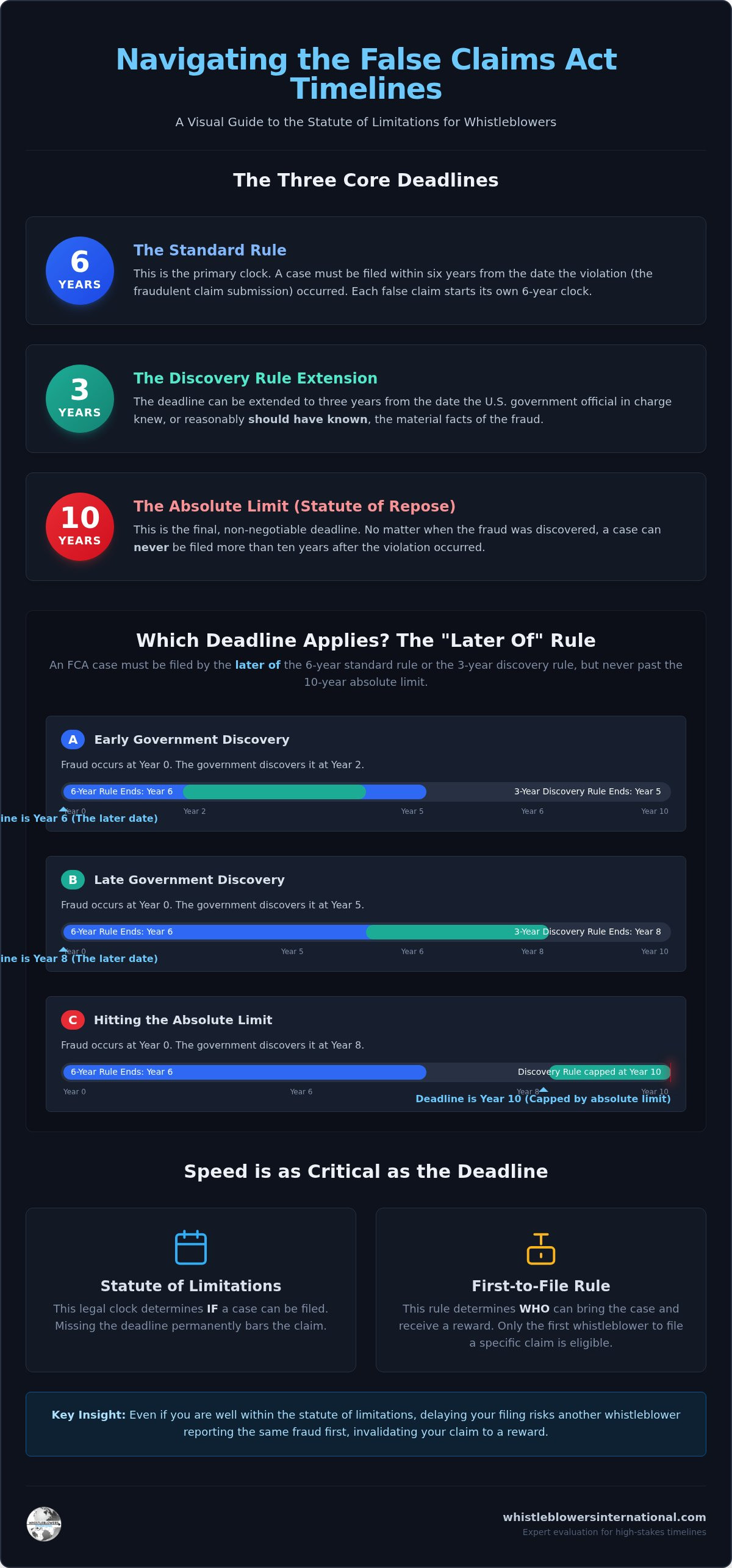
The First-to-File Rule vs. Statute of Limitations: Why Speed Matters
The legal expiration date defined by the false claims act statute of limitations isn’t the only deadline you must consider. While you may have years remaining before the statutory window closes, the “first-to-file” rule creates a high-stakes race where the reward is reserved solely for the swiftest. Under this provision, once a whistleblower files a qui tam action under seal, no other person may bring a related action based on the same underlying facts. This means that even if your evidence is superior or your investigation is more thorough, being second to the courthouse often results in an immediate dismissal of your claim. You’re effectively competing against every other individual who has access to the same fraudulent information.
Speed is a strategic necessity in federal litigation. Filing early under seal not only secures your place in line but also protects the integrity of the government’s investigation while your identity remains confidential. If you’ve uncovered evidence of systemic fraud, you should assume that others within the organization have seen it too. Waiting for the “perfect” moment to come forward often results in a lost opportunity.
How the First-to-File Rule Works
The prohibition against multiple relators is absolute and unforgiving. Courts apply a “related action” test to determine if a subsequent filing is barred. This doesn’t require the two lawsuits to be identical in every detail. If the second case relies on the same material elements of fraud as the first, it will be dismissed. This legal barrier remains in place even if the first whistleblower’s case is eventually settled or dismissed for reasons unrelated to the merits. You aren’t just racing against an abstract calendar; you’re racing against every other potential insider who might decide to act.
Managing the Public Disclosure Bar
Your case can also be neutralized by information that enters the public domain before you file. If the allegations of fraud are disclosed in news media, government reports, or judicial hearings, the Public Disclosure Bar may prevent you from proceeding. The only way to bypass this hurdle is by qualifying as an “original source,” which requires you to have independent knowledge that materially adds to the public information. Internal reporting to a company compliance hotline doesn’t stop the first-to-file clock or protect you from public disclosure. To secure your status and protect your right to a reward, you must file a formal qui tam lawsuit before the information becomes common knowledge or another relator beats you to the clerk’s office.
Evaluating Your Case Timeline with a Qui Tam Attorney
Determining the false claims act statute of limitations for a specific set of facts is rarely a matter of simple arithmetic. It requires a sophisticated audit of government knowledge, corporate concealment, and judicial precedents that vary across federal circuits. An elite advocate serves as a tactical guide through this labyrinth, ensuring that every potential extension is explored before a claim is deemed expired. At Piacentile & Associates, we apply a rigorous methodology to evaluate the viability of older fraud claims, specifically looking for “discovery rule” windows that may still be open. Because the stakes involve significant personal and professional risks, this evaluation is conducted with a deep commitment to transparency and protective reassurance.
Financial barriers shouldn’t prevent you from seeking elite representation in high-stakes litigation. Our firm operates on a whistleblower lawyer contingency fee structure, which means our interests are perfectly aligned with your success. We don’t charge hourly fees; instead, our compensation is tied directly to the recovery we secure for the government and the resulting reward for you. This model allows individuals to challenge massive corporate entities without the burden of upfront legal costs, providing a formidable ally in the pursuit of justice and integrity.
The Investigative Advantage
Our firm possesses a unique insider’s perspective that traditional law firms often lack. Led by a former whistleblower, our team understands the nuances of how fraud is hidden and, more importantly, how it is uncovered. This experience allows us to identify “hidden” tolling events (specific instances where the legal clock may have been paused) that others might overlook. We take a methodical approach to documenting evidence within the false claims act statute of limitations, ensuring that your filing is both timely and strategically sound. Throughout this process, your privacy and the integrity of the evidence remain our highest priorities, reflecting our status as a battle-tested mentor in the field of federal investigations.
Immediate Next Steps for Whistleblowers
If you possess evidence of fraud, the most critical step you can take is to organize your information for expert review. Begin by preparing a detailed timeline of events, noting when the fraudulent acts occurred and when you first became aware of them. This documentation is essential for navigating the False Claims Act filing process and determining which limitation period applies to your case. Once your timeline is ready, you should seek a professional evaluation to confirm if the window of opportunity is still open. Time is a finite resource in qui tam litigation, and early action is often the deciding factor in a successful outcome. Contact Whistleblowers International for a confidential case evaluation.
Protecting Your Right to Act Before Time Runs Out
Mastering the false claims act statute of limitations requires more than just marking a calendar; it demands a strategic evaluation of government knowledge and potential tolling events. You’ve seen that while the six-year standard remains the baseline, the discovery rule and the absolute ten-year repose provide a complex framework for pursuing older claims. However, legal viability is also a race against other potential relators under the first-to-file rule, making the timing of your filing as critical as the evidence you hold.
Piacentile & Associates LLP provides the elite investigative depth needed to navigate these high-stakes deadlines. Led by former whistleblower Dr. Joseph Piacentile, our firm offers a unique insider’s perspective with global reach. Because we operate on a contingency basis, we only get paid if you win, ensuring our interests are fully aligned with your success. Don’t let the fear of a closed window prevent you from seeking the justice you deserve. Taking the first step toward a confidential evaluation provides the clarity needed to move forward with confidence. Secure your whistleblower award; contact our elite legal team today.
Frequently Asked Questions
What is the absolute deadline to file a False Claims Act lawsuit?
The absolute ceiling for filing a claim is ten years from the date the violation occurred. Even if the government only discovers the fraud after this decade has passed, the claim is legally barred. This ten-year limit acts as a final backstop for all litigation under the False Claims Act, ensuring that defendants don’t face indefinite liability. It’s essential to consult with an expert early to ensure your specific timeline falls within this non-negotiable boundary before the window closes permanently.
Can I still file if the fraud happened more than 6 years ago?
You can still file if the fraud occurred more than six years ago, provided the government was unaware of the misconduct. In these instances, the false claims act statute of limitations extends to three years from the date a responsible government official learned the facts. However, this extension is still subject to the ten-year absolute limit. A detailed review of government awareness is necessary to confirm your case’s viability under the discovery rule.
Does the statute of limitations change for Medicare or healthcare fraud?
The filing deadlines for Medicare and healthcare fraud are identical to all other sectors governed by the False Claims Act. There are no separate timeframes specific to the medical industry. However, healthcare cases often involve ongoing fraudulent billing cycles that span many years. This pattern makes it vital to distinguish between older, potentially time-barred claims and more recent violations that fall comfortably within the standard six-year window, as each false bill represents a new violation.
What happens to the statute of limitations if the government intervenes?
Government intervention doesn’t typically change the original filing deadline for the whistleblower. If the government decides to intervene, they may file their own complaint, which can “relate back” to the date of your initial filing for statute of limitations purposes. This mechanism protects the case if the government’s investigation takes several years to complete. It ensures that the passage of time during the seal period doesn’t invalidate the claims you originally brought forward in your lawsuit.
Does reporting fraud internally to my company stop the statute of limitations clock?
Reporting fraud internally to your company’s compliance department doesn’t pause or stop the statute of limitations clock. Many employees mistakenly believe that starting an internal investigation preserves their legal rights, but only a formal filing in federal court satisfies the statutory requirements. If you wait for an internal resolution that never comes, you risk your case becoming time-barred. You should seek legal counsel immediately to protect your status as a relator while your evidence is still fresh.
Is the statute of limitations different for foreign nationals reporting fraud?
The false claims act statute of limitations applies equally to all whistleblowers, regardless of their nationality or geographic location. Foreign nationals reporting fraud against the U.S. government from abroad are held to the same six-year and three-year discovery standards as domestic relators. Because the False Claims Act has global reach, international whistleblowers must act with the same urgency to ensure their claims are filed within the prescribed federal windows, especially in cases involving customs or import fraud.
Can the statute of limitations be extended during a national emergency?
The statute of limitations can be suspended during times of war or authorized military conflict through the Wartime Suspension of Limitations Act. This suspension typically applies to fraud offenses against the United States while the country is at war. While the rules for civil cases are more restrictive than criminal ones, certain national emergencies and conflicts may provide a legal basis for tolling the clock on procurement fraud and other systemic violations involving government spending.
What is the difference between a statute of limitations and a statute of repose in the FCA?
A statute of limitations defines the period during which a party may bring a claim, often allowing for extensions like the discovery rule. In contrast, a statute of repose is an absolute barrier that cuts off the right to file after a specific time, regardless of when the injury was discovered. For the FCA, the six-year and three-year rules are the limitations, while the ten-year rule is the non-negotiable statute of repose that ends all liability.