
Most professionals who witness systemic procurement fraud believe their only options are to remain silent or risk their entire careers by speaking out alone. This isolation is a calculated byproduct of corporate culture, but it’s a false choice that ignores your strongest legal advantage. If you’ve uncovered evidence of misconduct, you aren’t just a witness; you’re a potential partner in a federal recovery effort. Identifying the right defense contractor fraud lawyer is the first step in shifting the power dynamic back in your favor.
It’s natural to feel overwhelmed by the complexity of the False Claims Act or the fear of professional retaliation. You’re likely concerned about the financial burden of litigation and the confusing distinction between lawyers who protect corporations and those who champion individuals. This guide promises to demystify the process, showing you how to secure a significant whistleblower reward without the burden of upfront legal fees. We’ll examine the strategic steps of a successful qui tam filing, the methods for maximizing your monetary recovery, and the rigorous protections available to safeguard your identity and professional future.
Key Takeaways
- Learn how the False Claims Act authorizes private citizens to file qui tam lawsuits, effectively acting as a partner to the Department of Justice in recovering misappropriated funds.
- Understand the vital importance of selecting a specialized defense contractor fraud lawyer who focuses exclusively on relator representation to avoid the conflicts of interest inherent in large defense firms.
- Identify the high-value evidence required to document procurement fraud, including specific patterns of fraudulent billing and the use of substandard materials in government contracts.
- Explore how a contingency fee partnership allows you to leverage an elite legal team’s investigative resources and insider expertise while mitigating your personal financial risk.
The Critical Role of a Government Contract Fraud Lawyer in Federal Procurement
Federal procurement represents one of the largest expenditures of the United States government, encompassing everything from advanced aerospace technology to basic infrastructure. When a contractor intentionally misleads the government to inflate profits, they aren’t merely committing a financial crime; they’re undermining the integrity of the federal ecosystem. The Department of Justice (DOJ) maintains a vast oversight network, yet the sheer complexity of modern defense contracts means that many sophisticated schemes remain hidden behind layers of corporate bureaucracy. This is why the government relies so heavily on private citizens to act as the primary catalyst for uncovering misconduct.
While the government relies on whistleblowers to expose those who exploit this complexity, legitimate businesses can navigate these intricate requirements by seeking professional support from the start; for example, you can check out Dynamic Contracts Consultants LLC for specialized assistance with AI-driven proposal development and grant writing.
Partnering with a specialized defense contractor fraud lawyer transforms an individual from a silent witness into a powerful legal force. Challenging a multi-billion dollar corporation requires more than just evidence; it requires a strategic legal team capable of managing high-stakes litigation against well-funded opponents. If you’ve discovered irregularities in how a contractor bills the government or fulfills its obligations, you’re standing at a crossroads between professional risk and the potential for a significant federal recovery. Moving from the role of an observer to a protected whistleblower is a transition that requires elite legal guidance to ensure your information is leveraged effectively while your career remains secure.
The Scope of Modern Procurement Fraud
Fraud in the defense sector has evolved beyond simple overbilling. Today, it frequently involves defective pricing, where contractors fail to provide accurate cost data during negotiations, or inferior product substitution, where substandard parts are used in critical military equipment. This can even extend to vehicle fleet maintenance, where substituting certified glass with inferior products—a stark contrast to the quality-standard parts provided by companies like Pinnacle Auto Glass—can compromise operator safety and violate contract specifications. Technological advancements have introduced new avenues for digital procurement fraud, such as falsifying cybersecurity compliance or misrepresenting the capabilities of AI-driven systems. These actions do more than drain taxpayer resources; they can directly compromise national security by providing unreliable tools to those who serve in the field. Identifying these patterns is the first step toward a successful recovery.
Protecting the Individual in High-Stakes Litigation
The decision to report misconduct is often clouded by the very real fear of professional retaliation or blacklisting. A defense contractor fraud lawyer acts as a critical shield, managing all communications and legal filings to minimize your personal exposure. Beyond the technical legal work, an elite firm provides the psychological reassurance of a battle-tested mentor who understands the unique pressures you face. By establishing a clear “if-then” framework for your case, your legal team ensures that you’re never navigating this labyrinthine process alone, prioritizing your privacy while pursuing the maximum possible reward under the law.
Understanding the False Claims Act and Qui Tam Provisions
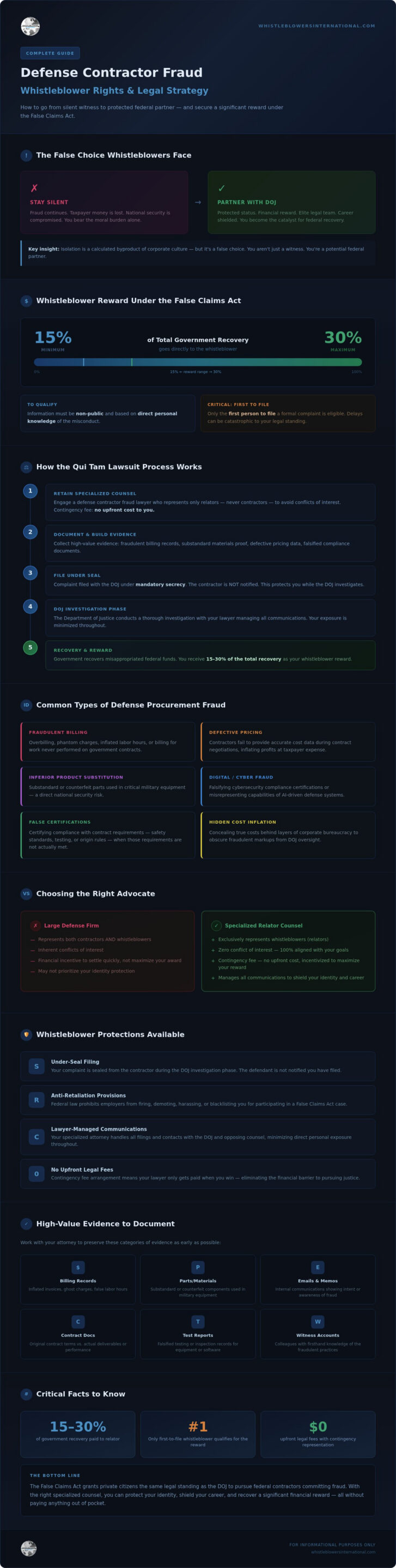
The False Claims Act serves as the legislative cornerstone for maintaining accountability within federal contracting. Its unique qui tam provisions grant private citizens the legal standing to initiate litigation on behalf of the government. This isn’t a mere reporting mechanism; it’s a formal judicial process where the individual, known as the relator, becomes a central party in the recovery of taxpayer funds. To qualify for a whistleblower reward, which can range from 15% to 30% of the total recovery, the information provided must be non-public and based on direct knowledge of the misconduct.
Timing is a decisive factor in these proceedings due to the “first to file” rule. If multiple individuals possess knowledge of the same fraudulent scheme, only the first person to file a formal complaint under the False Claims Act is eligible for the resulting financial reward. This creates a high-stakes environment where delays can be catastrophic to your legal standing. Partnering with an experienced defense contractor fraud lawyer ensures your claim is filed with the necessary precision to secure your position as the primary relator.
The Mechanics of a Qui Tam Lawsuit
When your case is filed, it enters a mandatory “under seal” phase. This period of secrecy allows the Department of Justice to conduct a thorough investigation without alerting the contractor to the impending litigation. During this time, the government evaluates your evidence to determine if it will intervene. If the government intervenes, they take the lead in the prosecution, though the relator remains entitled to a share of the recovery. Should the government decline intervention, you still retain the right to proceed as a private party, often with the support of your legal team.
Global Reach of U.S. Whistleblower Laws
The reach of the False Claims Act extends far beyond domestic borders. Foreign nationals and international employees of global corporations can file claims if the fraud impacts U.S. government funds. This is particularly relevant in cases involving international bribery or violations of the Trade Agreements Act (TAA), which governs how products are sourced for federal use. U.S. courts provide robust frameworks to protect the anonymity of international whistleblowers, ensuring that those reporting fraud from outside the United States are shielded from local professional retaliation while they pursue a federal reward. Those who also encounter commodities-related misconduct in their investigations may benefit from understanding the CFTC whistleblower claim process, which offers a parallel framework for maximizing awards through strategic and precise initial filings.
Choosing the Right Advocate: Whistleblower Representation vs. Contractor Defense
Selecting the right legal advocate is perhaps the most critical decision a potential relator will make. Many firms that appear in search results for procurement law actually specialize in defending the very corporations you intend to report. Contacting a firm that maintains a portfolio of major federal contractors creates an immediate and dangerous conflict of interest. If you’re seeking a defense contractor fraud lawyer, you must ensure their loyalty lies exclusively with whistleblowers rather than the entities that profit from government contracts. A firm that attempts to serve both sides may find its strategic options limited by the need to maintain corporate relationships.
A whistleblower-only firm offers a level of strategic alignment that dual-side firms simply cannot match. This exclusivity ensures that every resource, from forensic accounting to investigative outreach, is focused on maximizing your recovery and ensuring your professional safety. There’s also a profound advantage in partnering with a firm led by those who have walked in a whistleblower’s shoes. This insider perspective transforms the legal process from a cold procedural exercise into a mission-driven partnership. When your advocate understands the personal and professional stakes from first-hand experience, the guidance you receive is more nuanced, empathetic, and strategically sound.
Identifying Potential Conflicts of Interest
Before engaging any counsel, it’s essential to scrutinize their current client list and past litigation history. You should directly ask a potential lawyer if they currently represent any major defense contractors or if they’ve done so in the recent past. Dual-side firms may be hesitant to pursue aggressive legal theories that could jeopardize their reputation within the corporate defense community. To ensure your interests are the sole priority, prioritize a firm that has built its entire reputation on empowering relators and challenging corporate misconduct. This dedication is the only way to guarantee that your case will be pursued with the tenacity it deserves.
The Power of Investigative Expertise
A successful qui tam action requires more than just a deep understanding of the False Claims Act; it requires sophisticated investigative capabilities. Elite firms often employ former government insiders and forensic analysts who can validate your evidence before it ever reaches the Department of Justice. By leveraging technical resources to uncover hidden fraud patterns, these specialists strengthen your case, making it more attractive for government intervention. This multi-disciplinary approach ensures that your insider knowledge is translated into a rigorous, evidence-backed narrative. When your defense contractor fraud lawyer has the capability to conduct a deep-dive forensic audit, the resulting case is much harder for a defendant to dismiss or for the government to ignore.
Strategic Case Development: How to Document Procurement Fraud
Evidence is the bedrock of any successful qui tam action. Without a methodical approach to documentation, even the most egregious misconduct can be dismissed as a mere administrative error. When you’re working with a defense contractor fraud lawyer, your primary objective is to transform insider observations into a structured, evidence-backed narrative that the Department of Justice can easily validate. This requires focusing on the specific categories of data that carry the most weight in federal court, such as internal emails discussing cost-cutting measures that violate contract specifications or spreadsheets that reveal systemic labor mischarging.
Documenting fraud involves more than just collecting files; it requires a strategic understanding of what constitutes a “false claim.” If a contractor knowingly provides substandard parts while certifying they meet military grade, each invoice submitted for those parts is a separate violation. Similarly, falsifying the credentials of personnel to meet contract requirements or double-billing for the same service across different federal agencies creates a clear trail of deception. If you’ve discovered these patterns, contact a specialized legal team to evaluate your evidence before taking any further action.
Creating a Detailed Narrative of Fraud
A chronological timeline is the most effective way to present your case to federal investigators. You should identify the specific federal contracts involved, the agencies impacted (such as the Department of Defense or the GSA), and the key decision-makers who authorized the fraudulent activity. To qualify as an original source under the False Claims Act, a relator must possess voluntary, independent knowledge of the misconduct that hasn’t been publicly disclosed and must provide that information to the government before filing the action. This narrative ensures that your “original source” status is protected and that the government understands the full scope of the scheme from the outset.
Protecting Your Evidence and Your Career
Gathering evidence must be done with extreme caution to avoid violating privacy laws or corporate confidentiality agreements in a way that could jeopardize your case. You should never use company resources, such as work email or office printers, to store or transmit sensitive whistleblower documents. Instead, utilize personal, secure devices to maintain a separate record of your findings. If you find yourself being asked to participate in or sign off on fraudulent activity, it’s vital to document your objection in writing if it’s safe to do so. The False Claims Act provides robust protections against employer retaliation, including reinstatement and double back pay, but these protections are most effective when your defense contractor fraud lawyer can demonstrate a clear link between your protected activity and the employer’s adverse actions.
Why Piacentile & Associates is the Formidable Ally for Defense Whistleblowers
Choosing a legal representative for a federal procurement case is a decision that carries immense professional weight. Piacentile & Associates LLP distinguishes itself through a unique leadership perspective that most traditional law firms cannot replicate. Led by Dr. Joseph Piacentile, a former whistleblower and attorney, our firm approaches every case with the strategic depth of an investigator and the empathy of someone who has personally navigated the risks of reporting corporate misconduct. This insider perspective allows us to anticipate the tactics of corporate defendants and build cases that are specifically designed to meet the rigorous standards required for Department of Justice intervention.
Our firm operates on a national and global scale, providing a level of reach that transcends regional limitations. We recognize that modern defense contracts often involve international supply chains and multi-national entities, requiring a legal team that can manage complexities across jurisdictions. By leveraging an elite investigative team, we don’t just file paperwork; we conduct deep-dive forensic audits and validate evidence to ensure your claim is positioned for the maximum possible recovery. When you work with a defense contractor fraud lawyer from our team, you’re gaining a battle-tested mentor who prioritizes your privacy while aggressively pursuing justice.
The Contingency Fee Advantage
One of the most significant barriers to reporting fraud is the perceived cost of elite legal representation. We remove this obstacle by operating strictly on a contingency fee basis. This means that our financial success is directly tied to the results we achieve for you. If a reward is secured through a successful settlement or judgment, our fees are a percentage of that recovery; if no reward is secured, you owe nothing in legal fees. This model ensures that high-level legal and investigative resources are accessible to individuals regardless of their personal financial standing, creating a true partnership focused solely on the maximization of the federal recovery.
Taking the First Step Toward Justice
The process of reporting fraud begins with a strictly confidential evaluation of your evidence. During this initial phase, we employ a methodical approach to determine the viability of your potential case under the False Claims Act. We examine the specific contracts involved, the nature of the false statements, and the potential for a significant recovery. This thorough vetting process ensures that we only move forward with cases that have a strong legal foundation, protecting your time and professional reputation. If you’re ready to transition from a witness to a protected relator, the first step is a secure conversation about your findings. Schedule a confidential evaluation with Piacentile & Associates LLP to explore your options and secure the expert advocacy your case requires.
Advancing Your Claim with Precision and Protection
Reporting systemic fraud within federal procurement is a decision that requires both courage and a sophisticated legal strategy. By leveraging the qui tam provisions of the False Claims Act, you can transform your insider knowledge into a powerful instrument for federal recovery while accessing robust protections against career retaliation. Success in these high-stakes matters depends on the strength of your evidence and the strategic alignment of your legal team. Partnering with a specialized defense contractor fraud lawyer ensures that your case is built on a foundation of investigative excellence and insider expertise.
Piacentile & Associates LLP offers a unique advantage; we’re led by a former whistleblower who understands the personal gravity of your situation. Our contingency-based representation model means there are zero upfront legal costs, aligning our success directly with your recovery. We have a proven track record in securing rewards in complex federal fraud cases across the globe. Secure your confidential consultation with our battle-tested whistleblower lawyers today. You don’t have to face this process alone; the right mentorship can turn your integrity into a legacy of justice.
Frequently Asked Questions
How much is the whistleblower reward for reporting government contract fraud?
Whistleblowers are typically entitled to between 15% and 30% of the total funds recovered by the government. The specific percentage depends on whether the Department of Justice intervenes in the case and the significance of the information you provide. If the government joins the action, the reward is generally between 15% and 25%. If you proceed independently with your defense contractor fraud lawyer, the reward can increase up to 30% of the total recovery.
Can I report a defense contractor anonymously?
You can maintain your anonymity during the initial stages of the process by filing the case through legal counsel. Under the False Claims Act, qui tam complaints are filed “under seal,” meaning they’re kept secret from the public and the defendant while the government investigates. While your identity may eventually be disclosed if the case proceeds to open court, your legal team serves as a protective barrier and shield throughout the entire investigative process.
What happens if the government chooses not to intervene in my qui tam case?
If the government declines to intervene, you have the legal right to pursue the litigation on your own. This path requires a highly capable legal team with the resources to fund and manage complex litigation against major corporations. Proceeding without government intervention is more challenging, but it also entitles the relator to a higher percentage of the final recovery, reflecting the increased risk and effort involved in the private prosecution of the case.
Is there a time limit for filing a government contract fraud lawsuit?
The statute of limitations for a False Claims Act case is typically six years from the date the fraud occurred. In some instances, this window can be extended to three years after the government becomes aware of the facts, but it never exceeds ten years from the date of the violation. Because of the “first to file” rule, which bars subsequent claims on the same fraud, you should consult a defense contractor fraud lawyer as soon as you discover misconduct.
Can I be fired for whistleblowing against a defense contractor?
Federal law strictly prohibits employers from firing, demoting, or harassing employees who report government contract fraud. Section 3730(h) of the False Claims Act provides robust anti-retaliation protections, including the right to reinstatement, double back pay, and compensation for legal fees. If you face adverse professional consequences for your protected actions, your legal team can file a separate retaliation claim to secure these specific damages and protect your professional future.
Do I need a lawyer to file a False Claims Act lawsuit?
Yes, a relator must be represented by an attorney to file a qui tam lawsuit. Because you’re acting on behalf of the United States government, federal courts don’t allow individuals to file these cases “pro se” or without legal counsel. Engaging a specialized firm ensures that your complaint meets the rigorous “particularity” requirements of federal law, which are essential for surviving initial motions to dismiss and securing a successful monetary reward.
Can foreign citizens receive rewards under the U.S. False Claims Act?
Foreign citizens are fully eligible to receive whistleblower rewards under the False Claims Act. As long as the fraudulent activity involves the misappropriation of U.S. government funds or resources, the location or nationality of the whistleblower doesn’t disqualify them from a recovery. This global reach is a critical component of U.S. oversight, ensuring that international procurement schemes and bribery are held to the same standards as domestic operations regardless of where the fraud occurs.
What is the difference between a civil and criminal procurement fraud case?
Civil procurement fraud cases focus on recovering monetary damages for the government, while criminal cases focus on punishment and imprisonment. In a civil False Claims Act case, the defendant may be ordered to pay triple damages plus substantial penalties for each false claim. Criminal cases are prosecuted by the government and can result in prison sentences. Whistleblowers primarily participate in the civil aspect of the investigation to secure their financial rewards and career protections.