
What if the very evidence you believe will secure your future as a whistleblower is actually the catalyst for a devastating lawsuit against you? It’s a legitimate fear for any professional who discovers financial misconduct, as the boundary between gathering proof and violating a non-disclosure agreement can feel dangerously thin. Learning how to document corporate fraud is not merely about collecting every internal email; it’s about building a strategic “chain of intent” that links specific corporate actions to federal violations.
You likely feel a profound sense of duty to report the truth, yet you’re understandably anxious about professional retaliation or the legalities of handling company data. This guide provides a precise roadmap for identifying, gathering, and organizing evidence to build a high-stakes case while protecting your professional standing. We’ll examine the specific documents that serve as “smoking guns” for programs like the False Claims Act or the SEC, outline secure methods for documentation, and explain how to present your findings to a lawyer to maximize the value of your claim.
Key Takeaways
- Understand why “Original Information” is the cornerstone of federal rewards and how meticulous documentation helps your case survive initial legal hurdles.
- Identify the specific categories of evidence, ranging from internal Slack logs to double-booked ledgers, that federal agencies prioritize when evaluating high-stakes fraud.
- Learn how to document corporate fraud through a strategic lens that utilizes the “Public Policy” exception to confidentiality agreements, ensuring you gather proof without compromising your legal standing.
- Discover a structured framework for organizing your evidence, including how to build a comprehensive fraud timeline and a witness map to substantiate your claims.
- Gain insight into the investigative vetting process used by seasoned advocates to transform raw data into a formidable federal filing.
Why Precise Documentation is the Foundation of a Successful Whistleblower Claim
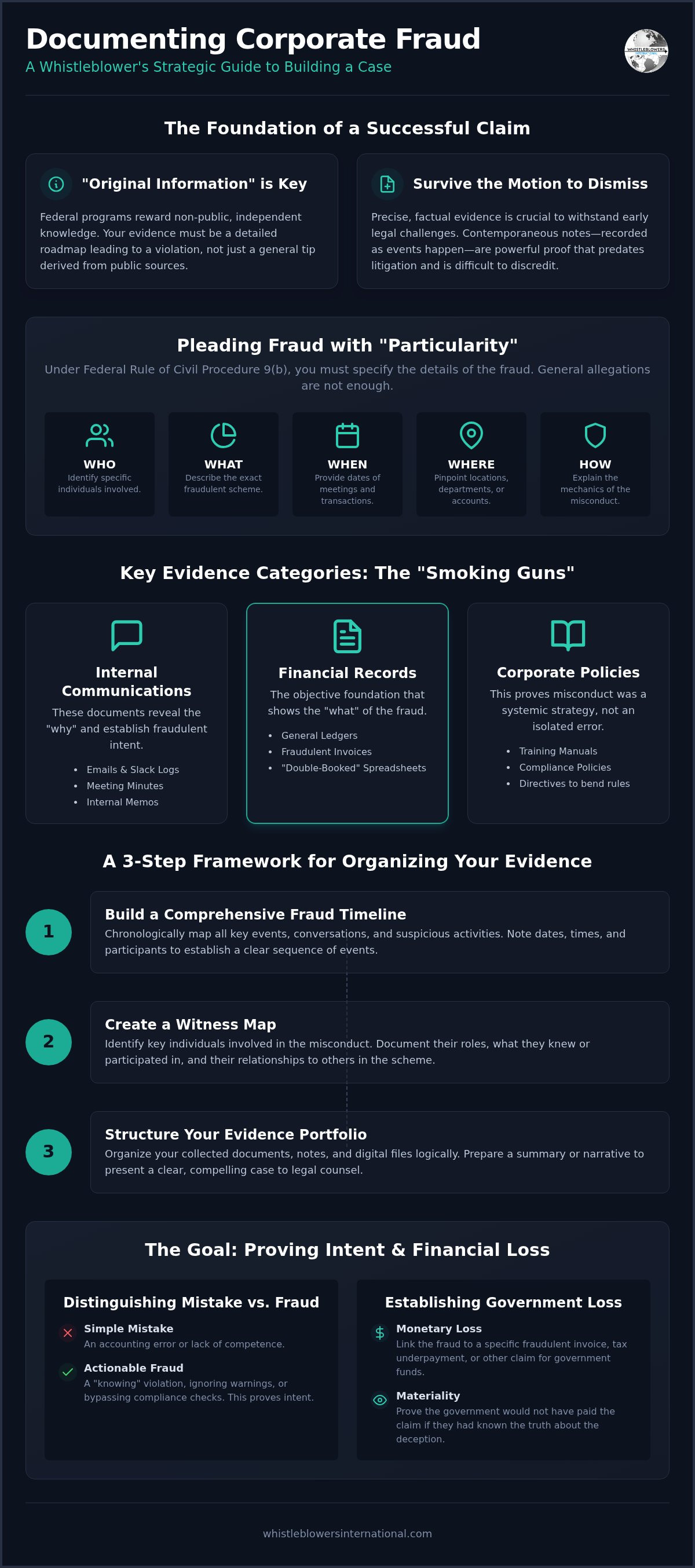
In the high-stakes environment of federal oversight, documentation serves as the vital bridge between a suspicion and a successful recovery. Federal programs, such as those governed by the SEC or the False Claims Act, require what’s known as “Original Information.” This means the data you provide must not be derived from publicly available sources like news reports or judicial hearings. It’s the independent knowledge you possess that creates value. Understanding how to document corporate fraud starts with recognizing that the government isn’t just looking for a tip; they’re looking for a roadmap that leads directly to a violation.
In Qui Tam litigation, the first major hurdle is often a Motion to Dismiss. If your evidence is purely anecdotal, a judge may rule that the complaint lacks the necessary factual foundation to proceed. Precise documentation allows your legal team to build a narrative that withstands scrutiny from corporate defense attorneys. While primary documents like contracts or internal ledgers are ideal, contemporaneous notes can be equally powerful. If you record your observations as they happen, those notes become a reliable record that predates the litigation. This makes it difficult for the defense to claim the allegations were fabricated after the fact.
You must also distinguish between a simple accounting error and actionable fraud. Evidence of a mistake might show a lack of competence, but evidence of fraudulent intent shows a “knowing” violation of the law. This distinction is often found in the paper trail of internal pushback. For instance, if a supervisor ignores a written warning or instructs an employee to bypass a compliance check, that documentation becomes the “smoking gun” that proves intent rather than accident.
The Threshold of “Particularity” in Fraud Reporting
Under Federal Rule of Civil Procedure 9(b), fraud must be pleaded with “particularity.” This legal standard requires the whistleblower to identify the specific who, what, when, where, and how of the misconduct. General allegations that a company is “cheating the system” are rarely sufficient. Instead, you need specific examples of fraudulent transactions, dates of internal meetings, and names of individuals who authorized the activity. Particularity is the legal standard for whistleblower complaints that ensures a case is grounded in verifiable facts rather than speculation.
Establishing the Government’s Monetary Loss
To secure a reward, you must demonstrate that the fraud resulted in a financial impact on the government. This involves identifying the specific “claim” for payment, such as a fraudulent invoice submitted to Medicare or a tax underpayment reported to the IRS. You must also establish “Materiality,” which means proving the government would not have paid the claim if they had known the truth about the deception. While there are robust legal protections for whistleblowers, the strength of your case ultimately rests on your ability to link corporate lies to a specific government payout.
Identifying Key Evidence Categories for Federal Fraud Programs
Building a successful case requires a diverse array of proof that goes far beyond altered bank statements. While numbers reveal the “what,” internal communications often reveal the “why.” Emails, Slack logs, and meeting minutes are critical because they capture the real-time decision-making process that establishes fraudulent intent. If a manager instructs a team to “find a way to make the numbers work” or to ignore a specific compliance flag, those digital footprints become the backbone of your claim. Understanding how to document corporate fraud involves recognizing these high-value interactions as much as the financial records themselves.
Financial records remain the objective foundation of any investigation. You should prioritize general ledgers, invoices, and any “double-booked” spreadsheets that contrast internal reality with external reports. Often, the most damning evidence is found in training manuals or policy documents that subtly or explicitly instruct employees to bend the rules for profit. These documents prove that the misconduct wasn’t a localized error but a systemic corporate strategy. While you might initially consider the Federal Trade Commission’s fraud reporting portal for general complaints, high-stakes federal programs require a much more granular level of evidence to trigger a formal investigation.
Evidence for False Claims Act (Healthcare & Defense)
In the healthcare and defense sectors, the False Claims Act remains the primary tool for recovery. For pharmaceutical cases, evidence of off-label marketing or kickback schemes often resides in sales training materials and internal incentive structures. If you’re documenting Medicare fraud, focus on capturing instances of “upcoding,” where a provider bills for a more expensive service than was actually rendered. In defense contracts, procurement fraud is often evidenced by falsified testing data or the use of substandard materials that don’t meet government specifications. If you possess this type of specific data, a consultation with experienced legal counsel can help determine the best path forward.
Evidence for SEC and CFTC Programs
The SEC and CFTC look for systemic market manipulation and accounting irregularities. Revenue recognition fraud, where a company reports income before it’s actually earned, is a frequent target of these programs. You should also look for documentation of hidden liabilities or insider trading patterns. For international operations, the Foreign Corrupt Practices Act (FCPA) provides a mechanism to report bribes paid to foreign officials. Evidence for these claims often includes travel and entertainment logs that mask illicit payments as legitimate business expenses or consultant fees that lack a corresponding work product.
Strategic Collection: How to Gather Evidence Without Compromising Your Case
Collecting evidence requires more than just a scanner and a sense of justice; it demands a sophisticated understanding of the legal boundaries surrounding corporate property. When you’re determining how to document corporate fraud, you must navigate the “Self-Help” Discovery Dilemma. This term refers to the inherent risk of being sued for theft or breach of contract when you remove company documents. While many employment contracts include strict confidentiality clauses, courts often recognize a “Public Policy” exception. This exception suggests that a company cannot use a private agreement to suppress evidence of federal crimes. However, this protection isn’t absolute, and it typically only covers documents that are directly relevant to the alleged fraud.
You should never attempt to “hack” into systems or access files outside your authorized job duties. If you use a password that wasn’t assigned to you, you risk criminal charges that could overshadow your whistleblower claim. Similarly, avoid using company-owned devices or networks for your documentation efforts. Corporate IT departments frequently employ screen scraping, USB port logging, and network monitoring to detect unusual data transfers. If the company discovers your activities before you’ve secured legal counsel, they may move to destroy evidence or terminate your employment under the guise of a security breach.
Protecting Privileged Information
The “Attorney-Client Privilege” trap is one of the most common ways a whistleblower case is compromised. If you take a memo written by or addressed to the company’s legal counsel, you may inadvertently expose your own lawyer to a conflict of interest. In many jurisdictions, a lawyer who reviews privileged material belonging to the opposing party can be disqualified from the case entirely. Healthcare fraud cases present additional complexities due to HIPAA-protected data. You must be careful to separate patient-identifying information from the financial data that proves the fraud. Keeping a clear boundary between your personal observations and proprietary trade secrets is essential for maintaining the integrity of your evidence portfolio.
Maintaining Your Digital Privacy
A Step-by-Step Framework for Organizing Your Evidence Portfolio
Raw evidence is often a liability until it’s transformed into a structured, analytical narrative. When you’re determining how to document corporate fraud, your primary objective is to make the federal investigator’s job as seamless as possible. A disorganized folder of random screenshots will not survive the scrutiny of a sophisticated defense firm or a government agency’s initial vetting process. Instead, you must curate an evidence portfolio that establishes a clear, chronological sequence of events, effectively telling the story of the fraud through the company’s own records. You don’t just want to show that something happened; you want to show why it was illegal.
You should begin by creating a “Fraud Timeline.” This document maps every significant event to a specific piece of evidence, ensuring there are no gaps in the narrative. If a fraudulent billing practice began in January, for example, you should link it to the internal memo from the previous December that outlined the policy change. Following this, you must develop a “Witness Map.” This is a strategic directory of individuals who possess firsthand knowledge of the misconduct. You should identify what each person saw, what they heard, and, crucially, what documents they likely control or have access to within the organization.
Once you’ve mapped the people and events, categorize your evidence by “Proof Point.” This involves breaking the data into three distinct buckets: Intent, Execution, and Impact. Intent focuses on documents showing the company knew the actions were illegal; Execution provides proof of the actual fraudulent transactions; and Impact demonstrates the financial loss to the government. This rigorous organization culminates in a “Disclosure Statement,” which serves as the definitive summary your counsel will use to present the case to the Department of Justice or the SEC. If you’ve reached the stage where your evidence is gathered, you can submit your documentation for a professional review to ensure it meets federal standards.
The Whistleblower Evidence Spreadsheet Template
A simple, structured spreadsheet is the most effective way to track your findings. You should organize your data into three primary columns to ensure clarity during the legal review process. Column 1 should list the date of the document or event to establish a precise timeline. Column 2 provides a concise description of the evidence, such as “Email from CFO regarding Q3 revenue targets.” Column 3 is the most critical, as it explains what the evidence proves, such as “This shows the CFO had direct knowledge of the illegal kickback scheme.”
Securing Your Physical and Digital Evidence
Security is just as vital as the evidence itself. You should utilize high-level encryption for all sensitive files and maintain redundant backups in secure, non-corporate locations, such as an encrypted personal drive. It’s also essential to preserve the “Metadata” of every digital file. The original properties, including the “Date Created” and “Author” fields, provide the digital fingerprint necessary to validate the authenticity of your evidence. If these properties are altered, the defense may argue the evidence was tampered with, potentially disqualifying it from the proceedings.
Evaluating Your Evidence with Piacentile & Associates
Once you’ve mastered how to document corporate fraud through meticulous collection and organization, the final and most critical phase is the professional validation of your evidence portfolio. Piacentile & Associates LLP operates as a high-level investigative powerhouse, led by Dr. Joseph Piacentile, a former whistleblower and attorney who understands the personal and professional stakes involved. This “Insider Advantage” means your case is evaluated by someone who has navigated the same labyrinthine processes you face today. We don’t just review documents; we apply a rigorous investigative lens to ensure your findings meet the exacting standards of the Department of Justice, the SEC, or the IRS.
Our firm possesses a global reach, representing whistleblowers from around the world in high-stakes federal claims. Because the stakes are significant, we operate on a contingency fee basis, meaning we only succeed when you secure a reward. If there is no recovery, there is no fee. This model aligns our interests entirely with yours, fostering a partnership built on transparency and a shared commitment to integrity. We bring a deep level of scrutiny to every piece of evidence, validating its authenticity and assessing its materiality before any formal filing occurs.
The Initial Case Evaluation Process
Your journey with our firm begins with a strictly confidential consultation. During this phase, our investigative team vetts your documentation to determine if it meets the “Original Information” threshold required for federal rewards. If the evidence is sufficient, we develop a strategy to protect your anonymity throughout the SEC, FinCEN, or IRS filing process. We understand the fear of retaliation, so we prioritize the use of secure communication channels as we transition your documentation into a formal Qui Tam lawsuit or a regulatory submission.
Partnering with a Battle-Tested Advocate
There is a profound peace of mind that comes from having elite legal and investigative representation. We focus on maximizing your potential award through the meticulous presentation of the “chain of intent” we established in your evidence portfolio. Under 2026 federal guidelines, rewards for programs like the False Claims Act or the SEC can range from 15% to 30% of the total recovery. By ensuring your evidence is presented with the highest level of detail and legal precision, we position you for the best possible outcome while shielding your career from unnecessary risk. To take the next step, you can schedule a confidential evaluation of your evidence with Piacentile & Associates LLP.
Securing Justice Through Strategic Evidence
Transforming internal knowledge into a successful federal claim requires more than courage; it requires a methodical approach to data. You now understand that knowing how to document corporate fraud is about establishing a chain of intent while navigating the complexities of confidentiality and digital privacy. By organizing your findings into a structured portfolio and identifying the specific proof points required by federal agencies, you’ve already taken the most difficult step toward transparency.
The path from discovery to recovery is long, but you don’t have to navigate it without a battle-tested mentor. Piacentile & Associates LLP brings worldwide experience in U.S. federal claims and the unique perspective of a firm led by a former whistleblower. We operate on a contingency basis, ensuring our elite investigative resources are focused entirely on your success and protection. If you’re ready to move forward, secure your future and report fraud with Piacentile & Associates. Your commitment to integrity deserves the support of a formidable ally.
Whistleblower Documentation: Frequently Asked Questions
Is it legal to take company documents to prove fraud?
It’s generally legal to take company documents if they serve as evidence of a federal crime, as courts often recognize a public policy exception to confidentiality agreements. However, this protection is limited to documents directly related to the misconduct. You must avoid taking proprietary trade secrets or unrelated personal files. If you’re unsure about the legality of a specific document, it’s essential to consult with counsel before removing it from the premises.
What is the most important piece of evidence in a whistleblower case?
The most critical evidence in any whistleblower case is proof of “scienter,” which is the legal term for fraudulent intent. While financial records show the loss, internal communications like emails or memos prove the company knew the actions were illegal. Showing that a supervisor was warned about a violation and chose to proceed anyway is often the “smoking gun” that secures a successful recovery under the False Claims Act.
Can I still be a whistleblower if I don’t have physical documents?
You can still pursue a case without physical documents by providing detailed testimony and contemporaneous notes. While digital or paper records are preferred, the government often initiates investigations based on credible insider testimony that describes the who, what, when, where, and how of the fraud. If you can identify exactly where the evidence is located within the company’s systems, federal investigators can use subpoenas to retrieve the necessary data.
How much evidence do I need before I contact a lawyer?
You don’t need a comprehensive portfolio to begin the process; a single credible lead or a set of specific observations is often enough for an initial evaluation. Contacting a lawyer early allows you to learn how to document corporate fraud safely without inadvertently triggering corporate security alerts. An experienced firm can guide your collection efforts to ensure you gather high-value evidence while maintaining your legal protections and avoiding common pitfalls.
Will my company know if I am gathering evidence against them?
Your company shouldn’t know you’re gathering evidence if you strictly avoid using corporate devices, networks, or cloud storage for your documentation. Most large organizations use advanced monitoring software to track unusual data exports or access to sensitive files. If you use a personal device and keep your physical notes in a secure, off-site location, you can significantly minimize the risk of discovery during the investigative phase of your claim.
What happens if I accidentally take privileged attorney-client documents?
Accidentally taking privileged attorney-client documents can seriously jeopardize your case and may lead to the disqualification of your legal team. If you discover you possess a memo from or to the company’s legal counsel, you must notify your lawyer immediately without reading or sharing the document further. Your attorney will follow specific taint team protocols to handle the material legally while protecting the integrity of your overall federal whistleblower claim.
Does the government provide a template for documenting fraud?
The federal government doesn’t provide a universal template for documenting fraud, though programs like the SEC and IRS have specific filing forms. Successful whistleblowers typically rely on their legal counsel to structure evidence into a formal Disclosure Statement. This document translates raw data into a narrative that aligns with the particularity requirements of federal law, making it easier for government investigators to validate the claims and initiate action.
How do I document verbal instructions to commit fraud?
Verbal instructions should be documented in a contemporaneous journal that records the date, time, location, and specific words used during the conversation. Learning how to document corporate fraud when no paper trail exists involves creating a reliable secondary record. If you send a follow-up email to the supervisor confirming the verbal instruction, that email becomes a permanent record of the interaction, even if the supervisor fails to respond or denies the conversation.