

Your knowledge of systemic money laundering isn’t just a professional burden; it’s a high-value asset that the U.S. government is now legally mandated to reward. You’ve likely spent months weighing the risks of reporting bank secrecy act violations, balancing your integrity against the very real fear of professional blacklisting or employer retaliation. It’s natural to feel overwhelmed by the complexity of federal oversight or to wonder if the evidence you hold is sufficient to trigger a million-dollar enforcement action.
We understand the gravity of your situation and the courage required to step into the role of an elite whistleblower. This guide explains how you can securely report BSA and AML violations to FinCEN while qualifying for mandatory monetary rewards that range from 10% to 30% of collected sanctions. We’ll outline the specific legal steps necessary to file a successful claim, the protocols for maintaining total anonymity throughout the investigative process, and the criteria used to evaluate high-value fraud. By the end of this article, you’ll have a clear roadmap for navigating this labyrinthine process with the support of a battle-tested mentor who prioritizes your privacy and success.
Key Takeaways
- Learn how reporting bank secrecy act violations can qualify you for a mandatory reward between 10% and 30% of collected government sanctions exceeding $1 million.
- Identify the systemic internal failures and manual compliance overrides that distinguish high-value fraud from isolated operational errors.
- Understand the protocols for maintaining total anonymity while gathering evidence, ensuring your professional reputation remains protected throughout the investigative process.
- Gain insight into the strategic advantages of partnering with a seasoned legal team that operates on a contingency fee basis to maximize your potential recovery.
Understanding Bank Secrecy Act (BSA) Violations for Whistleblowers
The Bank Secrecy Act (BSA) serves as the primary defense mechanism within the United States financial system, mandating that institutions actively assist government agencies in identifying and preventing money laundering. While most organizations maintain outward-facing compliance departments, the reality often diverges from the policy manual. Violations typically occur when an institution fails to implement a functional Anti-Money Laundering (AML) program or chooses to ignore specific reporting thresholds to maintain high-value, albeit suspicious, client relationships. Fundamentally, a BSA violation is a failure in recordkeeping or reporting that facilitates illicit finance.
Compliance officers, internal auditors, and high-level executives are frequently the first to recognize when these lapses transition from accidental errors to systemic misconduct. If an institution prioritizes transaction volume over regulatory adherence, reporting bank secrecy act violations becomes the only viable path to ensuring institutional integrity. This is not merely about a single missed form; it’s about identifying where the internal machinery of a bank has been compromised to allow the flow of “dirty” money.
Common Types of Reportable BSA Failures
Effective whistleblowing requires distinguishing between a clerical mistake and a systemic breakdown. Insiders should focus on patterns of behavior that suggest a deliberate avoidance of federal law. These patterns often manifest in three specific areas:
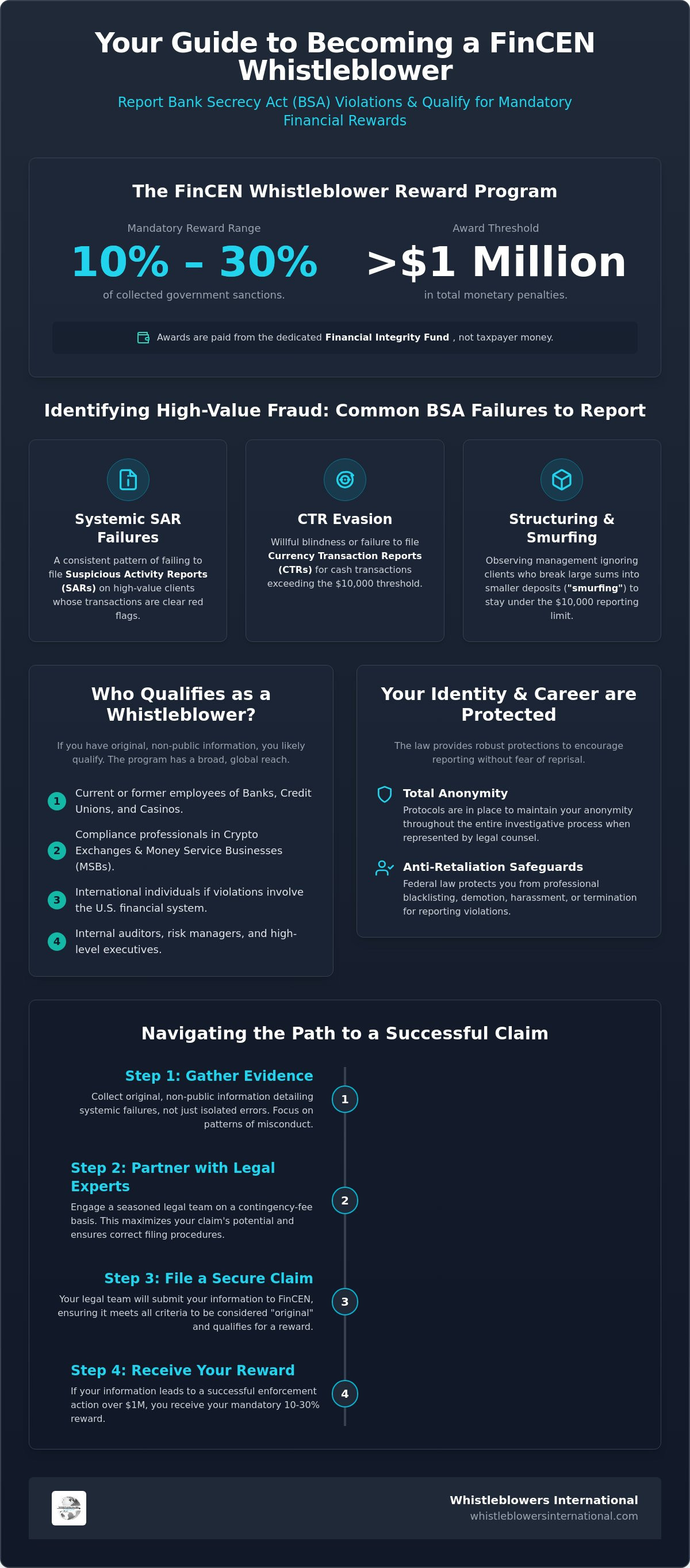
- Systemic SAR Failures: This involves a consistent pattern of failing to file Suspicious Activity Reports (SARs) on clients whose transactions meet the threshold for suspicious behavior, often because the client is considered “too important” to scrutinize.
- CTR Evasion: Financial institutions must file a Currency Transaction Report (CTR) for any cash movement exceeding $10,000. Willful blindness toward these requirements often signals a deeper culture of non-compliance.
- Structuring and Smurfing: if you observe management ignoring “smurfing,” where large sums are broken into smaller deposits to stay under the $10,000 limit, you’re witnessing a direct violation of federal law.
Who Qualifies as a BSA Whistleblower?
The scope of the law is broad, encompassing more than just traditional retail banks. If you have access to original information regarding reporting bank secrecy act violations, you likely qualify for protection and potential rewards. The program covers current or former employees of banks, credit unions, and casinos, where cash-heavy environments often hide illicit activity. It also extends to compliance professionals working within cryptocurrency exchanges and money service businesses (MSBs), both of which are under increased scrutiny by FinCEN. Notably, the law possesses a global reach; international individuals can file claims if the violations involve the U.S. financial system or utilize U.S. dollar clearing processes. Whether you’re a domestic auditor or an overseas executive, your role as an insider provides the unique perspective necessary to hold these institutions accountable.
The FinCEN Whistleblower Reward Program: 10% to 30%
The legal framework for incentivizing insiders has undergone a radical transformation. With the passage of the Anti-Money Laundering Act of 2020 and the subsequent AML Whistleblower Improvement Act of 2022, the federal government shifted from a discretionary model to a mandatory reward structure for reporting bank secrecy act violations. Today, the FinCEN Whistleblower Program guarantees that individuals who provide original information leading to successful enforcement actions are entitled to a significant portion of the recovery. Specifically, if the monetary penalties collected exceed $1 million (the statutory threshold for mandatory awards), the whistleblower receives between 10% and 30% of the total sanctions.
This capital doesn’t come from the institution’s general operating budget or taxpayer funds. Instead, awards are paid directly from the Financial Integrity Fund, a dedicated pool of capital established specifically to reward those who take the risk of reporting bank secrecy act violations. This ensures that the incentive remains solvent even when targeting massive global entities. If you’re considering coming forward, it’s vital to understand the nuances of how these percentages are calculated and what qualifies as a valid claim.
Criteria for Maximizing Your Reward Percentage
The difference between a 10% award and a 30% award often amounts to millions of dollars. FinCEN evaluates several factors when determining where a claimant falls on this spectrum. The most critical factor is the significance of the information. If your evidence is the primary catalyst for the investigation, you’re positioned for a higher percentage. Additionally, the degree of ongoing assistance provided by the whistleblower and their legal counsel plays a major role. Investigators look for high-level cooperation that streamlines the path to a settlement. Finally, the scale of the uncovered money laundering and the institution’s history of prior violations are weighed. A massive, systemic failure typically triggers a more substantial award percentage to reflect the gravity of the disclosure.
Eligibility Requirements for Monetary Awards
To qualify for a payout, your information must meet the legal definition of “original.” This means the data cannot be already known to the government or available through public news sources or judicial records. It must be derived from your independent knowledge or an independent analysis of complex data sets that others have overlooked. Under the proposed rules from April 2026, whistleblowers must also adhere to strict filing procedures through the FinCEN whistleblower office. This includes filing an award application within 90 days of a notice of covered action. Precision in the initial filing is non-negotiable; even minor procedural errors can jeopardize your eligibility for a reward.
Identifying Systemic AML and KYC Failures
BSA violations rarely stem from a single clerical oversight or a misunderstood regulation. Instead, they’re typically the byproduct of systemic internal failures where profit motives supersede regulatory obligations. When you begin the process of reporting bank secrecy act violations, the most compelling evidence often lies in the institutionalized disregard for basic safeguards. This is particularly evident in Know Your Customer (KYC) protocols, where high-net-worth individuals or Politically Exposed Persons (PEPs) are granted informal exemptions that bypass standard risk assessments. If an institution creates a “fast track” for certain clients that avoids scrutiny, the program isn’t just flawed; it’s non-compliant.
Management’s role in these failures is often active rather than passive. Willful blindness by management is a primary driver of BSA sanctions. By providing insiders with a mechanism for protecting the integrity of the U.S. financial system, the Department of the Treasury recognizes that only those within the organization can expose these hidden patterns of neglect. Identifying where the “tone at the top” encourages shortcuts is the first step toward building a successful whistleblower claim.
Red Flags in High-Risk Jurisdictions
High-stakes investigations often center on how a firm handles capital moving through volatile regions. Insiders should look for a consistent failure to apply enhanced due diligence (EDD) to transactions originating in “gray list” countries or jurisdictions known for systemic tax evasion. Another critical red flag involves the intentional ignoring of OFAC sanctions lists when processing international wire transfers. Some institutions utilize correspondent banking accounts specifically to mask the true origin of illicit funds, allowing high-risk capital to enter the U.S. financial system without the required scrutiny. These aren’t just technical errors; they’re gateways for illicit finance.
Internal Compliance Overrides
The most actionable evidence for reporting bank secrecy act violations usually involves direct interference with the compliance department. If you have documented instances of compliance officers being pressured by senior management to ignore suspicious patterns, you hold the key to a significant claim. This institutional pressure is often accompanied by a deliberate lack of independent testing for AML software or a choice to understaff compliance teams despite surging transaction volumes. When algorithms are tuned to produce fewer alerts rather than more accurate ones, the failure is no longer an accident. It’s a calculated strategy to prioritize speed over security. Working with a bank fraud whistleblower lawyer who understands these internal dynamics can be the decisive factor in transforming documented overrides into a compelling federal enforcement action.
How to Report BSA Violations While Protecting Your Career
The decision to expose institutional misconduct is often hindered by the legitimate fear of professional suicide. In the tightly knit world of high finance, a reputation for disloyalty can end a career overnight. However, reporting bank secrecy act violations doesn’t require you to sacrifice your future. By following a methodical, legally sound protocol, you can alert federal authorities while maintaining a protective barrier between your identity and your employer. Success in these high-stakes matters depends on your ability to remain invisible while the government builds its case.
Digital safety is your first line of defense. Never use company-issued laptops, mobile phones, or the corporate Wi-Fi network to research whistleblower laws or transmit evidence. Modern financial institutions employ sophisticated keystroke logging and network monitoring tools that can flag suspicious activity in real-time. Use personal hardware and encrypted communication channels to consult with your legal team. If an institution detects your inquiries before you’ve secured legal protection, you lose the strategic advantage of a controlled disclosure.
The Power of Anonymous Reporting
FinCEN’s program is specifically designed to accommodate insiders who wish to remain in the shadows. If you are represented by an experienced attorney, you can file your claim anonymously. This means your name is never disclosed to the institution under investigation and, in many instances, remains shielded from the public record even after the case concludes. This is the most effective defense against the blacklisting that many compliance professionals fear. By removing the threat of immediate retaliation, this structure allows you to focus on providing high-quality information without the constant shadow of professional ruin.
Best Practices for Documenting Evidence
A successful FinCEN claim relies on the specificity of the data provided. You must document the who, what, when, and where of the violation with surgical precision. Rather than taking massive amounts of sensitive customer data, which may violate privacy laws, focus on recording specific transaction IDs, dates of conversations, and the names of senior managers who authorized overrides. Identify the exact internal policies or federal regulations being bypassed. Before you remove any physical or digital files from the workplace, it’s essential to consult with a whistleblower attorney to ensure your collection methods don’t jeopardize your legal standing. A strategic, methodical approach to evidence is the difference between a dismissed tip and a multi-million dollar recovery.
Navigating FinCEN Claims with Piacentile & Associates LLP
The path to securing a mandatory reward for reporting bank secrecy act violations is fraught with procedural hurdles that can disqualify even the most significant evidence. Piacentile & Associates LLP provides the elite investigative and legal support necessary to manage these high-stakes claims with precision. We act as a battle-tested mentor for insiders, leveraging a unique perspective that only those with real-world investigative experience can offer. Our team doesn’t just act as legal counsel; we serve as strategic partners guiding you through the complexities of federal law from multiple angles.
Our firm operates on a contingency fee basis, which means we don’t receive payment unless a recovery is secured. This model ensures that our interests are perfectly aligned with yours; we’re fully committed to maximizing the results of your disclosure. We meticulously evaluate the technical merits of your evidence to build a compelling case that captures the attention of FinCEN investigators. By identifying the systemic nature of the reporting bank secrecy act violations you’ve witnessed, we help transform raw data into a formidable legal filing that demands government scrutiny.
Why Legal Representation is Critical for FinCEN Rewards
While the FinCEN whistleblower portal is accessible to the public, submitting a claim without seasoned legal backing is a significant risk. FinCEN receives thousands of reports annually, and a lawyer-led submission ensures your case stands out among the volume of incoming tips. We manage every communication with government agencies, acting as a protective buffer that allows you to maintain total anonymity throughout the investigative process. Additionally, our investigative background helps uncover deeper layers of fraud or related actions that can significantly increase the total sanction amount, thereby increasing your potential award.
Next Steps: Secure Your Confidential Consultation
If you’re ready to move forward, the first step is a risk-free evaluation of the information you possess. We provide a clear if-then framework for your potential case, helping you understand the specific legal requirements and the likelihood of a successful enforcement action. It’s essential to act before the information becomes public or is reported by another party, as the law prioritizes those who provide original information first. You can protect your future and report BSA violations with Whistleblowers International by reaching out for a confidential consultation. Our global reach and high-level influence ensure that your claim is handled with the gravity and expertise it deserves.
Take Decisive Action to Protect the Financial System
The decision to step forward requires more than just evidence; it demands a strategic partner who understands the high-stakes reality of the financial sector. You’ve seen how systemic failures in AML and KYC protocols compromise institutional integrity. By reporting bank secrecy act violations through the proper channels, you transform from a silent observer into a catalyst for global accountability. The FinCEN program’s mandatory reward structure ensures that your contribution is valued, while legal representation provides the shield necessary to preserve your professional future.
Our firm is led by a former whistleblower who provides a unique insider’s perspective on the complexities of federal investigations. We provide global legal advocacy for international whistleblowers and operate on a no-win, no-fee contingency basis (meaning you pay nothing unless a recovery is secured). If you possess original information regarding high-value fraud, then our team can evaluate the technical merits of your potential claim. Speak with an experienced whistleblower attorney about your FinCEN claim to begin your confidential evaluation. You don’t have to navigate this labyrinth alone; a formidable ally is ready to stand with you.
Frequently Asked Questions
What is the maximum reward for reporting Bank Secrecy Act violations?
Whistleblowers are entitled to receive up to 30% of the total monetary sanctions collected by the government in a successful enforcement action. There’s no fixed dollar cap on this amount; if a global bank is sanctioned for $500 million, the reward could reach $150 million. To trigger these mandatory award provisions, the total sanctions collected must exceed the $1 million threshold established by federal law.
Can I report BSA violations anonymously to FinCEN?
You can report misconduct anonymously provided that you are represented by legal counsel throughout the process. This protection ensures that your identity remains shielded from your employer and the public record during the investigation. Maintaining anonymity is the most effective strategy for preventing professional retaliation or blacklisting in the financial services sector.
Do I need to be a US citizen to receive a FinCEN whistleblower award?
U.S. citizenship isn’t a requirement for eligibility under the FinCEN whistleblower program. The law has a global reach, allowing international insiders to qualify for rewards when reporting bank secrecy act violations that involve the U.S. financial system. If the illicit transactions utilize U.S. dollar clearing or impact domestic financial integrity, the whistleblower is eligible regardless of their nationality or location.
What types of financial institutions are covered by the Bank Secrecy Act?
The Bank Secrecy Act applies to a wide array of entities beyond traditional retail banks and credit unions. Covered institutions include casinos, cryptocurrency exchanges, money service businesses (MSBs), and precious metal dealers. Any organization that facilitates significant financial movements within the U.S. jurisdiction is legally obligated to maintain robust anti-money laundering controls.
What happens if my employer retaliates against me for reporting AML failures?
Federal law provides robust protections for whistleblowers, including the right to seek reinstatement, back pay, and compensatory damages if retaliation occurs. If an employer terminates or demotes you for providing information to the government, they’re in direct violation of whistleblower protection statutes. However, we focus on anonymous filings to ensure your career remains intact before any conflict arises.
How long does the FinCEN whistleblower process typically take?
The timeline for a FinCEN claim is methodical and often spans several years from the initial filing to the final award payment. These investigations are highly complex and require the government to validate massive data sets and conduct thorough audits of institutional records. It’s a patient process that respects the gravity of the high-stakes penalties involved.
Can I get a reward if I was involved in the BSA violation?
You may still be eligible for an award even if you participated in the misconduct, though FinCEN has the authority to reduce your reward percentage based on your culpability. It’s important to note that if you’re balance-tested and eventually convicted of a crime related to the violation, you’re legally barred from receiving any payout. We evaluate your specific role during our initial consultation to determine the best path forward.
What is the difference between a SAR and a FinCEN whistleblower report?
A Suspicious Activity Report (SAR) is a mandatory filing made by an institution’s compliance department when they detect potential money laundering. A whistleblower report is an independent disclosure made by an individual regarding systemic failures or reporting bank secrecy act violations that the institution’s SAR process failed to capture. While SARs are internal compliance tools, whistleblower reports are external actions designed to expose institutional negligence. Understanding this distinction is one of the foundational reasons why consulting a bank fraud whistleblower lawyer before filing ensures your disclosure is properly structured to qualify for a monetary award.