
The most effective qui tam actions are often won in the investigative shadows long before a single document becomes public record. While the prospect of challenging a powerful entity is intimidating, the legal process for qui tam is specifically designed to shield those who step forward with integrity. It’s natural to feel a sense of trepidation regarding the “under seal” requirement or the inherent uncertainty of government intervention. You’re likely concerned about how a multi-year litigation timeline might impact your career and your privacy while you wait for a resolution.
This guide provides the clarity you need to navigate the False Claims Act journey, from the rigorous initial investigation to the final relator award. We’ll outline the exact steps required to protect your identity while the Department of Justice evaluates your evidence. By the end of this article, you’ll understand how the “first-to-file” rule dictates your eligibility for a reward and why the record $6.8 billion in recoveries seen in 2025 underscores the importance of a meticulous, well-timed filing.
Key Takeaways
- Establish a firm legal foundation by understanding the core definition of a relator’s role and the protective framework of the False Claims Act.
- Demystify the multi-year legal process for qui tam, including the progression from a confidential investigative audit to a formal court filing.
- Understand the strategic importance of the “under seal” phase and how it safeguards your privacy while the government evaluates your evidence.
- Evaluate the critical “intervention” junction where the Department of Justice decides whether to lead the litigation or allow you to proceed independently.
- Gain clarity on the specific percentages used to calculate a relator’s reward, which varies based on the government’s level of participation in the final recovery.
Understanding the Qui Tam Legal Process and the False Claims Act
The term qui tam is an abbreviation of the Latin phrase qui tam pro domino rege quam pro se ipso in hac parte sequitur, which translates to “who as well for the king as for himself sues in this matter.” This historical concept forms the bedrock of the False Claims Act (FCA), the primary legislative tool used to combat fraud against the United States government. The legal process for qui tam functions as a unique public-private partnership, where a private citizen, known as a “relator,” initiates litigation on behalf of the government to recover taxpayer funds lost to deceptive practices. It’s a high-stakes mechanism that empowers individuals to act as private attorneys general.
This dual-party structure is essential because it allows the Department of Justice to leverage the insider knowledge of individuals who witness fraud firsthand. However, the law includes strict safeguards to prevent “parasitic” filings, where individuals attempt to profit from information already known to the public. To bypass the public disclosure bar, a relator must typically qualify as an “Original Source,” meaning they possess voluntary, independent knowledge of the allegations that materially adds to any existing public information. This requirement ensures that the government rewards genuine whistleblowers rather than those who simply repeat what’s already in the news.
The Role of the Relator in Federal Litigation
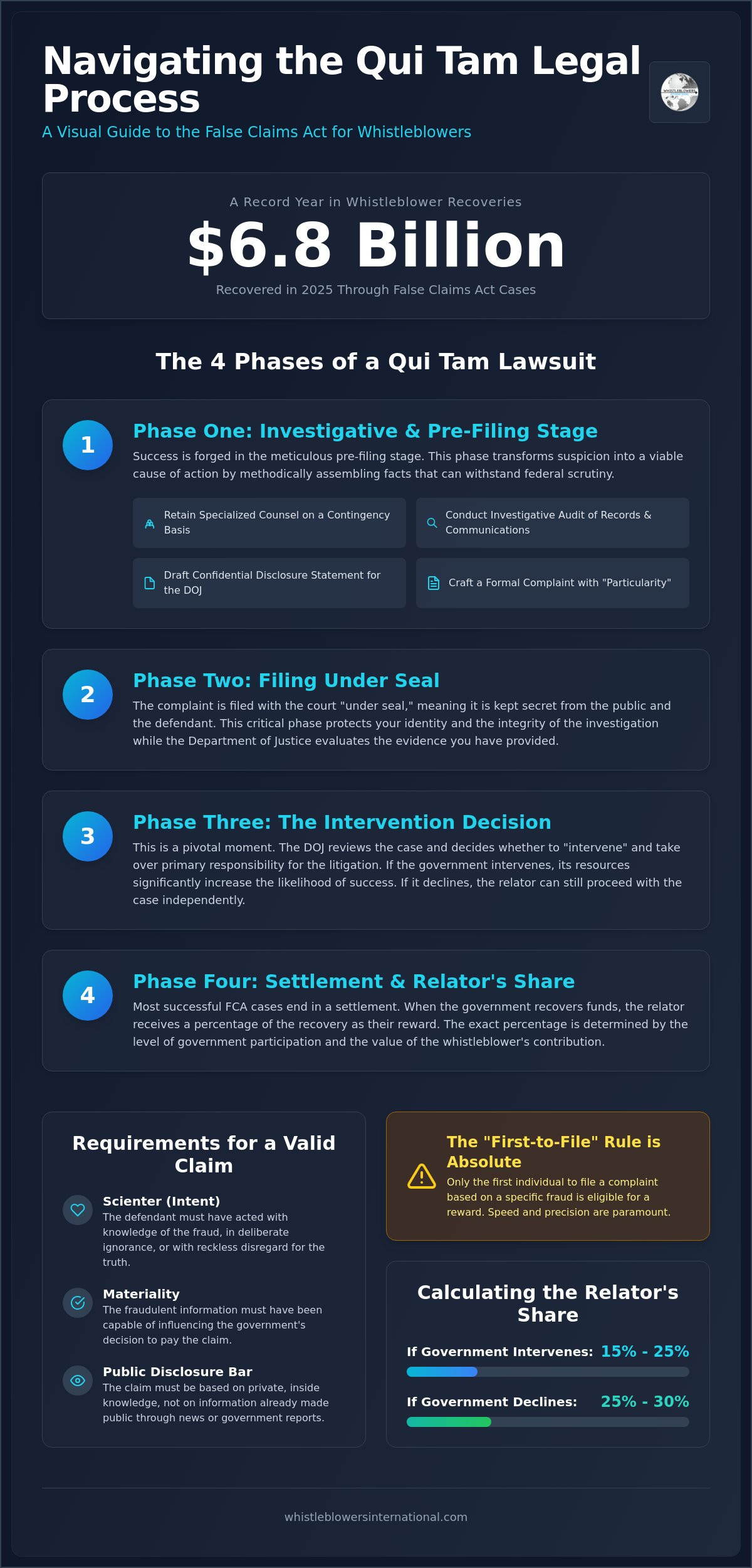
The relator holds a rare form of legal standing, effectively stepping into the shoes of the federal government to prosecute a civil action. Because the government cannot monitor every government contract or healthcare claim, it provides significant financial incentives for whistleblowers to expose misconduct. If you’re considering this path, you must understand the “first-to-file” rule. This statutory requirement dictates that only the first individual to file a complaint based on a specific set of facts is eligible for a recovery, making the speed and precision of your initial filing paramount. If another party files even a few hours before you, your claim could be barred entirely.
Statutory Requirements for a Valid Qui Tam Claim
A successful case requires more than just identifying an error; it requires proving “scienter,” or that the defendant acted with a specific intent to defraud or with reckless disregard for the truth. Additionally, the fraud must meet the threshold of “materiality.” This means the deception must have been capable of influencing the government’s decision to pay the claim. If the misrepresentation was trivial and wouldn’t have altered the payment outcome, the case may fail the legal process for qui tam requirements. Finally, counsel must carefully evaluate the public disclosure bar to ensure the allegations haven’t already been revealed in news media or government reports, as this could disqualify even a well-intentioned whistleblower.
Phase One: The Investigative and Pre-Filing Stage
Success in whistleblower litigation isn’t born in the courtroom; it’s forged during the meticulous pre-filing stage. The legal process for qui tam begins long before a defendant is served. It starts with the quiet, methodical assembly of facts that can withstand the scrutiny of federal investigators. This phase requires a unique combination of legal acumen and investigative rigor to transform suspicion into a viable cause of action. You must move with precision to ensure your evidence is preserved and your legal standing is protected.
The initial stage typically follows a four-step progression:
- Retaining specialized counsel: Securing a legal team on a contingency basis ensures your interests are aligned with your advocates. The firm assumes the financial risk, allowing you to proceed without upfront costs.
- Conducting an investigative audit: This involves a comprehensive review of emails, financial records, and internal communications to identify specific instances of fraud.
- Drafting the Disclosure Statement: This confidential document is provided to the Department of Justice, outlining every piece of material evidence in your possession.
- Crafting the Complaint: Your counsel writes a formal legal document that must meet the rigorous “particularity” standards of federal court.
Gathering and Organizing Admissible Evidence
There is a critical distinction between knowing about fraud and proving it with documentation. Federal courts require more than just anecdotal accounts; they demand admissible evidence that demonstrates a violation of the False Claims Act. You should avoid the pitfalls of “self-help” discovery, such as taking documents that contain trade secrets or privileged information, as this could violate privacy laws and jeopardize your case. Piacentile & Associates LLP leverages deep investigative expertise, often utilizing the perspective of former whistleblowers, to bridge evidence gaps and organize your files into a cohesive narrative that government attorneys can easily digest.
Drafting the Complaint with Particularity
Vague assertions are the enemy of a successful whistleblower case. Under Federal Rule of Civil Procedure 9(b), the legal process for qui tam requires that fraud be pleaded with particularity. This means your complaint must clearly define the “Who, What, When, Where, and How” of the alleged misconduct. If a complaint is too generalized, it faces a high risk of dismissal before the investigation even concludes. For those beginning this journey, understanding how to document corporate fraud correctly is the first step toward a successful recovery. You must also be aware that the qui tam lawsuit statute of limitations imposes strict filing deadlines that can permanently bar an otherwise valid claim if missed. You must be prepared to articulate exactly which government funds were misappropriated and the specific mechanisms used to facilitate the deception.
Phase Two: Filing Under Seal and the Government’s Investigation
Once the complaint is finalized, the legal process for qui tam enters its most clandestine phase. You file the lawsuit in camera and under seal, which ensures that the court records remain inaccessible to the public and, crucially, the defendant. This secrecy is not merely procedural; it’s a strategic necessity mandated by the False Claims Act to allow the government to investigate the allegations without tipping off the target. During this period, you act as a “silent partner” to the Department of Justice, providing additional information as requested while maintaining absolute confidentiality.
The statute provides for an initial 60-day seal period, yet this timeframe is rarely sufficient for a complex federal investigation involving massive datasets or global operations. In practice, the government frequently requests extensions from the court, and it’s common for a case to remain under seal for several years while investigators meticulously verify the claims. While this duration can be frustrating for a relator, it’s a critical period where the strength of the case is either solidified or dismantled. Piacentile & Associates serves as a protective ally during this time, ensuring that the government’s inquiries are met with precise, actionable data.
The Secrecy Requirement and Its Implications
Maintaining the seal is a non-negotiable obligation for any whistleblower. If you disclose the existence of the lawsuit to anyone, including family, colleagues, or the media, you risk “breaking the seal.” Such a breach can lead to the immediate dismissal of the case and the permanent loss of any potential reward. However, this secrecy offers a significant layer of professional protection; it allows you to continue your career without the immediate threat of retaliation while the government builds its evidentiary foundation. It’s a period of high-stakes patience where your primary duty is to remain discreet and available for government consultation.
The Government’s Investigative Process
The Department of Justice does not work in isolation. It collaborates closely with the Office of Inspector General (OIG) specific to the agency affected by the fraud, such as Health and Human Services (HHS) or the Department of Defense. To compel the production of documents and testimony, the government utilizes Civil Investigative Demands (CIDs), which are powerful administrative tools that do not require a grand jury. A Seal Extension is a standard procedural maneuver that grants the government additional time to complete these exhaustive inquiries before deciding whether to intervene. This rigorous vetting is a central component of the legal process for qui tam, ensuring that only the most substantiated claims move forward to active litigation.
Phase Three: The Intervention Decision and Litigation
After the exhaustive investigation under seal, the legal process for qui tam reaches its most critical juncture: the intervention decision. The Department of Justice (DOJ) must choose whether to “intervene” and take primary responsibility for the litigation or “decline” to participate. This decision is heavily influenced by the investigative depth achieved in the previous phases. Government attorneys prioritize cases with overwhelming evidence of fraud and the potential for a significant monetary recovery, especially considering that False Claims Act recoveries exceeded $6.8 billion in the fiscal year ending September 30, 2025. The government must weigh its limited resources against the strength of your disclosure to determine if the case warrants their direct leadership.
Once the intervention decision is filed with the court, the judge will typically order the complaint to be unsealed. At this point, the existence of the lawsuit becomes public record, and your legal team must formally serve the complaint upon the defendant. This transition from the shadows of a sealed investigation to the transparency of active litigation is a high-stakes moment. It marks the end of your role as a “silent partner” and the beginning of an open legal battle where the defendant’s counsel will likely move to dismiss the allegations based on procedural or substantive grounds.
Government Intervention vs. Declination
Statistically, cases where the government intervenes are far more likely to result in a successful settlement or judgment. When the DOJ takes the lead, they bring the full weight of federal resources and authority to the table. However, it’s vital to understand that a declination isn’t a death sentence for your case. If the government declines to intervene, the False Claims Act explicitly grants you the right to proceed independently as the relator. In these instances, your choice of counsel becomes even more paramount, as your legal team will be responsible for funding and managing the entire litigation process without the government’s direct assistance. Knowing how to select a qualified false claims act lawyer who can carry the full weight of an independent case is essential to protecting your interests at this stage. A well-supported case can still yield a substantial recovery even if the government chooses to remain on the sidelines.
The Discovery and Trial Phase (If Unsettled)
If the case doesn’t settle shortly after unsealing, it enters the discovery and trial phase under standard federal civil procedure. This involves a rigorous exchange of information, including depositions, interrogatories, and the production of internal corporate records. Unlike criminal cases, the burden of proof in a qui tam action is a “preponderance of the evidence,” meaning you must prove it’s more likely than not that the fraud occurred. Success in these complex matters often hinges on the testimony of expert witnesses who can parse through intricate billing data or procurement contracts to validate the allegations. If you have witnessed systemic fraud and are prepared to navigate this journey, you should contact an experienced whistleblower advocate to evaluate your evidence.
Phase Four: Settlement, Awards, and the Relator’s Share
The final stage of the legal process for qui tam represents the culmination of years of investigative rigor and complex litigation. Whether the case concludes through a voluntary settlement or a formal court judgment, the financial resolution is governed by the statutory framework of the False Claims Act. The government seeks to recover treble damages, which is three times the actual loss sustained by the taxpayers, in addition to mandatory civil penalties. For violations assessed in 2026, these penalties range between $14,308 and $28,619 for each individual false claim submitted. This compounding effect often results in substantial recoveries that reflect the gravity of the misconduct uncovered during the investigation.
Calculating the “Relator’s Share” is a nuanced process that depends largely on the government’s level of involvement. If the Department of Justice intervened in the case, you’re generally entitled to between 15% and 25% of the total recovery. If you and your counsel proceeded independently after a declination, that share increases to a range of 25% to 30%. The specific percentage within these brackets isn’t arbitrary; it’s determined by the quality of your evidence and the extent to which your cooperation facilitated the success of the case. Factors such as the timeliness of your report and the depth of your investigative disclosure play a pivotal role in maximizing this final award. Understanding how the qui tam lawsuit statute of limitations applies to your specific circumstances is equally critical, as filing outside the permissible window can forfeit your right to any share of the recovery entirely.
Finalizing the Whistleblower Award
Once a settlement is reached, your counsel must negotiate the specific percentage of your award with the Department of Justice. This isn’t a passive event; it’s a strategic advocacy phase where your legal team highlights your unique contributions as an “Original Source” to justify a higher percentage. You should also consider the tax implications and the necessity of structural settlement planning to manage a significant recovery effectively. To better understand how these figures are finalized, you can review our detailed breakdown of Whistleblower Award Percentages: What to Expect.
Why Experience Matters in the Qui Tam Process
Navigating the legal process for qui tam requires more than just technical legal knowledge; it demands a strategic investigative mindset and an understanding of the government’s internal priorities. Piacentile & Associates LLP brings a unique insider’s perspective to every case, leveraging a team that includes former whistleblowers who understand the personal and professional stakes involved. Our contingency-based model ensures that our interests are perfectly aligned with yours, as we only succeed when you do. This battle-tested approach allows us to handle massive complexities while remaining focused on your privacy and success. If you’re ready to take the next step, consult with Piacentile & Associates LLP to evaluate your potential case.
Protecting Your Future While Restoring Integrity
The journey of a whistleblower is defined by patience and precision. By understanding the legal process for qui tam, you’ve gained the knowledge necessary to move from being a witness to a proactive advocate for the public good. Remember that the “under seal” phase is your greatest protection, allowing a thorough federal investigation to proceed without compromising your professional standing. Whether the government chooses to intervene or you proceed independently, your status as an “Original Source” remains the cornerstone of a successful recovery.
Piacentile & Associates LLP provides the elite investigative resources and seasoned legal perspective needed to navigate these high-stakes complexities. Led by a former whistleblower and an experienced attorney, we utilize deep investigative resources to uncover complex fraud. We operate on a contingency-based fee model, which means we only get paid if you win. You don’t have to face this labyrinth alone. Secure your confidential case evaluation with our elite legal team and take the first step toward restitution and professional safety today.
Frequently Asked Questions
How long does the legal process for a qui tam case typically take?
The legal process for qui tam typically spans three to five years, though complex cases involving systemic healthcare or defense fraud can last even longer. While the statute initially provides for a 60-day seal, the Department of Justice almost always requests multiple extensions to conduct a thorough investigation. The total duration depends on the volume of evidence, the defendant’s cooperation, and the complexity of the financial audit required to prove the fraud.
Can I be fired for filing a qui tam lawsuit under the False Claims Act?
You are legally protected from retaliation under Section 3730(h) of the False Claims Act, which prohibits employers from firing, demoting, or harassing employees for whistleblowing. If you experience retaliation for acts taken in furtherance of a qui tam action, you’re entitled to “all relief necessary to make the employee whole.” This often includes reinstatement with the same seniority, double back pay with interest, and compensation for any special damages sustained.
What happens if the government decides not to intervene in my case?
You have the statutory right to proceed with the litigation independently if the government declines to intervene. In this scenario, your legal team takes the lead in prosecuting the case without the Department of Justice’s direct assistance. While these cases are more resource-intensive, the potential reward increases significantly. A successful relator who proceeds without government intervention is entitled to between 25% and 30% of the final recovery.
Is the legal process for qui tam anonymous?
The initial stages of the legal process for qui tam provide a high degree of anonymity because the complaint is filed under seal. This secrecy allows the government to investigate without the defendant’s knowledge while protecting your professional identity. However, you should be prepared for your identity to become public once the case is unsealed. Your counsel will work to manage this transition and ensure that all available whistleblower protections are in place.
Do I have to pay legal fees upfront for a qui tam case?
You don’t have to pay upfront legal fees when you partner with a specialized firm like Piacentile & Associates. We operate on a contingency fee basis, meaning our compensation is derived entirely from a percentage of the final settlement or judgment. If the case doesn’t result in a recovery, you don’t owe any attorney fees. This model allows individuals to pursue massive corporations without facing personal financial risk during the litigation.
What kind of evidence is required to start the legal process?
You need “particularized” evidence that demonstrates a specific and knowing intent to defraud the government. This typically includes internal emails, financial spreadsheets, billing records, or recorded communications that show the “who, what, when, where, and how” of the misconduct. Federal courts require more than just general suspicions; you must provide concrete documentation that can withstand the rigorous scrutiny of federal investigators and the Department of Justice. Partnering with a skilled false claims act lawyer who understands how to evaluate and organize this evidence is a critical early step in building a viable case.
Can foreign nationals file a qui tam case under U.S. law?
Yes, foreign nationals have the standing to file qui tam lawsuits if the alleged fraud involves U.S. federal funds or government programs. The False Claims Act has a broad reach that extends to international activities, such as customs fraud, overseas defense contracts, and global healthcare programs funded by U.S. taxpayers. Our firm has the global reach necessary to assist whistleblowers worldwide in navigating these sophisticated federal legal requirements.
What is the ‘first-to-file’ rule in the qui tam process?
The first-to-file rule is a statutory bar that prevents any person from bringing a related action based on the same underlying facts as a previously filed case. Essentially, it creates a race to the courthouse where only the first whistleblower to file is eligible for a financial reward. If another individual files even a few hours before you, your case could be dismissed, making the speed of your initial filing critical.