
In fiscal year 2025, the Department of Justice secured over $6.8 billion in False Claims Act settlements, marking the most successful year for whistleblowers in American history. If you’ve uncovered evidence of systemic fraud, you’re likely grappling with the immense gravity of your next steps. It’s natural to feel a sense of trepidation regarding the legal process for qui tam actions, especially when considering the potential for retaliation or the daunting prospect of a multi-year investigation. You aren’t alone in these concerns. The path from filing a complaint to receiving a relator’s share is rigorous, yet it’s built to protect your identity while the government evaluates your claims.
This guide serves as your strategic roadmap, promising to demystify the complex journey of a False Claims Act lawsuit from its inception to its final resolution. We’ll explore the critical “under seal” period where your identity remains shielded, the nuances of Department of Justice intervention, and the 2026 procedural standards for civil penalties. By understanding how the contingency fee model aligns your interests with those of your legal counsel, you can move forward with the confidence of a seasoned advocate. We’ll examine the specific milestones of the litigation timeline, ensuring you know exactly what to expect as you fulfill your role as a whistleblower.
Key Takeaways
- Understand the legal necessity of filing “under seal” to protect your identity and the government’s investigation while navigating the initial 60-day period.
- Learn how the Department of Justice utilizes Civil Investigative Demands to evaluate the merits of your claims during the high-stakes investigative phase.
- Identify the three potential outcomes of a government review and why intervention remains the “gold standard” for maximizing your potential reward.
- Master the multi-year legal process for qui tam actions, from the unsealing of the complaint through the rigorous discovery phase.
- Discover how a contingency fee model provides you with elite investigative support and legal expertise without the burden of upfront costs.
Filing the Complaint and the Mandatory ‘Under Seal’ Phase
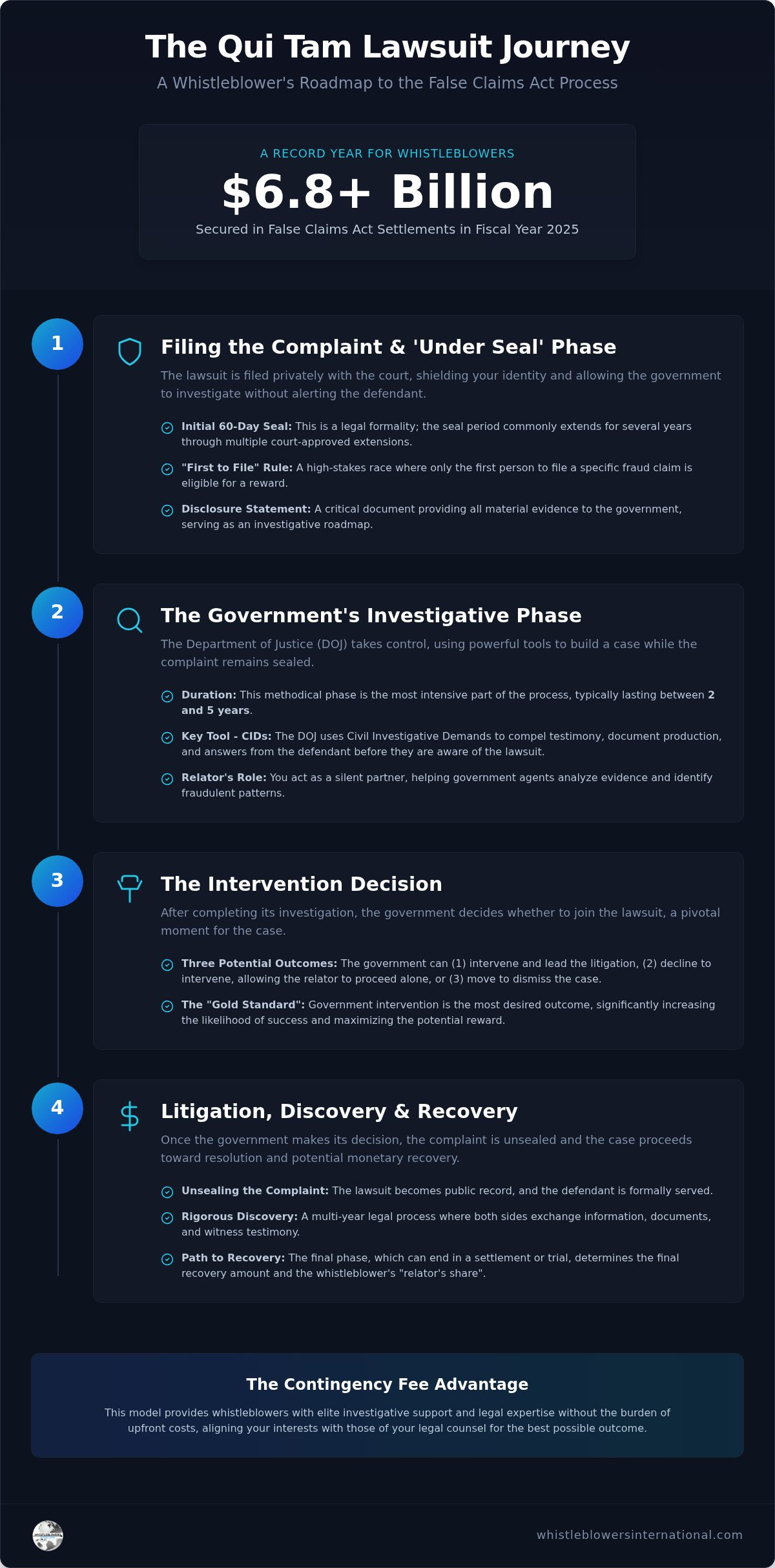
The initiation of a False Claims Act lawsuit begins with a procedural step unlike almost any other civil litigation. When an individual, known as a relator, decides to blow the whistle, they must file their complaint “in camera” and “under seal”. This means the lawsuit is filed privately with the court; it’s not served on the defendant and is not available to the public. This unique Qui tam mechanism allows the Department of Justice to investigate the allegations without tipping off the target company. Understanding the legal process for qui tam requires recognizing that your case exists in a state of suspended animation for months or years. If the defendant learns of the investigation prematurely, they might destroy evidence or intimidate witnesses.
While the statute suggests an initial 60-day seal, this timeframe is largely a legal fiction. In practice, the government frequently requests, and courts routinely grant, multiple six-month extensions. It’s common for a case to remain under seal for several years while federal agents conduct a thorough audit. During this period, the “First to File” rule creates a high-stakes environment. Because the law only allows the first person to file a specific fraud claim to proceed, you must act with both speed and extreme precision. A second filer, even one with superior evidence, is usually barred from recovery.
The Role of the Disclosure Statement
Alongside the complaint, your legal team must submit a written disclosure of substantially all material evidence and information you possess. This document is a cornerstone of the legal process for qui tam actions. It doesn’t just list facts; it serves as a persuasive investigative roadmap for the government. If the disclosure is robust, it significantly increases the likelihood that the Department of Justice will intervene. This statement is also essential for establishing yourself as an “original source”, particularly if the fraud involves information that might eventually become public through other channels.
Maintaining Secrecy: The Relator’s Burden
Violating the seal is the most significant risk a whistleblower faces during the early stages. If you discuss the existence of the lawsuit with anyone other than your attorney, including spouses, coworkers, or journalists, you risk a court-ordered dismissal of your claim. Under seal is a statutory requirement designed to prevent tipping off the defendant. This secrecy serves a dual purpose; it protects the integrity of the government’s investigation while shielding your identity and employment status. If the seal is maintained, you can continue your professional life while the elite investigative machinery of the federal government works behind the scenes to validate your evidence.
The Government’s Investigative Phase and Civil Investigative Demands
Once your complaint is filed, the Department of Justice (DOJ) assumes control of the investigative machinery. This period is the most intensive part of the legal process for qui tam actions. Unlike traditional civil lawsuits where parties exchange information through discovery, the government utilizes specialized tools authorized under The False Claims Act to build its case. The most powerful of these tools is the Civil Investigative Demand (CID). A CID allows federal prosecutors to compel testimony, document production, and written answers to interrogatories from the defendant before the lawsuit is ever unsealed. It’s a proactive strike that prevents the target from concealing evidence while the government evaluates the merits of your allegations.
You must manage your expectations regarding the timeline. This phase is methodical and thorough; it typically lasts between two and five years. During this time, you act as a silent partner to the government. You may be asked to review financial records or internal communications recovered through CIDs to identify fraudulent patterns that an external auditor might miss. Building a case that survives this level of scrutiny requires a partner who understands the tactical landscape. You can consult with our investigative team to understand how your specific evidence might be processed during this high-stakes period.
Agency Collaboration and Specialized Investigations
The DOJ does not work in isolation. Depending on the nature of the fraud, they collaborate with specialized agencies such as Health and Human Services (HHS) or the Department of Defense (DOD). These agencies bring forensic accountants and data analysts who scrutinize billing data and complex financial records. It’s vital to work with a law firm like Piacentile & Associates LLP that possesses internal investigative resources. Having “insider” expertise on your side ensures your evidence is presented in a way that resonates with federal agents who see thousands of complaints every year.
The Relator’s Ongoing Cooperation
Your involvement doesn’t end with the filing. You provide the technical expertise necessary to help government agents navigate industry-specific nuances. A critical milestone is the “Relator Interview,” where federal prosecutors will question you directly about your knowledge. Your legal team will prepare you for this meeting to ensure your testimony is consistent and impactful. If additional evidence emerges after the initial filing, you must relay it to your counsel immediately. This ongoing cooperation is essential for maintaining the case’s momentum and proving that you are a reliable source of information.
The Intervention Decision: Government Participation vs. Relator-Led Litigation
At the conclusion of the investigative phase, the Department of Justice faces a pivotal crossroad that determines the future trajectory of your qui tam action. The government must choose one of three paths: intervention, declination, or dismissal. Intervention is widely regarded as the “gold standard” for success. When the government intervenes, it takes primary responsibility for litigating the case, bringing the full weight of federal resources and authority to bear against the defendant. This shift often leads to a more efficient resolution, as defendants are far more likely to settle when facing the combined power of the DOJ and specialized agency investigators.
If the government declines to intervene, the legal process for qui tam allows you to proceed with the litigation independently. While a declination can feel discouraging, it isn’t necessarily a commentary on the merits of your evidence. The government may decline a meritorious case due to resource constraints, competing policy priorities, or the specific jurisdictional complexities involved. Litigating a declined case involves higher risk and requires your legal team to carry the full financial and procedural burden, but it also provides you with greater control over the strategic direction of the lawsuit.
Award Percentages: Intervened vs. Declined
The False Claims Act provides a clear statutory framework for relator rewards, incentivizing individuals to bring fraud to light. In cases where the government intervenes, the relator is typically entitled to receive between 15% and 25% of the total recovery. However, if the government declines and you successfully litigate the case on your own, your share increases to a range of 25% to 30%. Factors such as the quality of your initial disclosure and the extent of your cooperation during the investigative phase will influence where you fall within these percentage ranges. For a deeper dive into these reward structures, refer to our False Claims Act Guide.
The ‘Good Cause’ for Late Intervention
It’s important to recognize that a declination isn’t always the government’s final word. The DOJ maintains the right to monitor the progress of a non-intervened case as it moves through the courts. If new, compelling evidence surfaces during the discovery phase, the government can petition the court for “good cause” to intervene at a later date. This procedural flexibility ensures that the most significant frauds are addressed by federal authorities, even if they initially passed on the case. This possibility underscores the importance of maintaining a rigorous and professional litigation strategy throughout the entire life of the lawsuit.
Discovery, Litigation, and the Path to Monetary Recovery
The unsealing of the complaint marks a dramatic shift in the legal process for qui tam litigation. For years, the defendant may have been entirely unaware of the federal scrutiny; now, they’re served with the complaint and the government’s intervention notice. This transition triggers the discovery phase, a rigorous period of exchanging electronically stored information (ESI), conducting depositions, and responding to interrogatories. It’s a high-stakes environment where every internal email and financial ledger is scrutinized. While many expect a courtroom battle, the reality is that over 90% of successful cases conclude in a settlement rather than a trial. The government often prefers a negotiated resolution to ensure a guaranteed recovery and to avoid the unpredictability of a jury.
This phase demands patience and tactical precision. As the defendant’s legal team begins their investigation, you may be called for a deposition to testify about your firsthand knowledge of the fraud. Your attorneys will be by your side to protect your interests during these intense questioning sessions. The goal is to build an undeniable record of the defendant’s knowledge and intent. If the evidence is overwhelming, the defendant will likely seek a settlement to mitigate their financial exposure and avoid the treble damages possible under the False Claims Act.
The Defendant’s Counter-Strategy
Defendants typically respond with aggressive counter-strategies to halt the legal process for qui tam actions before they reach a jury. The most common tactic is a motion to dismiss under Rule 9(b), which argues that the whistleblower failed to plead the fraud with sufficient particularity. They may also invoke the “public disclosure bar” if the allegations were already mentioned in news reports, audits, or administrative hearings. Your status as an original source can defeat a public disclosure defense by proving you provided independent knowledge to the government before any public unveiling of the fraud. Overcoming these procedural hurdles requires a legal team that has anticipated these defenses from the very first day of the case.
Finalizing the Recovery
Finalizing the recovery involves a separate but equally critical negotiation regarding your reward. Once a settlement amount is reached, a “Relator’s Share” hearing may be necessary to determine your specific percentage of the award. The court evaluates your level of cooperation and the quality of the evidence you provided to decide where you fall within the statutory range. Additionally, the defendant is typically required to pay your attorney fees and litigation costs separately from the government’s recovery. The timeline from the settlement agreement to the actual receipt of funds can range from several months to a year. If you are ready to pursue a claim with a team that understands these final hurdles, you should contact our experienced attorneys today.
Navigating the Qui Tam Process with Experienced Counsel
The legal process for qui tam is a formidable undertaking that requires more than standard legal representation; it demands a strategic partnership with a firm that possesses deep investigative depth. When you challenge a multinational corporation or a massive healthcare system, you aren’t just fighting a legal battle. You’re engaging with a defense team that has nearly unlimited resources. To bridge this gap, elite whistleblower firms provide the investigative firepower necessary to uncover buried evidence and present a compelling case to the Department of Justice. This level of support is accessible to individuals through the whistleblower lawyer contingency fee model. This structure ensures that your access to high-level advocacy isn’t dependent on your personal wealth, as the firm carries the financial risk of the litigation.
Beyond the courtroom, your counsel serves as a vital shield against professional and personal retaliation. While the False Claims Act provides statutory protections for whistleblowers, an experienced firm actively manages your interactions with the government and the defendant to minimize your exposure. This is particularly critical for international whistleblowers who uncover fraud affecting U.S. interests. If you are reporting fraud from abroad that impacts U.S. federal programs or financial markets, you need U.S. counsel who understands the jurisdictional nuances of the FCA and SEC whistleblower programs. Our firm provides the global reach necessary to handle these massive complexities while remaining focused on your individual success.
The Piacentile & Associates Advantage
Piacentile & Associates LLP offers a unique perspective that few firms can match. Our firm was founded by a former whistleblower and attorney, providing us with an “insider” understanding of the emotional and professional stakes involved. We limit our practice exclusively to whistleblower representation, ensuring that our resources aren’t diluted by unrelated legal areas. This focus has allowed us to represent individuals worldwide, building a reputation for excellence in uncovering complex fraud against the U.S. government. By choosing a firm with this specific specialization, you ensure that every strategic decision is informed by real-world investigative experience.
Taking the First Step Securely
Your journey begins with a confidential case evaluation where we assess the merits of your evidence and the viability of your claim. When preparing for this initial meeting, it’s helpful to organize your documentation, but you must be careful not to violate privacy laws or trade secret protections in the process. We guide you on how to compile evidence legally and ethically to ensure your claim remains untainted. If you’re ready to explore your options with a battle-tested mentor, Contact Piacentile & Associates for a confidential consultation to begin the legal process for qui tam actions with confidence.
Initiating Your Path to Accountability
The legal process for qui tam is a marathon defined by procedural precision and strategic patience. By successfully navigating the mandatory seal period and the government’s rigorous investigative phase, you position your evidence for the highest potential recovery. Whether the Department of Justice chooses to intervene or you proceed with relator-led litigation, the integrity of your initial filing remains the primary driver of a successful resolution. This journey demands a formidable ally who understands the high stakes from an insider’s perspective.
Piacentile & Associates LLP provides this elite advocacy, led by a former whistleblower who has navigated these exact complexities. We represent individuals on a 100% contingency basis, ensuring that financial barriers never prevent the reporting of global fraud. Our firm’s international reach allows us to evaluate and litigate massive complexities while prioritizing your personal privacy and professional security. You don’t have to face corporate defense teams alone.
Secure a Confidential Case Evaluation with Our Experts to begin your journey with a battle-tested mentor by your side. You have uncovered the truth; we provide the strategy to ensure it’s heard.
Frequently Asked Questions
How long does the legal process for qui tam typically take?
The legal process for qui tam typically spans between two and five years from the initial filing to a final resolution. This duration is largely dictated by the government’s investigative phase; while the statute mentions a 60-day seal, the Department of Justice frequently secures multiple extensions. Each case involves complex audits and evidence reviews that require significant time to validate before an intervention decision is reached by federal authorities.
Can I file a qui tam lawsuit without a lawyer?
No, you cannot file a qui tam lawsuit without legal representation. Because a relator acts on behalf of the United States government, federal courts require that you are represented by qualified counsel. This rule ensures that the government’s interests are protected by an attorney who understands the procedural rigors of the False Claims Act. Our firm operates on a contingency fee basis, providing elite representation without upfront costs.
What happens if the government decides not to intervene in my case?
If the government declines to intervene, you have the statutory right to proceed with the litigation independently. This path is known as “non-intervened” or relator-led litigation. While you bear the full responsibility for the case’s costs and legal strategy, a successful outcome results in a higher reward percentage. Relators who litigate alone are typically entitled to receive between 25% and 30% of the total recovery from the defendant.
Is my identity protected during the qui tam process?
Your identity is protected by a mandatory court seal during the initial investigative phase. This means the defendant and the public are unaware of your filing while the government evaluates your claims. However, if the case is eventually unsealed for litigation or settlement, your name will become a matter of public record. We focus on maintaining the seal for as long as possible to protect your professional standing and privacy.
What is the statute of limitations for a qui tam action under the False Claims Act?
The statute of limitations for a qui tam action is generally the later of two periods. You must file within six years of the date the violation occurred; or within three years after the government knew or should have known the facts material to the right of action. In no event can a case be brought more than ten years after the date on which the violation was committed by the defendant.
How much money can a whistleblower expect to receive from a qui tam settlement?
A whistleblower’s reward is a percentage of the total government recovery. If the government intervenes, you typically receive between 15% and 25% of the settlement or judgment. If you litigate the case independently after a declination, that share increases to a range of 25% to 30%. The specific amount depends on the total funds recovered and the quality of the information you provided during the legal process for qui tam.
Can I be fired for filing a qui tam lawsuit?
Legally, your employer cannot fire, demote, or harass you for filing a qui tam lawsuit. The False Claims Act contains robust anti-retaliation provisions that allow whistleblowers to seek reinstatement, double back pay, and other damages if they’re targeted for their actions. While the seal period offers a layer of anonymity, our firm serves as a protective ally to ensure your rights are defended throughout the entire life of the litigation.
What evidence is required to start the legal process for a qui tam case?
To start the process, you must provide “substantially all material evidence” in your possession regarding the fraud. This includes internal emails, financial records, billing data, or witness lists that demonstrate a knowing violation of federal law. The evidence must be specific and non-public to meet the “original source” requirement. We help you compile this documentation securely to build a case that the government is more likely to join and prosecute.