
What if the internal documents you’ve uncovered represent more than just corporate misconduct, but a legal asset that qualifies for a multi-million dollar government award? It’s a heavy realization that often brings as much anxiety as it does hope. You’re likely asking yourself, “am I eligible for a whistleblower reward,” while navigating the very real fear of professional blacklisting and the confusion of which federal agency possesses the jurisdiction to act. We understand that the decision to step forward is never simple, especially when you’re uncertain if your evidence is considered original enough to trigger a recovery.
This 2026 guide is designed to remove that ambiguity by outlining the specific legal requirements and program thresholds that govern modern whistleblower claims. You’ll gain a clear understanding of the reward percentages offered by the SEC, IRS, and FinCEN, alongside the procedural safeguards that allow for anonymous reporting through counsel. By the end of this analysis, you will have a methodical path to evaluate your information and a strategy to protect your future while holding powerful entities accountable. We will guide you through the complexities of the False Claims Act and other federal programs to ensure your contribution is validated and your risks are mitigated.
Key Takeaways
- Learn how federal agencies define “voluntary” and “original” information to answer the critical question: am I eligible for a whistleblower reward in 2026?
- Navigate the specific recovery thresholds for the SEC, IRS, and False Claims Act to understand the potential scale and viability of your individual case.
- Recognize the “Public Disclosure Bar” and other legal disqualifiers that can jeopardize your claim if the information is already accessible to the government.
- Explore how filing through a specialized legal firm provides a vital mechanism for anonymity and protects your career from professional retaliation during the process.
The Core Criteria: What Defines a Reward-Eligible Whistleblower?
In the legal framework of 2026, a whistleblower isn’t merely an employee with a grievance; they’re a strategic partner in federal enforcement. To answer the question, “am I eligible for a whistleblower reward,” you must satisfy a specific set of statutory definitions that go far beyond basic reporting. Under programs like the False Claims Act or the SEC’s whistleblower initiative, eligibility is predicated on providing high-quality, actionable intelligence that the government doesn’t already possess. This information must lead directly to a successful enforcement action where the government recovers funds. If the government fails to collect monetary sanctions, even the most detailed report won’t result in a financial award.
The various whistleblower protection programs in the United States are designed to incentivize those with inside knowledge to step forward early. This creates a high-stakes environment where the timing of your disclosure and the “originality” of your evidence are the primary factors in your success.
The “Voluntary” Submission Rule
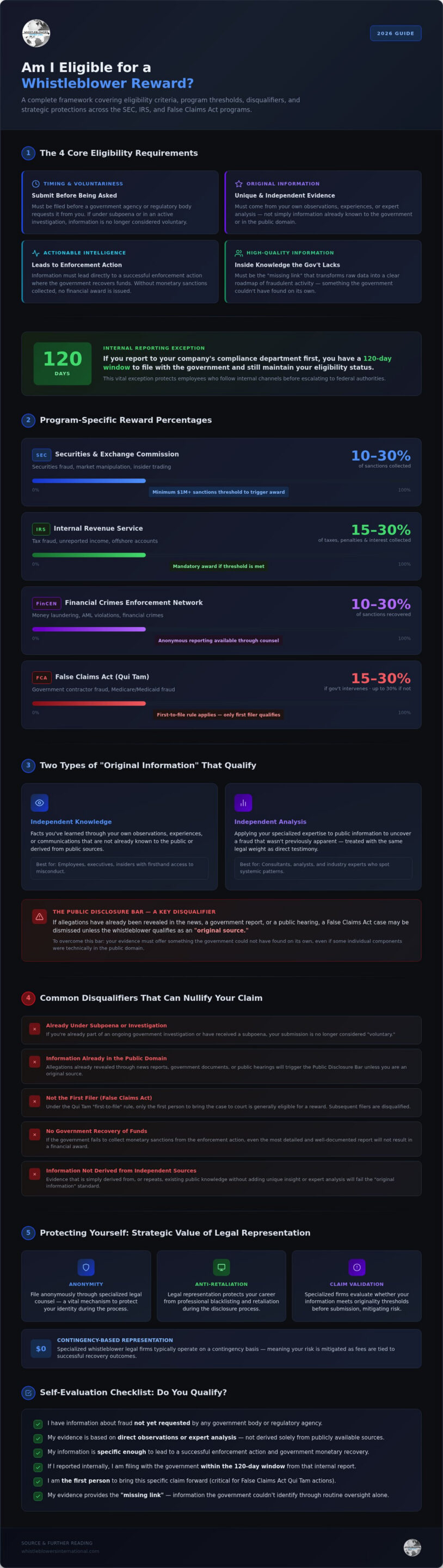
Timing is often the most critical factor in determining eligibility. A submission is legally “voluntary” only if you provide it before a government agency or regulatory body requests it from you. If you’re already under a subpoena or part of an ongoing investigation, your information won’t be considered voluntary. There’s a vital exception for internal reporting: if you report the misconduct to your company’s compliance department first, you typically have a 120-day window to file with the government and maintain your status. In Qui Tam actions under the False Claims Act, the “first-to-file” rule means that the first person to bring the case to court is generally the only one eligible for a reward.
Identifying “Original” vs. Derived Information
The government distinguishes between “independent knowledge” and “independent analysis.” Independent knowledge refers to facts you’ve learned through your own observations or experiences that aren’t already known to the public. Conversely, independent analysis involves taking public information and applying your unique expertise to uncover a fraud that wasn’t previously apparent. To overcome the “public disclosure bar,” your evidence must offer something the government couldn’t have found on its own. If your analysis reveals a sophisticated scheme by connecting disparate data points, it’s treated as original information, even if some individual components were technically in the public domain.
The “Original Information” Standard: Why Not All Tips Qualify
Establishing the eligibility of a claim requires more than just pointing to a corporate error; it demands “original information” that the government cannot obtain through routine oversight. If you’re asking “am I eligible for a whistleblower reward,” the answer hinges on whether your evidence is derived from your independent knowledge or a unique analysis that isn’t already in the public domain. In 2026, the threshold for what constitutes “original” has become increasingly sophisticated as federal agencies use advanced data monitoring to detect baseline irregularities. You must provide the “missing link” that transforms raw data into a clear roadmap of fraudulent activity.
Independent knowledge refers to facts you’ve acquired through your own observations, experiences, or communications that aren’t derived from public sources. Independent analysis, however, allows individuals without direct “insider” access to qualify if they use their specialized expertise to uncover a fraud hidden within public records. If your analysis reveals a pattern of misconduct that the government hadn’t previously identified, it’s treated with the same legal weight as direct testimony. This distinction is vital for consultants, analysts, and industry experts who recognize systemic failures that others overlook.
Navigating the Public Disclosure Bar
The “Public Disclosure Bar” is a legal mechanism designed to prevent opportunistic lawsuits based on information that is already common knowledge. If the allegations have already been revealed in the news, a government report, or a public hearing, the court may dismiss a False Claims Act case unless the whistleblower is an “original source.” You can review the SEC Whistleblower Program eligibility requirements to see how these standards apply to securities fraud specifically. Under 2026 legal standards, an individual qualifies as an original source if they provide information that materially adds to the publicly available data or if their independent knowledge of the misconduct existed prior to the public disclosure.
Documenting Evidence Without Violating Privacy Laws
While gathering evidence is necessary, “self-help” discovery can be a legal minefield if you inadvertently misappropriate privileged company documents. It’s essential to distinguish between non-privileged business records and documents protected by attorney-client privilege, as submitting the latter can disqualify you from an award and create personal legal exposure. Learning how to document corporate fraud correctly is a prerequisite for any successful filing. If you’re unsure whether a specific set of documents is safe to use, consulting with experienced counsel can help you build your case without compromising your legal standing or your eligibility for a reward.
Program-Specific Thresholds: SEC, IRS, and False Claims Act Requirements
Each federal program operates under a distinct set of statutory triggers that define the financial viability of a claim. While the underlying principles of integrity remain constant, the monetary gates vary significantly between agencies. To determine “am I eligible for a whistleblower reward,” you must first identify which agency possesses jurisdiction over the specific type of fraud you’ve uncovered. If the misconduct involves a government contract, it falls under the False Claims Act; if it involves a publicly traded company, the SEC is the primary authority. Identifying the correct program is essential because a high-quality tip submitted to the wrong agency can lead to procedural dismissal.
The False Claims Act, which governs fraud against the government such as Medicare overbilling or defense contract fraud, requires that the government recover funds through a settlement or judgment. In these “Qui Tam” cases, the whistleblower typically receives between 15% and 30% of the total recovery. Unlike other programs, the False Claims Act does not have a strictly defined minimum recovery amount for eligibility, but the cost of litigation often dictates that cases with higher recovery potential are prioritized by federal prosecutors.
Monetary Thresholds for Agency Action
The SEC and CFTC programs, established under the Dodd-Frank Act, focus on securities and commodities fraud. These programs require that the government’s enforcement action results in monetary sanctions exceeding $1 million. If the recovery falls below this floor, the agency isn’t legally mandated to provide an award, regardless of the quality of your information. For tax-related reporting, the IRS Whistleblower Informant Award program maintains two distinct tracks. If the amount in question exceeds $2 million, the IRS is generally required to pay an award of 15% to 30% of the collected proceeds. In cases involving individual taxpayers, the individual’s gross income must also exceed $200,000 for at least one of the tax years in question.
The 2026 landscape has also seen significant updates to the FinCEN program, which targets money laundering and violations of the Bank Secrecy Act. These 2026 standards have streamlined the process for reporting illicit financial flows, ensuring that those who uncover sophisticated money laundering schemes are eligible for rewards that track closely with the SEC’s successful model. These updates reflect a broader government commitment to incentivizing the detection of complex financial crimes.
International Eligibility for Foreign Nationals
A common misconception is that these programs are reserved for U.S. citizens or residents. In reality, the U.S. government encourages disclosures from individuals worldwide, provided the misconduct has a sufficient nexus to U.S. markets or government funds. You don’t need to be a U.S. citizen to collect a reward or to receive protection under these statutes. If you’ve uncovered bribery of foreign officials by a company listed on a U.S. exchange, you may qualify under the Foreign Corrupt Practices Act. Consulting an FCPA Whistleblower Lawyer: A 2026 Guide can help you understand how to report foreign bribery while navigating the complexities of international law and protecting your identity.
Common Disqualifiers: What Could Nullify Your Claim?
Identifying potential disqualifiers is just as vital as understanding the positive criteria for a claim. If you’re asking “am I eligible for a whistleblower reward,” you must evaluate whether your information was obtained through protected channels or if your own actions within the scheme might bar recovery. While the 2026 legal landscape is designed to encourage reporting, specific statutory exclusions exist to prevent individuals from profiting from their own orchestrated misconduct or from information they were already legally obligated to report. Understanding these nuances early can prevent years of fruitlessly pursuing a claim that is destined for dismissal.
One of the most common barriers involves information obtained through legal privilege. If you are an attorney or an individual working under the direction of counsel, the information you uncover is often protected by attorney-client privilege. Reporting this data to the government can lead to immediate disqualification and potential professional sanctions. Similarly, if you’ve obtained evidence through the violation of federal criminal laws, such as unauthorized hacking into secure servers, the “unclean hands” doctrine may jeopardize your standing. It’s essential to vet the source of your evidence with a professional who understands the boundaries of legal discovery.
The Role of Culpability in Reward Eligibility
Culpability doesn’t always result in an automatic disqualification, but it significantly impacts the final award percentage. The “Planned and Initiated” rule creates a clear distinction between a participant who followed orders and the “architect” who designed the fraudulent scheme. If the government determines you were the primary instigator of the fraud, you’ll likely be barred from any recovery. However, if you were a secondary participant, the agency may still grant an award but will typically reduce the percentage to reflect your level of involvement. Framing your role accurately in initial filings is a strategic necessity to preserve your eligibility.
Professional Capacity Exclusions
Certain professional roles carry inherent reporting restrictions that can complicate an eligibility determination. Compliance officers, internal auditors, and employees of external auditing firms are generally excluded from receiving rewards because their job is to identify and report misconduct. However, the SEC provides a critical “120-day rule” as an exception. If you’ve reported the fraud internally to your supervisor or compliance department and the company fails to take action within 120 days, you may then become eligible to file with the SEC. Government employees and contractors also face specific restrictions, as they’re often barred from collecting rewards for information they’re required to report as part of their official duties.
If you’re concerned that your professional role or past involvement might nullify your claim, you should speak with a whistleblower attorney to evaluate your specific circumstances under current 2026 standards.
Securing Your Award: The Strategic Value of Contingency Legal Representation
Securing a multi-million dollar award requires more than just possessing the right information; it demands a strategic presentation that aligns with the specific priorities of federal investigators. Once you’ve determined “am I eligible for a whistleblower reward,” the focus shifts to how that eligibility is validated and defended during the years of scrutiny that follow. Engaging elite legal representation isn’t merely a procedural step but a tactical decision that can determine whether your claim is prioritized or relegated to the back of the agency’s docket. Expert advocates ensure that your disclosure is framed to highlight its “originality” and “significance,” two factors that directly influence the final award percentage.
The difference between a 10% and a 30% award often rests on the quality of the initial filing and the persistence of counsel during the investigative phase. A seasoned firm acts as a strategic investigator, vetting your evidence to uncover the full scope of the fraud before it ever reaches the government’s desk. This pre-filing scrutiny ensures that the information is actionable and that all potential disqualifiers are addressed proactively. By aligning the firm’s interests with yours through a contingency-based model, you ensure that your legal team is as invested in a successful outcome as you are.
Anonymity and Protection from Retaliation
Protecting your professional reputation is a primary concern when stepping forward. For programs like the SEC and FinCEN, federal law mandates that whistleblowers who wish to remain anonymous must be represented by an attorney who submits the information on their behalf. This legal buffer ensures that your identity is shielded from the target of the investigation and the public record during the most sensitive phases of the case. The False Claims Act provides robust protection by allowing whistleblowers to seek reinstatement, double back pay, and compensation for litigation costs if they face workplace retaliation. These 2026 legal protections are designed to mitigate the risks of professional blacklisting while you pursue justice.
Evaluating Your Case with Piacentile & Associates
Our firm brings a unique insider’s perspective to every case we handle. Led by Dr. Joseph Piacentile, a former whistleblower and attorney, Piacentile & Associates LLP understands the personal and professional gravity of your decision. We utilize a methodical investigative process to determine if you meet the 2026 criteria for a recovery, focusing only on cases with high eligibility potential. This rigorous vetting process is why we operate on a contingency basis, meaning you pay nothing unless we successfully secure an award. For a deeper understanding of how these arrangements work, you can review our Whistleblower Lawyer Contingency Fees: A 2026 Guide. If you are still wondering, “am I eligible for a whistleblower reward,” our team is prepared to provide the clarity and strategic advocacy needed to maximize your results.
Validating Your Path to a Whistleblower Recovery
Determining your eligibility is a high-stakes process that requires balancing strict legal definitions with strategic timing. You’ve learned that qualifying for a reward in 2026 depends on providing voluntary, original information that leads to a successful government recovery. Whether you’re navigating the SEC’s $1 million threshold or the IRS’s $2 million requirement, the way your evidence is packaged can significantly impact your final award percentage. Knowing “am I eligible for a whistleblower reward” is only the beginning of a journey that requires professional validation.
Piacentile & Associates LLP provides the elite advocacy needed to navigate these complexities. Our firm possesses global expertise in SEC, IRS, and False Claims Act cases. We understand the stakes. Our team includes former whistleblowers who have walked this path before. We operate on a contingency-based model, which means you pay nothing unless an award is secured. Evaluate your eligibility with a confidential consultation today to begin the process of uncovering the truth. You’ve taken the first step by informing yourself; let us help you take the next one with confidence and security.
Frequently Asked Questions
Am I eligible for a whistleblower reward if I live outside the United States?
Yes, foreign nationals are eligible for awards if the fraud has a sufficient connection to U.S. markets or government funds. You don’t need to be a citizen or resident to file a claim under programs like the SEC or the Foreign Corrupt Practices Act. Many global whistleblowers successfully secure recoveries from abroad while working with U.S. counsel. This international reach ensures that global misconduct doesn’t escape federal scrutiny simply because the witness is located overseas.
Can I remain anonymous while claiming a whistleblower reward?
You can remain anonymous throughout the investigative process if you report through legal counsel. For programs like the SEC and FinCEN, filing through an attorney is a statutory requirement for maintaining your identity’s confidentiality. While your identity may eventually be disclosed if you’re required to testify in a public trial, your lawyer acts as a buffer between you and the government to protect your professional reputation for as long as possible.
What is the minimum amount of fraud required to get a reward?
The minimum amount of fraud required varies significantly by the specific program. The SEC and CFTC require that the government’s enforcement action results in monetary sanctions exceeding $1 million. The IRS generally requires tax underpayments to exceed $2 million to trigger mandatory awards. While the False Claims Act doesn’t have a strict statutory floor, the high cost of litigation means that cases involving smaller amounts are rarely prioritized by federal prosecutors.
What happens if I was partially involved in the fraud I am reporting?
Partial involvement doesn’t automatically disqualify you, but it will likely reduce your final award percentage. The government distinguishes between a participant who followed orders and the “architect” who planned the scheme. If you’re asking “am I eligible for a whistleblower reward” after being involved, you should know that “planned and initiated” participants are typically barred. However, those with minor culpability often still receive a meaningful, albeit reduced, portion of the recovery.
How long does it typically take to receive a whistleblower award?
Receiving an award is a long-term process that typically spans several years. It begins with the initial investigation, followed by government litigation or settlement negotiations, and finally the collection of funds. Even after the government collects the money, the agency must still process your award application. It’s a methodical journey that requires patience, as federal agencies must thoroughly validate every piece of evidence before authorizing a multi-million dollar payment.
Do I need a lawyer to file a whistleblower claim?
While you can technically file some reports alone, a lawyer is essential for maximizing your award and ensuring your protection. SEC and FinCEN rules specifically require you to have an attorney if you wish to file anonymously. Beyond that, the complexity of 2026 federal statutes makes it difficult for unrepresented individuals to package their information effectively. A specialized firm helps vet your evidence to ensure you meet the criteria for a successful claim.
Can I be fired for reporting my employer to the government?
Federal laws provide strong protections against workplace retaliation, though they don’t prevent an employer from attempting to fire you. Statutes like the False Claims Act allow you to sue for reinstatement, double back pay, and other damages if you’re terminated for reporting fraud. Despite these legal shields, the risk of professional blacklisting is why many individuals choose to file anonymously through counsel to keep their identities hidden from their employers during the investigation.
Is there a deadline or statute of limitations for whistleblower rewards?
Yes, every whistleblower program is subject to a statute of limitations that dictates how long you have to file. Under the False Claims Act, you generally have six years from the date the fraud occurred to bring a case. Other programs have different triggers based on when the misconduct was discovered. Missing these deadlines can permanently nullify your claim, making it vital to seek legal advice as soon as you uncover evidence of wrongdoing to preserve your rights.