

Could the same customs-duty tip lead to a reward under one legal route but not another? A whistleblower reward for customs duty evasion isn’t automatic. The available pathway, the information you can support, and how you report it may all affect whether a reward is possible.
If you’re unsure whether undervaluation, tariff misclassification, or false country-of-origin declarations could qualify, the key is to distinguish reporting information to an agency from filing a qui tam lawsuit under the False Claims Act. These aren’t interchangeable steps, and each route has different eligibility and procedural requirements.
This article explains potential options in 2026, including the customs informant award under the Moiety Statute, a False Claims Act case, and the DOJ Criminal Division’s Corporate Whistleblower Program. It also covers how an administrative route may apply to certain antidumping and countervailing duty matters. Learn what may affect eligibility and reward amounts, why original information and timing can matter, and how confidentiality and retaliation concerns vary by route. Before sharing sensitive records or contacting an agency, consider having experienced whistleblower counsel assess the facts. A legal assessment can help identify potential pathways and prudent next steps, but no route guarantees an award or a particular outcome.
Key Takeaways
- A whistleblower reward for customs duty evasion depends on meeting the requirements of a specific legal pathway. Reporting a concern alone doesn’t guarantee payment.
- Compare a potential customs informant award under 19 U.S.C. § 1619 with a False Claims Act qui tam case before deciding how to proceed.
- Review each route’s process, reward conditions, and uncertainties. Don’t assume one filing qualifies under another program.
- Preserve lawfully accessible records and note how each item relates to the suspected conduct before sharing sensitive information.
- Have experienced whistleblower counsel assess the facts, evidence, and potential government loss to help identify possible next steps without assuming eligibility or a recovery.
What does a whistleblower reward for customs duty mean?
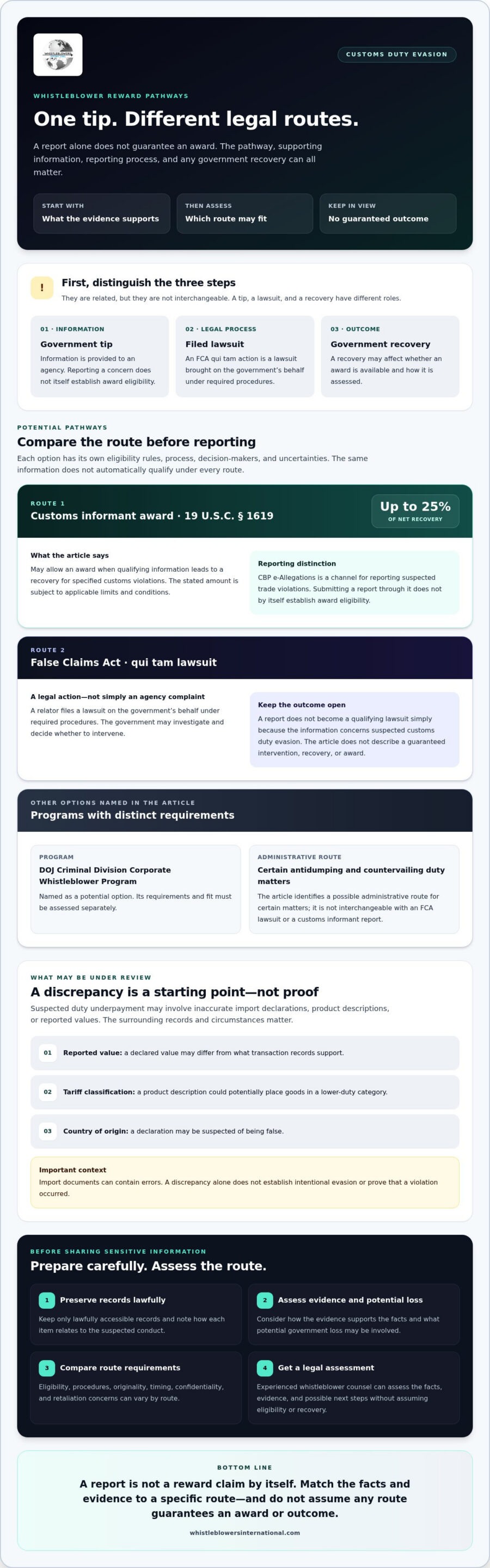
A whistleblower reward for customs duty is a possible payment under a legal program when information about suspected duty evasion meets that program’s requirements. A reward isn’t automatic. Eligibility may depend on the information, the route used, and whether government action leads to a recovery. Making a report doesn’t establish that a violation occurred or entitle the reporter to payment.
It helps to separate three steps. A government tip provides information to an agency. A filed lawsuit, such as a qui tam action under the False Claims Act, is a legal proceeding brought on the government’s behalf under specific rules. A government recovery is an outcome that may affect whether a reward is available and how it’s assessed. The steps are related, but they aren’t interchangeable.
The appropriate route depends on the facts, the law that may apply, and the relevant agency or court process. A customs informant award and a False Claims Act case, for example, use different mechanisms and have different requirements. The first question isn’t simply whether the information sounds serious. It’s whether the evidence and circumstances may fit a particular pathway.
What customs-duty evasion can involve
Suspected duty underpayment may involve inaccurate import declarations, product descriptions, or reported values. For example, a product description could potentially place goods in a tariff category with a lower duty, or a reported value could be lower than transaction records support. These are general illustrations, not proof of unlawful conduct. Import documents can contain errors, and a discrepancy alone doesn’t establish intentional evasion. Its meaning depends on the surrounding records, communications, and other evidence.
Why a report does not automatically earn a reward
Authorities may investigate information without pursuing enforcement. Enforcement may also occur without the person who supplied a tip qualifying for an award. Eligibility, the information’s usefulness or originality, the reporting process, and whether the government obtains a recovery can all matter. Requirements differ by route, so don’t assume an agency tip can later be treated as a qualifying lawsuit or reward claim.
Reporting information starts a conversation with the government; qualifying for an award requires meeting the legal and procedural conditions of a specific reward pathway. Before reporting or sharing sensitive records, a legal assessment can help evaluate which route, if any, may fit the facts. No assessment can guarantee that authorities will investigate, accept a claim, or obtain a recovery.
Which customs-duty whistleblower reward pathways may apply?
Two potential routes warrant close review: an informant award under 19 U.S.C. § 1619, often called the customs “moiety” statute, and a qui tam lawsuit under the False Claims Act (FCA). These are separate mechanisms, not different names for the same report. Each has its own eligibility rules, procedures, decision-makers, and uncertainties. The facts must be assessed against the particular route. Neither is automatically available just because suspected duty evasion has been reported.
Customs informant awards and 19 U.S.C. § 1619
Section 1619 may allow an award when qualifying information leads to a recovery for specified customs violations. The statute provides for an award of up to 25% of the net recovery, subject to applicable limits and conditions. Customs and Border Protection (CBP) is a relevant agency, and its CBP e-Allegations program provides a channel for reporting suspected trade violations. Submitting a report through that channel doesn’t, by itself, establish award eligibility.
Before relying on this pathway, verify the current statutory requirements, exclusions, reporting procedures, agency discretion, and how any applicable award limit is calculated. Whether information qualifies and leads to a recovery depends on the circumstances and governing rules.
False Claims Act qui tam claims involving customs duties
An FCA qui tam claim is a lawsuit, not simply a complaint to CBP. The person who brings the action, called a relator, files on the government’s behalf under required procedures. The government can investigate and decide whether to intervene, but neither intervention nor a successful recovery is assured. The claim needs a legally supportable basis. A customs discrepancy alone may not establish one. Learn more in this False Claims Act comprehensive guide.
A potential whistleblower reward for customs duty may therefore depend on whether the information fits an informant-award process or supports an FCA case, among other considerations. DOJ is relevant to potential FCA litigation, while CBP is a key agency for customs reporting. Filing with one doesn’t necessarily satisfy the requirements of the other. A lawyer experienced in customs fraud and whistleblower matters can assess the evidence, applicable procedures, and possible routes before sensitive information is shared. Explore customs fraud whistleblower representation to learn about legal assessment options.
How do customs informant awards and False Claims Act rewards differ?
A customs informant award and a False Claims Act (FCA) qui tam recovery arise under different laws and follow different processes. The comparison below is a starting point, not a determination that either route applies. Check eligibility, exclusions, award calculations, and current procedures against the governing law and agency guidance.
| Comparison | Customs informant award | False Claims Act qui tam |
|---|---|---|
| Legal basis | 19 U.S.C. § 1619, subject to statutory conditions and applicable rules. | The FCA’s qui tam provisions, which permit a relator to bring a qualifying action on the government’s behalf. |
| Receiving authority | Customs authorities, including CBP, assess information and any potential award under the applicable process. | A relator files a lawsuit in court under FCA procedures. DOJ may investigate and decide whether to intervene. |
| Process | An informant provides qualifying information that may lead to a specified customs recovery. A tip alone doesn’t establish an award claim. | The relator must file a legally supportable qui tam action and follow court procedures. The case may proceed with or without government intervention. |
| Potential reward | The statute may allow an award of up to 25% of the net recovery, subject to applicable limits, conditions, and agency decisions. | The statutory range is generally 15% to 30% of the government’s recovery. If DOJ intervenes, the relator’s share is generally 15% to 25%; if DOJ declines and the relator successfully litigates, it is generally 25% to 30%, subject to statutory requirements. |
| Key uncertainties | Whether the information qualifies, leads to a covered recovery, and meets current eligibility and award rules. | Whether the allegations support an FCA claim, what action DOJ takes, whether the case succeeds, and how the court determines any share. |
Who evaluates the information and what can follow
For an agency tip, customs authorities assess the information and decide whether to investigate or pursue enforcement. A qui tam action also involves a court process: DOJ can investigate and choose whether to intervene, while the case may continue under applicable rules if it declines. Reporters don’t control those decisions. A report doesn’t predict whether authorities will act, the amount recovered, or when any recovery may occur. A DOJ example involving importers that resolved False Claims Act liability illustrates an enforcement outcome, not a promise of a whistleblower award.
Eligibility, award discretion, and timing are not interchangeable
Meeting a threshold eligibility requirement is different from a later decision about whether an award is available and how it’s calculated. Statutory rules, government actions, and the complexity of the matter can affect the process and its timing. Don’t assume that pursuing both mechanisms is permitted or improves the result. Their interaction requires case-specific legal review. For broader reporting context, see this trade fraud reward guide.
What should you do before reporting suspected customs-duty evasion?
Careful preparation can help preserve the value of what you know without creating new legal or privacy risks. Before making a report, contacting an employer, or sharing sensitive records, consider documenting facts you already have lawful access to and getting advice tailored to your circumstances. These steps are general guidance, not a substitute for individualized legal advice.
Organize facts and preserve evidence responsibly
Start with a factual timeline. Note relevant transactions, entities, dates, and the customs-duty issue you believe may be involved. Separate what you personally observed from what you infer or heard from others, and record where each document or detail came from. This can help a lawyer assess both the information’s significance and how it may be used.
Keep original records intact. Don’t edit files, alter metadata, remove materials from a workplace, access restricted systems, or disclose confidential or privileged information without legal guidance. If you’re unsure whether a document is sensitive or whether you’re authorized to retain it, don’t copy or distribute it while you seek advice. Make notes accurately, including the circumstances in which you obtained the information.
Get advice before contacting an agency or employer
Early legal review can help assess which reporting route may fit, what evidence is relevant, and whether disclosure could raise confidentiality, privilege, or employment concerns. Identity protections and retaliation remedies vary by legal pathway and individual circumstances. Don’t assume that a report will remain anonymous or that a particular law will prevent retaliation in your situation.
Consider discussing the facts with a lawyer experienced in customs fraud and whistleblower matters before approaching an agency or employer. Counsel can review the information and help you understand potential disclosure risks. That review can’t guarantee eligibility, confidentiality, protection from retaliation, or an award. For additional context on reporting options, read this customs fraud reporting guide.
If you’re weighing a whistleblower reward for customs duty, a legal assessment before sharing records may help you make an informed decision. Request an assessment of a customs fraud matter to discuss whether the facts may fit a potential federal whistleblower claim.
How can a customs-duty whistleblower assess the next step?
An initial legal assessment can help determine whether the suspected conduct, available evidence, and potential government loss may fit a customs informant award, a False Claims Act theory, or another reporting route. A useful review separates documented facts from assumptions and considers how the information was obtained, what it supports, and what remains uncertain. These factors can guide next steps, but they don’t establish eligibility or predict what authorities will do.
Questions to raise during an initial legal assessment
Before sharing sensitive information, consider asking counsel:
- Which law or reporting mechanism may fit the known facts, and what supports that assessment?
- How should existing records be preserved, and what information should not be shared yet?
- What confidentiality limits may apply, and what protections or retaliation remedies might be relevant to this route?
- What are the likely stages of the process, and what fee terms would apply to representation?
Clear answers can help you understand both a potential pathway and its limits. No lawyer can guarantee that a claim will be accepted, that the government will pursue it, or that a reward will result.
Understand representation and possible outcomes
Piacentile & Associates LLP represents whistleblowers in customs-fraud matters, including import-export customs fraud, on a contingency-fee basis. Generally, contingency representation means legal fees are tied to a successful recovery, subject to the terms of the agreement. Ask how the agreement defines a recovery, what costs or other terms may apply, and what happens if there’s no recovery. This whistleblower lawyer contingency-fee guide provides additional context.
A careful assessment can clarify potential options without promising an outcome. If you’re considering a whistleblower reward for customs duty, you may request a confidential case assessment to discuss whether the facts merit further review. The discussion can help identify questions to resolve before deciding whether to take another step.
Take a careful next step with your information
A potential whistleblower reward for customs duty depends on the legal pathway and its requirements, not simply on whether someone reports suspected underpayment. A customs informant award and a False Claims Act qui tam case involve distinct procedures, eligibility questions, and potential outcomes. Before sharing sensitive records, preserve information lawfully and seek an assessment of the facts, evidence, and possible risks.
Piacentile & Associates LLP represents whistleblowers in import-export customs fraud matters and describes its federal representation as contingency-based, subject to the terms of the representation agreement. The firm also states that its team includes former whistleblowers. These details may help inform your choice of counsel, but they don’t establish eligibility or guarantee an award, case acceptance, or recovery.
If you have information about suspected customs-duty evasion, request a confidential case assessment to discuss whether the facts may merit further review. This can help you consider your options while protecting the integrity of your information.
Frequently Asked Questions
Is there a whistleblower reward for reporting customs-duty evasion?
Yes, a reward may be available through certain legal pathways, but reporting suspected evasion alone doesn’t guarantee eligibility or payment. Depending on the facts, a person may consider an informant award under 19 U.S.C. § 1619 or a False Claims Act qui tam case. Each route has distinct requirements, procedures, and uncertainties, and the government must take action that meets the relevant conditions. Legal review can help assess which route, if any, may apply.
How much is a customs-duty whistleblower reward?
The amount depends on the pathway and its requirements. Under 19 U.S.C. § 1619, an eligible informant may receive up to 25% of the net recovery, subject to statutory and regulatory limits. A successful False Claims Act case generally provides a relator 15% to 30% of the government’s recovery. The applicable share depends on factors such as government intervention and successful litigation. No percentage guarantees an award or predicts the amount recovered.
Can I receive a False Claims Act reward for customs fraud?
Possibly, if the facts support a legally valid False Claims Act claim involving customs duties and the required qui tam procedures are followed. A relator brings the lawsuit on the government’s behalf. The Department of Justice may investigate and decide whether to intervene. If the case results in a qualifying recovery, a relator may be eligible for a share under the statute. A customs complaint or suspected discrepancy alone doesn’t establish a claim or reward eligibility.
What evidence should I have before reporting customs-duty fraud?
You don’t need to prove the case yourself before seeking legal review. Useful information may include lawfully accessible import records, transaction documents, product descriptions, valuation information, relevant communications, and a timeline identifying entities and dates. Keep original records intact and note how you obtained each item. Don’t access restricted systems, remove materials without authorization, or disclose confidential or potentially privileged information before getting advice about how to handle it.
Can I report customs-duty evasion anonymously?
Don’t assume that any reporting route guarantees anonymity. Identity protections and disclosure rules differ between an agency tip and a False Claims Act qui tam action, and protections can depend on the circumstances. The customs informant process may offer confidentiality protections, but that isn’t the same as guaranteed anonymity. Before identifying yourself or sharing sensitive details, ask a lawyer to explain the relevant procedures, confidentiality limits, and potential risks for the route you’re considering.
What happens after I report suspected customs-duty evasion?
After a report, the receiving authority may review the information and decide whether to investigate or take enforcement action. In a qui tam case, the government may investigate and decide whether to intervene, while court proceedings follow the applicable legal process. You don’t control those decisions, and a report doesn’t establish that authorities will act or recover funds. Timing and any potential award depend on the route, evidence, government action, and outcome.