
A whistleblower settlement isn’t necessarily the amount that reaches the person who reported the misconduct. Understanding how whistleblower settlements are paid means tracing several separate steps: funds may need to be collected, an agency or court determines the award, and any legal fees or other applicable deductions are addressed before the claimant receives a net payment.
If you’re wondering who pays, how your share is calculated, or how long the process takes, the answers depend on the program and the facts of the case. A False Claims Act recovery, for example, follows a different award process from a payment under an SEC or IRS whistleblower program. The terms of a legal fee agreement and tax treatment may also affect what you ultimately receive.
This guide explains the steps from settlement or collected funds to award and distribution, why calculations and timing vary across federal programs, and what to ask counsel before funds are paid. Use it to understand the process, not as a promise of a particular award or payment date.
Key Takeaways
- A settlement announcement doesn’t necessarily mean funds have been collected or are ready for distribution.
- To understand how whistleblower settlements are paid, trace the process from resolution through collection, award determination, and payment.
- False Claims Act relator shares and agency-program awards are determined under different rules. Identify which rules apply to your case.
- Review the award decision, your fee agreement, and any documented expenses to understand what may affect your net payment.
- Ask counsel to clarify your case status, applicable procedures, and any unclear award notice. Don’t assume a payment date is guaranteed.
How whistleblower settlements are paid: the four stages from resolution to payment
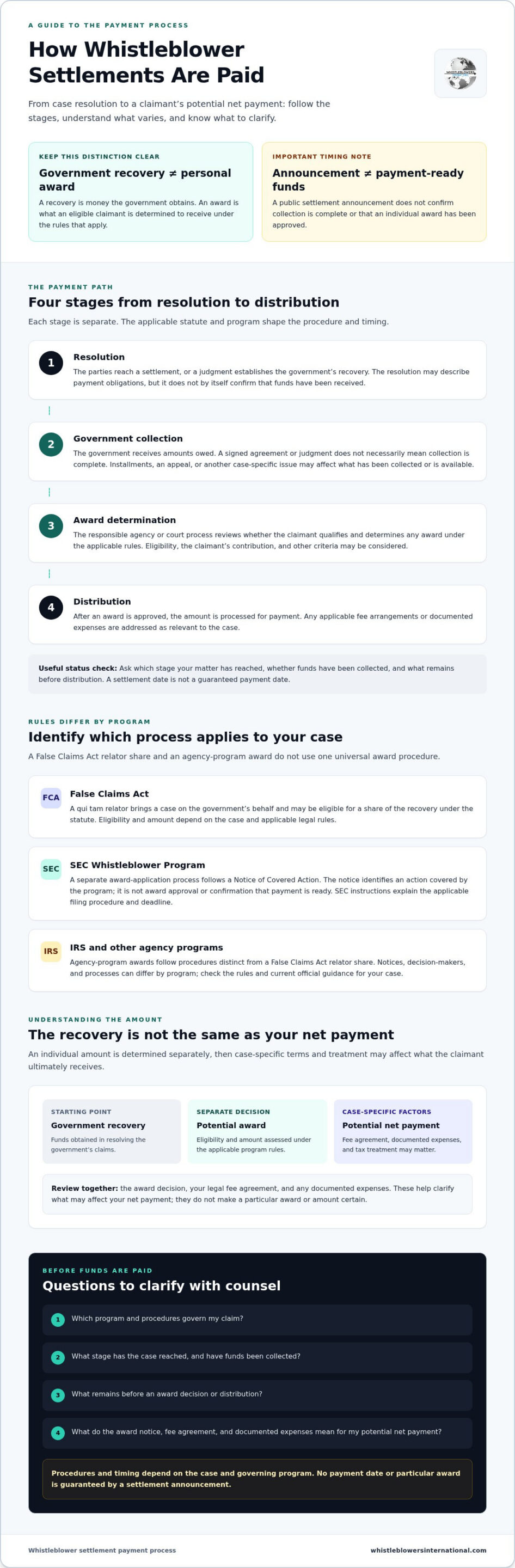
A settlement announcement doesn’t necessarily mean a whistleblower’s funds are ready. A resolution may establish the government’s recovery, but collection, an award decision, and the claimant’s payment are separate steps. The process for how whistleblower settlements are paid depends on the statute and program governing the claim.
A case recovery is money the government obtains; a whistleblower award is the amount an eligible claimant is determined to receive under the applicable program rules. The figures aren’t interchangeable, and a recovery doesn’t automatically entitle everyone who provided information to a share.
What does a whistleblower settlement payment actually mean?
The total recovery may resolve claims brought by the government, while an individual relator share or agency award is assessed separately. Under the False Claims Act, for example, a qui tam relator brings a case on the government’s behalf and may be eligible for a share of the recovery under the statute. Eligibility and the amount depend on the case and applicable legal rules.
A settlement can resolve disputed claims without completing every payment step. The agreement may describe payment obligations, but a public announcement alone doesn’t confirm that funds have been collected or that an individual award has been approved.
Why can payment follow resolution by a separate process?
Funds generally must be collected before they can be distributed, and a whistleblower’s eligibility or award may require separate review. The responsible agency or court process can also involve administrative steps before payment is issued. These stages don’t follow one universal schedule. Timing depends on the case and governing program.
Think of the sequence as four stages:
- Resolution: The parties reach a settlement, or a judgment establishes the government’s recovery.
- Government collection: The government receives the amounts owed. A signed agreement or judgment doesn’t necessarily show that collection is complete.
- Award determination: The relevant decision-maker evaluates whether a claimant qualifies and, if so, determines the award under the applicable rules.
- Distribution: The approved amount is processed for payment, with any case-specific fee arrangements or documented expenses addressed as applicable.
The steps vary across programs. A False Claims Act relator share and an agency-program award follow distinct procedures, so a timeline or status update in one type of case may not apply to another. Ask counsel or the relevant agency which stage your matter has reached, whether funds have been collected, and what remains before distribution. That status is more useful than treating the settlement date as a payment date.
From government recovery to claimant payment: what happens at each stage?
After a case resolves, the key questions are whether the money has been paid and what process governs a whistleblower’s potential award. A signed settlement or court judgment can establish an obligation without confirming that the government has received the funds. Payment may also depend on a separate agency or court review of the claimant’s eligibility and award.
A recovery generally must be collected before an award tied to those funds can be paid. If the agreement provides for installments, or collection is affected by an appeal or another case-specific issue, the amount available for distribution may not match the headline figure at that point. These factors don’t apply identically in every matter, so check the relevant program’s procedures and current official guidance.
How collection and award determinations affect timing
Even after funds are collected, the award decision may require review under the governing program. The responsible agency or court process can assess eligibility, the claimant’s contribution, and other applicable criteria. These steps are separate from negotiating or announcing a settlement, and they don’t follow a universal timetable.
For example, the SEC Whistleblower Program uses a separate award-application process after a Notice of Covered Action is posted. The SEC’s current instructions explain the applicable filing procedure and deadline. The notice identifies an action covered by the program; it isn’t an award approval or confirmation that payment is ready. Other programs may use different notices, decision-makers, and procedures.
What documents may accompany a payment decision?
Depending on the program and case, you may receive agency correspondence, an award determination, or a distribution statement. Each document answers a different question. A notice may describe a decision or required next step, while a payment record can show what was actually distributed. Don’t assume one document confirms that every stage is complete.
Keep copies of relevant case communications, settlement or judgment documents, award notices, your legal fee agreement, records of approved expenses, and payment confirmations. These records can help you compare the decision with the amount ultimately distributed. Ask counsel what each notice establishes, whether review or processing remains, and how any fees or expenses are reflected.
If you’re unsure which stage your matter has reached, a case-specific discussion can clarify the governing process and which documents to review. You can explore a whistleblower payment case review without assuming that a particular award or payment date is assured.
How payment differs in False Claims Act, SEC, IRS, and other cases
The governing program determines who reviews an award, what recovery can support payment, and how a claimant seeks a share. The process for how whistleblower settlements are paid differs by program: a False Claims Act relator share follows a different legal path from an agency award.
| Program | Who administers the process | What can trigger payment | What varies |
|---|---|---|---|
| False Claims Act | The court and government in the qui tam case | A recovery collected in a successful action, with a relator share determined under the statute | Whether the government intervened, the case outcome, and statutory factors affecting the share |
| SEC | Securities and Exchange Commission | Collected sanctions in a covered action, followed by an award application and decision | Eligibility, application requirements, and the award determination |
| IRS | Internal Revenue Service Whistleblower Office | Collected proceeds and an award decision under the applicable rules | Whether mandatory or discretionary award criteria apply and how the claim is assessed |
| CFTC and other agency programs | The relevant agency | A qualifying enforcement recovery and an agency award decision, where the program provides for awards | Program-specific eligibility, procedures, calculations, and payment steps |
How False Claims Act qui tam payments are handled
A relator share is a portion of the government’s recovery that may be awarded to the person who brought a qui tam action on the government’s behalf. It isn’t the same as the total recovery, and it isn’t automatic. Under the False Claims Act, the statutory share generally ranges from 15% to 25% if the government intervenes, and from 25% to 30% if it declines intervention and the relator successfully proceeds. The case outcome and statutory rules matter. Confirm how current law applies to the specific action. A comprehensive False Claims Act guide can provide further background on filing and procedure.
How agency awards differ
Agency programs have their own eligibility and award procedures. For SEC cases, eligible awards generally range from 10% to 30% of collected sanctions in qualifying actions where sanctions exceed $1 million. A claimant must follow the SEC’s application process, including the deadline stated in the agency’s notice. The percentage range alone doesn’t establish eligibility or predict an award.
IRS rules also distinguish between mandatory awards, generally 15% to 30% of collected proceeds when specified criteria are met, and discretionary awards of up to 15% in other qualifying cases. The IRS Whistleblower Office explains its program. Check its current guidance for the requirements that apply. CFTC, FinCEN, and other programs have separate rules. Confirm thresholds, funding sources, and payment sequence using the relevant agency’s official materials rather than applying one program’s rules to another.
How to understand your potential net payment and plan responsibly
A potential award and the amount you ultimately receive aren’t necessarily the same figure. To understand how whistleblower settlements are paid in your case, review each part of the calculation separately: the recovery or collected proceeds, the formal award decision, the legal fee agreement, and any documented expenses addressed under that agreement.
Don’t budget around an announced settlement alone. It may not reflect collected funds, an approved award, or your eventual net payment. You can’t reliably estimate an individual’s net amount without the relevant case documents and program rules. Fee arrangements also vary, so don’t assume a standard percentage or deduction.
Questions to ask before funds are distributed
Before distribution, ask for a clear explanation of the steps and documents that apply to your matter. Consider asking:
- Which program’s rules govern the award, and have the relevant funds actually been collected?
- Has an award been formally determined, or are eligibility or the amount still under review?
- How does the written fee agreement address legal fees, case expenses, and distribution?
- Which notice or statement will confirm the final award amount and payment status?
Request explanations in writing where appropriate, especially if a notice uses unclear terms or appears to show a different amount from what you expected. A lawyer can help interpret case documents and explain the fee agreement, but can’t promise a particular award or payment date.
What records should a whistleblower keep?
Keep an organized file of settlement communications, award notices, your signed fee agreement, expense records, distribution statements, and payment confirmations. Retain tax forms and other records relating to the payment as well. These documents can help you understand how the amount was determined and provide a basis for questions if the figures don’t appear to align.
Tax treatment depends on the facts and circumstances of the payment. Don’t assume that a particular award or deduction receives a specific tax treatment. Consult a qualified tax professional about reporting obligations and planning. For questions about how a contingency-fee arrangement works, review a whistleblower contingency-fee guide if available, and compare general information with the terms of your own agreement.
If you need help understanding your award documents or fee terms, discuss your whistleblower payment questions with counsel familiar with the applicable program.
When to seek legal guidance about a whistleblower settlement payment
A case-specific review may help if you’re unsure whether funds have been collected, which program’s rules apply, or whether an award notice confirms a final decision. It can also clarify how your signed fee agreement addresses legal fees, expenses, and distribution. These details matter because how whistleblower settlements are paid depends on the governing program and the documents in your case.
Counsel can explain what a notice says, what it doesn’t confirm, and whether another step appears to remain. But no lawyer can promise that you’ll receive an award, predict its amount, or guarantee a payment date. A careful review helps you understand the status and applicable rules without treating an expected payment as certain.
What to prepare for a confidential case discussion
Before speaking with counsel, gather relevant dates and non-privileged materials that help identify the matter and its current status. These may include agency or court notices, award communications, settlement-related correspondence, and your signed fee agreement. You don’t need to send every document before asking what information is useful.
Protect sensitive information. Don’t post case details publicly or send confidential or protected documents through a channel you haven’t verified. Ask the lawyer or firm how to share materials securely and which details require a more protected review. If you’re unsure whether a document is privileged or otherwise sensitive, get guidance before forwarding it.
How counsel can clarify the payment process
An attorney familiar with the relevant federal whistleblower program may help you distinguish a recovery from an award decision, interpret payment notices, and understand the terms of representation. Piacentile & Associates LLP represents whistleblowers in federal matters, including False Claims Act, SEC, IRS, CFTC, and FinCEN matters. The firm works on a contingency basis and is paid for legal services only when it secures a monetary award for clients. Confirm the specific terms of any representation in the written agreement.
Before engaging counsel, ask what the review covers, how the fee agreement addresses expenses and distribution, and how to provide case documents appropriately. Clear answers can help you assess next steps without relying on assumptions about timing or net payment.
If you’d like to discuss your matter, discuss your whistleblower matter with the firm. You can ask about the applicable program, your payment status, and the terms that govern representation without assuming any particular outcome.
Take the next step with a clearer understanding
Understanding how whistleblower settlements are paid starts with separating a case resolution from collected funds, an approved award, and the final distribution. The process and timing depend on the program and the facts of the matter, so a settlement announcement alone can’t confirm what you’ll receive or when.
Before planning around a potential payment, identify which rules govern your case, review the award decision and written fee agreement, and keep records of expenses and payment notices. If a document or deduction is unclear, case-specific guidance can help you understand what has been decided and what steps may remain, without promising an award or payment date.
Piacentile & Associates LLP represents whistleblowers in federal programs, including False Claims Act, SEC, IRS, CFTC, and FinCEN matters. The firm works on a contingency-fee basis and is paid only when it secures a monetary award. Its team includes former whistleblowers and uses investigative techniques to uncover fraud while protecting client privacy.
For a confidential discussion about your circumstances, discuss your whistleblower matter with the firm. Ask about the process that applies to your matter and the terms of representation.
Frequently Asked Questions
How are whistleblower settlement payments distributed?
Payments generally involve resolution, collection of funds, an award determination, and distribution, but the precise sequence depends on the case and governing program. The total government recovery isn’t necessarily the amount a claimant receives. An announced settlement may not confirm that funds have been collected or an award approved. Review your award notice and ask counsel or the relevant agency what has been completed and what steps remain.
When does a whistleblower receive money after a settlement?
There’s no single timeline for every whistleblower case. Payment may depend on the settlement terms, whether funds have been collected, award review, possible appeals, and administrative processing. A settlement announcement alone can’t establish when a claimant will be paid. Ask counsel or the responsible agency whether collection is complete, whether the award decision is final, and whether an application or processing step remains. Don’t rely on a general estimate as a case-specific payment date.
Is a whistleblower award paid by the company or the government?
It depends on the program and payment mechanism. A company or other defendant may pay a settlement to resolve claims, while a separate government or agency process may determine and distribute a whistleblower award. These steps aren’t identical across all programs. Check the settlement documents and award notice to see who is responsible for each payment, and ask counsel or the administering agency if the distribution route is unclear.
How is a whistleblower’s share of a False Claims Act settlement determined?
A relator’s share is determined under the False Claims Act and depends on the case. It doesn’t automatically match a fixed portion in every matter. Whether the government intervened may affect the applicable statutory range, along with other case-specific factors. The relator’s potential share is distinct from the government’s total recovery. Review the award decision with counsel and confirm current statutory rules; a general range can’t establish an individual award amount.
Are attorney fees and expenses deducted from a whistleblower award?
The written representation agreement governs the fee arrangement and how case expenses are treated, so don’t assume a universal percentage or standard deduction. Review the agreement and ask for a clear explanation of any proposed distribution before funds are paid. Piacentile & Associates LLP describes its representation as contingency-based, with payment for legal services tied to securing a monetary award. Confirm the specific terms in your own written agreement.
Are whistleblower settlement payments taxable?
Tax treatment can depend on the nature of the payment, the underlying claim, and your individual circumstances. Don’t assume every whistleblower award receives the same tax treatment or rely on general information as personal tax advice. Keep award notices, payment records, and tax documents, then consult a qualified tax professional about reporting obligations and planning. If payment documents are unclear, counsel may help explain the case records, but tax advice should come from a tax professional.
Can a whistleblower receive payment before the government collects the settlement?
That depends on the program and payment mechanism, but an announced settlement, signed agreement, or judgment doesn’t necessarily mean claimant funds are immediately available. In some processes, payment depends on actual collection and a separate award decision. Ask counsel or the administering agency whether funds have been received, whether an award has been approved, and what steps remain. Don’t treat a public settlement figure as confirmation of your payment status.