
What if the most useful evidence in a qui tam case isn’t a cache of documents, but a clear account of who submitted false claims, how they did it, and what they knew? If you’re asking what kind of evidence is needed for a qui tam case, it’s understandable to wonder whether firsthand knowledge is enough, whether records are essential, or what to do when your information is incomplete.
A viable case depends on specific, traceable facts, not simply the volume of documents. Emails, billing records, internal reports, financial documents, and witness information may help show how a company knowingly caused false claims to be submitted to the government. Your firsthand observations can provide important context, even if you don’t have every record.
This article explains what evidence may help establish the relevant facts, how to organize what you know, and why you should avoid altering or improperly obtaining sensitive information. It also covers what to discuss with qui tam counsel, who can assess whether the evidence supports a coherent False Claims Act theory and help evaluate next steps. Early legal review can be especially important when records are confidential, privileged, or difficult to interpret.
Key Takeaways
- What kind of evidence is needed for a qui tam case depends on the facts: firsthand observations, records, communications, data, and witnesses may help support specific allegations.
- Invoices, claim data, contracts, and audit records can be useful when they connect clearly to the alleged false claims.
- Assess each information source for its origin, detail, corroboration, and context; suspicion alone doesn’t establish what happened.
- Build a dated timeline and note where records came from, while preserving original context and avoiding edits to source documents.
- Qui tam counsel can evaluate the evidence, identify gaps and handling concerns, and explain procedural requirements before a filing.
What Evidence Can Support a Qui Tam Case Under the False Claims Act?
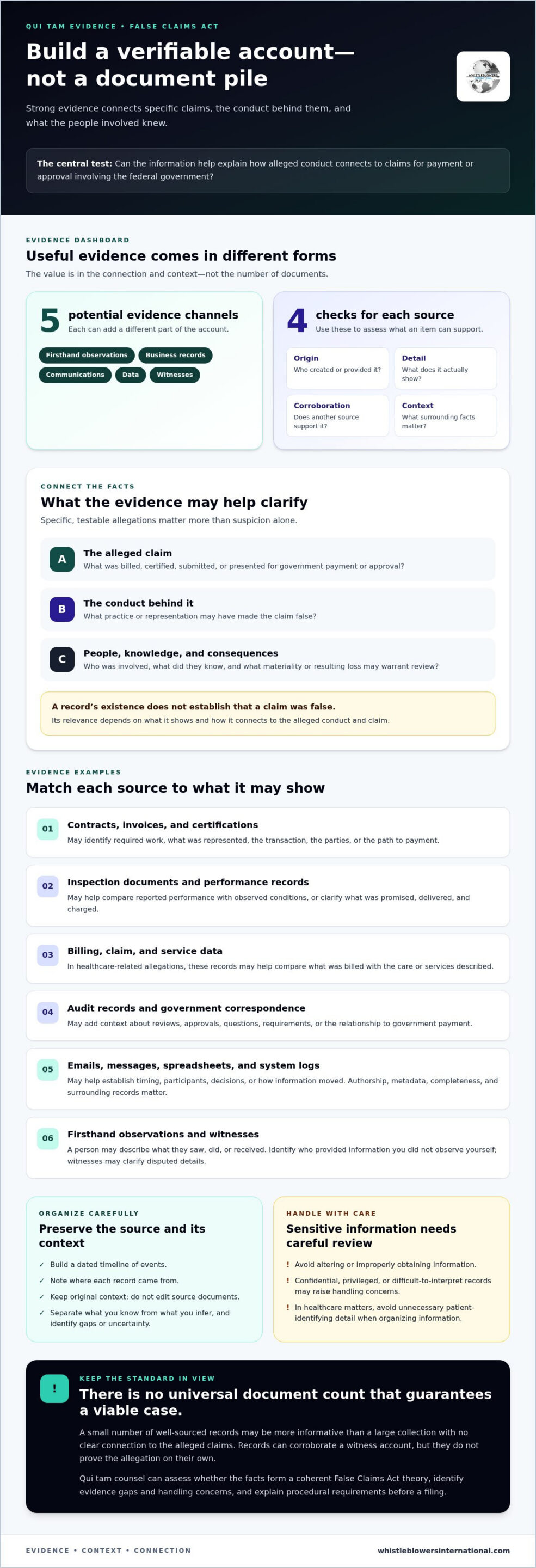
Evidence for a qui tam case supports specific, testable allegations about false claims; it doesn’t need to be a document dump. Firsthand observations, business records, communications, data, and corroborating witnesses may each help explain what happened. The central question is how the alleged conduct connects to claims for payment or approval involving the federal government, not simply whether the conduct appears suspicious.
A Qui tam action allows a private person, known as a relator, to bring a case on the government’s behalf under the False Claims Act. But concerning information alone doesn’t establish a violation. The significance of any evidence depends on the facts and the applicable legal standards.
What must the evidence help establish?
The evidence should help identify the alleged claims and the conduct that made them false. For example, records might show what was billed or certified, while communications or firsthand observations may shed light on who was involved and what they knew. A review may also examine whether the alleged misrepresentation was material to the government’s payment decision and what loss may have resulted. These issues are fact-specific, and their legal significance depends on current FCA standards.
Does a relator need firsthand knowledge?
Firsthand knowledge can provide important detail, but it isn’t the only potentially useful source. A person may directly observe a practice, participate in a process, or receive a relevant communication. They may also learn about events from records or other people. Distinguish those sources clearly: state what you saw, did, or received, and identify who provided information you didn’t observe yourself. Firsthand knowledge alone doesn’t prove every part of a claim.
There’s no universal document count that guarantees a viable case. A small number of well-sourced records may be more informative than a large collection with no clear connection to the alleged claims. Consider each item in context: who created it, when, what it actually shows, and whether another source supports or clarifies it. An incomplete record doesn’t automatically resolve the issue, but identify gaps and uncertainty rather than filling them with assumptions.
So, what kind of evidence is needed for a qui tam case? Evidence that helps build a coherent, verifiable account of the alleged claims, the conduct behind them, and the relevant knowledge. Evaluating how those facts fit together requires careful legal analysis, not simply counting documents or relying on suspicion.
Which Records and Firsthand Facts Can Strengthen a Qui Tam Allegation?
Useful records help connect a specific practice to claims submitted for government payment or approval. Depending on the alleged scheme, examples may include contracts, invoices, certifications, inspection documents, billing or claim data, audit records, and correspondence with a government agency. These are examples, not a checklist: relevance depends on what a record shows and how it relates to the alleged claims. The U.S. Department of Justice’s overview of The False Claims Act provides background on the statute and its enforcement.
What business records may matter in a government-payment scheme?
Start with records that may identify the transaction, the parties, and the path to payment. A contract may describe required work; an invoice or certification may show what was represented; inspection documents may help compare reported performance with observed conditions. Relevant government correspondence can add context about approvals, questions, or requirements. A record’s existence alone doesn’t establish that a claim was false, so its connection to the alleged conduct matters.
In healthcare-related allegations, claim and service records may help compare what was billed with the care or services described. Avoid unnecessary patient-identifying detail when organizing information for legal review. In procurement matters, bid materials, performance records, invoices, and compliance documents may help clarify what was promised, delivered, and charged, if you can lawfully access them.
How can communications and data corroborate what happened?
Emails, messages, spreadsheets, and system logs may help establish when decisions were made, who participated, or how information moved through an organization. Policies, training materials, and operational records can explain expected procedures or provide context, but they need a meaningful connection to the alleged claims. Dates, participants, submission pathways, and payment details make an account easier to assess and verify.
Context matters. A partial email chain may omit earlier discussion; a spreadsheet may not reveal who entered or reviewed the data. Authorship, metadata, completeness, and surrounding records can affect how an item is understood. Separate what a record directly shows from what you infer, and note which witnesses may be able to clarify disputed details.
Contemporaneous records can corroborate a witness’s account by anchoring it to dates and events, but they don’t prove the allegation on their own. That distinction helps answer what kind of evidence is needed for a qui tam case: records and firsthand facts that fit together into a verifiable account, rather than documents collected without a clear connection. If you’re weighing sensitive records or are uncertain about how they were obtained, discussing them with qui tam counsel can help you consider responsible next steps.
How Do You Assess Evidence Quality Without Mistaking Suspicion for Proof?
Evidence quality depends on more than whether a detail sounds concerning. A policy violation, unusual transaction, or troubling message may justify closer examination, but it doesn’t necessarily show that a false claim was submitted to the government or establish the requirements of an actionable False Claims Act allegation. Ask what each item directly shows, where it came from, and how it connects to the alleged claims.
The categories below offer a way to assess information, not a ranking of legal weight. Any source may be incomplete or need context.
| Evidence type | Source and specificity | Corroboration and context | Limitations to consider |
|---|---|---|---|
| Firsthand observation | What you personally saw, did, received, or heard; describe the event, people, and timing as precisely as you can. | Records or other witnesses may support details; explain your role and circumstances. | An observation may not reveal what was submitted, who knew what, or whether the event related to a government claim. |
| Contemporaneous record | A record created near the event, with an identifiable date, author, or system source. | Related documents, data, or testimony may confirm its meaning. | A record can be partial, ambiguous, or separated from the context needed to interpret it. |
| Secondhand report | Information another person shared; identify who said it, when, and whether they had direct knowledge. | The original source or independent records may help verify the account. | Retelling can obscure the source, wording, or circumstances of the underlying event. |
| Unsupported inference | A conclusion drawn from circumstances without a directly identified source. | Look for facts that could confirm or disprove the inference. | Suspicion alone may not establish what happened or connect conduct to a false claim. |
What makes a record more useful to investigate?
Consider whether it appears authentic, dated, attributable to a person or system, complete, and tied to a particular allegation. Identify related records or potential witnesses, and note inconsistencies rather than leaving them out. A lawyer and government investigators assess evidence in its full factual context, including what supports an account and what remains uncertain.
What important gaps should a potential relator recognize?
Flag missing claim-level details, uncertain sources, unexplained timelines, and assumptions that haven’t been verified. A record may suggest misconduct without showing how it connects to a claim for government payment or approval. No single document or witness automatically satisfies the legal requirements. Separately, the National Whistleblower Center discusses whistleblower protection provisions; those protections are distinct from the evidence needed to support an allegation.
A credible lead can point investigators toward a concern; it doesn’t, by itself, prove every element of an FCA claim. If you’re asking what kind of evidence is needed for a qui tam case, focus on how sources fit together, while keeping gaps and competing explanations visible for legal review.
How Should You Organize and Preserve Qui Tam Evidence Safely?
Organize what you know before trying to gather more. A clear record of your recollections and potential evidence can help counsel understand the facts, identify gaps, and consider responsible next steps. The goal isn’t to collect as much as possible. It’s to preserve accurate context without creating new legal or privacy risks.
What should an evidence inventory include?
Start with your own recollections while events are fresh. Separate what you personally observed from what you learned from records or other people. Then build a dated timeline and make an inventory of potentially relevant material. For each item, note:
- Description and date range: Identify the type of record and the period it covers.
- Source and custodian: Record where you encountered it and, if known, who maintains it.
- Connection to the conduct: Briefly explain what it may relate to, without presenting an assumption as a fact.
- Potential witnesses: Note who may have firsthand knowledge and what you understand each person observed or did.
Mark uncertainty plainly. Preserve original context and, where you lawfully have access, keep records unaltered. Don’t edit, highlight, or write notes on originals. If you need to explain a document, keep your explanation separately and identify it as your own note.
How can you avoid creating new legal or privacy risks?
Stay within your authorized access. Don’t bypass access controls, mass-copy files, remove restricted or privileged materials, or covertly record conversations. A person’s access to a system doesn’t necessarily mean every record may be copied or shared. Before transferring or disclosing sensitive information, discuss its source and handling with counsel.
Use particular care with confidential business information, personal data, and protected health information. Avoid sending or sharing details that aren’t necessary to explain the concern. Recording laws and other legal issues can depend on the circumstances, so seek legal guidance before recording conversations, moving records to a personal account or device, or responding to an investigation. Keep any notes about sensitive information separate from the source records, and document where and how you encountered each item.
If you’re unsure how to organize sensitive material or what kind of evidence is needed for a qui tam case, discuss your evidence with qui tam counsel before taking further steps. Careful early review can help assess the information while keeping its source, context, and handling concerns clear.
What Happens When You Bring Qui Tam Evidence to Counsel?
A legal review looks at how the facts fit together, not just how many records you have. Counsel may organize the chronology, identify the alleged claims and the people involved, assess each evidence source, look for corroboration, and flag gaps or concerns about how information was obtained. That analysis can help determine whether the facts support a coherent False Claims Act theory and what additional questions require attention.
Because sensitive material may raise privilege, privacy, or access issues, discuss its source and handling before transferring or disclosing it. Counsel can also explain the relevant filing and disclosure requirements and how they apply to your circumstances.
How does evidence relate to filing and government review?
Under the False Claims Act’s qui tam procedure, the relator’s complaint is generally filed under seal initially, along with a disclosure to the government containing substantially all material evidence and information the relator possesses. The initial seal period is at least 60 days and may be extended by the court. Review the applicable statutory procedures and any exceptions against current law before filing.
This process is one reason evidence organization matters: the complaint and disclosure must present the allegations and supporting information in a structured way. A legal assessment, however, isn’t a prediction or guarantee that the government will intervene, that a case will proceed, or that funds will be recovered. Organize the supporting facts so counsel can assess what is known, what is uncertain, and how each item relates to the allegations.
What should you prepare before an initial legal discussion?
A concise, accurate overview is a useful starting point. Consider preparing:
- A dated timeline that separates firsthand knowledge from information learned elsewhere.
- A brief summary of the suspected conduct and how it may relate to government claims or payment.
- An inventory of potentially relevant records you could access lawfully, including each record’s source.
- A list of possible witnesses and what you understand each person may know firsthand.
- Notes about any ongoing investigation, litigation, disclosure, or immediate document-retention concern.
Don’t alter originals or gather restricted records to fill gaps. Identify uncertainty clearly and raise handling questions before sharing sensitive information. These steps can help counsel focus the discussion while preserving the context needed to evaluate the evidence.
If you’re asking what kind of evidence is needed for a qui tam case, a review with counsel can help clarify how your facts and records fit together. Piacentile & Associates LLP represents whistleblowers in federal False Claims Act matters on a contingency fee basis. You can discuss your information and concerns with the firm, without assuming that any particular facts establish eligibility or guarantee an outcome. The firm’s representation is contingency-based, with a portion of a monetary recovery or agency award paid as the legal fee.
Take the Next Step With a Clear, Careful Evidence Review
Strong qui tam allegations are built on specific facts that connect suspected conduct to claims involving government payment or approval. Firsthand observations, records, communications, and witness information may help tell that story, but each source needs context. A dated timeline and a careful inventory can help identify what is known, what remains uncertain, and how information was obtained.
If you’re considering what kind of evidence is needed for a qui tam case, you don’t need to resolve every legal question or gather every possible record before seeking guidance. Avoid altering documents or accessing information improperly. Early review can help assess how your facts fit together and how to handle sensitive material responsibly.
Piacentile & Associates LLP represents whistleblowers in federal matters, including False Claims Act cases. Led by Dr. Joseph Piacentile, Esq., a former whistleblower and attorney, the firm uses investigative techniques to evaluate and develop whistleblower matters. The firm represents clients on a contingency fee basis. To discuss the facts and records you have, discuss your qui tam evidence with our legal team.
Frequently Asked Questions
What kind of evidence is needed for a qui tam case?
Evidence should help support a specific account of false claims involving government payment or approval. Firsthand observations, invoices, claim data, contracts, internal communications, audit records, and witness information may help establish what happened and who knew about it. No single document type is required in every matter. The key question is what kind of evidence is needed for a qui tam case based on its particular facts, sources, context, and applicable legal standards.
Do I need to prove the entire False Claims Act case before filing?
No, a relator doesn’t need to prove the case as if it has already gone through trial before filing. But a complaint must meet applicable legal and procedural requirements, and allegations need a factual basis rather than suspicion alone. The government also receives a disclosure of the material evidence and information the relator possesses under the statutory process. Counsel can assess whether the known facts support filing and identify significant gaps.
Can I use company documents as evidence in a qui tam case?
Company documents may be relevant, but whether and how to use them depends on their source, content, and handling. Don’t bypass access controls, mass-copy files, or take privileged, restricted, or otherwise protected material. Keep track of where a record came from and preserve its context. Before transferring or disclosing sensitive documents, discuss them with qui tam counsel, who can assess potential legal, privacy, and privilege concerns.
What if I have firsthand knowledge but no documents?
Firsthand knowledge may still be useful, even if you don’t possess documents. Write down what you personally observed, did, received, or heard, and include approximate dates, participants, and your role in the events. Clearly separate those memories from information others told you. Note potential witnesses who may have direct knowledge. Your account doesn’t automatically prove every legal requirement, but counsel can assess its detail and whether other evidence may corroborate it.
How much evidence is enough to support a qui tam case?
There’s no universal number of documents or witnesses that makes a case viable. A smaller set of specific, well-sourced information may be more useful than a large collection with no clear connection to government claims. Counsel can assess how the evidence fits together, what it directly shows, and what remains uncertain. Avoid filling gaps with assumptions or gathering records improperly to increase the volume of material.
Should I share sensitive evidence with the government or coworkers?
Don’t circulate sensitive evidence among coworkers or send it directly to the government without legal guidance. Qui tam filings involve specific procedures for submitting the complaint and material evidence to the government, and counsel can help address those requirements. Before sharing records, consider whether they contain privileged, confidential, personal, or protected health information. Discuss the source and handling of sensitive material with counsel first; no communication should be assumed to guarantee anonymity or confidentiality.