
Before reporting suspected fraud, it can help to identify which legal route may fit the facts. If you’re unsure whether your information is relevant, concerned about your identity or your job, or simply don’t know where to begin, legal help for reporting fraud can help you assess your options before you disclose information.
Those concerns are understandable. A report involving government funds may raise different issues from suspected securities, tax, commodities, or financial-crimes violations. The information you have may also need careful review before a formal filing. Whistleblower counsel can help evaluate potential program fit, organize supporting information, and explain the process and fee terms. No assessment can promise eligibility, anonymity, protection from retaliation, or an award. This guide explains the role counsel may play, what to consider when assessing representation, and how to take a discreet next step. Piacentile & Associates LLP represents individuals in federal whistleblower matters, and its legal team includes a former whistleblower.
Key Takeaways
- Legal help for reporting fraud can help assess which federal reporting route may fit the conduct and information you have before a formal filing.
- When assessing counsel, consider experience with the relevant whistleblower program, approach to evaluating evidence, communication, and fee structure.
- Prepare a concise account of the concern, key dates, entities, and records you already have. Don’t alter records or obtain or share restricted material improperly.
- False Claims Act, SEC, CFTC, FinCEN, and IRS matters follow distinct routes. Whether one applies depends on the facts and program requirements.
- Piacentile & Associates LLP represents whistleblowers in these federal matters, works on a contingency fee basis, and includes a former whistleblower on its team.
When Do You Need Legal Help for Reporting Fraud?
It’s reasonable to feel uncertain before reporting suspected fraud. You may not know which agency, if any, has authority, whether your information matters, or what could happen at work if you speak up. A useful first step is to distinguish a general concern from a potential whistleblower matter that may fit a specific legal reporting process.
Whistleblower counsel is a lawyer who evaluates and, where appropriate, represents a person in connection with a potential legal report of misconduct to a government agency or through a formal legal proceeding. That’s more focused than a general search for a lawyer: the key questions are whether the facts may fit a particular route and what steps to consider before disclosure. An agency tip is information submitted to an agency; it isn’t, by itself, the same as legal representation. A workplace dispute may also raise different issues from a potential fraud report, even if both arise from the same events.
A suspicion alone doesn’t establish eligibility for a whistleblower program or guarantee an award. The term Whistleblowing covers a broad range of disclosures, while legal options depend on the specific facts and applicable requirements.
What can a whistleblower lawyer help you assess?
Counsel can review the conduct you’re concerned about, the entities or funds involved, and the information you already have to consider whether a federal whistleblower route may be relevant. Suspected fraud involving government payments, for example, raises different questions from suspected misconduct affecting securities markets or tax revenue. A lawyer may help organize the timeline and records, identify gaps or uncertainties, and discuss possible next steps before a formal disclosure. Any assessment depends on the facts, applicable law, and program-specific requirements.
When is it prudent to seek advice before reporting?
Consider seeking advice before acting if the information involves sensitive records, could relate to more than one agency, or may affect your work or personal life. A public disclosure or an unplanned report can complicate a potential matter, depending on the circumstances and governing rules. Before sharing information, avoid accessing, copying, altering, or retaining records without authorization. You can note what you recall and where relevant records may exist without taking materials improperly.
Legal help for reporting fraud can provide a structured review before you decide how to proceed. It can’t remove every risk or predetermine the outcome, but it can help identify which questions need careful attention before you make a report.
Which Legal Route May Apply to the Fraud You Are Reporting?
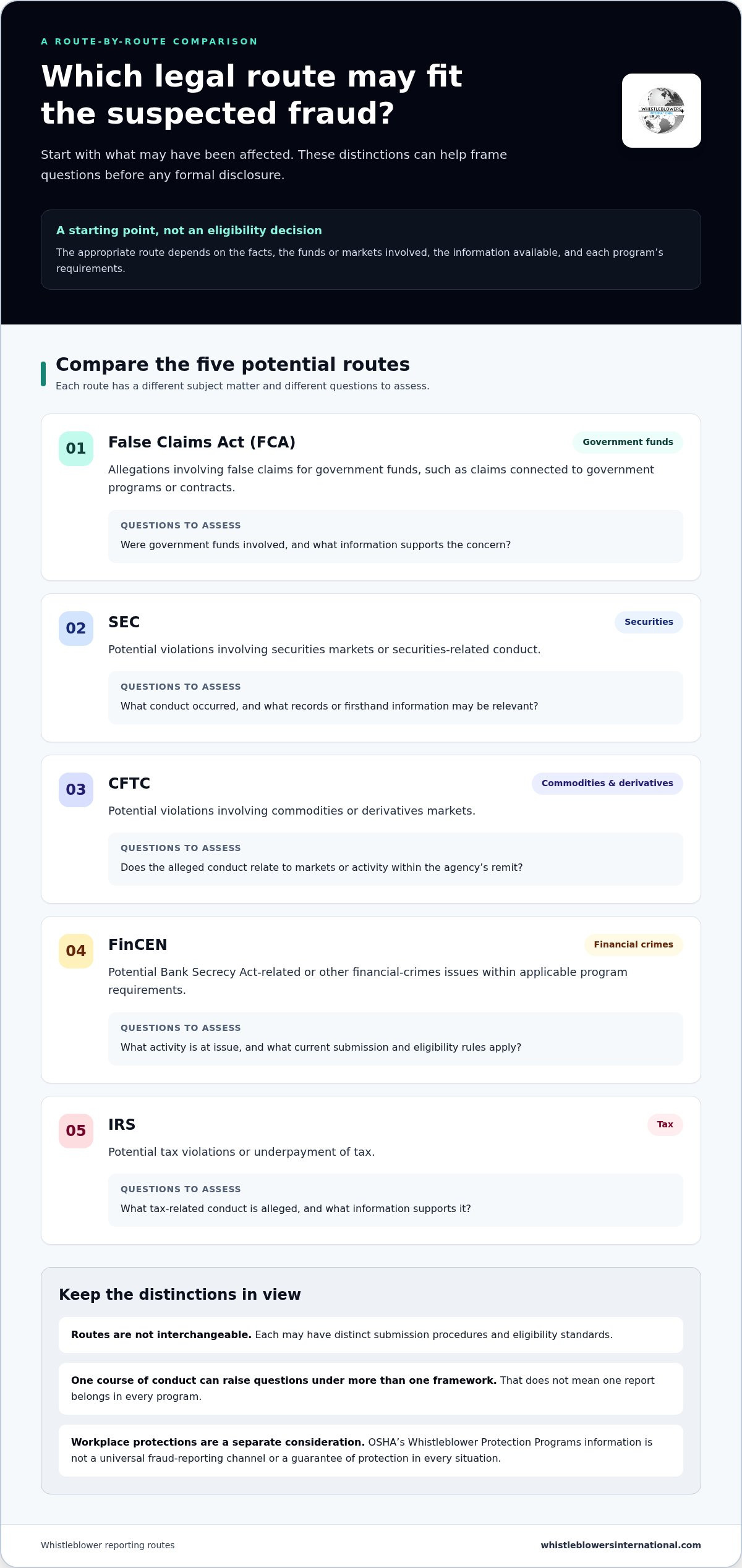
The right route depends on what may have been misrepresented, which funds or markets were affected, and what information is available. A concern involving government payments, for example, raises different questions from suspected securities or tax misconduct. These distinctions are a starting point, not a determination of eligibility. Each program has its own requirements, and legal help for reporting fraud can help assess how the facts may fit before disclosure.
How do federal whistleblower programs differ?
The table offers a high-level comparison, not a filing guide. The categories aren’t interchangeable, and the same conduct may call for a closer legal assessment before anyone chooses a reporting route.
| Potential route | Broad subject matter | Questions to assess |
|---|---|---|
| False Claims Act (FCA) | Allegations involving false claims for government funds, such as claims connected to government programs or contracts. | Were government funds involved, and what information supports the concern? Learn more in this False Claims Act guide. |
| SEC | Potential violations involving securities markets or securities-related conduct. | What conduct occurred, and what records or firsthand information may be relevant? |
| CFTC | Potential violations involving commodities or derivatives markets. | Does the alleged conduct relate to markets or activity within the agency’s remit? |
| FinCEN | Potential Bank Secrecy Act-related or other financial-crimes issues within applicable program requirements. | What activity is at issue, and what current submission and eligibility rules apply? |
| IRS | Potential tax violations or underpayment of tax. | What tax-related conduct is alleged, and what information supports it? |
Each route may involve distinct submission procedures and eligibility standards. The Whistleblower Protection Programs information from OSHA addresses workplace whistleblower protections. It should not be mistaken for a universal fraud-reporting channel or a guarantee of protection in every situation.
What if the fraud crosses industries or jurisdictions?
One course of conduct can raise questions under more than one legal framework. For instance, a scheme involving company disclosures and financial transactions may require careful review of which facts relate to each potential route. That doesn’t mean one report belongs in every program. Counsel can assess the overlap, available information, and applicable requirements before you make a disclosure.
When conduct or the people involved cross borders, the analysis may require additional care. Piacentile & Associates LLP represents individuals in the United States and internationally in U.S. federal whistleblower actions. The firm handles FCA, SEC, CFTC, FinCEN, and IRS matters. The fit of any route depends on the specific facts and governing requirements.
How to Evaluate Legal Help for Reporting Fraud
Choosing counsel for a potential whistleblower matter calls for more than a general assessment of legal experience. The relevant program may shape how information is reviewed, what procedures apply, and how a matter could proceed. Use a focused checklist to assess the fit and approach of representation, rather than assuming any lawyer or firm can guarantee a particular result.
- Federal program experience: Consider experience with the type of matter involved, such as a False Claims Act case or an SEC, CFTC, FinCEN, or IRS whistleblower matter. Familiarity with the relevant program helps counsel identify questions its procedures and requirements may raise.
- Fact development: Ask how counsel evaluates information, identifies gaps, and organizes records into a clear account of what may have happened. Investigative work can help assess the available facts, but it doesn’t guarantee that a claim will qualify or succeed.
- Communication: A sound working relationship depends on clear explanations of the process, realistic discussion of uncertainty, and a shared understanding of next steps.
- Fee terms: Read the written agreement carefully, including how fees are calculated and what happens if no award is obtained.
What experience and approach are relevant?
Program-specific experience matters because the available routes aren’t interchangeable. A lawyer familiar with one agency process may not have the same experience with another. Ask how counsel would assess the facts and develop the matter before a formal filing. Piacentile & Associates LLP represents individuals in U.S. federal whistleblower matters, and its legal team includes a former whistleblower. That perspective is relevant context, not a prediction or promise of outcome.
What should you understand about contingency fees?
A contingency arrangement ties legal fees to an outcome as provided in the written agreement. Piacentile & Associates LLP works on a contingency fee basis and is paid only if it secures a monetary award for clients. The agreement governs the arrangement, so read its terms closely and understand what applies if no award is obtained. For more detail, see this whistleblower contingency-fee guide.
Before deciding, make sure you understand the proposed scope of representation, how counsel plans to communicate with you, and which terms govern the fee arrangement. Effective legal help for reporting fraud is grounded in the relevant program, a careful review of the facts, and clear expectations, not assurances about eligibility or recovery.
What Should You Prepare Before Discussing a Fraud Report?
You don’t need to prove a case or assemble a complete file before seeking legal help for reporting fraud. A concise, factual outline can help counsel understand the concern and identify what needs closer review. Preparation supports an initial assessment, but it doesn’t establish eligibility or determine whether a report can proceed.
Start with three steps:
- Summarize the concern: Describe the conduct in plain terms and why it raised concern. Separate what you personally observed from what you suspect or heard from someone else.
- Identify dates and entities: Note approximate dates or time periods, organizations, programs, transactions, and people involved, if known. Mark estimates as estimates rather than presenting them as confirmed facts.
- List existing records: Identify records you already have lawful access to or know about, such as correspondence, reports, or transaction details. Don’t alter, remove, or obtain records improperly to strengthen your account.
How can you organize what you know?
A neutral chronology can make a complex concern easier to assess. For each event, record when it occurred, who was involved, what you observed, and how you learned about it. Label the source as a personal observation, an existing document, public information, or a secondhand account. Note uncertainties openly. Avoid speculating about motives or declaring that conduct was illegal; counsel can assess how the facts relate to applicable law and program requirements. For more on preserving a factual account, see this corporate fraud documentation guide.
How should you handle sensitive records and identity concerns?
Don’t access systems or records without authorization, bypass controls, or copy or share restricted material while preparing. Instead, note where relevant information may be located and raise questions about its handling before taking action. Confidentiality and anonymity depend on the circumstances, applicable law, and the procedures of the relevant program; neither should be assumed. If you’re concerned that a disclosure could reveal your identity or affect your work, describe that concern to counsel and discuss how information may be handled in the specific process.
Keep your notes factual and secure, and avoid circulating them more broadly than necessary. These steps can make an initial discussion more focused while preserving a clear distinction between what you know, what you infer, and what remains uncertain.
How Piacentile & Associates LLP Can Help With Fraud Reporting
Once you’ve organized what you know, the next question is whether the facts may fit a federal whistleblower route and what a careful next step could involve. Piacentile & Associates LLP represents individuals in U.S. federal whistleblower matters, including False Claims Act cases and matters involving the SEC, CFTC, FinCEN, and IRS. Each program has its own requirements, so suspected fraud alone doesn’t establish that a particular filing is appropriate or that a person qualifies for an award.
The firm assesses potential legal fit and helps develop information before an appropriate formal filing. Its legal team includes a former whistleblower, bringing relevant personal perspective to the representation. That experience can inform the work, but it doesn’t guarantee acceptance, eligibility, confidentiality in every circumstance, or a particular outcome.
What happens when you reach out for an initial discussion?
An initial discussion can focus on the conduct you’re concerned about, the dates and entities involved, what you know firsthand, and what information or records are already available. It can also help identify which federal program may warrant closer consideration and what questions remain. You don’t need to arrive with a final legal theory, but be prepared to distinguish confirmed facts from estimates or secondhand information.
An initial discussion doesn’t, by itself, mean the firm has agreed to represent you or that an attorney-client relationship has been formed. Representation depends on the appropriate engagement process. Any assessment remains subject to the facts and applicable program requirements.
A measured next step for potential whistleblowers
Seeking an assessment can help you understand possible routes before deciding how to proceed. Piacentile & Associates LLP represents individuals in the United States and internationally in U.S. federal whistleblower actions. The firm works on a contingency fee basis and is paid only if it secures a monetary award for clients. That arrangement doesn’t promise that a matter will qualify or produce an award; the terms of any representation are governed by the applicable agreement.
If you’re considering a federal whistleblower matter, discuss your whistleblower matter with Piacentile & Associates LLP as a measured step toward understanding the available options. Share only information you’re authorized to provide, and raise any identity or sensitive-record concerns as part of the discussion.
Take a Careful First Step Toward Reporting Fraud
The right reporting route depends on the conduct, the information available, and the requirements of the relevant federal program. Before disclosing anything, organize what you know, distinguish firsthand observations from assumptions, and avoid accessing or sharing records without authorization. These steps can support a more informed assessment, but they don’t establish eligibility or predict an outcome.
Legal help for reporting fraud can help you consider potential program fit and understand possible next steps before a formal filing. federal whistleblower matters and works on a contingency fee basis. Its legal team includes a former whistleblower, a perspective that informs its work but doesn’t guarantee an award or any particular result.
If you’re ready to discuss the facts and consider whether a federal whistleblower route may apply, discuss your whistleblower matter with Piacentile & Associates LLP. A measured, informed conversation can help you decide what to do next.
Frequently Asked Questions
Should I speak with a whistleblower lawyer before reporting fraud?
Speaking with counsel before reporting may help you assess which program could fit, what risks may need consideration, and what next steps are appropriate. Suspected fraud involving government payments, for example, may raise different questions from concerns involving securities or taxes. Timing and strategy depend on the facts and applicable requirements. This is general information, not legal advice; a lawyer’s assessment of your circumstances is needed to address your specific situation.
Can a whistleblower lawyer help me report fraud anonymously?
Possibly, but anonymity depends on the applicable program, submission method, and circumstances, so it shouldn’t be assumed. A confidential legal discussion and the identity rules for a formal agency submission are separate matters; speaking with a lawyer doesn’t itself determine whether your identity can be withheld during the reporting process. If identity exposure is a concern, raise it with counsel before disclosing information or taking steps toward a formal report.
How much does legal help for reporting fraud cost?
Costs depend on the fee arrangement, so read and understand the written agreement before deciding to proceed. Piacentile & Associates LLP works on a contingency fee basis and is paid only if it secures a monetary award for clients. That arrangement doesn’t mean every matter qualifies or results in an award. Review the agreement’s terms carefully so you understand how fees apply to the representation and what happens if no award is secured.
What does a whistleblower lawyer do when reporting fraud?
A whistleblower lawyer can evaluate the facts against a potentially relevant federal program, help develop and organize information, and advise on appropriate legal steps. The work may differ depending on whether the concern involves government claims, securities, commodities, tax, or another area, as well as the information available and program requirements. Counsel can’t guarantee that a matter will be accepted, prompt government action, or produce an award.
Can someone outside the United States get legal help for reporting fraud to a U.S. agency?
Yes. Piacentile & Associates LLP represents individuals internationally in U.S. federal whistleblower actions. A person’s location alone, however, doesn’t establish eligibility for a particular program or award. The relevant conduct, available information, and applicable program requirements all matter. If you’re outside the United States, discuss where the events occurred, which entities may be involved, and what information you have so counsel can assess the potential U.S. federal route.
What should I do if I have information about possible fraud but no documents?
You can still describe what you know. Documents aren’t the only information a lawyer may assess; firsthand observations, dates, people involved, and how you learned about the conduct may also be relevant. Record those details as accurately as possible, distinguishing what you saw from assumptions or secondhand accounts. Don’t access systems or obtain records without authorization. Only a fact-specific legal assessment can determine which information may be useful for a potential report.
Is contacting a whistleblower lawyer the same as filing a fraud report?
No. An initial discussion with a lawyer isn’t necessarily a formal report to an agency or a court filing. Formal steps depend on the applicable program, the facts, and legal strategy. Don’t assume that contacting a firm automatically establishes representation or determines how your information will be handled. Engagement and confidentiality terms depend on the circumstances and applicable rules, so clarify them before sharing sensitive information or proceeding with a formal disclosure.