
How can you report a company without the company learning who you are? The answer depends on the reporting channel, and anonymity when you submit information may not continue through every stage of an investigation. If you’re considering reporting a company anonymously, concern about retaliation is understandable. The choice between an anonymous report and a confidential one can affect whether investigators can follow up and what protections may apply.
Start by identifying the suspected misconduct, then compare the reporting channels that may address it. This guide explains how internal channels and federal whistleblower programs differ, what anonymity and confidentiality can mean in practice, and how to share relevant information responsibly without improperly accessing or disclosing records. Reporting rules and identity protections vary by program, so legal guidance can help you understand the route and its implications before you act. The aim is to set realistic expectations, not to promise complete secrecy.
Key Takeaways
- Anonymous reporting means the recipient does not know your identity; confidential reporting means the recipient knows it but limits who can access it. Safeguards depend on the channel and applicable rules.
- Match the reporting route to the suspected misconduct. Different concerns may fall under company channels or separate government programs.
- When reporting a company anonymously, include concrete facts such as dates, locations, and conduct so investigators can assess the report. Anonymity may limit follow-up.
- Prepare a factual timeline and distinguish what you observed from assumptions, estimates, or information you heard from others.
- For potential government fraud, securities, tax, or financial misconduct, legal guidance can help assess program fit, submission requirements, and identity-related considerations.
What Does Reporting a Company Anonymously Actually Mean?
Anonymity means the recipient does not know who made the report; confidentiality means the recipient knows, but limits who can learn the reporter’s identity. Neither term guarantees that an employer can’t infer who raised a concern from the timing, details, or documents described. The safeguards depend on the channel’s procedures and the law that applies.
“Anonymous” may describe how you submit an initial tip, not every stage of a formal whistleblower matter. A government program may accept information without your name, while a formal filing or later process may require identifying details. Requirements differ by program. Don’t assume an anonymous intake option means your identity will never be requested or disclosed.
Anonymous, confidential, and pseudonymous reports
The practical difference is whether the recipient can connect the report to its source. A pseudonym may let you respond to follow-up questions without confirming your identity, but it does not prove that the reporting platform or agency cannot identify you.
| Approach | Reporter identity | Recipient knowledge | Follow-up ability |
|---|---|---|---|
| Anonymous | Not provided or otherwise known to the recipient | Does not know who submitted the report | Possible if the channel provides a way to exchange messages |
| Confidential | Provided to the recipient | Known to a limited group, subject to applicable rules | Can be direct, though identity access may be restricted |
| Pseudonymous | A name or alias is used instead of a verified identity | May not know the person’s legal identity | Possible through the alias or account, but privacy is not assured |
For example, someone using a portal nickname might answer investigators’ questions through that account. That does not establish that the portal operator or agency cannot identify them, or that the alias will remain usable throughout later proceedings.
Why the reporting channel changes the privacy picture
Internal hotlines, government agencies, and counsel-assisted submissions have different intake processes. An employer hotline may accept anonymous tips; an agency may have program-specific rules; and some federal programs allow counsel to submit information on a client’s behalf under procedures that address identity. The suspected conduct helps determine the right route, but the submission method alone doesn’t decide what happens later.
An initial privacy description may not explain every possible disclosure later in the process. Investigators may need clarification, a formal claim may require identifying information, or legal requirements may affect confidentiality. For a program-specific example, review the SEC whistleblower anonymity rules. The federal Whistleblower Protection Act is relevant background, but it is not a universal guarantee of anonymity or protection across every workplace and reporting program.
Which Channel Can You Use to Report a Company Anonymously?
Identify the suspected misconduct before choosing where to report it. A company hotline, a government agency, and a counsel-assisted federal submission have different purposes. An anonymous intake option may not satisfy the requirements for a formal legal claim or award. The appropriate route depends on what happened, which laws or programs may apply, and what investigators need to assess the information.
For example, an allegation involving government billing raises different issues from suspected securities fraud or tax misconduct. Choosing a channel only because it appears anonymous can send your report to an office without authority over the conduct. It can also leave you unsure whether a separate filing is needed.
Internal company hotlines and compliance channels
A company hotline or compliance office may be suited to suspected policy breaches, internal control failures, or concerns the organization can investigate and address. In regulated sectors such as healthcare, organizations often work with specialist advisors like CQC Consultancy to establish robust internal governance and ensure operational compliance. Some channels accept anonymous reports, but they are operated for or by the company, so they may not provide the same separation as an outside agency. Intake methods, access to submissions, and identity safeguards vary. Don’t assume every employer handles reports in the same way.
Internal reporting is not interchangeable with an agency submission. If the concern involves a potential legal violation, the existence of a company channel does not by itself determine whether you should also report externally. OSHA’s Whistleblowers’ Rights resource describes protections under various laws and how complaints are handled. The relevant process depends on the subject and applicable law.
Federal agencies and counsel-assisted reporting
Federal programs cover different subject areas and have different filing procedures. The SEC addresses securities-related matters; the IRS handles tax-related issues; the CFTC oversees matters within its commodities and derivatives remit; and FinCEN focuses on financial-crime reporting under its programs. These broad distinctions can help orient you, but they don’t determine eligibility or show which program fits a particular set of facts.
For potential fraud involving government funds or programs, the False Claims Act may be relevant. A False Claims Act whistleblower guide explains that route. In certain federal programs, counsel may assist with a submission, including procedures that address identity. That does not make every report anonymous or ensure eligibility for a formal claim or award. An anonymous tip may be reviewed, while a later filing may have separate requirements.
Before reporting a company anonymously, map the conduct to the most plausible channel and review that program’s procedures and identity requirements. Piacentile & Associates LLP represents whistleblowers in federal matters, including False Claims Act cases and submissions under SEC, CFTC, FinCEN, and IRS programs. Legal representation can help assess potential program fit and privacy implications, but cannot guarantee anonymity or an outcome. If federal misconduct may be involved, learn about federal whistleblower reporting options as you consider your next step.
Can an Anonymous Report Be Investigated Without Revealing Your Identity?
Yes, an anonymous report may be assessed without disclosing the reporter’s identity, but anonymity can limit an investigation. Investigators—whether an internal compliance team or an independent corporate private investigator NYC retained by counsel—may review the allegation and compare it with records or other evidence. They may also need more detail to verify what happened. If they can’t contact the source, gaps may remain unresolved, and the report may not support further action. An anonymous submission does not guarantee an investigation or mean the reporter’s identity can never be inferred.
Give investigators concrete details to examine. Include, when known, the approximate date or period, location or business unit, nature of the conduct, people involved, and potential witnesses. For example, “payments were approved repeatedly without the required review” gives investigators a subject to examine. The report becomes more useful if it also identifies the relevant period, process, and basis for the observation. Separate what you saw firsthand from what you learned from others.
What anonymity can make harder for investigators
Without a way to reach you, investigators may be unable to clarify a term, confirm the sequence of events, request supporting information, or distinguish a direct observation from an inference. They can still assess the details you provide, but an unanswered question may leave an important point uncorroborated.
A confidential route may let an investigator contact you while limiting access to your identity under the channel’s procedures. That can make follow-up easier, though it doesn’t guarantee secrecy or resolve every disclosure question. Before choosing between an anonymous tip and a confidential submission, consider whether you can provide enough detail initially and whether follow-up could clarify the allegation. The available options depend on the reporting channel and applicable rules.
How a report can reveal its source indirectly
Removing your name doesn’t necessarily remove clues about who made the report. Details may point to one person because they refer to unique job duties, a very small team, access to a particular system, or attendance at a specific meeting. A precise event date can also narrow the possible sources if only a few people were present or knew what happened.
Review your report for unnecessary identifying context, but don’t make it less accurate or conceal material facts. Describe the conduct truthfully and include details that help establish what happened. Don’t alter records, remove relevant information, or imply certainty where you’re unsure. Label estimates as estimates and distinguish firsthand knowledge from what someone else told you. If essential facts could identify you, consider the channel’s procedures or seek legal guidance before submitting.
Reporting a company anonymously means weighing identity concerns against investigators’ need to assess and verify the allegation. No reporting method can promise a particular investigation, identity protection, protection from retaliation, or outcome. Focus on a factual account with enough relevant detail, and make the privacy decision with realistic expectations about what the channel can and can’t do.
How to Prepare Before Reporting a Company Anonymously
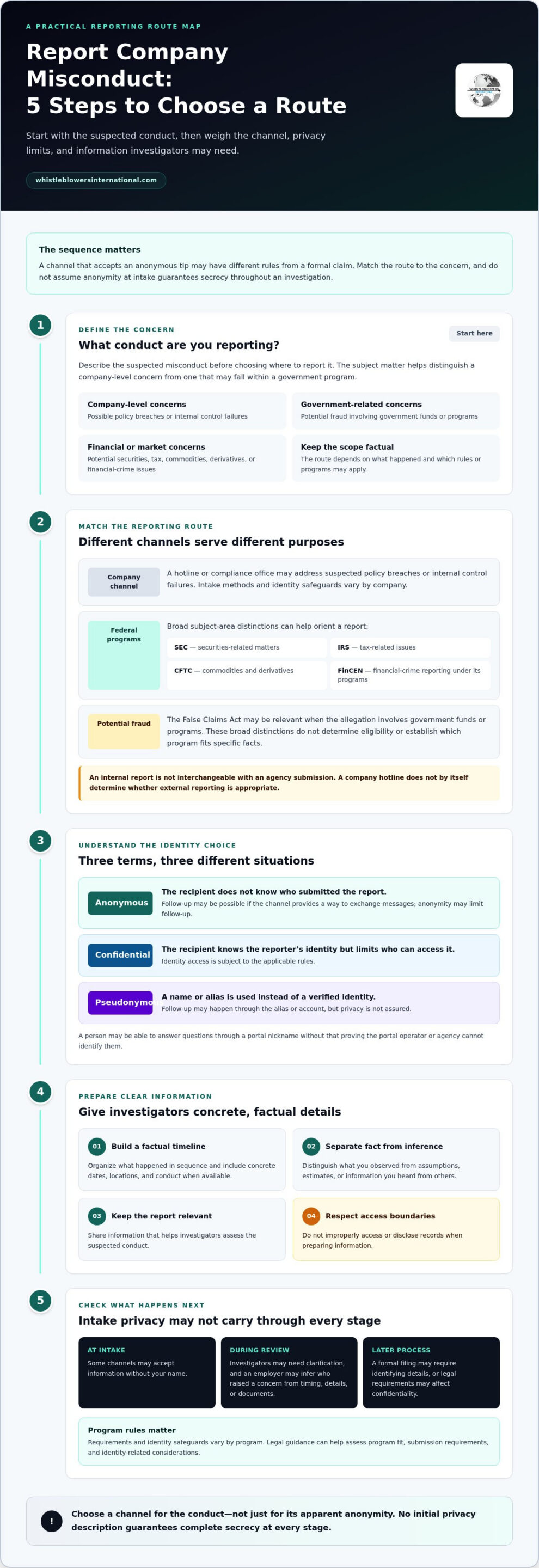
Preparation can make a report clearer and help you avoid unnecessary risks. Before reporting a company anonymously, organize what you know, choose a suitable channel, and review what you plan to submit. You don’t need to conduct your own investigation or obtain records you aren’t authorized to access.
Use this sequence:
- Identify the conduct. Describe what you believe happened without claiming more than the facts support.
- Build a timeline. Note dates or estimated periods, relevant events, transactions, people involved, and locations or business units.
- Record how you know. Separate firsthand observations from assumptions, estimates, and information learned from others.
- Preserve lawful notes. Keep accurate notes and only materials you may lawfully access and retain.
- Select and review the channel. Consider its subject-matter fit, submission requirements, privacy information, and follow-up options before sending.
Organize what you know without taking unnecessary risks
A concise timeline is often more useful than a long narrative. For each event, record what occurred, when it occurred, who was involved, and how you learned the information. Label an approximate date as an estimate. If someone else described an event to you, say so rather than presenting it as something you witnessed.
Preserve only materials you’re permitted to access and retain. Don’t enter restricted systems, bypass access controls, take confidential records without authorization, or breach legal obligations to gather evidence. This article can’t assess the specific legal risks of handling particular records; those depend on the circumstances. If you’re unsure whether keeping or sharing a document is lawful, pause and seek advice before acting.
Review the channel and submission before sending
Before submitting, find out whether the recipient accepts anonymous information and whether it provides a way to answer follow-up questions. Read the form carefully for identity fields, contact details, attachment requests, and explanations of confidentiality or information handling. Review files for unnecessary personal details, but don’t alter records or remove information that changes their meaning. If it’s safe and appropriate, keep a factual copy of your final narrative and note when and where you submitted it.
For potential government fraud, securities violations, tax issues, or other financial misconduct, legal review can help assess program fit, submission requirements, and identity-related concerns before you file. Counsel can also help evaluate how to handle sensitive evidence, but cannot guarantee anonymity or a particular outcome. If you’re considering representation, this whistleblower contingency-fee guide explains one aspect of how legal representation may be structured.
If you’re weighing a federal reporting path, discuss a potential federal whistleblower matter with counsel to evaluate your next steps carefully.
When Legal Guidance Can Help You Report Company Misconduct
Legal guidance may be useful when suspected misconduct involves government funds, securities, taxes, or financial activity and the appropriate reporting route or its privacy implications aren’t clear. Before reporting a company anonymously, you can ask counsel to assess whether the facts may fit a federal whistleblower program, what its submission process requires, and how identity questions could affect later participation.
This review is not a promise of anonymity or a particular result. Counsel can help explain the limits of available protections and identify issues to consider before submitting information or contacting an agency. That can be especially useful when weighing an anonymous tip against a formal program submission, which may have different requirements.
Questions legal counsel can help evaluate
A focused review can help clarify whether the reported conduct may fit a federal whistleblower program or another reporting route. Counsel can also explain how a program’s procedures may affect identity disclosure, required information, and your role if the matter proceeds. Before acting, discuss practical and legal risks related to the facts, including handling sensitive records and communicating with an agency.
The goal is informed decision-making, not a guarantee that a particular channel will accept a report, preserve your identity, or lead to an investigation. Each program has its own rules, and an assessment depends on the specific facts available.
Consider a protected, informed next step
The False Claims Act and agency whistleblower programs have distinct eligibility and filing requirements. A route that may suit suspected government fraud won’t necessarily apply to securities, tax, or other financial misconduct. Counsel can evaluate potential fit and submission requirements without assuming that one process or protection applies across programs. Program-specific anonymity rules require separate consideration.
Piacentile & Associates LLP represents individuals in federal whistleblower matters, and its team includes former whistleblowers. That perspective can inform a careful assessment of reporting choices and practical concerns. The firm uses investigative techniques to evaluate potential matters and represents whistleblowers on a contingency fee basis, receiving a portion of a monetary recovery or agency award when successful. Representation cannot guarantee anonymity, protection from retaliation, an award, or a successful outcome.
If you’re considering a federal whistleblower matter, contact Piacentile & Associates LLP about your potential matter to discuss whether the facts may fit a federal program and what questions to address before taking the next step.
Make Your Next Step Deliberate
Choosing how to report misconduct involves more than deciding where to send information. Consider what you’re prepared to share, how you’ll handle follow-up, and whether you need guidance before taking a step that may be difficult to reverse. If you’re weighing reporting a company anonymously, learn how the relevant federal program treats submissions and what identity-related questions may arise as the matter progresses.
Piacentile & Associates LLP represents whistleblowers in U.S. federal matters. The firm’s team includes former whistleblowers, and its representation is provided on a contingency fee basis. These facts may inform a discussion about potential federal reporting paths, but no attorney can guarantee anonymity, legal protection, an award, or a particular result.
If suspected misconduct may fall within a federal whistleblower program, discuss the circumstances before submitting information. Discuss a potential federal whistleblower matter with Piacentile & Associates LLP. Careful guidance can help you understand the available options and make a deliberate decision.
Frequently Asked Questions
Can I report a company anonymously to the government?
Yes, some government channels accept anonymous tips, but the rules depend on the agency and type of submission. Reporting a company anonymously through a tip line may differ from filing under a whistleblower program, particularly if you later seek an award or pursue a formal claim. Review the agency’s current instructions or obtain legal guidance so you understand what information the process requests and whether your identity may be needed later.
Can my employer find out who submitted an anonymous report?
Possibly, though an employer may not receive an external report directly. If you report through a company-managed hotline, people assigned to administer or investigate that channel may have access under its process. Even when a report goes outside the company, a narrow set of facts, a distinctive attachment, or contact details tied to you may make the source inferable. No channel can promise that an employer will never identify the reporter.
Is an anonymous company report protected from retaliation?
Not automatically. Whether anti-retaliation provisions apply can depend on the law, the type of misconduct, your role, and how the report was made. An anonymous tip by itself shouldn’t be treated as proof that you qualify for legal protection or that a required complaint has been filed. If adverse action occurs or seems imminent, document events lawfully and promptly seek advice about the rules and deadlines that may apply.
Can an anonymous report be investigated if I cannot answer follow-up questions?
Yes. Investigators may compare an allegation with company records, audit data, public filings, or interviews, if those sources are available and relevant. But a report that omits a key period or process may be difficult to verify, and investigators may be unable to test a detail that only the reporter can explain. Include enough factual context when you submit the report to make the concern assessable, even if you cannot respond later.
What should I include in an anonymous report about a company?
Include a concise account of the conduct, the approximate period, where in the organization it occurred, and how you learned about it. Identify people or transactions only as specifically as your knowledge supports, and label estimates or secondhand information. For example, distinguish a payment you reviewed during authorized work from a concern a coworker described. Avoid attaching records you aren’t authorized to access or retain.
Can I receive a whistleblower award if I report anonymously?
Possibly, but an anonymous tip and an award application aren’t necessarily the same submission. Program rules may require additional steps, documentation, or identity verification before an award can be considered, and requirements differ among agencies. Don’t assume that a report filed without your name preserves eligibility or counts as an award claim. Review the applicable program’s current procedures before filing; counsel can help assess how anonymity affects the process.
Should I report misconduct internally or directly to a government agency?
Neither route is right for every concern. An internal channel may fit a policy issue or allow the company to investigate, while direct agency reporting may be relevant if the alleged conduct falls within a regulator’s authority. Don’t assume internal reporting is required before an external submission, or that telling the company satisfies a federal program’s filing rules. Consider subject matter, privacy, evidence access, and applicable deadlines before deciding.