

Could information you uncovered at work qualify for an SEC award, even if you first raised the concern internally? SEC whistleblower reward eligibility depends on more than where the information came from. Your submission must meet the program’s legal criteria and contribute to a successful enforcement action.
It’s reasonable to be uncertain. “Original information” has a specific meaning, and a detailed tip alone doesn’t guarantee an award. Generally, the information must lead to an SEC action resulting in more than $1 million in monetary sanctions. Reporting internally or having a work connection doesn’t automatically disqualify you, but your role, how you obtained the information, and applicable exclusions may matter. A related criminal conviction, for example, can bar an award.
This article explains the SEC’s award criteria, what may count as original information, and circumstances that can limit or prevent eligibility. It also distinguishes submitting a potentially qualifying tip from meeting the requirements for an award after an enforcement action. Because each matter is fact-specific, these criteria can help you identify questions to examine, but they can’t guarantee an outcome.
Key Takeaways
- SEC whistleblower reward eligibility depends on whether your information meets the program’s criteria and contributes to a qualifying enforcement action, not simply whether you submit a tip.
- Assess how you obtained the information and whether it offers original insight beyond allegations already known to the SEC or information available to the public.
- Workplace reporting, government roles, and possible involvement in misconduct can affect eligibility in different ways. Don’t assume any one factor determines the outcome.
- Before pursuing an award claim, organize what you know about the suspected violation, your information sources, reporting timeline, and how your evidence could assist the SEC.
- Legal counsel can evaluate how the facts fit SEC rules, but eligibility and an award remain fact-specific and aren’t guaranteed.
SEC whistleblower reward eligibility: what the program actually rewards
The SEC whistleblower program may pay an individual for original information and assistance that contributes to a successful enforcement action. Sending information to the SEC is only the starting point. A person may submit a tip without meeting the requirements for an award, and a tip that prompts an investigation does not, by itself, establish a right to payment.
A qualifying tip may help the SEC identify or pursue misconduct. An award determination asks whether the individual and information satisfy the program’s rules and contributed to a successful action with qualifying monetary sanctions. That distinction is central to SEC whistleblower reward eligibility: the information matters, but so does what happens after the SEC receives it.
What counts as an SEC whistleblower award?
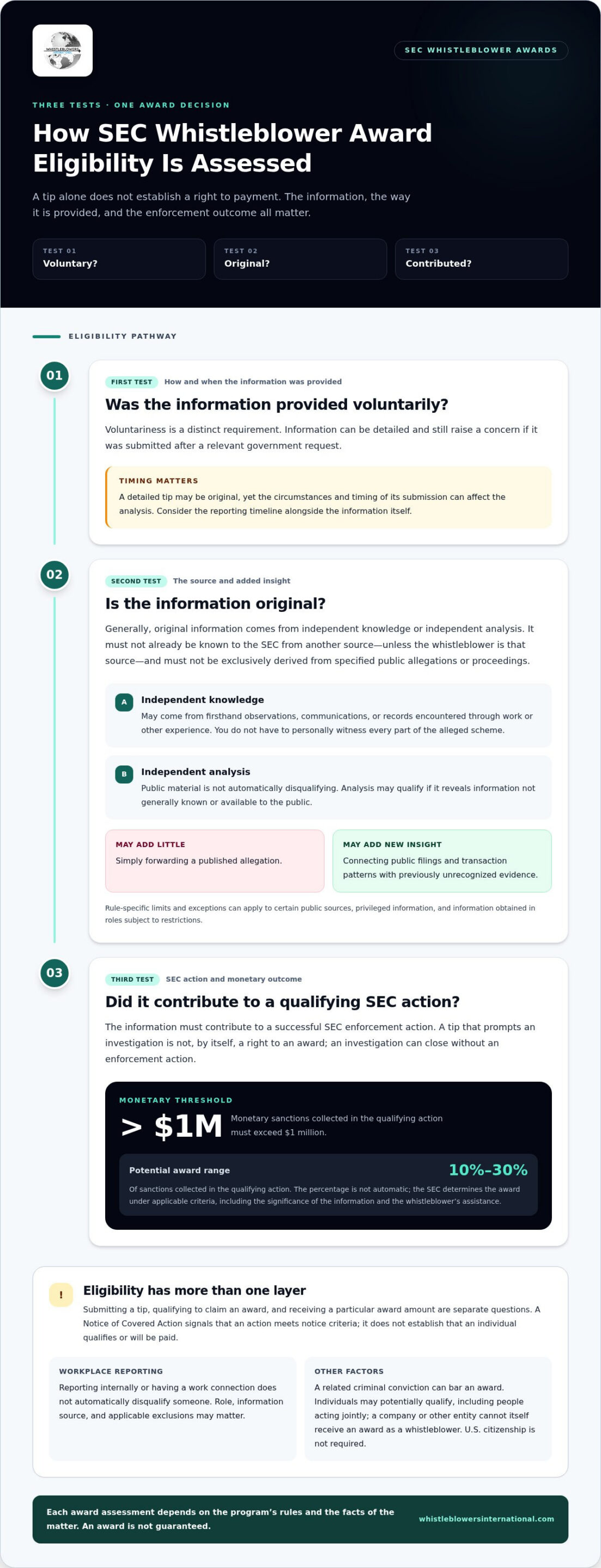
An award is a potential payment tied to a successful SEC enforcement action in which monetary sanctions collected exceed $1 million. Under the program, an eligible whistleblower may receive 10% to 30% of the sanctions collected in the qualifying action. The percentage isn’t automatic. The SEC determines the award under applicable criteria, including the significance of the information and the whistleblower’s assistance.
A detailed tip may help the SEC investigate, but an investigation can close without an enforcement action. Even if the SEC brings an action, it must meet the required threshold, and other award conditions still apply. A Notice of Covered Action signals that an action meets the notice criteria; it doesn’t establish that a particular person qualifies or will be paid. The individual must also follow the separate process for claiming an award.
For example, a person who identifies a concealed accounting issue and supplies records that help the SEC establish a violation may have information worth evaluating. That doesn’t settle whether the records were sufficiently original, whether the person meets all eligibility rules, or whether the action results in qualifying sanctions. Those questions depend on the program’s requirements and the facts of the matter.
Who can potentially qualify to receive an award?
The SEC program defines a whistleblower as an individual, or two or more individuals acting jointly, who provide information about a possible securities-law violation. A company or other entity cannot itself receive an award as a whistleblower. An employee, investor, or other person may potentially qualify as an individual, subject to the rules and any applicable exclusions.
U.S. citizenship isn’t required. A person outside the United States may potentially qualify if the relevant program criteria are met; nationality alone doesn’t decide eligibility. Potential eligibility is not a prediction of payment. The person’s role, information source, submission, assistance, and the enforcement outcome can all affect the analysis.
Keep the distinction clear: the SEC can receive information from someone who ultimately doesn’t qualify for an award. Eligibility to submit a tip, eligibility to claim an award, and entitlement to a particular award amount are separate questions. Each depends on specific facts. An award isn’t guaranteed simply because the SEC investigates or publishes a covered-action notice.
The SEC reward eligibility criteria: original, voluntary, useful information
To assess whether a submission may support an SEC award, consider three connected questions: Was the information provided voluntarily? Was it original under the program’s rules? Did it contribute to a successful SEC action? These are distinct tests. A detailed tip may be original but submitted after a relevant government request. Information may be timely yet add little to what investigators already know. The SEC Whistleblower Program Official Site provides the agency’s program materials and related rules. How those rules apply depends on the circumstances of the report.
When is information considered original?
SEC rules generally define original information as information derived from a whistleblower’s independent knowledge or independent analysis, not already known to the SEC from another source unless the whistleblower is that source, and not exclusively derived from specified public allegations or proceedings. Independent knowledge may come from firsthand observations, communications, or records encountered through work or other experience. You don’t have to personally witness every part of the alleged scheme.
Public information isn’t automatically disqualifying. A person’s independent analysis of public materials may qualify if it reveals information that isn’t generally known or available to the public. Simply forwarding a published allegation may add little. By contrast, analysis connecting public filings, transaction patterns, and previously unrecognized evidence may offer a new insight. The distinction turns on what the whistleblower contributes, not simply whether some underlying material was public.
Rule-specific limits and exceptions apply to information drawn from certain public sources, as well as information protected by privilege or obtained in roles subject to restrictions. Don’t assume that firsthand access always satisfies the test or that public sources always defeat it. The source, how the information was obtained, and the insight it adds all require careful evaluation.
What makes a submission voluntary and useful?
Voluntariness is assessed by timing. In general, information must reach the SEC before a request, inquiry, or demand about the subject is directed to the whistleblower or the person’s representative by the SEC or another specified authority. The rules include qualifications, including whether a request concerns the same subject matter, so any government contact doesn’t resolve the issue by itself. Preserve notices and correspondence that show when a request was made and what it covered.
Useful information materially helps the SEC detect, investigate, or advance a securities-law matter. It does more than describe suspected wrongdoing. Specific dates, entities, transaction details, relevant records, and explanations of how evidence fits together can help investigators assess a tip. Avoid overstating what a document proves. Identify what you observed directly and what remains an inference.
Even a voluntary, original, credible submission cannot ensure that the SEC will bring an enforcement action. The information must contribute in the manner required by the program, and the investigation may develop in ways no whistleblower can control. Assess SEC whistleblower reward eligibility by considering the information’s source, timing, and practical contribution together.
For suspected foreign bribery involving a securities-law connection, the reporting pathway may require careful analysis. A guide to FCPA whistleblower reporting explains that related context. A focused legal assessment can also help evaluate how the facts fit SEC criteria before you decide on next steps.
SEC award eligibility exclusions and misconceptions that can change the analysis
Reporting suspected securities misconduct doesn’t automatically make someone eligible for an award. The SEC evaluates the person, the source and handling of the information, and the circumstances of the submission. Some restrictions depend on a person’s professional role; others concern how information was obtained or whether the person was convicted of related misconduct. Exceptions and fact-specific rules matter, so a job title alone rarely tells the whole story.
The SEC Whistleblower Program Final Rules set out these categories and qualifications. Reviewing the rules alongside the facts can help distinguish a potential obstacle from a disqualification. The analysis shouldn’t be reduced to a checklist of job titles.
How can job duties or access to information affect eligibility?
Certain people may face restrictions if they learned information through duties designed to detect or address violations. This can include some officers, directors, auditors, compliance or internal audit personnel, and attorneys. For example, a lawyer generally can’t use information obtained through legal representation when disclosure would violate applicable duties. The analysis depends on the person’s role and the information’s source.
These restrictions have exceptions. Under specified circumstances, someone who first reported information through internal channels may later qualify after reporting to the SEC, including where the applicable waiting period has passed. Other exceptions can apply when information is disclosed to the SEC or authorized individuals. The details matter: internal reporting doesn’t establish eligibility by itself, and a professional role doesn’t always rule it out.
Lawful access is different from unlawful acquisition. Receiving records through ordinary job responsibilities doesn’t, by itself, show that a person is disqualified. But information obtained through illegal means can raise a separate barrier. Preserve the context of how records came into your possession, and don’t access or remove materials unlawfully to strengthen a potential submission.
Do culpability, prior knowledge, or internal reporting disqualify someone?
A person’s own participation in reported misconduct doesn’t automatically bar an award. However, culpability may affect the award determination, and a criminal conviction related to the misconduct can disqualify the person. Knowingly making false statements or submitting misleading information can also jeopardize eligibility. Be candid about your role and distinguish facts you observed from conclusions you drew.
Prior SEC knowledge is a separate issue. If the agency already has the same information, a submission may be less likely to qualify as original or materially assist an investigation. That doesn’t mean every fact related to an existing inquiry is useless. Additional evidence, analysis, or a new lead may add value. The key question is what the SEC knew and what the new information contributed.
Internal reporting isn’t a universal prerequisite to an SEC award, but it also isn’t irrelevant in every case. The timing and content of an internal report may affect how the rules apply, and assistance to a company’s compliance process can be relevant to award considerations. Assess the sequence carefully rather than assuming that internal reporting either guarantees protection or defeats a claim. A fact-specific SEC whistleblower eligibility assessment can help clarify how these issues interact.
How to assess your SEC whistleblower reward eligibility before an award claim
A preliminary review is most useful when it separates what you know from what depends on an SEC investigation. Organize the facts and records around the questions below. This won’t determine an award, but it can help identify issues for closer legal analysis before you file an award claim.
A five-question preliminary eligibility checklist
- What possible violation are you reporting? Identify the conduct and how it may relate to federal securities law. Note the people or entities involved, relevant transactions, and approximate dates. Distinguish direct observations from assumptions.
- Where did the information come from? Record whether it came from firsthand knowledge, documents, analysis, or public sources. Consider whether it may be original, voluntary, specific, and information the SEC didn’t already know.
- How and when did you report it? Keep a timeline of any report to the SEC, internal report, or government inquiry or request. The sequence and subject matter may affect how the rules apply.
- Could a restriction apply to you or your information? Consider whether your work duties, role, method of obtaining information, or involvement in the conduct raises an eligibility issue. Exceptions may apply, so a potential concern isn’t automatically a final answer.
- What contribution can you identify? Explain how your information could assist detection or investigation, and track any known SEC action. An award also requires a successful action with more than $1 million in monetary sanctions.
Submit the tip, track any resulting covered action, then file a separate award application if the notice and rules call for one. None of those steps alone guarantees payment. A tip may not lead to an action, and an action may not produce the qualifying sanctions required for an award.
What a Notice of Covered Action does, and does not, mean
A Notice of Covered Action identifies an SEC action for which potential award claims may be submitted under the program. It’s a procedural signal to review the claim requirements, not a personal ruling that you qualify. The SEC still evaluates each claimant’s eligibility, the information’s contribution, and other applicable criteria.
Under the current instructions, a claim generally must be submitted within 90 calendar days after the SEC posts the notice. Missing that deadline can put a potential claim at risk. Read the specific notice and current SEC award-claim instructions promptly for the applicable filing procedure and required materials. Don’t treat the date of a tip or investigation as the start of this claim period.
For a fact-specific review of how your information and reporting timeline fit the rules, request an SEC whistleblower eligibility assessment. No assessment can guarantee that the SEC will bring an action or issue an award.
Get a confidential legal assessment of SEC whistleblower reward eligibility
Eligibility questions often turn on details a short tip summary can’t capture: what you knew, how you learned it, when you reported it, and what the SEC may already have known. Counsel can assess those facts against the program’s requirements and identify issues for closer review. That analysis can inform next steps, but it can’t guarantee that you qualify or that the SEC will issue an award.
What a lawyer can evaluate in an SEC reward matter
A careful review considers how the information was developed, whether it may meet the SEC’s originality and voluntariness standards, and whether the timing or submission history raises concerns. Counsel can also examine whether a work role, potential culpability, or information source may trigger a restriction or exception. The purpose is to understand how the rules fit the facts, not to reach a favorable conclusion by assumption.
Legal counsel can assess how your information might support an investigation, including whether records, transaction details, or your observations clarify a potential violation. Share information thoughtfully. Don’t access or take materials without authorization to build a claim, and explain any limits on what you can safely provide. A privacy-conscious, investigative approach can help organize relevant facts while accounting for sensitive information.
Piacentile & Associates LLP’s team includes former whistleblowers and uses investigative techniques to develop whistleblower matters. That experience can help counsel evaluate evidence and procedural choices, then explain potential outcomes and uncertainties in plain terms. Every assessment remains fact-specific; representation doesn’t mean an enforcement action or award will follow.
What to expect from an initial eligibility discussion
A useful starting point is a factual chronology. Note when you observed the conduct, how you obtained relevant information, what you reported internally or to a government agency, and whether you received any requests or notices. Identify documents by type and context, but don’t remove, copy, or disclose confidential or restricted materials unlawfully. Counsel can discuss appropriate ways to handle sensitive information before it is shared.
The firm represents SEC whistleblowers on a contingency-fee basis and receives a fee only when it secures a monetary award. That fee arrangement doesn’t guarantee SEC eligibility, an enforcement action, or a particular award. For more detail about how contingency arrangements work, see this whistleblower contingency-fee guide.
If you’re weighing whether to proceed, a measured discussion can help clarify which facts matter and what questions remain unresolved. Discuss your SEC whistleblower matter with counsel without assuming the outcome in advance.
Take the Next Step With a Clearer Assessment
Deciding what to do with information about possible securities misconduct can carry professional and personal consequences. You don’t need to predict the SEC’s response before seeking guidance. A focused legal assessment can help identify unresolved questions, clarify possible next steps, and support decisions grounded in a clearer understanding of the risks. SEC whistleblower reward eligibility depends on the facts, so an informed assessment is more useful than relying on assumptions or comparisons with another person’s case.
Piacentile & Associates LLP approaches whistleblower matters with investigative care. Its legal team includes former whistleblowers, and representation is contingency-based, with fees tied to securing a monetary award. Neither an assessment nor representation can promise an SEC action or award.
If you’re ready to discuss what you know and consider a path forward, Discuss your SEC whistleblower matter confidentially. A careful first conversation can help you approach the next decision with greater clarity.
Frequently Asked Questions
Who is eligible for an SEC whistleblower reward?
An individual may qualify if they provide information that meets SEC program requirements and contributes to a successful enforcement action. The SEC assesses factors such as the information’s originality, how and when it was submitted, the person’s assistance, and any applicable exclusions. For example, an employee with firsthand knowledge may be eligible to submit a tip, but award eligibility depends on the full circumstances and enforcement outcome.
Does the SEC pay a reward for every tip?
No. A tip may be reviewed or contribute to an investigation without producing an award. An award generally requires a successful SEC enforcement action with more than $1 million in monetary sanctions, along with satisfaction of the program’s other requirements. If the SEC doesn’t bring a qualifying action, or if a person doesn’t meet the eligibility rules, submitting information alone doesn’t entitle that person to payment.
Can I receive an SEC whistleblower award if I work outside the United States?
Yes, living or working outside the United States doesn’t by itself prevent an individual from qualifying. The SEC program doesn’t require U.S. citizenship, but the same award criteria and exclusions apply. A person reporting from abroad should consider how to submit information securely and, if seeking anonymity, use an attorney to submit the tip. The SEC must learn the whistleblower’s identity before it can pay an award.
Do I have to report securities fraud to my employer before contacting the SEC?
No, internal reporting isn’t a universal prerequisite for submitting a tip to the SEC. However, your job duties and the circumstances of an internal report may affect how eligibility rules apply. If you’re concerned about retaliation, note that Dodd-Frank protections generally require a written report to the SEC. Keep a record of reporting dates and communications, and consider how to protect sensitive information before taking action.
Can an auditor or compliance officer qualify for an SEC whistleblower award?
Possibly, but the person’s responsibilities and information source matter. SEC rules restrict awards for certain auditors, compliance personnel, and others who learn information through duties intended to identify, address, or report violations. Exceptions may apply, including in specified circumstances after internal reporting or when information is reported to the SEC. A title alone doesn’t resolve eligibility; the particular role, timeline, and information source need review.
What does a Notice of Covered Action mean for my SEC reward eligibility?
A Notice of Covered Action identifies an SEC enforcement action that may support award applications; it doesn’t decide whether you personally qualify. You must establish your eligibility and connection to the action under SEC rules. The notice also starts a time-sensitive claim process: generally, an award application must be submitted within 90 calendar days of posting. Read the notice and follow its current instructions promptly.
How much can an SEC whistleblower receive?
An eligible whistleblower may receive 10% to 30% of monetary sanctions collected in a qualifying SEC action, where sanctions exceed $1 million. The SEC determines the percentage based on applicable factors, including the significance of the information and the person’s assistance. The range isn’t a prediction of what any particular claimant will receive; an award depends on the case outcome, collection, and individual eligibility.
Can someone who participated in misconduct still qualify for an SEC whistleblower award?
Possibly. Participation in the reported conduct doesn’t automatically bar an award, although culpability may reduce the amount. A criminal conviction related to the misconduct is a bar to receiving an award. The SEC may also examine the person’s role, the accuracy and completeness of the submission, and the assistance provided. Describe your involvement honestly when assessing eligibility; omitting material facts can create additional problems.