
A pattern of inflated or fragmented billing may reflect deliberate conduct, a coding dispute, or an ordinary mistake. How can you assess the difference without putting your job or sensitive information at unnecessary risk? An upcoding and unbundling fraud attorney can help evaluate whether the facts may support a False Claims Act (FCA) whistleblower matter, but suspicious codes alone don’t prove fraud.
If you’ve noticed claims for more expensive services than were provided, or separate charges for services that should have been billed together, it’s understandable to want clear answers before taking action. This article explains how upcoding differs from unbundling and routine billing errors, what information may help reveal a broader pattern, and what to look for in counsel with relevant FCA and whistleblower experience.
You’ll also learn what to discuss during an initial case review, how to approach confidentiality and retaliation concerns without assuming anonymity or guaranteed protection, and how contingency representation may work. Piacentile & Associates LLP develops whistleblower cases using investigative techniques and a careful approach to client privacy. A measured first step can help you understand your options before deciding what to do next.
Key Takeaways
- Compare an upcoding and unbundling fraud attorney by their FCA experience, familiarity with billing issues, investigative approach, and ability to explain uncertainty.
- Assess suspected billing patterns against the documentation and applicable coding rules; unusual claims alone don’t establish fraud.
- FCA analysis may depend on what was submitted for government payment, what the responsible parties knew, and other case-specific facts.
- For an initial review, organize what you already know and lawfully possess. Don’t access restricted systems or remove records without authorization.
- Piacentile & Associates LLP evaluates potential FCA matters by considering available information, legal issues, and possible investigative avenues. The firm’s contingency fee comes from a monetary recovery or award only if the case is successful.
Upcoding and Unbundling: What These Healthcare Billing Patterns Mean
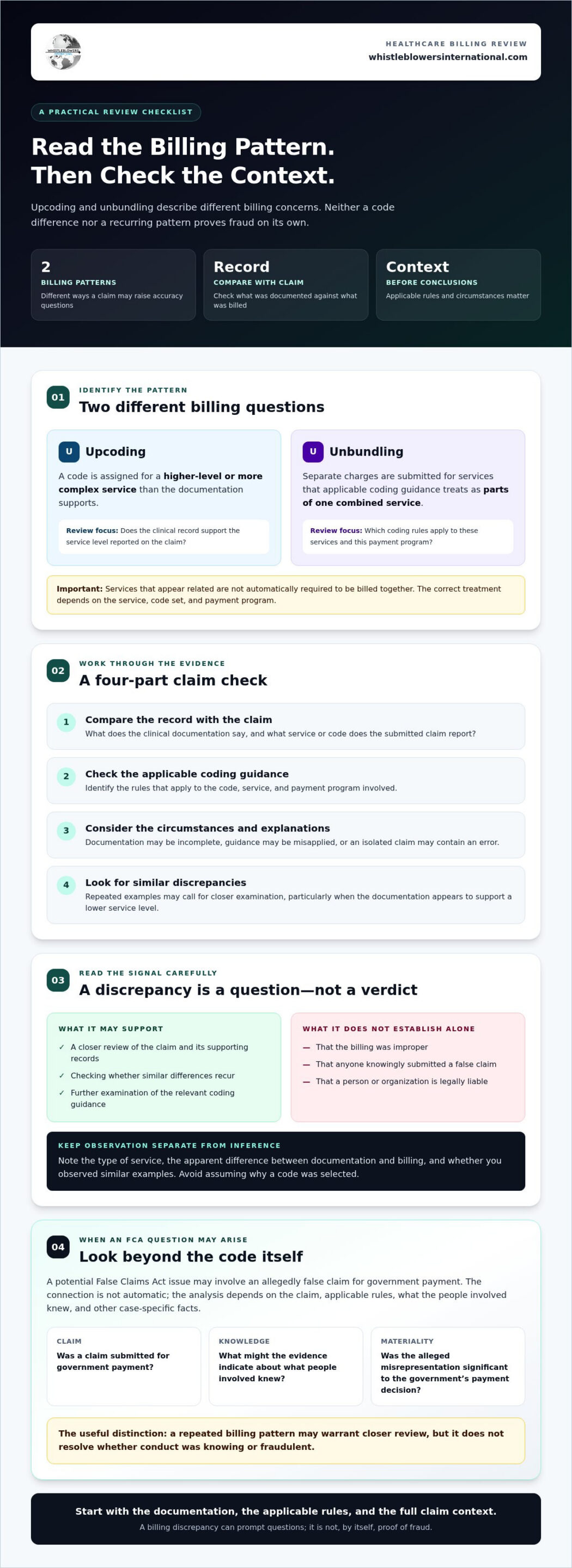
Upcoding and unbundling describe different ways a healthcare claim may report services in a way that raises questions about billing accuracy. Upcoding generally means assigning a code for a higher-level or more complex service than the documentation supports. Unbundling generally means billing separately for services that applicable coding rules treat as part of a combined service. Either pattern can warrant scrutiny, but a discrepancy alone doesn’t establish that anyone knowingly submitted a false claim or is legally liable.
Code selection depends on the service provided, the clinical record, and the rules that apply to the code and payment program. Documentation may be incomplete, coding guidance may be misapplied, or an isolated claim may contain an error. A useful review looks beyond an unexpected code: compare what the record says with what the claim reports, identify the coding guidance that may apply, and consider whether similar discrepancies recur. The broad Health care fraud overview also discusses upcoding and unbundling as billing practices.
How can upcoding appear in healthcare claims?
Consider a hypothetical outpatient visit documented as a brief, straightforward evaluation, while the submitted claim uses a code associated with a more extensive service. That difference may raise a question for review, but it doesn’t settle whether the code was improper. The complete note, circumstances of the visit, and applicable coding criteria all matter.
A single mismatch could reflect a mistake or another explanation. Repeated claims with similar discrepancies may call for closer examination, particularly if the documentation consistently appears to support a lower service level. Repetition is a reason to look carefully, not proof of intent or fraud. A qualified review compares claims with supporting records, checks the relevant coding guidance, and considers possible explanations before reaching a conclusion.
When might separate billing suggest unbundling?
Unbundling may be a concern when a provider submits separate charges for services that the applicable coding guidance treats as components of one combined service. The correct treatment can depend on the service, code set, and payment program, so two services that appear related aren’t automatically required to be billed together.
Claim-level details matter: which services were performed, how they were documented, and which rules applied to the claim. A recurring pattern of separate charges may justify further review, but it doesn’t establish by itself that the billing was improper or knowing. An upcoding and unbundling fraud attorney evaluating a potential False Claims Act matter will need to assess the surrounding facts and records, rather than treating a code difference as a legal conclusion.
For someone who has noticed irregularities, distinguish what you observed from what you infer. Note the type of service, the apparent difference between the documentation and billing, and whether you saw similar examples. Avoid assuming why the code was selected. The next step is to assess the claim context and applicable guidance, which can help separate ordinary billing questions from concerns that may warrant a broader legal review.
How Upcoding and Unbundling Allegations May Connect to the False Claims Act
A coding concern may raise a False Claims Act (FCA) question if it involves a claim for government payment that was allegedly false. The connection isn’t automatic: an inaccurate code or billing disagreement alone doesn’t establish FCA liability. The analysis depends on the claim, the applicable rules, what the people involved knew, and other facts specific to the situation. The U.S. Department of Justice’s overview of The False Claims Act explains the statute’s role in addressing claims for government funds.
The FCA’s whistleblower process is one route for raising certain allegations on the government’s behalf. Whether suspected healthcare billing conduct fits that process depends on the claims, the supporting information, and the legal requirements. Applying the law to particular claims requires careful, fact-specific analysis.
What must an attorney examine beyond the code itself?
An attorney evaluating a potential claim looks beyond the code on a bill. The review may compare it with clinical documentation, applicable coding guidance, the circumstances of submission, and any explanations for the billing decision. A key question is whether the evidence may indicate knowing conduct or instead an inadvertent, isolated mistake. Repeated billing patterns may be relevant, but they don’t resolve that question by themselves.
Other legal issues matter, too. For example, materiality asks whether an alleged misrepresentation was significant to the government’s payment decision. That inquiry, along with questions about knowledge and the claim’s factual basis, depends on current law and the specific evidence. An upcoding and unbundling fraud attorney should be able to explain what is known, what remains uncertain, and why each fact may matter, without promising a particular legal outcome.
How does a qui tam case differ from an internal billing concern?
An internal billing concern may be raised through an organization’s compliance process. A qui tam action is a civil case brought by a private person, known as a relator, on behalf of the government under the FCA. The government may evaluate the allegations and decide how to proceed; the relator’s role doesn’t mean the government has confirmed wrongdoing.
Qui tam filing procedures include specific requirements, and some case information may be subject to confidentiality rules during the process. Timing and handling matter, so a person considering a filing shouldn’t assume that an internal report, public disclosure, or informal communication has the same legal effect as a properly prepared case. These civil whistleblower matters are distinct from criminal proceedings, though separate proceedings may arise from the same underlying conduct. An ordinary billing dispute, meanwhile, doesn’t become a fraud case simply because parties disagree about a code.
If you’re weighing whether a pattern warrants legal review, a careful discussion with counsel can help distinguish the concern from the evidence needed to assess it. Piacentile & Associates LLP represents whistleblowers in federal False Claims Act matters. Learn more about False Claims Act whistleblower representation.
How to Compare an Upcoding and Unbundling Fraud Attorney
Choosing counsel for a potential whistleblower matter is not just a matter of comparing headline results. You don’t need to prove an entire case before seeking legal review. An initial assessment can help identify what the available information supports, what remains uncertain, and what further investigation may be appropriate. Use the table below to compare an upcoding and unbundling fraud attorney on practical points.
| Factor | What to look for |
|---|---|
| FCA and whistleblower experience | Experience representing whistleblowers in False Claims Act matters, including familiarity with the distinct demands of a qui tam case. |
| Healthcare billing familiarity | A method for examining coding guidance, claim patterns, clinical documentation, and the context of claim submission. |
| Investigative approach | A clear explanation of how counsel assesses available evidence, identifies gaps, and considers potential investigative avenues. |
| Communication and privacy | Plain-language explanations of uncertainty, practical expectations for updates, and a careful discussion of sensitive information. |
Which experience is relevant to coding-fraud allegations?
Prioritize demonstrated False Claims Act and whistleblower representation, then consider how counsel would analyze the billing concern itself. A useful discussion should connect the coding rules and records to the alleged claims, rather than treating an unusual billing pattern as proof. Counsel should explain investigative steps and legal uncertainty in language you can follow, including what additional facts could change the assessment.
Ask how the firm handles potential conflicts, who will communicate with you, how updates are generally provided, and how decisions about the matter are made. These questions help clarify the working relationship without requiring you to draw legal conclusions or assemble every piece of evidence first.
How should you assess communication, privacy, and fees?
Before sharing sensitive details or records, ask how prospective information is handled and what communication methods are appropriate. Don’t assume that anonymity or complete confidentiality is guaranteed. A careful conversation should explain the limits that may apply and how the matter would be handled during representation.
Discuss the contingency arrangement in writing: what the agreement says about the firm’s fee, what circumstances trigger payment, and how a recovery or award is handled if the case succeeds. Piacentile & Associates LLP represents whistleblowers in federal False Claims Act matters on a contingency basis, receiving a portion of a monetary recovery or award only if successful. The written agreement sets out the specific terms.
Clear, measured answers are more useful than promises of a particular result. To prepare for a review, note what you observed, what records you lawfully possess, and what questions remain. You can learn about whistleblower representation at Piacentile & Associates LLP.
Preparing for an Attorney Review Without Creating New Risks
You don’t need to arrive with a complete case file or a legal conclusion. A concise, factual account can help counsel understand what you observed and identify what may need further assessment. Keep preparation focused on information you already know and materials you’re authorized to possess.
What information can help counsel understand the concern?
Before speaking with an upcoding and unbundling fraud attorney, organize your account into firsthand observations, available records, and open questions. Separate what you personally saw from what someone else told you or what you suspect. That distinction helps counsel assess the information without mistaking an inference for a confirmed fact.
- Summarize your role. Note your position, responsibilities, and how your work brought you into contact with the billing or documentation at issue.
- Set out the timeline. Record when you noticed the concern, whether it appeared more than once, and any relevant conversations or changes you observed.
- Describe the pattern. Identify the type of service, billing practice, or claim feature that raised questions. Avoid deciding whether it violated a rule.
- List potential supporting information. Describe records or systems by type, and identify people who may have relevant firsthand knowledge. Don’t casually send patient information or sensitive files.
- Write down what you need to understand. Include questions about coding policies, payer programs, claim context, and what further information may help evaluate the concern.
Keep notes factual and contemporaneous where possible. If a detail is uncertain, label it as uncertain rather than filling in gaps. Preserve any materials you lawfully possess in their original form, and make clear which information came from your own observations.
What should a potential whistleblower avoid doing?
Preparation should not create a new access, privacy, or workplace concern. Don’t enter restricted systems, retrieve records outside your authorization, or ask someone else to obtain materials improperly. Avoid altering, deleting, forwarding, or publicly disclosing potentially sensitive information, including patient records. If relevant material is held by your employer, describe it to counsel rather than removing it without authorization.
Reporting obligations and rules concerning workplace information, patient privacy, and record handling can depend on the facts and applicable law. Don’t assume that a particular disclosure is permitted, that an internal report preserves your legal options, or that raising a concern will prevent retaliation. These are issues for careful, case-specific discussion with counsel. If you’re unsure whether a document can be shared, pause before sending it and explain the concern without attaching the file.
A measured first conversation can begin with a simple account of what you observed, when it happened, and what information may exist. Discuss your whistleblower concerns with Piacentile & Associates LLP, which represents individuals in federal False Claims Act matters and develops cases with careful attention to privacy.
What to Expect When Piacentile & Associates LLP Reviews a Potential Case
Piacentile & Associates LLP represents whistleblowers in federal False Claims Act matters, including concerns involving healthcare billing. A potential case review assesses what the available information may show, what legal questions arise, and whether further investigation could help clarify the matter. It isn’t a finding that fraud occurred or a promise that a claim will proceed.
How can counsel assess a suspected coding scheme?
Case development begins with the reported concern and the information available to evaluate it. Counsel may consider the billing pattern, relevant claims and supporting documentation, the coding rules that may apply, and whether the claims involved a government payment program. The review may also consider how the concern came to light and what the person knows firsthand.
Investigative techniques can help develop a whistleblower matter, but they don’t replace careful legal analysis. Counsel may identify gaps, unanswered questions, or potential investigative avenues before assessing possible next steps. One coding discrepancy doesn’t automatically support a viable case; the significance of a pattern depends on the facts, evidence, and applicable law.
For someone considering an upcoding and unbundling fraud attorney, a useful review should distinguish established information from assumptions. You can describe what you observed and what records may exist without arriving with a complete case file. If information is sensitive, discuss how to handle it before sending or sharing documents. Privacy is an important consideration, but no review should be understood as a guarantee of anonymity or absolute confidentiality.
What should you understand about representation and fees?
If representation proceeds, the written fee agreement governs the relationship and explains its terms. Piacentile & Associates LLP works on a contingency basis, receiving a portion of a monetary recovery or award only if successful. Read the agreement carefully to understand how the arrangement applies to your matter. A contingency arrangement doesn’t guarantee that a case will be accepted, that a recovery will occur, or that a whistleblower award will be available.
Before deciding on next steps, raise practical questions about the proposed representation, communication, privacy, and what additional information may be needed. A careful discussion can clarify what is known, what remains uncertain, and how the firm would approach developing the matter without treating a suspected billing irregularity as a proven violation.
If you’ve observed billing practices that concern you, discuss a potential whistleblower matter with Piacentile & Associates LLP. A measured account of what you know can help counsel assess the information and explain potential next steps without presuming eligibility or a particular outcome.
Take a Careful Next Step
You don’t have to resolve every uncertainty before asking whether a billing concern merits legal review. A focused conversation can help you identify what you know, what remains unclear, and how to avoid unnecessary risks as you consider your options. The right upcoding and unbundling fraud attorney should take those questions seriously without treating suspicion as proof or promising a particular result.
Piacentile & Associates LLP is led by Dr. Joseph Piacentile, Esq., a former whistleblower and attorney. The firm represents whistleblowers in federal matters and uses investigative techniques, with careful attention to client privacy. Any decision about representation or next steps depends on the facts and applicable law.
To discuss what you’ve observed, contact Piacentile & Associates LLP about a potential whistleblower matter. A measured first step can help you understand your options and move forward thoughtfully.
Frequently Asked Questions
What is the difference between upcoding and unbundling?
Upcoding concerns the level or complexity represented by a billed code; unbundling concerns how related services are billed separately. For example, a claim might use a higher-level service code than the visit documentation supports, or list components separately where applicable guidance treats them as one service. The comparison depends on the actual records and coding rules. A mismatch can warrant questions, but it doesn’t by itself establish fraud.
Can upcoding or unbundling lead to a False Claims Act case?
Yes, alleged upcoding or unbundling may raise False Claims Act issues if false claims were submitted for government payment and the legal requirements are met. The analysis isn’t based on a coding discrepancy alone. It can involve what was billed, the supporting documentation, the rules in effect, what relevant parties knew, and whether the alleged misrepresentation mattered to payment. An attorney can assess how those facts fit current law.
How can an attorney tell whether a coding issue was intentional?
An attorney assesses the available evidence and context; intent can’t be reliably determined from a code alone. Relevant information may include whether similar claims recur, how billing practices were explained internally, and whether concerns were raised or corrected. Documentation may also provide context for a coding choice. These facts can support different interpretations, so a review should distinguish evidence from inference rather than assume that a repeated error proves knowing misconduct.
Do I need proof of every false claim before speaking with an attorney?
No. You can seek an initial review based on what you personally observed, even if you don’t know how many claims may be involved. Be ready to describe your role, the general billing practice that concerned you, and how you learned about it. Don’t try to fill gaps by accessing records outside your authorization. An attorney can help assess what you know and what information may be needed next.
Can I report suspected healthcare billing fraud without disclosing patient information publicly?
Don’t post patient-identifying details or sensitive records publicly. A potential whistleblower matter may involve information shared through legal processes rather than public disclosure, but the handling of patient information depends on the facts and applicable rules. Before sending records, describe what they contain and ask how to handle them appropriately. No reporting process should be assumed to guarantee anonymity or prevent sensitive information from being disclosed where required.
How much does an upcoding and unbundling fraud attorney cost?
Piacentile & Associates LLP represents whistleblowers on a contingency fee basis. The firm receives a portion of a monetary recovery or award only if successful; the specific terms are governed by the written fee agreement. Review that agreement to understand when payment is owed and how the arrangement applies. Contingency representation doesn’t guarantee that a case will be accepted or that it will result in a recovery.
Can a whistleblower face retaliation for reporting suspected healthcare fraud?
Workplace retaliation is a concern worth discussing before taking action, but the risk and any available legal protections depend on the circumstances and applicable law. Keep a factual record of relevant events, such as dates and communications, without removing confidential workplace information or accessing restricted systems. An attorney can discuss reporting options and how the facts may affect your situation. No one should assume that reporting guarantees protection from adverse treatment.