

Being first to report suspected fraud is not always the test. What is original source information for a whistleblower? It is information based on the whistleblower’s independent knowledge or analysis that the relevant agency does not already know, subject to program-specific rules and exclusions. The SEC and CFTC apply different criteria, so they may assess the same information differently.
It may seem that information discussed publicly or reported to an agency by someone else can no longer matter. But new, undisclosed details about previously reported events may still be relevant. CFTC rules recognize that information first disclosed by a whistleblower may remain original even if another source discloses it later. Key questions include where the information came from, what the agency already knew, and whether the whistleblower contributed genuinely independent information.
This article explains independent knowledge and analysis, why prior agency knowledge matters, and how SEC and CFTC rules treat original information. It also clarifies why being the first to report is not always the same as qualifying as an original source, and how that distinction can affect a whistleblower submission.
Key Takeaways
- Separate firsthand knowledge from analysis that adds genuinely new insight to public material; merely pointing investigators to public information may not be enough.
- Assess whether the agency already knows the information and whether your submission contributes distinct facts rather than repeating an existing report.
- Compare the SEC’s and CFTC’s separate rules, including exclusions that may affect whether information qualifies as original.
- Understand why information first disclosed to an agency may remain original even if another source reports it later.
- Distinguish original-source status from simply being the first person to report suspected fraud.
Independent knowledge and analysis
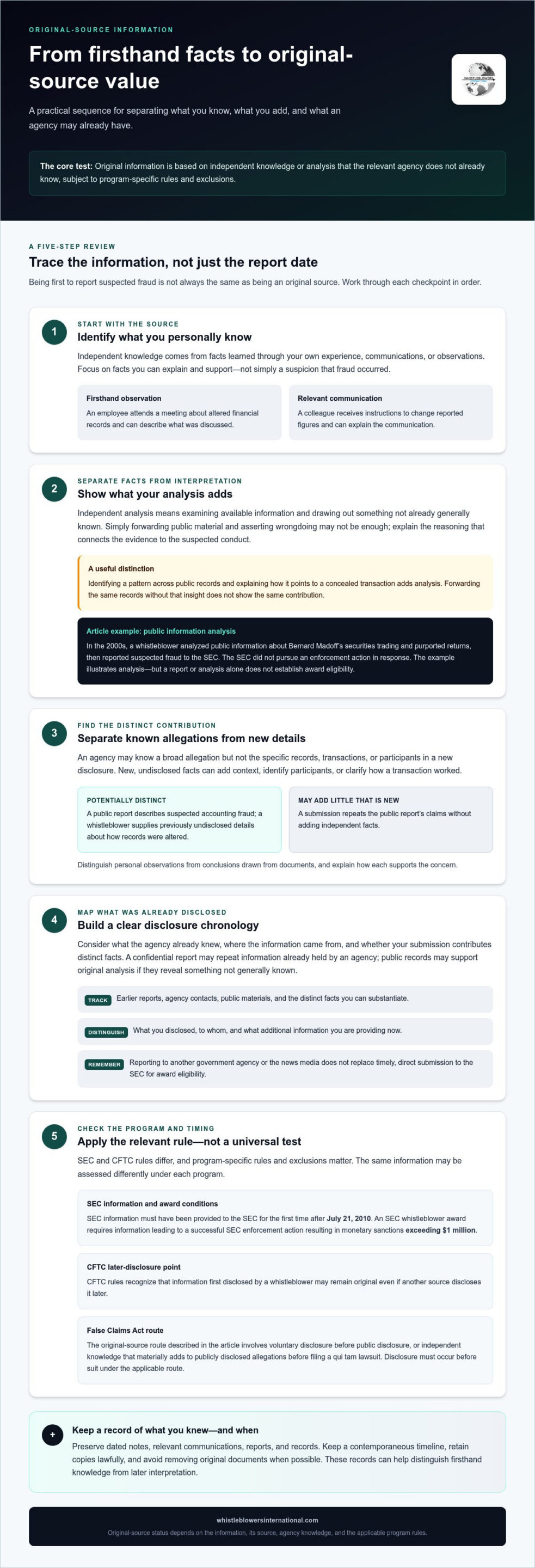
For a whistleblower, independent knowledge comes from facts personally learned through experience, communications, or observations. An employee who attends a meeting about altered financial records, for example, may have firsthand knowledge of what was discussed. A colleague instructed to change reported figures may have relevant communications. The value lies in facts the person can explain and support, not simply a suspicion that fraud occurred.
Independent analysis is different: it involves examining available information and drawing out something that was not already generally known. In the 2000s, a whistleblower analyzed publicly available information about Bernard Madoff’s securities trading and purported returns, then reported suspected fraud to the SEC. The SEC did not pursue an enforcement action in response to that report. The example illustrates what independent analysis can involve, but also why an analysis or report alone does not establish eligibility for an award.
Simply directing government investigators to public material is not, by itself, independent analysis. A person must contribute insight that reveals something beyond the material’s obvious contents. For example, identifying a pattern across public records and explaining how it points to a concealed transaction differs from forwarding the records and asserting that they suggest wrongdoing. Investigators assess the reasoning that connects the records to the suspected conduct.
Information may still be useful even if an event has appeared in public reports. New, undisclosed facts can add context, identify participants, or clarify how a transaction worked. A whistleblower should distinguish personal observations from conclusions drawn from documents and explain how each supports the concern. Under the False Claims Act, an original source may voluntarily disclose information before public disclosure or provide independent knowledge that materially adds to publicly disclosed allegations before filing a qui tam lawsuit.
There is no single deadline for every U.S. whistleblower claim: SEC information must have been provided to the SEC for the first time after July 21, 2010, while False Claims Act disclosure must occur before suit under the applicable original-source route. According to the U.S. Securities and Exchange Commission, an SEC whistleblower award requires information leading to a successful SEC enforcement action resulting in monetary sanctions exceeding $1 million.
Preserve dated notes, relevant communications, reports, and records showing what you observed and when. Keep a contemporaneous timeline, retain copies lawfully, and avoid removing original documents when possible. These steps help distinguish firsthand knowledge from later interpretation.
Information already known to an agency
An agency’s existing files can affect whether a whistleblower’s submission qualifies as original information. Under the SEC framework, information generally must not already be known to the SEC from another source, unless the whistleblower is its original source. The agency may know a broad allegation but lack specific records, transactions, or participants identified in a new disclosure. The submission’s content and source matter, not just its date.
Understanding what is original source information for a whistleblower means looking beyond whether investigators have heard of the alleged conduct. Consider a public report describing suspected accounting fraud at a company. The SEC may know the general allegation, while a whistleblower supplies previously undisclosed details about how records were altered. Those details may add information beyond the report. Repeating its claims without independent facts may contribute little that is new.
Prior disclosure to another recipient raises a separate question. Providing information to another government agency or the news media does not replace timely, direct submission to the SEC for award eligibility. If you reported concerns elsewhere, distinguish what you disclosed, to whom, and what additional information you are now providing. That chronology can help establish whether the agency received the relevant material from you or another source.
Public disclosure can also affect a False Claims Act case. The public disclosure bar generally limits suits based on publicly available allegations, including disclosures through congressional hearings, federal proceedings, media reports, or other public channels. The original-source exception may apply if the relator voluntarily disclosed relevant information to the government before public disclosure, or independently adds materially to public allegations before filing suit. The applicable jurisdiction and the relationship between new facts and earlier disclosures matter.
Determining what is original source information for a whistleblower also means examining the information’s source, not just whether it is confidential. A confidential report may repeat information already held by an agency. Public records may support original analysis if they reveal something not generally known. Create a chronology of earlier reports, agency contacts, public materials, and distinct facts you can substantiate.
An attorney experienced in whistleblower matters can help assess how prior agency knowledge affects a submission. The review can also identify privileged communications or information learned through legal representation that program rules may exclude. Preserve original records and note when each item was obtained. This helps clarify the information’s source and sequence for the agency’s assessment.
An attorney experienced in whistleblower matters can help assess whether material reflects independent knowledge or analysis. The SEC defines original information as information derived from independent knowledge, meaning facts known to the person that are not derived from publicly available sources, or from independent analysis that reveals information not generally known and not already known by the SEC. SEC regulations define independent analysis as examining publicly available data or materials to reveal information not already in the public domain.
For original-source status under the U.S. False Claims Act, disclosure must go to an appropriately responsible government official or agency. Disclosure to a state or local official or agency is insufficient.
SEC definition of original information
The SEC defines original information under 17 C.F.R. § 240.21F-4(b). It must come from a whistleblower’s independent knowledge or independent analysis, and it must not already be known to the SEC from another source. The definition focuses on how the information was obtained and what it adds. An allegation’s seriousness alone does not make it original.
Independent knowledge means facts a person knows through experience, communications, or observations, rather than facts derived from public sources. For example, an employee who personally observed a supervisor instruct staff to alter a report may provide firsthand information. Independent analysis means examining public data or materials to reveal information not generally known. Merely sending the SEC a public filing and asserting that it indicates fraud is not enough.
The distinction matters when events have already appeared in news reports or public records. A submission may still contain original information if it adds undisclosed facts, such as transaction details or communications explaining how the conduct occurred. The SEC considers whether those facts came from the whistleblower’s independent work and whether the agency already knew them. Information exclusively derived from a judicial or administrative hearing, a government report, or news media is excluded.
SEC rules also identify exclusions tied to privilege and certain company roles. Attorney-client privileged information does not qualify as original information. Rule 21F-4(b)(4) also addresses information learned from another person or through an entity’s internal reporting systems in certain company roles. A person should therefore distinguish direct observations from information received through internal channels, and separate both from privileged communications.
Submission mechanics are part of the analysis. For SEC whistleblower purposes, information must have been provided to the SEC for the first time after July 21, 2010. Under Rule 21F-9, a whistleblower submits information on Form TCR or through the SEC’s online TCR portal, with the submission declared under penalty of perjury. Reporting the matter to another agency or the news media does not replace timely direct submission to the SEC.
Before submitting, organize your account around the information’s source, substance, and sequence. Identify which facts you personally observed, which resulted from analysis, and which came from public materials or other people. Attach relevant records that support your explanation, and state what each record demonstrates. This helps the SEC assess whether the information is independent, new to the agency, and capable of supporting an enforcement result.
CFTC original-source criteria
The CFTC defines original information under 17 C.F.R. § 165.2. A central question is whether the information came from the whistleblower or had already been received from someone else. If another source first provided the same information, it generally isn’t original to a later whistleblower unless that person can show they were the original source. The sequence of disclosure matters.
That sequence also explains why a later public report does not automatically erase an earlier whistleblower’s contribution. Information first disclosed by a whistleblower may qualify as original even if another source discloses it later. For example, if a person gives the CFTC specific facts about a trading practice before those facts appear in public materials, later publication does not change who disclosed them first.
The practical inquiry is more precise than asking whether anyone has discussed the suspected violation. Identify what the CFTC received, when it received it, and from whom. Then compare that record with the proposed submission. A report about the same market or company may differ materially from a disclosure supplying distinct facts about particular conduct. Both the source and content matter.
A useful review separates information into three categories: facts personally observed, facts received from another person, and facts obtained from public materials. For each item, record its source and when you learned it. If someone else provided a detail, explain whether you independently developed or first disclosed that information. This creates a clearer account of how the submission relates to prior reports or an ongoing CFTC investigation.
The CFTC also excludes attorney-client privileged communications and information obtained through legal representation from independent knowledge. Before disclosure, distinguish those materials from ordinary business records or personal observations. Mixing privileged communications into a submission can complicate the assessment of what the whistleblower independently knew.
Do original-source rules differ under SEC, IRS, or state whistleblower programs? Yes. The SEC and CFTC have separate federal definitions, the IRS may reduce an award percentage for claims based on public-source information, and state programs have their own rules. The applicable program depends on the suspected violation and the government agency with authority over it.
What percentage of a whistleblower reward can an original source receive? There is no single percentage across the CFTC, SEC, IRS, and state programs; each has its own award rules. The program, the information’s contribution, and the enforcement outcome shape the award assessment.
How is an original source different from the first person to report fraud?
Being first to raise an alarm and qualifying as an original source are related, but they are not identical. Timing matters, yet the relevant program also examines where the information came from, whether the agency already knew it, and what distinct facts the person contributed. Someone may be first to make a general allegation without providing original information. Another person may contribute new facts after an earlier report.
For SEC purposes, information submitted to the government through another whistleblower or made public through media reporting will generally not qualify as original information for a later SEC whistleblower. But new, undisclosed information about previously reported events may still qualify. For example, a news story may describe suspected misconduct, while a later submission supplies firsthand communications or transaction details the story did not report. What matters is the new information, not merely who speaks next.
The False Claims Act applies a related but distinct test when fraud allegations have already become public. Under 31 U.S.C. § 3730(e)(4)(A), a relator generally cannot bring a qui tam lawsuit based on certain public disclosures unless the original-source exception applies. Under 31 U.S.C. § 3730(e)(4)(B), a person may qualify by voluntarily disclosing information to the government before public disclosure, or by providing independent knowledge that materially adds to public allegations before filing suit.
“Materially adds” means more than repeating an existing account. The Third Circuit Court of Appeals explained that a contribution must provide distinct information that significantly adds to the essential factual background. The facts and the applicable court’s interpretation matter.
Consider a public account alleging that a contractor billed the government for work it never performed. A person who repeats that allegation may add nothing. Someone with distinct records, observations, or information about an essential part of the alleged scheme may contribute facts that change the picture. The relator must disclose relevant information in their possession before filing suit, and the disclosure must support an allegation of fraud, not mere suspicion.
To evaluate the difference, compare the earlier report or public disclosure with the proposed submission. Identify each fact that was already public, each fact the agency may have received from another source, and each distinct fact you can support. That comparison helps clarify whether the contribution is simply earlier, or genuinely original. An attorney experienced in whistleblower matters can help assess that distinction; review your whistleblower information before deciding how to proceed.
Piacentile & Associates LLP: SEC Whistleblower Program Filings
Piacentile & Associates LLP prepares SEC Whistleblower Program Filings for people assessing whether their information may support an SEC submission. This can be a useful next step if you have firsthand facts or independent analysis and need to distinguish them from public reports, prior agency knowledge, or excluded material.
The review can focus on how you obtained the information, what it adds, and how to organize it for filing. If the suspected misconduct falls under another program, the firm also handles IRS Whistleblower Program Filings, FinCEN Whistleblower Filings, and CFTC Whistleblower Program Filings. The relevant program depends on the conduct and the agency with authority to address it.
To discuss a potential whistleblower filing, contact Piacentile & Associates LLP.
Make Your Next Move With a Clear Record
The next step is to decide how to present your information, not simply whether it feels important. Understanding what original source information for a whistleblower means can help frame that decision, but the submission must also fit the relevant program’s rules. A careful assessment can clarify which facts are firsthand, what was learned elsewhere, and how the information may support an agency’s review.
Piacentile & Associates LLP handles False Claims Act / Qui Tam Lawsuits, SEC Whistleblower Program Filings, and IRS Whistleblower Program Filings. If your information concerns securities, tax matters, or fraud against the government, the firm can help you consider the appropriate filing path. Organizing a clear chronology and records supporting your account can make an initial discussion more focused.
For a considered next step, contact Piacentile & Associates LLP to discuss your potential whistleblower matter. A well-prepared account can help you move forward with greater clarity.
Frequently Asked Questions
What does “original source” mean in whistleblower cases?
An original source contributes information that meets the requirements of the applicable whistleblower program, rather than merely being first to make a report. For example, under the False Claims Act, a person may qualify by voluntarily disclosing information before public disclosure or by materially adding independent knowledge before filing suit, as described in 31 U.S.C. § 3730(e)(4)(B). SEC and CFTC rules use their own definitions, so the governing program matters.
What information must a whistleblower provide to qualify as an original source?
The submission should explain the suspected conduct with specific facts and show how the whistleblower obtained them. Under the False Claims Act, a relator must disclose the facts and circumstances underlying the allegations or transactions, and the disclosure must support fraud rather than suspicion alone. For an SEC submission, distinguish personal knowledge or analysis from public material and identify what is new to the agency. Supporting records can make those distinctions clear.
What does independent knowledge mean for a whistleblower?
Independent knowledge means facts a person learned through their own experiences, communications, or observations, rather than from publicly available sources. For example, an employee who personally hears a manager instruct staff to misstate a transaction has direct information about that instruction. Someone who only reads a news report about the same conduct has information from a public source. Keeping these origins distinct helps explain the basis for a disclosure.