
U.S. citizenship is not a prerequisite for reporting certain misconduct to U.S. authorities. A non-U.S. citizen can be a whistleblower and may qualify for an award under programs such as those of the SEC, CFTC, IRS, and the False Claims Act, provided the report meets the program’s requirements and has the necessary connection to the United States.
It’s reasonable to wonder whether a report made from abroad can lead to a U.S. award or expose your identity. In general, eligibility depends less on where you live or what passport you hold than on what the information reveals and whether it falls within a U.S. program’s scope.
This article explains which programs may accept reports from international whistleblowers, how U.S. jurisdiction and award eligibility may apply, and what confidentiality protections could matter. It also outlines how potential awards are determined, helping you understand the legal and practical considerations before deciding what to do with information about suspected fraud or misconduct.
Key Takeaways
- Citizenship and residence don’t automatically bar a claim; the alleged misconduct must fit a U.S. program’s rules and jurisdiction.
- Identify which program matches the information, such as securities, tax, government-contract, or financial-crime reporting.
- Reward eligibility and amount depend on the information’s contribution and the government’s qualifying recovery.
- Confidentiality options vary by program; understand the role of legal counsel before submitting information anonymously.
Eligibility of non-U.S. citizens for U.S. whistleblower programs
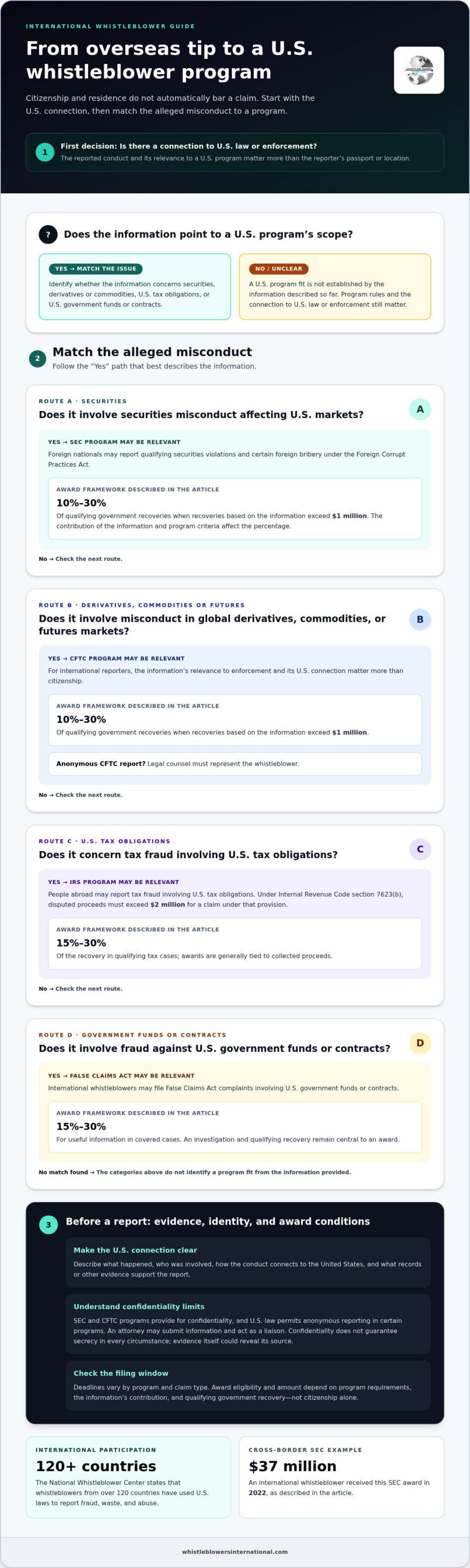
U.S. citizenship or residence is not generally required to participate in the SEC, CFTC, IRS, or False Claims Act whistleblower programs. Eligibility depends on the reported wrongdoing and its connection to U.S. law or enforcement.
SEC and CFTC Program Rules
The Dodd-Frank Act created the SEC and CFTC whistleblower programs, and it was signed on July 21, 2010. Foreign nationals may report qualifying misconduct, including securities violations affecting U.S. markets and bribery of foreign officials under the Foreign Corrupt Practices Act. The CFTC program covers misconduct involving global derivatives, commodities, and futures markets. For international reporters, the U.S. connection and the information’s relevance to enforcement matter more than citizenship.
IRS Whistleblower Program Eligibility
The IRS program allows people abroad to report tax fraud involving U.S. tax obligations. Under Internal Revenue Code section 7623(b), disputed proceeds must exceed $2,000,000 for a claim under that provision; qualifying cases may produce an award based on collected proceeds. Are whistleblower awards taxable for non-U.S. citizens, and how are they paid? Tax treatment depends on applicable U.S. and home-country rules, while payment follows the relevant program’s award process. Citizenship alone doesn’t determine tax treatment or payment eligibility.
Submitting Tips From Abroad
A non-U.S. citizen can submit a U.S. whistleblower tip from abroad by reporting relevant information to the agency or program that covers the suspected violation. Describe the conduct, its U.S. connection, and the records or other evidence supporting your report. For an anonymous CFTC report, legal counsel must represent the whistleblower.
International eligibility extends beyond agency tips: non-U.S. citizens may also file False Claims Act complaints involving U.S. government funds or contracts. The National Whistleblower Center states that whistleblowers from over 120 countries have used U.S. laws to report fraud, waste, and abuse. That global participation does not remove program-specific requirements; the facts must still fall within the law and support an investigation or recovery.
Can International Whistleblowers Claim US Rewards?
Yes. An international whistleblower may receive a U.S. award if the information supports a qualifying enforcement action and the misconduct falls within the program’s jurisdiction. Citizenship does not determine the award; the usefulness of the information and the government’s collected proceeds are key factors.
For SEC and CFTC claims, the U.S. Securities and Exchange Commission and U.S. Commodity Futures Trading Commission provide rewards of 10 percent to 30 percent of qualifying government recoveries when recoveries based on the whistleblower’s information exceed $1 million. The percentage reflects program criteria and the contribution of the information to successful enforcement, not the whistleblower’s nationality.
International examples show how awards can follow cross-border investigations. For instance, a foreign citizen who exposed illicit financial activities involving UBS and other institutions helped prompt major enforcement actions, and an international whistleblower received a $37 million SEC award in 2022. These outcomes demonstrate that evidence originating abroad can help expose violations involving U.S. taxpayers, investors, or markets.
The IRS program generally ties awards to collected proceeds in qualifying tax cases. Under Internal Revenue Code section 7623, awards may range from 15% to 30% of the recovery. The False Claims Act also allows international whistleblowers to report fraud involving U.S. government funds or contracts, with awards of 15% to 30% for useful information in covered cases. Neither range means every report produces an award; the investigation and recovery are central.
Deadlines vary by program and claim type, so identify the relevant filing window before submitting a U.S. whistleblower claim. Provide specific facts and supporting material, such as records showing who was involved, what happened, and how the conduct connects to the United States.
Organizing evidence around the alleged violation, relevant officials, and U.S. connection can make a submission clearer. For guidance on evaluating international reward claims, consider international whistleblower claim support.
Confidentiality and protecting a whistleblower’s identity
Confidentiality can help limit exposure, but it is different from protection against retaliation. For an international whistleblower, the reporting program, employer, and applicable jurisdiction all affect which safeguards apply.
Identity Confidentiality
The SEC and CFTC whistleblower programs provide for confidentiality, and U.S. law permits anonymous reporting in certain programs. An attorney can submit information and act as a formal liaison with federal agencies, helping limit direct disclosure of your identity. For anonymous CFTC reports, legal counsel must represent the whistleblower. Confidentiality does not guarantee secrecy in every circumstance, so consider whether the evidence itself could reveal its source.
Protected Disclosures
A protected disclosure is information shared through an authorized channel about conduct covered by a specific whistleblower protection. For HHS employees, the Whistleblower Protection Act and Presidential Policy Directive 19 address retaliation for protected disclosures; classified information or information specifically barred from release has separate limits. Under 41 U.S.C. § 4712, employees of federal contractors, subcontractors, grantees, and subgrantees may have protection for specified disclosures concerning federal funds, contracts, or public health and safety.
Risks for Foreign Nationals
Before reporting a U.S. company, foreign nationals should consider employment, confidentiality, and personal-safety risks. Assess whether local employment rules apply, whether documents contain restricted information, and whether workplace or personal relationships could reveal the source. U.S. protections may not cover someone whose employer falls outside their legal scope.
Public Health Service Commissioned Corps members have a separate safeguard: the Military Whistleblower Protection Act, 10 U.S.C. § 1034, protects members from retaliation for protected communications. Commissioned Corps Directive 121.06 identifies procedures for designated recipients. These rules do not create universal protection for every international reporter; the person’s role and the disclosure’s recipient matter. Before sharing records, preserve their context and avoid distributing confidential material beyond authorized channels.
Can non-US citizens receive SEC whistleblower awards, and what are the eligibility rules?
Yes. A non-U.S. citizen may receive an SEC whistleblower award if the reported securities misconduct falls within the program and the information contributes to qualifying enforcement. The U.S. connection is central, such as a violation involving a company publicly traded in the United States or affecting U.S. investors. Where the whistleblower lives does not, by itself, rule out eligibility.
The reported conduct must give the Securities and Exchange Commission information it can use to investigate a violation. Cross-border bribery may also fall within the SEC program when it involves the Foreign Corrupt Practices Act, including bribery of foreign officials. For example, in 2014, a foreign national received $30 million for assistance in prosecuting a Foreign Corrupt Practices Act violation. The example shows how evidence about conduct abroad can support U.S. enforcement.
Award amounts depend on qualifying monetary sanctions and the information’s contribution. The U.S. Securities and Exchange Commission and U.S. Commodity Futures Trading Commission provide awards of 10 percent to 30 percent of qualifying government recoveries when recoveries based on the whistleblower’s information exceed $1 million. The percentage is not an automatic payment for submitting a tip; the case must produce a qualifying recovery.
International participation is established: since its whistleblower program began in 2011, the SEC has reported claims from whistleblowers in 130 countries outside the United States. In September 2018, it awarded $4 million to an international whistleblower. These examples illustrate that foreign residence does not itself bar an award.
Before submitting a claim, organize evidence by conduct, dates, people involved, and its connection to U.S. markets or investors. A clear account helps distinguish firsthand information from conclusions and shows how the details may assist an investigation. To assess a potential international SEC claim, discuss your SEC whistleblower claim.
Piacentile & Associates LLP: False Claims Act / Qui Tam Lawsuits
Piacentile & Associates LLP helps whistleblowers assess and pursue claims involving fraud against U.S. government programs. When evidence points to false claims involving federal funds or contracts, the firm handles False Claims Act / Qui Tam Lawsuits. It also assists with SEC, IRS, and FinCEN whistleblower filings when the reported conduct fits those programs.
Consider reaching out if you have firsthand information, records, or a clear account of suspected misconduct and want to understand which U.S. process may apply. Piacentile & Associates LLP works with individuals worldwide and represents whistleblowers on a contingency fee basis, receiving payment only if it wins a monetary award for the client.
To discuss information that may support a U.S. whistleblower claim, contact Piacentile & Associates LLP.
Choose a Deliberate Next Step
If you’re asking whether a non-U.S. citizen can be a whistleblower, start by preserving a clear, factual account of what you observed and how you obtained the information. Avoid circulating sensitive records unnecessarily, and separate what you know firsthand from what you suspect. The right reporting path depends on the conduct and the evidence available.
Piacentile & Associates LLP handles False Claims Act / Qui Tam Lawsuits, SEC Whistleblower Program Filings, and IRS Whistleblower Program Filings. If your information concerns government claims, securities misconduct, or tax violations, the firm can assess how the facts fit the relevant filing process and what protections may apply.
Taking time to organize your information can help you approach a consequential decision with greater clarity. Contact Piacentile & Associates LLP to discuss your potential whistleblower matter. A careful, informed next step can make a difficult process feel more manageable.
Piacentile & Associates LLP and Whistleblower Filings
Piacentile & Associates LLP handles False Claims Act / Qui Tam Lawsuits and filings under the SEC, IRS, FinCEN, and CFTC whistleblower programs. Non-U.S. citizens considering a report can contact the firm to discuss which path may fit their concerns.
The firm also handles import-export customs fraud legal actions. Contact Piacentile & Associates LLP to discuss reporting suspected fraud or obtaining legal assistance with a filing or lawsuit.
Frequently Asked Questions
What is a protected disclosure?
A protected disclosure is a report made through a legally recognized channel about information covered by a whistleblower protection. The rules depend on the program and the person’s role. For example, a federal contractor’s report about misuse of contract funds may be treated differently from a public employee’s report about agency conduct. The recipient, subject matter, and applicable protection all matter.
What is whistleblower retaliation?
Whistleblower retaliation is adverse treatment linked to a person’s protected report. In an employment setting, it may involve dismissal, demotion, threats, or another penalty affecting work. The key issue is the connection between the disclosure and the treatment, not simply whether workplace conflict followed. Keep a dated record of relevant communications and employment changes; these details can help establish what happened.
Can a non-US citizen file a whistleblower complaint in the United States?
Yes, a non-U.S. citizen can be a whistleblower and submit information or, where permitted, file a complaint under a U.S. program. The alleged conduct must fall within that program’s legal scope. For example, someone abroad may report securities misconduct affecting U.S. investors. The reporting route depends on the type of wrongdoing and whether the program accepts a tip, court complaint, or formal filing.
Which U.S. whistleblower programs accept claims from noncitizens?
Noncitizens may qualify under programs including those of the SEC, CFTC, IRS, and False Claims Act, subject to each program’s rules and the U.S. connection. The SEC addresses qualifying securities violations, while the CFTC focuses on covered derivatives, commodities, and futures misconduct. False Claims Act cases concern fraud involving U.S. government funds or contracts. FinCEN filings may apply to qualifying financial-crime information.
Can foreign nationals report fraud to the IRS whistleblower program and receive an award?
Yes. A foreign national may report suspected fraud involving U.S. tax obligations, and an award may be available if the statutory criteria are met and the IRS collects proceeds. For a claim under Internal Revenue Code section 7623(b), disputed proceeds must exceed $2,000,000. Useful information can include transaction records, account details, or documents explaining how the suspected tax fraud occurred.
Do immigration status or work authorization affect whistleblower protections in the U.S.?
Immigration status or work authorization does not, by itself, determine whether information qualifies for a federal whistleblower program. However, protection against workplace retaliation depends on the specific law, employer, person’s role, and disclosure. A foreign employee should distinguish a reward claim from an employment-protection claim: eligibility for one does not automatically establish coverage under the other. Past results do not guarantee future outcomes.