
A FinCEN whistleblower for AML violations may seek an award when information leads to a qualifying enforcement action. According to the Financial Crimes Enforcement Network, eligible whistleblowers may receive 10% to 30% of monetary sanctions collected in qualifying actions, where the recovery exceeds $1 million. The submission must give the government useful information about suspected violations.
Reporting possible money laundering or Bank Secrecy Act misconduct can raise serious questions about confidentiality, workplace risks, and whether an internal report affects eligibility. This article explains how FinCEN’s whistleblower program works, what information may support a tip, and how anonymity and award considerations apply. It also covers how legal representation can help prepare a submission and protect your interests throughout the process.
The practical point is that a strong report needs more than an allegation. Understanding the program’s scope, the evidence it may require, and the safeguards available can help you consider your options before taking action.
Key Takeaways
- Assess whether your information directly supports a potential AML or Bank Secrecy Act violation, and organize relevant evidence before reporting.
- Understand how the program’s covered laws and enforcement focus shape whether a tip may qualify for an award.
- Consider confidentiality and anti-retaliation protections when weighing whether and how to report suspected misconduct.
- Legal representation can help structure a submission, address reporting risks, and guide you through the whistleblower process.
How Do I Apply for a FinCEN Whistleblower Award?
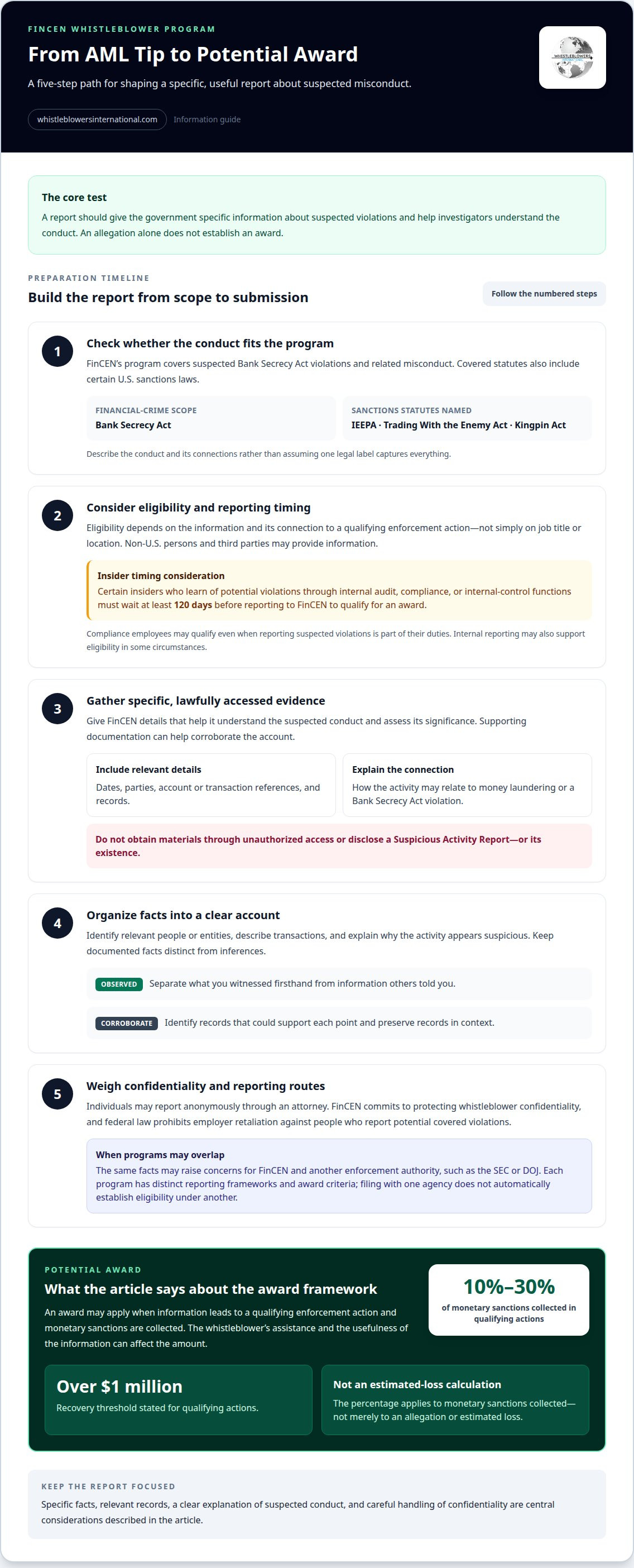
Submit specific information about suspected money laundering or other covered misconduct to FinCEN. According to the Financial Crimes Enforcement Network, rewards apply to fines or penalties recovered over $1 million, and eligible whistleblowers may receive 10% to 30% of monetary sanctions collected in qualifying enforcement actions.
Who May Qualify for an Award
Eligibility depends on the individual’s information and its connection to a qualifying enforcement action, not simply their job title or location. A non-U.S. person or third party may provide information; what matters is whether it identifies suspected violations and assists an investigation. A FinCEN whistleblower for AML violations should explain how their knowledge relates to the conduct.
Compliance employees may qualify even when reporting suspected violations is part of their duties. Certain insiders who learn of potential violations through internal audit, compliance, or internal-control functions must wait at least 120 days before reporting to FinCEN to qualify for an award. Reporting internally may also support eligibility in some circumstances.
Evidence of AML Violations
Useful evidence is specific information, lawfully accessed, that helps FinCEN understand suspected conduct and assess its significance. Include relevant dates, parties, account or transaction references, records, and a clear explanation of how the activity may relate to money laundering or a Bank Secrecy Act violation.
Separate what you observed firsthand from what others told you, and identify records that could corroborate each point. FinCEN encourages detailed supporting documentation. Don’t obtain materials through unauthorized access or disclose a Suspicious Activity Report or its existence.
A tip may support an award if it leads to an enforcement action. The whistleblower’s assistance, including how useful the information is to investigators, can affect the award amount. The percentage applies to monetary sanctions collected in qualifying actions, not merely to an allegation or estimated loss.
Before submitting, organize the facts into a clear account: identify relevant people or entities, describe transactions, and explain why the activity appears suspicious. A FinCEN whistleblower for AML violations can distinguish documented facts from inferences and preserve records in context. If seeking anonymity, submit through an attorney. This preparation gives FinCEN a clearer basis to assess the tip’s value.
FinCEN’s Bank Secrecy Act whistleblower program
FinCEN’s program covers information about suspected Bank Secrecy Act violations and related misconduct. It also reaches certain U.S. sanctions violations, so the underlying conduct matters when identifying a possible reporting route.
Program Background and History
The program’s modern framework grew from whistleblower provisions in the Anti-Money Laundering Act of 2020, which amended 31 U.S.C. 5323. The Anti-Money Laundering Whistleblower Improvement Act of 2022 expanded the types of violations covered and strengthened the award framework.
Those changes matter because the program is not limited to traditional money laundering allegations. FinCEN accepts tips about violations and conspiracies connected to the Bank Secrecy Act, sanctions programs, and other laws protecting the financial system and national security. Individuals may report anonymously through an attorney, and FinCEN is accepting tips.
The covered statutes under 31 U.S.C. 5323 include the Bank Secrecy Act, the International Emergency Economic Powers Act, the Trading With the Enemy Act, and the Kingpin Act. This scope can matter when transactions involve sanctions evasion as well as suspicious financial activity. A whistleblower should describe the conduct and its connections, rather than assume one legal label captures everything.
Overlap With Other Whistleblower Programs
Program overlap can arise when the same conduct raises concerns for FinCEN and another enforcement authority. For example, suspected money laundering tied to securities transactions could involve financial-crime concerns as well as securities-related issues.
The FinCEN and SEC whistleblower programs have distinct reporting frameworks and award criteria. DOJ matters may also intersect when alleged conduct warrants criminal enforcement. Identify the facts relevant to each potential route; filing with one agency does not automatically establish eligibility under another program.
Sanctions-related tips can concern violations of the International Emergency Economic Powers Act, the Trading With the Enemy Act, or the Kingpin Act. These authorities address distinct sanctions frameworks, while FinCEN’s role focuses on information within its statutory program. FinCEN published a proposed whistleblower rule on April 1, 2026, addressing incentives and protections. The agency’s powers and eventual enforcement action depend on the conduct and evidence presented.
Confidentiality also shapes how a person reports. Anonymous submissions must go through an attorney, and retaliation concerns may affect the safest way to document and communicate information. An attorney familiar with whistleblower program filings can help assess whether facts point to FinCEN, another program, or overlapping channels.
Whistleblower anti-retaliation protections
Federal law prohibits employer retaliation against people who report potential anti-money-laundering, Bank Secrecy Act, or U.S. sanctions violations. FinCEN also commits to protecting whistleblower confidentiality under 31 U.S.C. § 5323.
Protection From Employer Retaliation
Anti-retaliation protections address adverse treatment tied to reporting suspected misconduct. A change in duties, discipline, or termination after a report may raise concerns, but timing alone does not establish why an employer acted.
Keep a dated record of relevant events, including the report, communications, performance reviews, and later workplace decisions. Preserve materials you’re legally permitted to access, and separate firsthand observations from assumptions. This record can help clarify whether an employment action followed protected reporting.
Federal protections relate to reports of potential AML, Bank Secrecy Act, and sanctions violations. They do not mean every workplace dispute is retaliation or that reporting prevents an employer from taking unrelated action. If criminal conduct or an enforcement inquiry is also involved, keep relevant communications and employment records distinct and organized.
Anonymity and Whistleblower Protections
Anonymity can limit disclosure of a whistleblower’s identity during a submission, but it cannot guarantee that others will not infer who provided the information. Under the FinCEN program, an anonymous tip must be submitted through an attorney.
This process matters for foreign individuals as well as U.S. persons considering a report. An attorney can submit information anonymously while handling the identity requirements associated with the process. The report should still explain the original information, its source, and how it relates to suspected misconduct.
FinCEN’s confidentiality commitment under 31 U.S.C. § 5323 is distinct from anonymity. Avoid sharing a submission or sensitive details broadly, and don’t disclose a Suspicious Activity Report or its existence. If an employer responds adversely, document the event and retain relevant, lawfully accessible records. Careful handling supports both confidentiality and a clear account of any retaliation concern.
Legal representation for whistleblowers
Legal representation can help a whistleblower assess how information fits the FinCEN program and prepare a coherent submission. The central task is connecting specific facts to suspected violations, rather than offering unsupported conclusions.
An attorney can help organize records, distinguish firsthand knowledge from inference, and explain how transactions may relate to the Bank Secrecy Act or sanctions laws. For example, a report can identify the relevant parties, describe the observed activity, and explain which documents support each point. This structure helps investigators understand the lead and assess its potential significance.
Representation also matters when seeking anonymity. FinCEN permits anonymous reporting through an attorney, who can submit information while handling the identity requirements. An attorney can help you consider confidentiality and avoid disclosing a Suspicious Activity Report or its existence, which federal law protects from unauthorized disclosure.
For a person working in compliance, internal audit, or internal controls, counsel can examine how the information was obtained and whether reporting rules affect timing. Certain insiders must wait at least 120 days before reporting to FinCEN to qualify for an award. A careful review can separate that timing question from the report’s substance and the evidence supporting it.
Legal review can also help when one set of facts involves multiple government authorities. Alleged money laundering, sanctions violations, and securities-related conduct may raise different enforcement questions. An attorney can help map the facts to the relevant program without assuming that a submission to one department automatically meets another program’s requirements.
Representation does not control whether the Treasury Department or another authority brings an enforcement action, or whether monetary sanctions are collected. It can, however, help ensure the submission is organized, specific, and handled with attention to confidentiality. If you are weighing a report, discuss a FinCEN whistleblower filing with counsel before sharing sensitive records.
Piacentile & Associates LLP: SEC Whistleblower Program Filings
Piacentile & Associates LLP handles FinCEN Whistleblower Filings for people reporting suspected AML violations. If the facts also involve securities misconduct, its SEC Whistleblower Program Filings may be relevant to that distinct reporting path.
Consider legal representation when you need to organize financial records, assess whether information supports a report, or address confidentiality concerns. A focused review can distinguish firsthand evidence from assumptions and identify how the conduct relates to the appropriate whistleblower program. The firm also handles IRS and CFTC whistleblower program filings, which concern separate reporting frameworks.
For a matter involving potential money laundering, sanctions, or Bank Secrecy Act violations, the next step is to discuss the facts and the records you can lawfully share. Contact Piacentile & Associates LLP to discuss a FinCEN whistleblower filing.
Choose a Deliberate Next Step
Before sharing sensitive records, consider what you can lawfully disclose and how you want your identity handled. If you are considering a FinCEN whistleblower for AML violations report, a focused legal review can help assess your information and prepare for the next stage. Your circumstances shape which reporting path may apply, and the firm’s attorneys or investigators can provide personalized guidance.
Piacentile & Associates LLP also handles SEC and IRS whistleblower filings, as well as False Claims Act and qui tam lawsuits. These are distinct legal pathways for different kinds of reported misconduct, so the facts should guide the choice rather than assumptions about which program applies.
When you’re ready to discuss your situation, contact Piacentile & Associates LLP to consider your options. A clear, carefully prepared next step can help you move forward with greater purpose.
Piacentile & Associates LLP and FinCEN Whistleblower Filings
Piacentile & Associates LLP handles FinCEN Whistleblower Filings. If you are considering reporting suspected AML violations, the firm’s FinCEN filing work is a natural next step to explore.
The firm also handles SEC, IRS, and CFTC whistleblower filings, False Claims Act and qui tam lawsuits, and import-export customs fraud legal actions.
Frequently Asked Questions
Should I Report an AML Violation Internally or Externally to FinCEN?
You can report suspected misconduct directly to FinCEN; internal reporting isn’t a prerequisite for submitting information to the government. For example, if a compliance employee has direct knowledge of suspicious transactions, they can consider an external report without first notifying their employer. Certain insiders who learned of potential violations through internal audit, compliance, or internal-control functions face a 120-day waiting period to qualify for an award.
What Is FinCEN?
FinCEN, the Financial Crimes Enforcement Network, is the U.S. government agency that handles whistleblower information involving the Bank Secrecy Act and related financial misconduct. Its work includes suspected money laundering and certain sanctions violations. A tip, for example, may describe transactions that appear connected to a covered violation, explain how the activity occurred, and identify supporting information for government review.
What Is the First Step for Blowing the Whistle with FinCEN?
Start by organizing what you know into a factual account, then consider how to submit it safely. A FinCEN whistleblower for AML violations should separate personal observations from secondhand information and identify records supporting each claim. Use only material you’re legally permitted to access. If anonymity matters, an attorney must submit the tip on your behalf.
What Is the Reward for a FinCEN or OFAC Whistleblower?
For qualifying FinCEN enforcement actions, eligible whistleblowers may receive 10% to 30% of monetary sanctions collected, when fines or penalties recovered exceed $1 million, according to the Financial Crimes Enforcement Network. The program covers certain sanctions-related violations, but that does not mean every OFAC matter automatically qualifies for a FinCEN award. Eligibility depends on whether the information relates to a covered violation and supports an enforcement action.
What Type of Fraud and Wrongdoing Gets Reported to FinCEN?
FinCEN accepts tips about suspected Bank Secrecy Act violations, money laundering, and certain U.S. sanctions violations or related conspiracies. A report might describe transactions that appear designed to conceal illicit funds or activity connected to sanctions evasion. The program also reaches other violations of laws intended to protect the U.S. financial system and national security, so explain the conduct and its connection clearly.
Who Is Eligible?
Individuals may qualify, including non-U.S. persons, third parties, and employees whose compliance duties involve identifying suspected violations. A person’s job title alone doesn’t decide eligibility; the information must relate to a covered violation and contribute to a successful enforcement action. For example, a compliance employee with original information may be eligible even when reporting suspected misconduct is part of their regular responsibilities.