
Hospice fraud can involve billing for services that weren’t provided, medically unnecessary care, or patients who don’t qualify. According to the Centers for Medicare & Medicaid Services, hospice is for people with an anticipated life expectancy of 6 months or less when a cure isn’t an option and care focuses on symptom management and quality of life. A hospice fraud attorney can assess whether concerns about eligibility, referrals, or billing may point to a legal claim.
It’s understandable to question a hospice recommendation or an agency’s billing, particularly when care is provided in a nursing home or assisted-living facility. The setting alone doesn’t establish fraud; the facts about the patient’s eligibility, services, referrals, and claims matter.
This article explains common hospice fraud concerns, how audits and whistleblower complaints may arise, and which deadlines can apply to fraud and retaliation claims. It also examines risks tied to facility arrangements and what to consider before taking the next step.
Key Takeaways
- Learn how to distinguish potential billing or referral concerns from facts that, by themselves, don’t establish fraud.
- Understand how audits, subpoenas, and whistleblower complaints can bring hospice billing practices under scrutiny.
- See why retaliation claims and underlying fraud claims may have different filing deadlines, and why timing matters.
- Consider how care-facility relationships can shape an investigation and when evidence may support a whistleblower claim.
WHAT IS HOSPICE FRAUD?
Hospice care is for people with an anticipated life expectancy of 6 months or less when a cure isn’t an option and care focuses on symptom management and quality of life, according to the Centers for Medicare & Medicaid Services. The eligibility decision should reflect the patient’s condition, prognosis, and clinical documentation at the time of certification. A later change in health doesn’t, by itself, prove the original decision was improper.
Hospice fraud concerns arise when billing knowingly misrepresents eligibility, services, or medical necessity. A claim for visits that never occurred, for example, differs from a dispute over whether a documented visit was helpful. Compare billed services with care records, dates, and the patient’s condition. A mistake or disagreement alone doesn’t establish fraud; evidence of a knowingly false claim matters.
Medicare covers hospice through its benefit, and Medicaid covers hospice in most states. In California, Medi-Cal claims may also face scrutiny. Hospice is intended to provide comfort-focused care, not replace curative treatment that remains appropriate. If a patient is enrolled despite records showing no qualifying terminal condition, or billing continues for services not delivered, those facts warrant careful review.
Before speaking with a hospice fraud attorney, preserve records you’re authorized to access. Keep copies and note dates, without altering original documents. Relevant evidence may include:
- Hospice enrollment and certification records, including prognosis documentation.
- Care plans, visit notes, medication records, and patient-specific service logs.
- Claims, invoices, referral communications, and records showing services differed from billing.
- A dated account of who raised concerns and how the organization responded.
To identify an attorney experienced in hospice fraud near you, look for relevant work involving healthcare billing investigations, False Claims Act matters, or whistleblower claims in your jurisdiction. Ask about experience with the type of records and alleged conduct involved. Hospices can face repayment demands, civil or criminal proceedings, payment suspensions, and license consequences; the outcome depends on the evidence and applicable proceedings. In California, Medicare or Medi-Cal payment action can affect operations while allegations are examined.
Audits, subpoenas, and whistleblower complaints
An audit may examine whether Medicare claims match patient eligibility, clinical records, referrals, and billed services. A records request or subpoena may involve documents from a hospice, nursing facility, or referral source. Neither automatically proves fraud. Investigators may compare billing data with patient files, staff accounts, and evidence showing whether a terminal prognosis supported enrollment.
The False Claims Act prohibits billing the U.S. government under false pretenses. Under 31 U.S.C. section 3730, private relators may bring qui tam actions on the government’s behalf. A hospice employee, contractor, or other person with firsthand information may report alleged false claims. If litigation leads to a government recovery, a whistleblower may receive up to 30% of that recovery.
Useful records can show how an allegation developed. Preserve documents lawfully available to you and keep a dated account of events. Don’t alter records, access files without authorization, or circulate confidential patient information unnecessarily. A lawyer can assess how billing records, referral communications, eligibility certifications, and service notes fit together before preparing a complaint.
- Claims and billing records that appear inconsistent with documented services.
- Patient eligibility and prognosis records relevant to hospice enrollment.
- Referral communications, payment records, or instructions about patient recruitment.
- Dates of audits, subpoenas, interviews, and management responses.
State and federal authorities may pursue separate licensing, payment, civil, or criminal processes. These proceedings can follow different schedules, so an audit response should account for each inquiry rather than treating every request as the same matter. A careful review can distinguish a billing question from evidence of intentional misconduct and identify which records directly relate to the allegations.
If suspected conduct also involves securities, tax, financial crime, or commodities issues, whistleblower filing options may be relevant to those separate allegations. Keep the hospice evidence distinct and explain how each concern connects to the records. Careful organization helps investigators assess the allegations without conflating a billing dispute with intentional misconduct.
Deadlines for fraud and retaliation claims
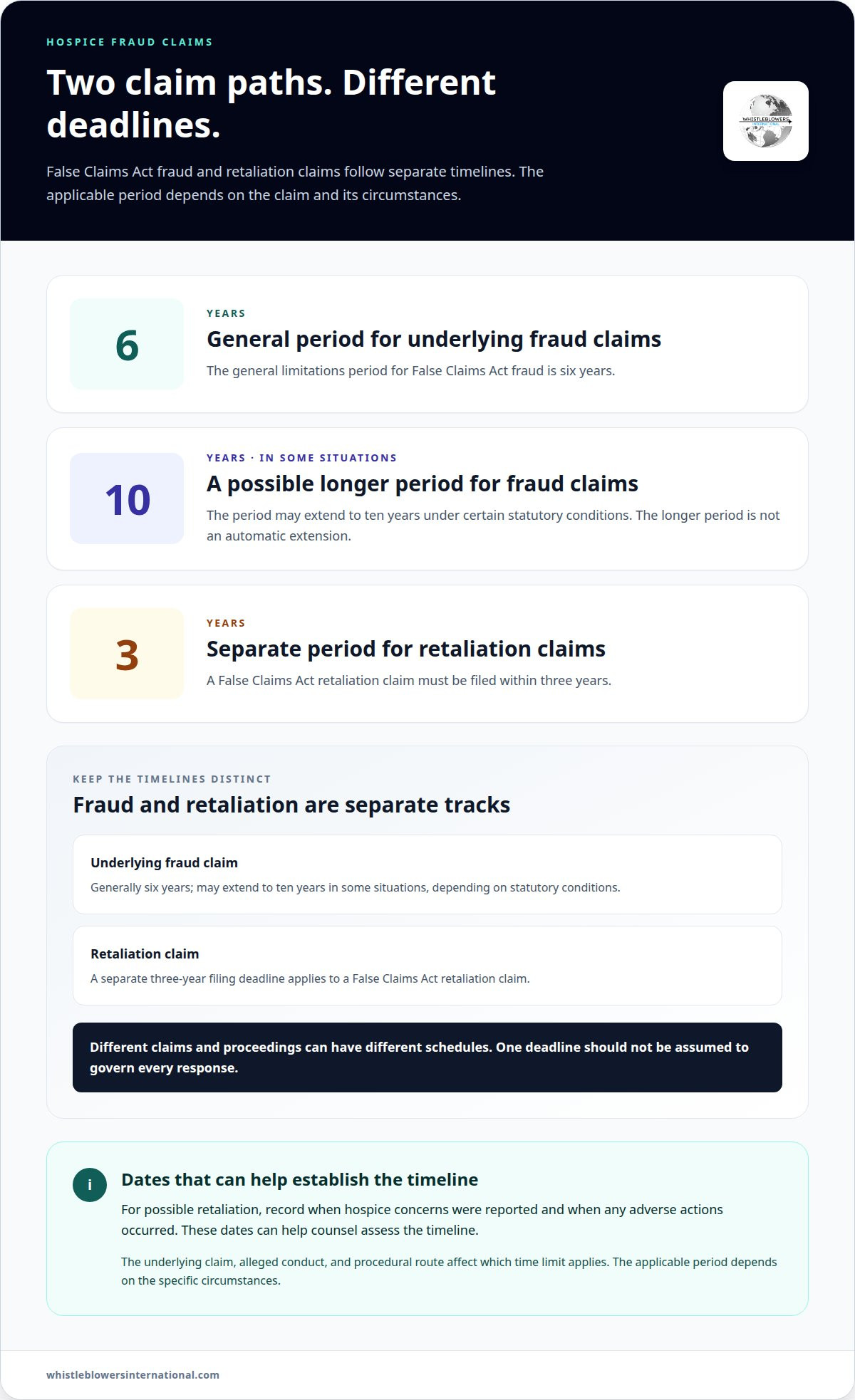
Hospice fraud allegations can trigger separate civil, retaliation, criminal, and administrative processes. Each may follow a different schedule, so a provider shouldn’t assume one deadline governs every response. The underlying claims, alleged conduct, and procedural route all affect which time limit applies.
For underlying False Claims Act fraud, the general limitations period is six years. In some situations, it may extend to 10 years, according to the Office of the Law Revision Counsel, U.S. House of Representatives. The applicable period depends on the claim and statutory conditions. Don’t treat the longer period as an automatic extension.
Retaliation has a separate deadline. A False Claims Act retaliation claim must be filed within three years, according to the Office of the Law Revision Counsel, U.S. House of Representatives. An employee facing discipline after raising concerns about hospice care should record key events, including when concerns were reported and when adverse actions occurred. Those dates help counsel assess the timeline.
Can a hospice patient or family sue for fraud, neglect, or false Medicare claims? A patient or family can report suspected conduct, but a False Claims Act qui tam action is brought by a private relator on the government’s behalf. A neglect claim or an individual fraud claim is distinct and depends on the facts and applicable law.
For a timely review, organize the chronology before a consultation:
- Record when the provider submitted or corrected disputed claims.
- Note when concerns were raised, to whom, and how the provider responded.
- Keep notices of audits, subpoenas, payment actions, or employment decisions.
- Separate patient-care events from billing and referral concerns.
A hospice fraud attorney can evaluate how the alleged illness, enrollment, billing, and reporting dates fit the relevant claim. In California, state and federal matters may also move on different schedules. Preserve the chronology and seek advice promptly, rather than waiting for a government inquiry to conclude. A delayed consultation can narrow the options available, especially when the issue involves both alleged fraud and workplace retaliation.
How hospice fraud may occur in nursing homes and assisted-living facilities
Hospice care can take place in a nursing home or community living arrangement where residents already receive support. That setting alone doesn’t establish care fraud. Concerns arise when enrollment, services, referrals, or billing don’t match the resident’s condition and records.
One potential scheme involves recommending hospice to an older person who lacks a terminal illness instead of arranging skilled nursing or hospital care. A facility may benefit from hospice billing or receive kickbacks from a hospice provider for referrals. Investigators would examine whether the resident qualified, what services were delivered, and whether payments influenced referrals.
Ownership relationships can create another risk. If a hospice refers patients to a facility in which it holds an ownership interest, that self-referral may violate the Stark Law. The relationship and actual referral arrangement matter; shared ownership alone doesn’t prove fraud. In California, suspected arrangements may attract state or federal scrutiny.
To understand a facility-based concern, organize the relevant facts by resident and date:
- Compare hospice enrollment and certification records with documented condition and prognosis.
- Match hospice visit notes and billed services against the resident’s care records.
- Record who recommended hospice, any referral communications, and related financial arrangements.
- Preserve relevant material lawfully, and keep confidential patient information secure.
A pattern may emerge when multiple residents with similar records were enrolled, services were billed but not provided, or referrals followed a financial relationship. Assess each example based on its own evidence. A family’s concern about a care decision, without evidence of false billing or improper referrals, doesn’t establish a scheme.
Facility investigations can involve payment reviews, licensing action, civil claims, or criminal charges, depending on the allegations and evidence. Keep firsthand observations separate from assumptions, and note how each record supports a concern. If you have direct information about facility referrals or billing, explore whistleblower filing options as a possible next step.
Piacentile & Associates LLP: Import Export Customs Fraud Legal Action
Piacentile & Associates LLP handles Import Export Customs Fraud Legal Action and whistleblower filings involving securities, tax, financial, and commodities matters. These offerings are relevant when evidence points to those distinct forms of misconduct, rather than hospice billing alone.
When hospice-related evidence also points to securities or derivatives fraud, tax fraud, money laundering, or another area the firm handles, a separate whistleblower filing may be relevant. The firm also handles customs fraud actions. Keep records for each concern organized so the alleged conduct and supporting evidence remain clear.
For questions about whether a matter fits one of these areas, contact Piacentile & Associates LLP to discuss the concern.
Choose a Clear Next Step
Turning a concern into a sound legal strategy starts with identifying what the records can show and which process fits the alleged conduct. A hospice fraud attorney can assess whether evidence supports a potential False Claims Act matter, a retaliation claim, or another route. The right path depends on the facts and the person’s role in uncovering them.
Piacentile & Associates LLP handles False Claims Act / Qui Tam Lawsuits and whistleblower filings with the SEC and IRS, as well as the CFTC and FinCEN. These distinct offerings may be relevant when evidence points beyond hospice billing to other alleged government or financial misconduct. Whistleblower cases are very complex and take a long time to resolve, so bring strong information and evidence for the firm to evaluate.
Contact Piacentile & Associates LLP to discuss your concerns and consider a practical next step.
Piacentile & Associates LLP and Whistleblower Legal Action
The Piacentile Law Firm, PLLC represents whistleblowers in False Claims Act / Qui Tam Lawsuits and filings with the SEC, IRS, FinCEN, and CFTC. If you suspect hospice fraud and are considering reporting it, the firm can assess whether your information and evidence may support a whistleblower action.
The firm also handles Import Export Customs Fraud Legal Action. Consider reaching out when you want to discuss whether your concerns may fit one of these legal matters.
Frequently Asked Questions
Can I go to jail for fraud?
Yes, a person convicted of federal healthcare fraud may face imprisonment. Under 18 U.S.C. § 1347, the penalty can exceed 10 years; if serious harm occurs, it may reach 20 years. Extreme cases may carry a life sentence. The prosecution must prove knowing and willful execution or attempted execution of the alleged healthcare fraud scheme.
How are hospice whistleblowers rewarded?
A hospice whistleblower may receive a share of money the government recovers through a successful False Claims Act lawsuit. The potential award depends on the recovery and the whistleblower’s role in the case. A report alone doesn’t create an automatic payment. A relator’s attorney can assess whether the information and procedural posture may support a qui tam action.
What triggers a fraud investigation?
An investigation may follow an audit, subpoena, whistleblower complaint, or evidence of questionable claims. Examples include billing for visits unsupported by records, claims involving patients who may not qualify, or payments connected to referrals. Investigators may examine billing patterns alongside patient files, referral communications, and service records. An inquiry is not, by itself, proof of fraud.
What constitutes hospice fraud under U.S. federal and state law?
Federal hospice fraud can involve knowingly submitting false claims to a healthcare benefit program. The False Claims Act addresses qualifying knowingly false claims, while 18 U.S.C. § 1347 concerns healthcare fraud schemes. The Anti-Kickback Statute addresses knowing and willful remuneration to induce or reward referrals of Medicare or Medi-Cal patients. California law also addresses fraudulent Medi-Cal claims under Welfare and Institutions Code section 14107.
What protections apply to hospice fraud whistleblowers, and can they receive a reward?
Federal False Claims Act retaliation protections may provide remedies when a plaintiff succeeds on a retaliation claim, including reinstatement, attorney fees, and damages for emotional distress. These remedies differ from a whistleblower award tied to a government recovery. A person’s role, conduct, evidence, and the response to protected reporting can affect the available claim; reporting does not guarantee a reward or remedy. Past results do not guarantee future outcomes.