
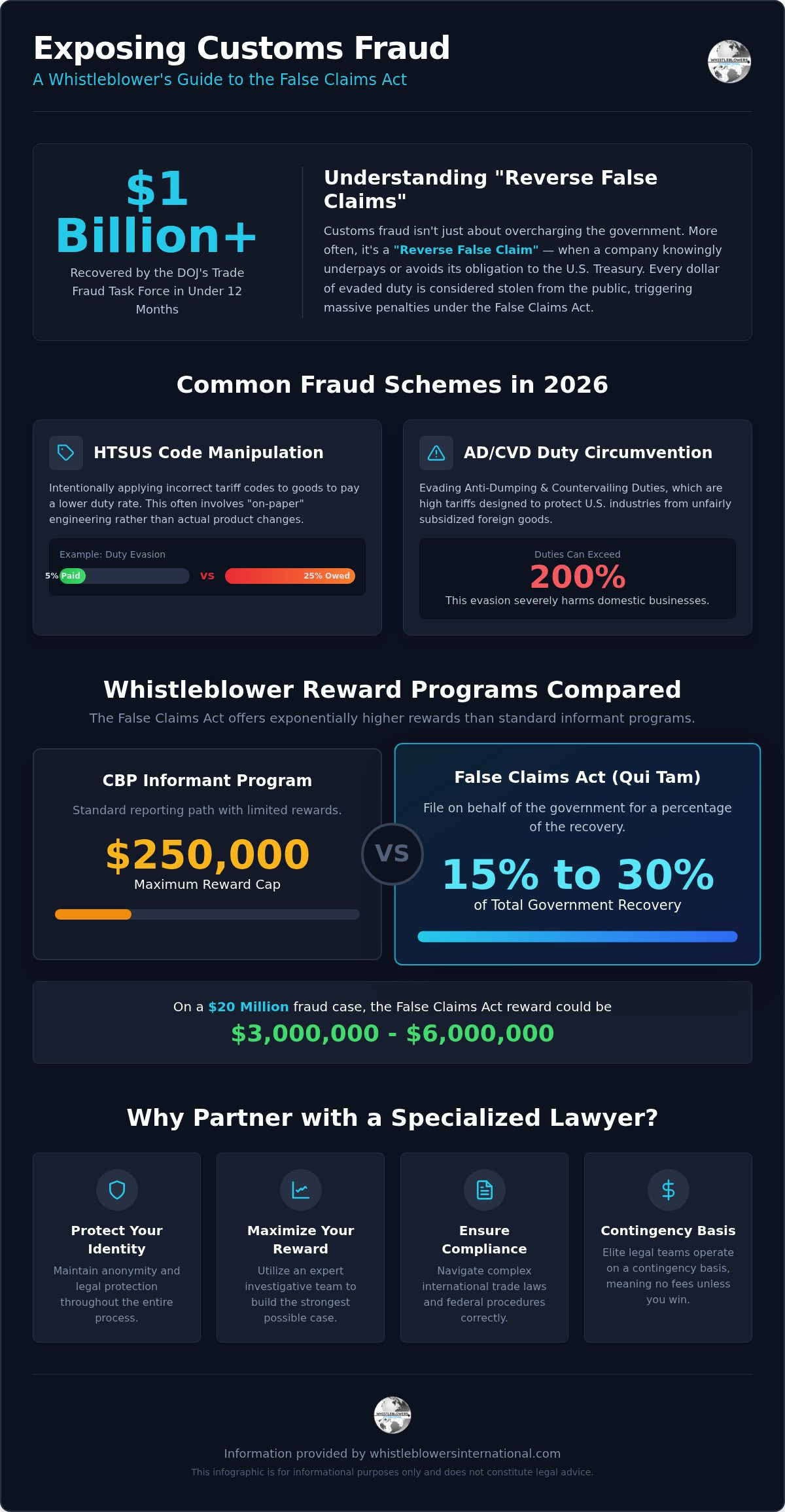
In less than twelve months, the Department of Justice’s Trade Fraud Task Force has recovered over $1 billion from entities evading international trade laws. This surge in enforcement proves that the federal government is no longer treating duty evasion as a mere administrative error, but as a high-stakes financial crime. You might feel certain that fraud is occurring within your industry, yet you’re likely hesitant because of the risks to your career or the confusion over which agency handles these multi-million dollar cases. It’s common to wonder if your evidence is truly “good enough” to stand up against a global corporation.
By working with a seasoned customs fraud lawyer, you can navigate these complexities while maintaining your anonymity and legal protection. This 2026 guide will show you how to leverage the False Claims Act to secure significant rewards, explaining the specific reward structures and the benefit of partnering with an elite legal team that operates on a contingency basis. We will detail the path from identifying a “Reverse False Claim” to maximizing your potential recovery through a methodical, strategic investigation.
Key Takeaways
- Understand the “Reverse False Claim” mechanism where underpaying government obligations creates high-stakes liability for importers.
- Identify common 2026 fraud schemes, including HTSUS misclassification and valuation fraud, that serve as the foundation for successful legal action.
- Compare reward structures to see why the False Claims Act offers significantly higher payouts than the standard $250,000 CBP informant cap.
- Learn how a specialized customs fraud lawyer protects your identity while utilizing an investigative team to maximize your potential recovery.
- Follow a methodical process for gathering internal documentation to ensure your evidence meets the rigorous standards of federal oversight.
What is Customs Fraud and Why Does the Government Pay for Reports?
Customs fraud is a deliberate act of deception aimed at U.S. Customs and Border Protection (CBP) to avoid paying legally required tariffs and duties. While many associate fraud with the direct theft of government funds, trade violations often take the form of a “Reverse False Claim.” In this scenario, a company doesn’t overcharge the government for a service; instead, it knowingly underpays an existing financial obligation. This distinction is critical because every dollar withheld from the U.S. Treasury through misclassification or undervaluation is a dollar essentially stolen from the public purse.
The sheer scale of international commerce makes it virtually impossible for federal agencies to monitor every shipment entering the country. Current enforcement trends suggest that without the assistance of insiders, investigators would likely miss the vast majority of sophisticated trade schemes. If you possess specific, non-public information regarding these violations, you’re more than a witness; you’re a primary asset in maintaining the integrity of the global supply chain. This is why the government provides substantial financial incentives to those who step forward with the help of a customs fraud lawyer.
The Economic Impact of Trade Fraud
When an importer evades tariffs, they gain a predatory advantage over domestic manufacturers who play by the rules. This illegal cost-cutting suppresses wages and can force law-abiding U.S. businesses out of the market entirely. Anti-Dumping (AD) and Countervailing Duties (CVD) are specifically designed to prevent foreign entities from flooding the market with artificially low-priced goods that threaten national security and industrial stability. Evasion of AD/CVD remains a primary target for Department of Justice prosecution in 2026, as these schemes represent some of the most damaging financial losses to the American economy.
The Legal Basis for Rewards
The primary mechanism for reporting these violations is the False Claims Act, a Civil War-era statute that has evolved into the government’s most effective tool against corporate theft. The Fraud Enforcement and Recovery Act (FERA) of 2009 significantly strengthened this law, clarifying that any person who knowingly conceals or improperly avoids an obligation to pay money to the government is liable for treble damages. This expansion ensured that “reverse” claims, common in customs cases, are treated with the same severity as traditional procurement fraud.
Under these laws, a whistleblower is legally referred to as a “Relator.” By filing a “qui tam” lawsuit, the Relator acts on behalf of the government to recover lost revenue. If the case is successful, the Relator is entitled to a percentage of the total recovery, which can range from 15% to 30%. Because these cases involve intricate international regulations and high-stakes litigation, partnering with an experienced customs fraud lawyer is essential to ensure your evidence is presented effectively while your personal and professional interests remain protected.
Common Customs Fraud Schemes in 2026
The establishment of the Trade Fraud Task Force in August 2025 marked a fundamental shift in how the U.S. government monitors international trade. In the first half of 2026 alone, False Claims Act settlements have already exceeded $1.8 billion, driven largely by the uncovering of sophisticated evasion tactics. These schemes aren’t merely clerical errors; they’re calculated attempts to bypass the financial obligations that protect the American economy. Identifying these patterns is the first step toward securing a whistleblower reward, as the government relies on insiders to decode the complex paper trails left by fraudulent importers.
HTSUS Code Manipulation
While some companies attempt legitimate tariff engineering to minimize costs, fraudulent misclassification involves intentionally applying incorrect Harmonized Tariff Schedule (HTSUS) codes. This tactic allows importers to pay a 0% or 5% duty rate on goods that should legally be taxed at 25% or higher. To prove this in a qui tam case, a customs fraud lawyer looks for internal communications or “cheat sheets” that instruct employees to use specific codes despite knowing the product’s true nature. Evidence of “engineering” that occurs only on paper, rather than in the physical design of the product, often serves as a “smoking gun” for investigators.
Circumvention of AD/CVD Duties
Anti-Dumping and Countervailing Duties (AD/CVD) are designed to offset unfair foreign subsidies, often reaching rates of 200% or higher. Because of these extreme costs, AD/CVD evasion is a primary target for multi-million dollar settlements. In May 2026, the record-breaking $549.5 million settlement with Perfectus Aluminum Inc. highlighted the government’s aggressive stance on aluminum extrusion evasion. Common tactics include:
- Transshipment: Moving goods through a third country, like Vietnam or Malaysia, to disguise their true origin from China or other sanctioned nations.
- Honey Laundering: A famous example of transshipment where origin labels are falsified to avoid massive duties on food products.
- Double Invoicing: Maintaining one set of invoices with an artificially low price for customs officials while using a second set for actual payment to the supplier.
Importers also frequently engage in valuation fraud by failing to report “assists.” These are items provided by the importer to the foreign manufacturer at a reduced cost, such as specialized tooling, molds, or R&D, which must legally be included in the declared value of the goods. While the CBP e-Allegations portal is a tool for general reporting, it doesn’t offer the same legal protections or high-reward potential as a formal lawsuit. If you’ve uncovered evidence of double invoicing or systematic undervaluation, it’s vital to discuss your findings with an expert before the government initiates its own investigation. A specialized customs fraud lawyer can help you organize this evidence to meet the rigorous “reverse false claim” standards required for a successful recovery.
Comparing Reward Programs: CBP Informant vs. False Claims Act
When you’ve uncovered evidence of trade violations, you’ll find two primary paths for reporting. The first is an administrative report through the Tariff Act (Section 592), while the second involves a formal lawsuit under the False Claims Act. While both programs aim to stop fraud, the difference in potential outcomes is staggering. Choosing the wrong path can result in a reward being capped at a fraction of what the case is actually worth.
The Tariff Act rewards are managed directly by Customs and Border Protection (CBP) and are strictly capped at $250,000, regardless of whether the fraud involves millions or billions of dollars. In contrast, a qui tam lawsuit filed under the False Claims Act allows a whistleblower to receive between 15% and 30% of the total government recovery. Because these lawsuits are litigated in federal court, they require the expertise of a customs fraud lawyer to ensure the filing meets the specific procedural requirements that trigger these higher payouts.
Why the False Claims Act is Superior
To understand the difference in scale, consider a case involving $10 million in evaded duties. Under the CBP informant program, your reward would hit the mandatory ceiling of $250,000. Under the False Claims Act, that same case could yield a reward between $1.5 million and $3 million. This discrepancy exists because the Department of Justice Fraud Section views whistleblowers as essential partners in high-level enforcement rather than mere tipsters. The FCA provides significantly more robust anti-retaliation protections than administrative programs, allowing relators to seek reinstatement and double back pay if they are penalized for their whistleblowing activities.
Timing is also a decisive factor in these cases due to the “First to File” rule. Federal courts generally only allow the first whistleblower to file a lawsuit to collect a reward. If a competitor or another employee files a similar claim just one day before you, your right to a recovery could be permanently barred. This makes it imperative to secure a customs fraud lawyer early to evaluate your evidence and file your claim before the opportunity vanishes.
Eligibility for Rewards
Whistleblower rewards aren’t reserved only for current employees. Competitors who are being priced out of the market, industry experts who spot anomalies in shipping data, and even former employees can serve as relators. To qualify, you must meet the “Original Source” requirement, meaning your information can’t be based on public news reports or government audits. You must provide independent knowledge that the government doesn’t already possess.
The program also maintains a global reach. Foreign nationals who have evidence of fraud against the U.S. government are eligible to file claims and receive rewards. Whether you are based in a manufacturing hub in Asia or a corporate office in Europe, the legal framework protects your identity and your right to a financial recovery if you help the U.S. Treasury reclaim lost revenue. If your evidence involves illicit payments made to foreign government officials to secure trade advantages, you may also have a parallel claim worth exploring with an FCPA whistleblower lawyer who specializes in foreign bribery reporting.
How to Safely Report Trade Fraud to Customs
Reporting a multi-million dollar trade fraud scheme is a high-stakes endeavor that requires tactical precision. It’s not enough to simply possess information; you must present it in a way that the government can effectively utilize while ensuring your professional safety remains entirely intact. The process is methodical and requires a clear understanding of federal litigation procedures to avoid common pitfalls that could disqualify your claim or expose your identity prematurely.
The first and most critical step is to consult an experienced customs fraud lawyer before you make any contact with federal agencies. This initial step ensures that your communications are protected by attorney-client privilege from the very beginning. Once a legal strategy is in place, you must systematically gather documentation such as commercial invoices, shipping logs, and internal financial ledgers. These records serve as the foundation of your case, providing the objective proof needed to validate your allegations of duty evasion.
It’s equally vital to preserve evidence of “scienter,” which is the legal term for intent. This often takes the form of emails, internal memos, or Slack messages where leadership acknowledges the evasion or explicitly instructs staff to misclassify goods to save on costs. Preserving these communications is often what elevates a case from a simple administrative error to a high-value False Claims Act recovery. Finally, your legal team will file a formal qui tam complaint “under seal.” This legal mechanism ensures the lawsuit is hidden from the public, the media, and the defendant while the government conducts its investigation.
Documenting Fraud Correctly
In customs cases, the “smoking guns” are usually found in the discrepancies between a company’s internal records and the filings submitted to CBP. You should look for double invoices, spreadsheets tracking “tariff savings” from misclassification, or specific instructions to use HTSUS codes that contradict the product’s physical specifications. It is vital to handle this proprietary data with care to avoid violating trade secret laws or employment contracts. Understanding How to Document Corporate Fraud Correctly is essential for protecting both the integrity of your claim and your long-term career prospects.
Protecting Your Anonymity
Many potential relators hesitate because they fear their name will immediately appear on a public docket. However, the “under seal” process serves as a protective shield, keeping your identity confidential during the initial investigative phase, which can last for years. Your customs fraud lawyer acts as a strategic buffer, handling all interactions with the Department of Justice so that your direct involvement remains obscured from your employer. This is particularly crucial for international whistleblowers reporting from jurisdictions where labor protections may be less robust. If you’re prepared to take the next step, you should secure a confidential evaluation to determine the most effective path for your specific evidence.
The Role of a Customs Fraud Lawyer in Your Case
Trade fraud litigation involves a labyrinth of international regulations, financial forensics, and multi-agency coordination. General practice attorneys often lack the specialized knowledge required to challenge global corporations and their sophisticated legal teams. A customs fraud lawyer does more than file paperwork; they act as a strategic investigator who understands how to transform raw data into a compelling narrative for the Department of Justice. This expertise is what differentiates a dismissed tip from a multi-million dollar recovery.
Choosing the right firm means looking for an investigative advantage. Piacentile & Associates LLP maintains a dedicated team of investigators who work alongside attorneys to uncover hidden fraud and protect your privacy throughout the process. This depth of scrutiny is essential because the government is more likely to intervene in a case that is presented with clear, validated evidence. Their team possesses the global reach necessary to assist individuals worldwide, ensuring that distance is never a barrier to justice.
Most importantly, elite whistleblower firms operate on a 100% contingency fee basis. This model ensures that you never pay out-of-pocket for high-level legal representation or investigative costs. Your interests are perfectly aligned with your legal team: they only recover their fees if you successfully secure a reward. When it comes time to finalize a settlement, your lawyer negotiates the reward percentage with the DOJ, advocating for the maximum possible payout based on the quality and timeliness of your information.
Why Experience Matters in Trade Fraud
Success in these high-stakes cases often depends on having an advocate with an “insider perspective.” Piacentile & Associates LLP is led by Dr. Joseph Piacentile, a former whistleblower and attorney who understands the personal and professional risks you face. Navigating the intersection of the SEC, CBP, and DOJ requires a steady hand and a deep understanding of how these agencies evaluate evidence. For a deeper look into the specific mechanics of these cases, consult our Customs Duty Evasion: 2026 Whistleblower Reward Guide.
Getting Started with a Case Evaluation
Your journey begins with a strictly confidential consultation. During this evaluation, a customs fraud lawyer will review your evidence to determine if it meets the “Original Source” and “Reverse False Claim” criteria required for a Qui Tam lawsuit. The firm typically looks for cases with significant government losses and documented intent of evasion. If your case is accepted, you gain a formidable ally capable of handling massive complexities while remaining focused on your success. You can Contact Piacentile & Associates LLP for a confidential case evaluation to explore your options without financial risk.
Protecting Global Trade and Your Financial Future
The 2026 enforcement landscape confirms that the U.S. government is prioritizing the recovery of lost revenue through aggressive Trade Fraud Task Force initiatives. By recognizing the distinction between limited administrative caps and the unlimited potential of the False Claims Act, you can position yourself to secure a significant reward while correcting systemic market imbalances. Success in these matters requires more than just raw evidence; it demands a strategic partner who understands the high-stakes nature of international trade litigation and the complexities of “Reverse False Claims.”
Engaging a seasoned customs fraud lawyer ensures that your case is built on a foundation of rigorous investigation and legal precision. Piacentile & Associates LLP provides an insider’s perspective as a firm led by a former whistleblower, utilizing a global investigative reach to uncover the most sophisticated evasion schemes. We operate on a strictly contingency-based model, which means we only get paid if you win. If you’re prepared to transition from observation to action, Secure Your Reward: Contact Our Elite Whistleblower Team for a confidential evaluation of your evidence. Your commitment to integrity is the vital catalyst for a fairer and more transparent global marketplace.
Frequently Asked Questions
Can I report customs fraud anonymously?
You can maintain your anonymity by having a customs fraud lawyer file a qui tam lawsuit “under seal” on your behalf. This procedural safeguard ensures that your identity is hidden from the public, the media, and your employer while the Department of Justice conducts its initial investigation. If the case remains under seal, the defendant will not be aware of your involvement during the critical early stages of the probe.
How much is the whistleblower reward for reporting customs duty evasion?
Whistleblower rewards under the False Claims Act typically range from 15% to 30% of the total government recovery. Unlike administrative programs that impose a mandatory ceiling on payouts, the False Claims Act has no upward limit. If the government recovers $100 million in unpaid duties and penalties, the whistleblower’s share could realistically reach $15 million to $30 million depending on the quality of the information provided.
What is the difference between the False Claims Act and the Tariff Act?
The primary difference lies in the reward potential and the level of legal protection afforded to the whistleblower. The Tariff Act (Section 592) caps informant rewards at $250,000 and offers limited administrative oversight. In contrast, the False Claims Act allows for unlimited rewards based on a percentage of the recovery and provides robust statutory protections against professional retaliation, making it the preferred path for high-stakes trade fraud cases.
Do I need a lawyer to report trade fraud to customs?
While you can submit a basic tip through the CBP portal independently, you must be represented by a customs fraud lawyer to file a formal qui tam lawsuit in federal court. The law requires an attorney to represent the interests of the United States in these proceedings. A specialized lawyer also ensures your evidence is properly structured to meet the rigorous “Reverse False Claim” standards required for a successful recovery.
Can a foreign national receive a reward for reporting U.S. customs fraud?
Foreign nationals are fully eligible to receive financial rewards under the False Claims Act for reporting trade violations. The U.S. legal system recognizes that insiders at foreign manufacturing hubs or international shipping firms often possess the most critical evidence of duty evasion. As long as the fraudulent activity results in a financial loss to the U.S. Treasury, the whistleblower’s citizenship or physical location is not a barrier to collection.
What kind of evidence do I need to prove tariff evasion?
Successful cases require concrete documentation that proves both the physical act of evasion and the defendant’s intent to deceive the government. This typically includes “double invoices,” internal spreadsheets tracking duty savings from misclassification, and emails where leadership acknowledges the fraudulent HTSUS coding. Evidence of “scienter,” or the knowing disregard for trade laws, is essential for transforming a regulatory error into a high-value whistleblower case.
How long does a customs fraud whistleblower case take to resolve?
These complex international investigations typically take between two and five years to reach a final settlement or judgment. The timeline depends on the volume of evidence, the number of shipments involved, and the level of cooperation from the government. During this period, your legal team manages the procedural complexities and maintains communication with federal investigators, allowing you to move forward with your professional life while the case matures.
Will I lose my job if I report my employer for customs fraud?
The False Claims Act contains powerful anti-retaliation provisions that make it illegal for an employer to fire, demote, or harass a whistleblower. If you face adverse professional consequences, you are entitled to seek “make whole” relief, which may include reinstatement, double back pay, and compensation for legal fees. Filing your case under seal provides an additional layer of safety by keeping your identity confidential during the investigation’s most vulnerable phases. Trade fraud schemes frequently intersect with money laundering and sanctions evasion, and understanding what is FinCEN and how the Financial Crimes Enforcement Network investigates these financial crimes can help you identify whether your evidence spans multiple enforcement jurisdictions.