

In 2026, reporting a single violation of the Bank Secrecy Act can now result in a whistleblower award exceeding $30 million. If you have uncovered evidence of money laundering or sanctions evasion, you likely feel a mix of professional duty and personal trepidation. It’s understandable to worry about retaliation or to feel confused about which federal agency actually handles these high-stakes investigations. This guide provides a definitive answer to the question, what is fincen, and explains how this elite bureau within the Treasury Department has transformed into a powerful ally for those with insider knowledge.
We’ll examine the Financial Crimes Enforcement Network’s critical role in global security, including its recent policy shifts regarding beneficial ownership and nationwide real estate reporting. You’ll learn exactly which financial crimes fall under its jurisdiction and, most importantly, how the 2026 regulatory overhaul guarantees whistleblowers between 10% and 30% of any penalty exceeding $1 million. By the end of this article, you’ll have a clear roadmap for navigating the complexities of the whistleblower program while ensuring your privacy remains a top priority. This is the essential framework for anyone prepared to stand against financial misconduct on a global scale.
Key Takeaways
- Gain a precise understanding of what is fincen and its specialized role as the Treasury Department’s nerve center for analyzing global financial intelligence.
- Learn to distinguish between the jurisdictions of FinCEN, the SEC, and the IRS to ensure your information is directed to the agency with the proper enforcement authority.
- Identify the specific criteria for the 2026 whistleblower program, which offers substantial financial rewards for reporting money laundering or Bank Secrecy Act violations.
- Understand the critical protocols for maintaining total anonymity when reporting high-stakes financial misconduct through experienced legal advocates.
- Discover how the agency utilizes Suspicious Activity Reports (SARs) to uncover complex patterns of illicit money flows and sanctions evasion.
Defining FinCEN: The Nerve Center of U.S. Financial Intelligence
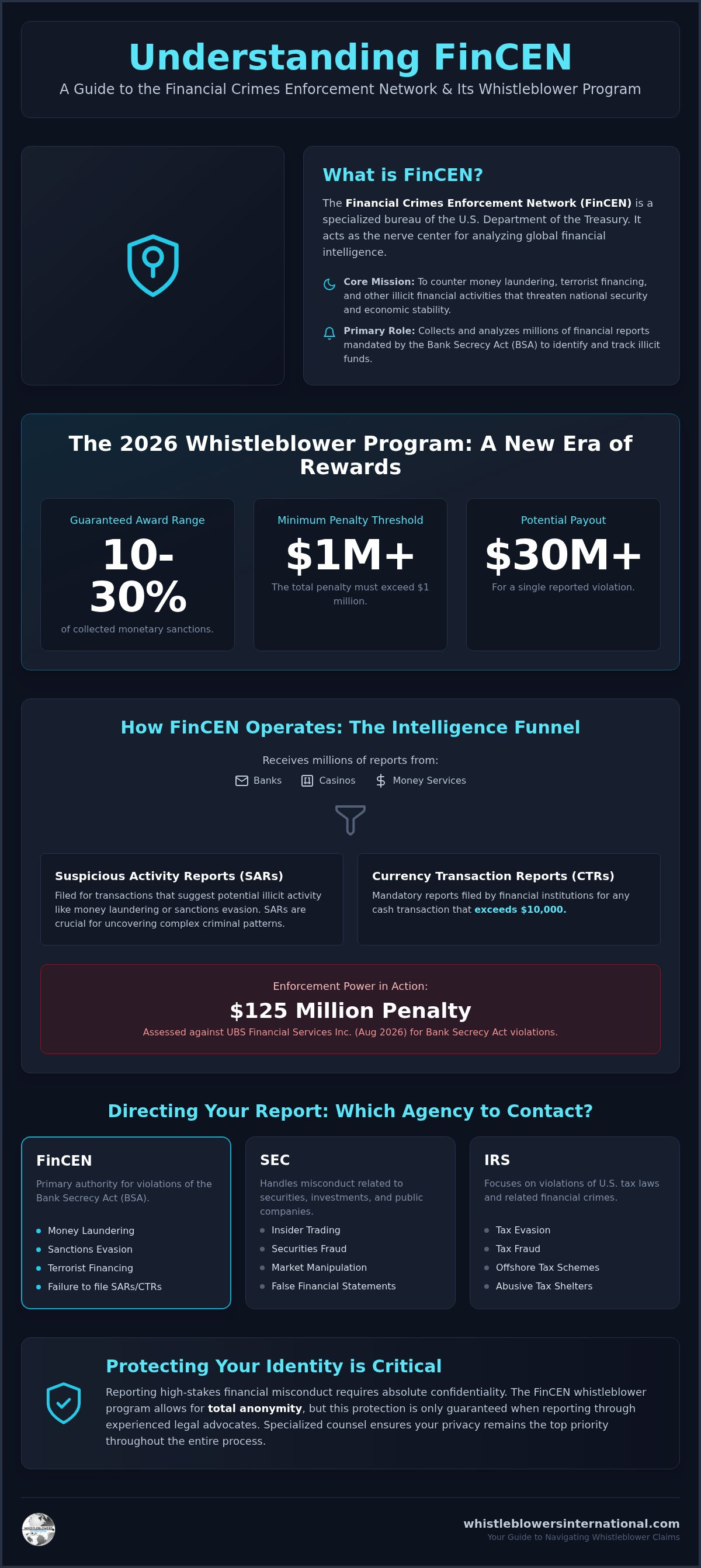
To understand the mechanics of global financial oversight, one must first ask: what is fincen? Formally known as the Financial Crimes Enforcement Network (FinCEN), it’s a specialized bureau of the U.S. Department of the Treasury that operates at the intersection of law enforcement and the global banking system. Established in 1990, it was designed to serve as a multi-source intelligence network, collecting and analyzing data to protect the financial infrastructure of the United States. In 2026, its role has become even more critical as it serves as the central repository for millions of reports mandated by the Bank Secrecy Act (BSA). This makes it the primary destination for data on suspicious financial movements that cross international borders.
The Core Mission and National Security
The agency’s primary mission is to counter money laundering, terrorist financing, and other illicit financial activities that threaten the stability of the economy. By identifying and tracking the flow of funds through both traditional banks and non-bank financial institutions, the bureau safeguards the integrity of the U.S. financial system. This intelligence is vital for national security. It allows the government to disrupt criminal organizations and foreign adversaries who rely on the anonymity of complex money transfers to fund their operations. FinCEN effectively serves as the connective tissue between financial institutions that observe suspicious behavior and the law enforcement agencies that prosecute those crimes. Its analytical work transforms raw transactional data into actionable intelligence that can stop a criminal enterprise in its tracks.
Key Authorities and Governing Statutes
The Director of the bureau reports directly to the Under Secretary for Terrorism and Financial Intelligence within the Treasury Department, ensuring that financial oversight remains a top priority for the Secretary of the Treasury. While the bureau has always held significant power, the Anti-Money Laundering (AML) Act of 2020 substantially expanded its reach and investigative capabilities. Subsequent updates between 2024 and 2026 have further refined these authorities, particularly in response to evolving digital threats and the need for more targeted enforcement in specific geographic areas. These regulations allow the bureau to coordinate seamlessly with international bodies, such as the Financial Action Task Force (FATF), to set global standards for financial transparency. If a professional uncovers a violation of these governing statutes, they’re often looking at a landscape governed by these specific federal mandates. Understanding what is fincen is the first step in identifying whether a financial irregularity qualifies for a whistleblower claim under these robust federal protections.
How FinCEN Operates: Tracking the Global Flow of Illicit Funds
The operational effectiveness of the bureau relies on a continuous intake of data from the private sector. FinCEN operates as a massive intelligence funnel, receiving millions of reports annually from a diverse array of financial institutions, including banks, casinos, and money services businesses. This data is not merely stored; it’s processed through advanced technological systems designed to identify complex patterns that might indicate organized crime, tax evasion, or terrorism. According to official details About FinCEN, once the agency identifies a threat, it disseminates actionable intelligence to federal, state, and international law enforcement partners. When institutions fail to maintain these rigorous standards, the agency exerts its enforcement power through massive civil money penalties. In August 2026, for example, the bureau assessed a record-setting $125 million penalty against UBS Financial Services Inc. for violations of the Bank Secrecy Act.
The Bank Secrecy Act (BSA) Framework
Financial institutions serve as the primary defensive line in the U.S. strategy against financial crime. Under the BSA, these entities must file Currency Transaction Reports (CTRs) for any cash transaction exceeding $10,000. While these reports provide a baseline, Suspicious Activity Reports (SARs) are often more significant. A SAR is filed when a bank observes behavior that appears to lack a legitimate business purpose, regardless of the dollar amount. When individuals ask what is fincen in a practical context, it’s best described as the entity that transforms these fragmented reports into a cohesive map of criminal activity. If you’ve observed a firm systematically ignoring these filing requirements, you may have grounds for a claim under the FinCEN whistleblower program.
Beneficial Ownership Information (BOI) Reporting
The landscape of corporate transparency underwent a major shift in 2026. While the Corporate Transparency Act initially required broad reporting from most small businesses starting in 2024, a final rule issued on August 11, 2026, permanently removed this requirement for U.S. companies and persons. However, transparency remains a critical priority for foreign entities operating within the United States. These foreign reporting companies are still required to disclose their beneficial ownership information to prevent the use of shell companies for illicit gains. This targeted approach allows the bureau to focus its investigative resources on high-risk foreign interests while maintaining a rigorous analytical mindset regarding the global flow of capital. By uncovering who truly controls a foreign entity, the agency can better evaluate risks related to sanctions evasion and international money laundering.
FinCEN vs. SEC and IRS: Identifying the Right Agency for Reporting
Choosing the correct agency for your disclosure is a strategic decision that directly impacts the protection you receive and the potential for a reward. While the SEC and IRS maintain high-profile whistleblower programs, they operate under distinct mandates that don’t always align with the specific misconduct you’ve witnessed. To determine if your case belongs with the Treasury, you must understand what is fincen in relation to its peers. While other agencies protect investors or the public treasury, this bureau focuses on the systemic movement of illicit capital. If your evidence centers on money laundering, violations of the Bank Secrecy Act (BSA), or the evasion of international sanctions, this agency is your primary point of contact.
- FinCEN: Monitors the movement of money and enforces AML/BSA compliance.
- SEC: Focuses on investor protection, market integrity, and securities fraud.
- IRS: Targets tax underpayment, offshore tax evasion, and general tax fraud.
When to Report to FinCEN
You should direct your attention to this bureau when the misconduct involves a failure of a financial institution’s internal controls. This includes systematic failures to file Suspicious Activity Reports (SARs), the knowing facilitation of money laundering, or the active evasion of U.S. economic sanctions. For instance, if a bank is intentionally bypassing “know your customer” protocols to process transactions for prohibited foreign entities, it’s a direct violation of federal law. For more detailed insights, see our guide on Reporting Bank Secrecy Act Violations: A Guide to FinCEN Whistleblower Rewards. These cases are often defined by the “how” of the transaction rather than just the “who” or “how much,” focusing on the methods used to disguise the origin of funds.
Overlap with SEC and IRS Programs
Complex financial crimes rarely fit into a single regulatory box, often creating “hybrid” cases that span multiple jurisdictions. A massive accounting fraud designed to mislead shareholders is primarily an SEC matter, yet if those fraudulent proceeds are then moved through a series of shell companies to hide the trail, it triggers a separate violation. Similarly, tax-related money laundering might involve both the IRS and the FinCEN Whistleblower Program. In these scenarios, the strategic importance of filing with the correct agency cannot be overstated. If you file with the wrong entity, you risk missing statutory deadlines or failing to meet specific eligibility requirements for an award. Understanding what is fincen as a specialized enforcement tool allows you to evaluate which agency offers the most robust path for your specific evidence. A coordinated approach often yields the best results, ensuring that every facet of the misconduct is scrutinized by the appropriate federal authority.
The FinCEN Whistleblower Program: Rewards for Reporting Financial Crimes
The regulatory landscape shifted dramatically in early 2026 with the full implementation of regulations overhauling the whistleblower award program. This modernization, driven by the Anti-Money Laundering Whistleblower Improvement Act, ensures that individuals who provide high-quality intelligence are fairly compensated for the risks they take. Understanding what is fincen in the context of these rewards is essential; it’s no longer just a data repository but a source of significant financial recovery for those who uncover systemic misconduct. If the government recovers more than $1 million in sanctions based on your information, you’re now entitled to between 10% and 30% of those collected funds. This replaces the outdated $150,000 maximum cap, reflecting the high stakes of modern financial enforcement.
Eligibility for these rewards is broad, extending beyond traditional employees. While internal compliance officers or bank staff often have the most direct view of illicit activity, contractors, consultants, and even outside observers can qualify. The program is designed to be inclusive because the bureau recognizes that critical intelligence often comes from those on the periphery of a criminal enterprise. To encourage participation, federal law includes strict anti-retaliation provisions. These protections are bolstered by the ability to file anonymously through legal counsel, ensuring your identity remains shielded from the institution you’re reporting.
Qualifying Violations for a FinCEN Reward
Not every financial irregularity qualifies for a federal reward. The program specifically targets schemes involving money laundering through U.S. financial institutions and violations of the International Emergency Economic Powers Act (IEEPA). This includes the active evasion of U.S. sanctions by foreign entities or the banks that facilitate their transactions. For those dealing with broader institutional misconduct, consulting a Bank Fraud Whistleblower Lawyer: Navigating Money Laundering & FIRREA Claims can help determine which statutes offer the strongest protection. These violations often involve complex layering of transactions designed to hide the true source or destination of capital.
The Importance of Original Information
To secure an award, you must provide “original information.” This means the intelligence must be derived from your independent knowledge or an independent analysis of data that isn’t already known to the government from another source. Even non-insiders can qualify if their intelligence is specific, credible, and leads to a successful enforcement action. This allows external analysts who spot red flags that internal compliance departments ignored to step forward. Because the bureau prioritizes high-impact cases, the specificity of your evidence often determines the final award percentage. If you’re considering a disclosure, it’s vital to submit your FinCEN whistleblower claim through an advocate who can maintain your anonymity. While anti-retaliation measures exist, filing through counsel remains the most effective way to protect your identity from the subjects of the investigation.
Navigating FinCEN Claims: Why Specialized Legal Advocacy is Critical
The decision to move forward with a federal disclosure is rarely simple. Because the Bank Secrecy Act (BSA) and Anti-Money Laundering (AML) regulations are notoriously dense, a successful filing requires more than just a basic understanding of what is fincen. It demands a sophisticated investigative approach that can withstand the scrutiny of federal agents. Engaging specialized legal advocacy ensures that your information is filtered through a lens of technical expertise before it ever reaches a government desk. Perhaps most importantly, a whistleblower lawyer preserves your anonymity by filing on behalf of the client, acting as a buffer between you and the institution under investigation.
This process is often supported by advanced investigative techniques used to validate and strengthen a claim. By the time a submission is made, the evidence has been rigorously evaluated to ensure it meets the high threshold required for a federal recovery. This level of elite representation is accessible through a whistleblower lawyer contingency fee model. It means you don’t face financial risk or upfront costs while pursuing justice. It aligns the interests of the advocate and the whistleblower, prioritizing the maximization of results above all else.
Maximizing the Value of Your Claim
Experienced counsel does not merely submit documents; they package evidence for maximum impact. If a disclosure only highlights a single transaction, it might be overlooked. However, if the filing identifies a systematic failure across multiple regulatory frameworks, the potential award increases significantly. By clarifying what is fincen and its specific evidentiary requirements, your legal team can transform raw data into a compelling narrative for the Department of Justice. Our team includes former whistleblowers and seasoned investigators who provide a unique strategic advantage. This insider perspective allows us to anticipate how government investigators will react to specific data points, ensuring that every possible violation is identified and articulated with precision.
Taking the First Step Securely
Reporting internally often carries a high risk of retaliation, even in companies with robust compliance programs. Going directly to the government with the support of counsel provides a much safer path. At Piacentile & Associates LLP, we evaluate cases based on the credibility of the financial intelligence and the likelihood of a significant recovery. We understand that you are facing professional risks, and our mission-driven purpose is to protect your interests while uncovering the truth. If you possess information regarding high-stakes financial misconduct, we encourage you to contact our team for a confidential evaluation. We provide the steady, guiding hand needed to navigate this labyrinthine process with realistic expectations and a focus on your ultimate success.
Securing Your Role in Global Financial Integrity
The 2026 financial landscape requires both vigilance and a deep understanding of what is fincen to navigate the risks of reporting high-level misconduct. This bureau serves as the ultimate authority for money laundering and sanctions enforcement, offering substantial rewards for original intelligence. By utilizing the updated whistleblower program, you can secure between 10% and 30% of recovered penalties while maintaining total anonymity through the right legal partner. This framework ensures that those with the courage to speak up are both protected and compensated for their contribution to national security.
Success in these complex cases requires a strategic ally with an insider’s perspective. Piacentile & Associates LLP offers specialized expertise in FinCEN, SEC, and False Claims Act litigation, led by a former whistleblower who understands the gravity of your situation. We operate on a contingency-based fee structure that ensures your whistleblower lawyer only gets paid if you win. This ensures our interests are fully aligned with yours as we work to maximize the results of your disclosure while safeguarding your professional future.
If you are ready to move forward, contact Piacentile & Associates LLP for a confidential FinCEN case evaluation. You have the power to uncover the truth, and we have the tools to protect you while you do it.
Frequently Asked Questions
What is the primary purpose of FinCEN?
The primary purpose of the Financial Crimes Enforcement Network is to safeguard the financial system from illicit use and combat money laundering. It doesn’t just store data; it analyzes transactional reports from millions of financial institutions. This intelligence is then shared with law enforcement to disrupt criminal networks and protect national security from threats like terrorist financing and the evasion of international sanctions.
Who is eligible for a FinCEN whistleblower reward?
Eligibility for a reward extends to any individual who provides original information that leads to a successful enforcement action. This includes bank employees, compliance officers, contractors, and even outside analysts who identify violations through independent research. To qualify, the information must pertain to violations of the Bank Secrecy Act or international sanctions, and the resulting government recovery must exceed $1 million in total sanctions.
Can I report a FinCEN violation anonymously?
You can report a violation anonymously provided that you are represented by legal counsel who submits the information on your behalf. This protection is a cornerstone of the 2026 whistleblower program, designed to shield individuals from professional retaliation. While you must eventually disclose your identity to your attorneys, they maintain your confidentiality throughout the investigative process, ensuring your name isn’t revealed to the target institution or the public.
What is the difference between FinCEN and the SEC?
To understand the difference, you’ve first got to define what is fincen: it is a bureau focused on the movement of money and anti-money laundering compliance. In contrast, the SEC focuses on protecting investors and maintaining fair, orderly markets. While the SEC handles securities fraud and insider trading, this agency focuses on the systemic failure of banks to monitor illicit flows or the active evasion of economic sanctions.
How much can a FinCEN whistleblower earn in 2026?
In 2026, a whistleblower is entitled to receive between 10% and 30% of the total monetary sanctions collected by the government. This award structure applies whenever the agency recovers more than $1 million in penalties. These new regulations replaced the previous $150,000 maximum cap, so you don’t have to worry about capped rewards for massive recoveries that reflect the gravity of high-stakes financial crimes and the risks taken by informants.
What are Suspicious Activity Reports (SARs) and why are they important?
Suspicious Activity Reports (SARs) are mandatory filings that financial institutions submit when they detect transactions that lack a clear business purpose or appear illegal. These reports are critical because they serve as the primary intelligence source for federal investigators. By spotting patterns across millions of SARs, the government can identify money laundering syndicates and sanctions evasion tactics that would otherwise remain hidden within the global financial system.
Does FinCEN investigate individuals or just banks?
The agency has the authority to investigate and penalize both financial institutions and the individuals who facilitate criminal conduct. While many high-profile cases focus on global banks, the bureau also targets individual executives, money launderers, and professionals who knowingly bypass compliance protocols. This broad jurisdiction ensures that everyone involved in the movement of illicit capital can be held accountable for undermining the integrity of the U.S. financial system.
How do I know if I have a valid FinCEN whistleblower case?
A valid case typically requires original evidence of systematic violations, such as a failure to implement an effective anti-money laundering program or the intentional processing of transactions for sanctioned entities. If you possess credible documents or specific knowledge that isn’t publicly known, your case may qualify for a reward. Determining the strength of a claim often requires a detailed evaluation by specialized counsel to verify that the misconduct meets enforcement priorities.