
The greatest threat to your SEC whistleblower award isn’t the corporation’s legal team; it’s the calendar. While you might possess undeniable evidence of financial misconduct, your window to act is governed by a strict SEC whistleblower statute of limitations that rewards the swift and penalizes the hesitant. In the first half of 2026 alone, the SEC has already issued at least $80 million in awards, yet many potential claimants risk losing their life-changing compensation simply because they miscalculated a filing deadline or misunderstood the definition of original information.
It’s natural to feel a sense of paralysis when weighing the risks of professional retaliation against the density of federal oversight. This guide provides the clarity you need to move from uncertainty to action, mastering the intricate eligibility requirements and filing timelines necessary to secure your standing. We will examine the updated 2026 Enforcement Manual’s strengthened confidentiality protections, the critical 90-day window for award applications following a Notice of Covered Action, and the strategic steps required to ensure your Form TCR leads to a successful recovery.
Key Takeaways
- Define the threshold for “Original Information” by distinguishing between direct knowledge and independent analysis to ensure your tip qualifies as voluntary.
- Navigate the SEC whistleblower statute of limitations with precision, focusing on the 90-day deadline to file for an award once a Notice of Covered Action is issued.
- Understand the specific “Compliance Exception” protocols that allow auditors and officers to report misconduct safely when leadership fails to act.
- Learn how the SEC evaluates “substantial assistance” to determine where your reward lands within the 10% to 30% statutory range.
- Confirm the legal requirements for maintaining 100% anonymity through the use of an elite advocate who serves as your strategic buffer.
Criteria for SEC Whistleblower Reward Eligibility in 2026
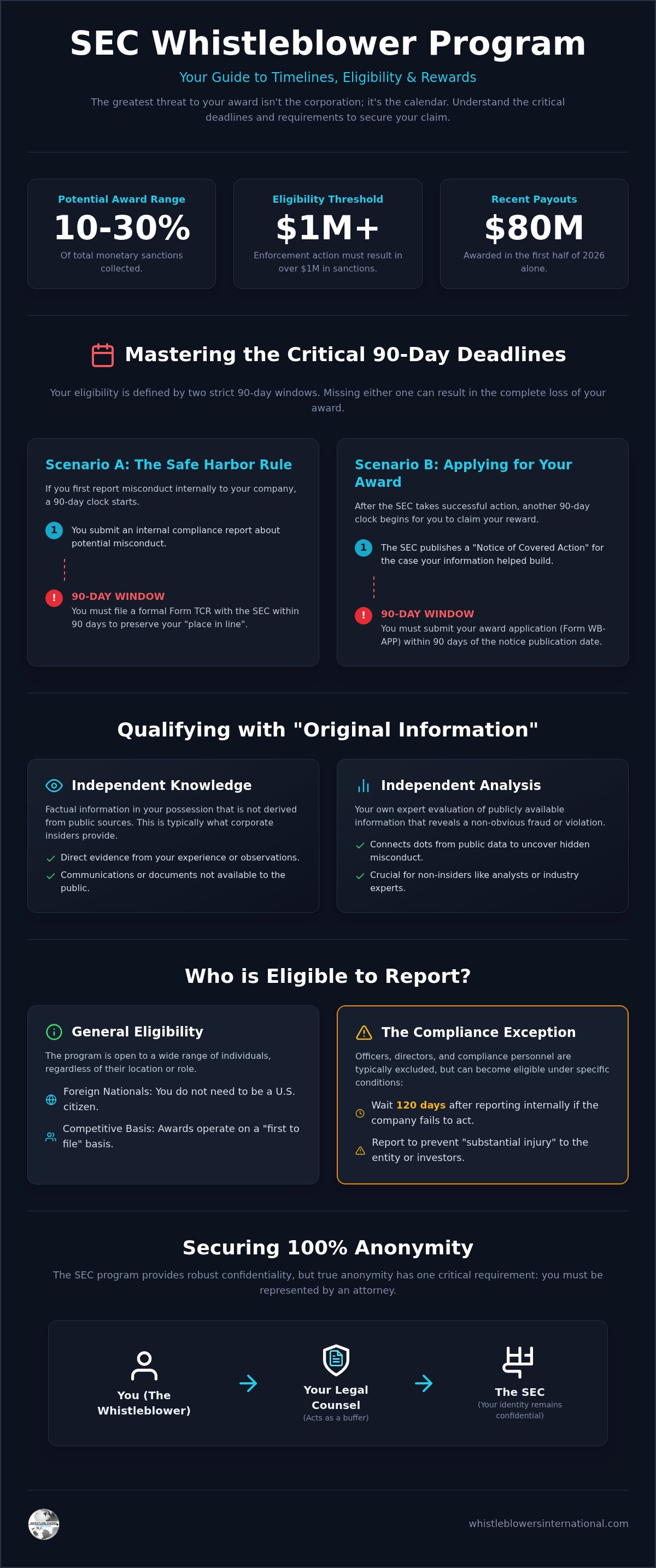
To qualify for a reward under the SEC Whistleblower Program, your submission must meet several rigorous criteria before the clock runs out. The most fundamental requirement is that the information provided must lead to successful enforcement actions resulting in monetary sanctions exceeding $1 million. While this threshold is clear, the definition of a “voluntary” submission is often where potential claimants stumble. If the SEC or another regulatory body has already contacted you, or if you provide information after receiving a subpoena, your submission is generally not considered voluntary. This makes early action critical; waiting until an investigation is already underway can effectively bar you from recovery under the SEC whistleblower statute of limitations.
Corporate officers, directors, and compliance personnel face a higher bar for eligibility. Typically, these individuals are excluded from rewards unless they can demonstrate that at least 120 days have passed since they reported the misconduct internally, or that the company failed to act on the information. Exceptions also exist if reporting is necessary to prevent substantial injury to the entity or its investors. Understanding these nuances is vital for those in high-level positions who see fraud but fear their role disqualifies them from the program’s protections and rewards.
Independent Knowledge vs. Independent Analysis
You don’t need to be a corporate insider with access to “smoking gun” emails to qualify for an award. The SEC recognizes two distinct types of original information: independent knowledge and independent analysis. Independent knowledge refers to facts known to the whistleblower that are not derived from public sources. Conversely, independent analysis involves using your expertise to connect dots from publicly available data to reveal a hidden fraud. Independent analysis is the critical bridge for non-insider eligibility, defined as the examination of public information to reveal hidden misconduct through a whistleblower’s unique expertise or specialized evaluation.
Global Eligibility for Foreign Nationals
The SEC’s jurisdiction extends far beyond U.S. borders, covering any securities fraud that has a substantial effect within the United States or involves U.S. markets. You don’t need to be a U.S. citizen or resident to claim a reward; in fact, the program has issued hundreds of millions of dollars to individuals living abroad. Engaging a whistleblower lawyer for foreign nationals is often a strategic necessity for those outside the country, as it ensures that your filing complies with local laws while maximizing your protection under U.S. regulations. This global reach ensures that international misconduct is held to the same scrutiny as domestic violations, provided you act within the SEC whistleblower statute of limitations.
The SEC Whistleblower Statute of Limitations: The 90-Day Rule
Understanding the temporal constraints of the Official SEC Whistleblower Program is paramount for any individual possessing evidence of securities violations. Many potential claimants conflate the SEC’s own deadline to bring an enforcement action with the specific deadlines required to maintain reward eligibility. While the SEC generally has a five year window to initiate enforcement (which can extend to ten years for certain violations), your personal window as a whistleblower is much narrower. The Supreme Court’s ruling in Digital Realty Trust, Inc. v. Somers established that you must report misconduct directly to the SEC to qualify for anti-retaliation protections; simply reporting internally is no longer sufficient to secure your legal standing under federal law.
The program operates on a “first to file” basis, which effectively creates a race to the Commission’s door. If multiple individuals possess the same original information, the person who submits their Form TCR first is typically the only one eligible for the primary award. This competitive environment means that even a delay of a few days can result in the total loss of a multi-million dollar recovery. If you are unsure where your specific timeline stands, consulting with a specialized legal advocate can clarify your position before the window closes.
Calculating Your Filing Deadline
To preserve your “place in line,” you must adhere to the 90-day safe harbor rule. If you choose to report misconduct through your company’s internal compliance channels first, you have exactly 90 days from that initial report to file your Form TCR with the SEC. If you meet this deadline, the SEC will treat your filing date as the date of your internal report. Failing to meet this 90-day window means you lose that earlier “effective date,” potentially allowing another whistleblower to leapfrog your claim. Additionally, the SEC may reduce your award percentage if it determines there was an unreasonable delay in reporting the fraud after you became aware of it.
Tolling and Exceptions to the 5-Year Window
The SEC whistleblower statute of limitations is not always a fixed point in time; certain conditions can pause or “toll” the clock. Under the discovery rule, the statutory period might not begin until the fraud was discovered or should have been discovered through reasonable diligence. This is particularly relevant in cases of fraudulent concealment where the bad actors took active steps to hide their tracks. However, waiting for “perfect evidence” or a complete investigative file is a high-risk strategy that often leads to missed deadlines. The SEC encourages reporting as soon as you have a credible basis for the tip, as ongoing fraud can impact the Commission’s willingness to grant a maximum award percentage.
Maximizing Your Award: Thresholds and Percentages
The SEC is legally required to pay between 10% and 30% of the total money collected in sanctions when the enforcement action results in penalties exceeding $1 million. As of August 2026, the Commission has awarded over $2 billion to 444 individuals since the program’s inception. This isn’t a flat rate; it’s a sliding scale based on the quality of your submission and the depth of your cooperation. Under the updated 2026 Enforcement Manual, there’s a presumption that whistleblowers will receive the maximum 30% for awards totaling $5 million or less. If your information assists other agencies, like the DOJ, the SEC can aggregate those related actions to increase your total payout significantly.
Navigating the nuances of SEC whistleblower lawyer fees is a standard part of the process for high-stakes claimants. Most elite firms utilize a contingency fee model, ensuring that you face no upfront costs while your legal team handles the investigative heavy lifting. This approach is particularly beneficial when dealing with the SEC whistleblower statute of limitations, as it allows your counsel to move quickly to preserve your claim without financial friction. The Commission doesn’t merely look at the fraud; it looks at how your reaction helped stop it.
Factors That Increase Your Reward Percentage
Whistleblowers who provide substantial assistance typically see their awards move toward the 30% ceiling. This includes handing over specific, non-public documents that serve as “smoking gun” evidence for investigators. If you reported the misconduct through your company’s internal compliance program before going to the SEC, the Commission often views this as a positive factor. Exposing fraud that involves high-level executives or widespread systemic failure also tends to result in a higher award percentage. The SEC rewards those who make their job easier through organized, actionable intelligence.
Factors That Decrease Your Reward Percentage
Certain actions can negatively impact your final cut, potentially dropping it to the 10% minimum. One of the most common pitfalls is an unreasonable delay in reporting the violation. If you sit on evidence while the fraud continues to harm investors, the SEC may reduce your reward for failing to act within the spirit of the SEC whistleblower statute of limitations. Other negative factors include interfering with an internal investigation or having a high degree of personal culpability in the underlying securities violation. You can review the full list of evaluative factors in the SEC Whistleblower Program FAQs.
Barriers to Eligibility: Who Cannot Claim a Reward?
Identifying a violation is only the first step; ensuring you do not fall into a statutory exclusion is equally critical for securing your future. Employees of the Department of Justice, law enforcement agencies, and other regulatory bodies are generally barred from the program because their reports are viewed as a fulfillment of their professional mandates. If you have been criminally convicted for conduct related to the specific securities fraud you are reporting, the law prohibits you from receiving any financial payout. Many individuals inadvertently sabotage their own standing by making common mistakes in SEC whistleblower claims, such as submitting informal tips that do not carry the weight of a sworn declaration.
Even if you occupy a role that is typically eligible, the SEC whistleblower statute of limitations acts as an unrelenting barrier for those who hesitate. The Commission prioritizes the “first to file” above all else, meaning that even a perfectly documented tip is worthless if it arrives after a competitor has already alerted the authorities. This competitive reality necessitates a proactive approach to filing, ensuring your evidence is the primary catalyst for the Commission’s investigation.
The 120-Day Rule for Compliance and Audit Professionals
Internal gatekeepers, such as auditors and compliance officers, are generally excluded from reward eligibility because their job is to identify and stop misconduct. However, the SEC provides a critical “compliance exception” to this rule. If you report the violation internally and 120 days pass without the company taking appropriate action, you may then file with the SEC, provided you remain within the SEC whistleblower statute of limitations for timely reporting. This rule also applies if you have a reasonable belief that reporting to the Commission is necessary to prevent substantial injury to the financial interest of the entity or its investors. Documenting the failure of internal systems is essential to successfully triggering this exception and protecting your reward standing.
Publicly Available Information Barriers
The SEC requires “original information,” which means your tip cannot be based solely on news reports or public filings unless you provide a unique perspective. While “independent knowledge” comes from what you’ve seen or heard firsthand, “independent analysis” allows you to qualify by evaluating public data in a way that reveals a hidden fraud. Independent analysis is the process of using your specialized expertise to derive non-obvious conclusions from information that is already in the public domain. To overcome this barrier, your submission must add significant value that the Commission could not have easily obtained through its own review of public records. If you’re concerned that your professional role or the nature of your evidence might bar you from a reward, contact an elite whistleblower advocate to evaluate your eligibility before the window closes.
Securing Your Claim: Why Anonymous Filing Requires Counsel
The decision to come forward is often tempered by a legitimate fear of professional exposure. While the SEC provides a mechanism for anonymous reporting, this protection is strictly conditional. You can only maintain 100% anonymity if you’re represented by legal counsel who submits the information on your behalf. Without an attorney, your identity must be disclosed on the Form TCR, leaving you vulnerable to the very retaliation the program seeks to prevent. An elite firm serves as more than a clerical intermediary; it acts as a formidable buffer, ensuring your name never reaches the Commission’s investigative staff until the final award stage.
This professional shield is particularly vital when navigating the SEC whistleblower statute of limitations. Your advocate ensures that the rush to meet filing deadlines doesn’t result in a sloppy or incomplete submission. By working on a contingency basis, our team assumes all financial risk, providing high-level advocacy without requiring you to pay upfront legal fees. This model aligns our success entirely with yours, fostering a partnership built on transparency and the shared goal of maximizing your recovery. It’s a strategic alliance designed to handle massive complexities while you remain focused on your personal security.
The Investigative Power of Piacentile & Associates LLP
Dr. Joseph Piacentile’s background as a former whistleblower provides our firm with a unique investigative depth that traditional law offices often lack. We don’t just file tips; we build comprehensive evidence packages designed to survive the SEC’s intense scrutiny. This involves vetting documents, identifying corroborating data, and presenting the narrative in a format that matches the Commission’s own investigative logic. For cases involving international bribery, we coordinate with our FCPA whistleblower lawyer teams to ensure your claim captures every available statutory reward across multiple jurisdictions.
Your Path to a 2026 SEC Award
Securing a significant award in 2026 requires a methodical approach to a labyrinthine process. The lifecycle of a case begins with a confidential evaluation, where we determine if your evidence meets the $1 million threshold and falls within the SEC whistleblower statute of limitations. From there, we move to the formal filing of the TCR, followed by ongoing strategic support during the Commission’s investigation. If you’re ready to move from discovery to action, contact Whistleblowers International for a confidential case review to protect your interests and your future.
Take Decisive Action to Protect Your Future
The path to a significant SEC recovery is defined by precision and timing. You’ve seen that award eligibility hinges on providing original information while strictly adhering to the SEC whistleblower statute of limitations, specifically the critical 90-day window for those who report internally. Securing your standing requires more than just possession of evidence; it demands a strategic presentation that emphasizes the substantial assistance you provide to federal investigators. By partnering with a firm led by former whistleblowers, you gain access to worldwide representation and a contingency fee model that ensures you face no upfront costs for elite advocacy. We act as your protective shield, maintaining your anonymity while we navigate the labyrinthine filing process on your behalf. Don’t let the complexity of the law or the fear of professional risk prevent you from claiming the reward you’ve earned through your integrity.
Secure your SEC reward with a confidential legal consultation today. Your courage in exposing corporate misconduct is the first step toward justice, and with a battle-tested mentor by your side, it’s also the first step toward a transformative financial recovery.
Frequently Asked Questions
Is there a deadline to file an SEC whistleblower claim?
Yes, you must adhere to specific timelines to maintain your eligibility for a reward. While the SEC has a multi-year window to pursue enforcement, you have exactly 90 days to apply for an award after the SEC posts a Notice of Covered Action on its website. Additionally, if you report internally first, the SEC whistleblower statute of limitations requires filing a Form TCR within 90 days to preserve your original filing date.
Can I still get a reward if I was involved in the fraud?
Participation in the misconduct does not automatically disqualify you, but it will likely result in a reduced award percentage. The SEC evaluates your degree of culpability when determining where your reward falls within the 10% to 30% range. However, if you are criminally convicted of the specific violation you reported, you are statutorily barred from receiving any financial award from the Commission, regardless of the quality of your information.
What is the minimum amount of fraud required for an SEC reward?
To trigger reward eligibility, the SEC enforcement action must result in total monetary sanctions exceeding $1 million. This threshold can be met through a single case or by aggregating multiple related actions that stem from your original information. If the sanctions are $5 million or less, the updated 2026 Enforcement Manual creates a presumption that the whistleblower will receive the maximum 30% award to encourage smaller, high-quality tips.
Can I report securities fraud anonymously to the SEC?
You can report anonymously to the SEC, provided you are represented by legal counsel throughout the process. Your attorney acts as a buffer, submitting the Form TCR on your behalf so that your identity remains hidden from the Commission during the investigative phase. You only need to disclose your identity to the SEC at the final stage when you apply for the actual award payout, ensuring your privacy is protected.
Does the SEC whistleblower program apply to foreign companies?
The program possesses global reach and applies to any company with a sufficient nexus to U.S. securities markets. This includes foreign entities listed on U.S. exchanges or those whose fraudulent activities have a substantial effect within the United States. Foreign nationals are fully eligible for rewards and protections, provided their information leads to successful enforcement actions meeting the $1 million threshold and they act within the law.
How long does the SEC take to pay out a whistleblower award?
The timeline for receiving a payout is extensive, often spanning several years from the initial report. The process includes the SEC investigation, the litigation or settlement phase, and the collection of sanctions from the violators. Once a Notice of Covered Action is posted, the award application and review process itself can take additional time as the SEC evaluates the contributions and eligibility of all claimants involved.
Can I be fired for reporting fraud to the SEC in 2026?
Retaliation against whistleblowers is strictly prohibited under the Dodd-Frank Act and remains a top priority for the Commission in 2026. If you face adverse employment action for reporting to the SEC, you have the right to sue in federal court for reinstatement, double back pay, and legal fees. The SEC continues to aggressively pursue enforcement against firms that attempt to stifle reporting through restrictive agreements or retaliatory tactics.
What happens if someone else reports the same fraud before me?
The SEC prioritizes the “first to file,” meaning the individual who provides high-quality, original information first is typically the one who receives the award. If you delay your submission and another whistleblower provides the same evidence before you, you may lose your eligibility entirely. This competitive framework makes it imperative to act quickly within the SEC whistleblower statute of limitations to secure your standing as the primary source.