

The path to an IRS award is not a sprint, but a strategic marathon that often spans seven to ten years of rigorous scrutiny. For many, the IRS whistleblower claim timeline feels like a “black hole” where information vanishes and silence becomes the standard response. It’s understandable to feel a sense of unease when your career and financial future are tethered to a process that moves at a glacial pace. If you’ve uncovered high-level tax noncompliance, you’re likely balancing the weight of your discovery against the fear of professional retaliation during these long years of waiting.
We understand that the uncertainty of the 10-year statute of limitations and the lack of regular updates can be draining. This guide promises to provide you with a realistic roadmap of the claim lifecycle, grounded in the latest 2026 regulatory updates and historical data. We’ll preview the critical milestones, from the initial 90-day evaluation to the final determination of collected proceeds, ensuring you know exactly when to expect notifications. By the end of this analysis, you’ll have the strategic insights needed to monitor your claim with confidence while we navigate the complexities of the IRS Whistleblower Office on your behalf.
Key Takeaways
- Recognize that the IRS process is a unique administrative journey, distinct from SEC or False Claims Act timelines, requiring a specialized strategic approach.
- Identify the critical requirements of the initial 6 to 12 month intake period, where the Whistleblower Office evaluates if your information is sufficiently specific and credible.
- Prepare for the multi-year investigation phase and the “Two-Year Rule,” which mandates that the IRS must fully collect proceeds before any award can be authorized.
- Master the award determination process to ensure you maximize your 15% to 30% recovery during the 30-day window following a preliminary recommendation.
- Discover how professional advocacy from a contingency-fee firm can optimize the IRS whistleblower claim timeline by maintaining pressure and ensuring your claim does not languish in bureaucratic channels.
Understanding the IRS Whistleblower Claim Lifecycle
The IRS whistleblower claim lifecycle is a multi-stage administrative and judicial process that demands more than just a valid tip; it requires endurance. Unlike the SEC program or the False Claims Act, which often involve active litigation or settlement negotiations with different regulatory pressures, the IRS path is strictly governed by the Internal Revenue Code. This means the IRS whistleblower claim timeline is inextricably linked to the taxpayer’s audit cycle and the government’s eventual collection of funds. For those accustomed to the faster pace of private litigation, the multi-year wait can be jarring. High-stakes tax recovery is a marathon where patience serves as a prerequisite for success.
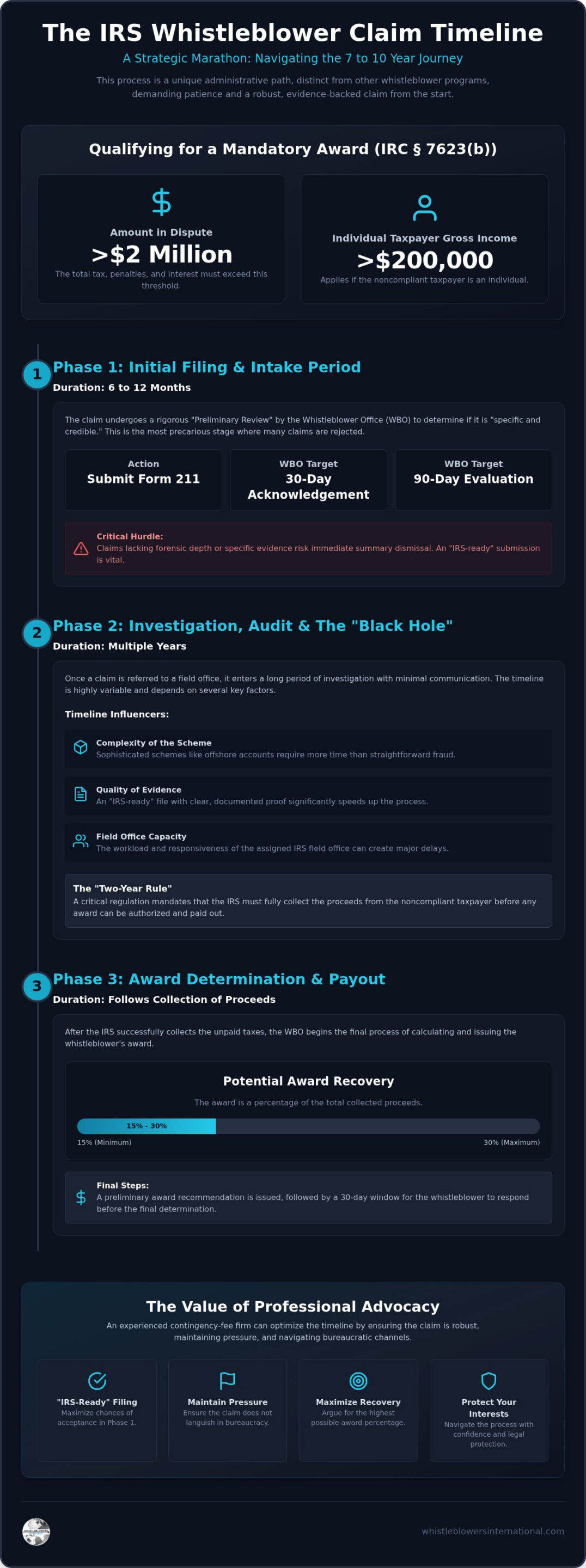
For a claim to qualify for a mandatory award under IRC Section 7623(b), the amount in dispute must exceed $2 million. If the noncompliant taxpayer is an individual, their gross income must also exceed $200,000 for any taxable year at issue. Meeting these thresholds shifts the award from the IRS’s discretion to a legal requirement, typically ranging between 15% and 30% of collected proceeds. Our firm approaches these cases with a battle-tested perspective, ensuring every filing is robust enough to survive years of internal government scrutiny. We focus on uncovering the specific evidence that IRS agents need to initiate an audit, which reduces the likelihood of your claim being rejected during the preliminary review.
The Role of the IRS Whistleblower Office (WBO)
The IRS Whistleblower Office acts as the primary gatekeeper for every Form 211 submission. It’s responsible for the initial intake and determining whether a case is referred to a specific field office for audit. The WBO serves as the central hub for claim evaluation as of 2026. This office manages the transition of claims from initial receipt to final award determination, ensuring that the legal requirements for mandatory payments are met before funds are disbursed. Because the WBO handles thousands of claims annually, its internal priorities can fluctuate based on legislative changes or shifting enforcement goals.
Timeline Variables: What Accelerates or Slows Your Claim
Several factors influence how quickly your case moves through the system. While the IRS whistleblower claim timeline is notoriously long, certain elements can mitigate or exacerbate delays:
- Complexity of the Scheme: Investigations into hidden offshore accounts or sophisticated corporate tax shelters naturally take longer than straightforward payroll fraud cases because they require specialized forensic analysis.
- Evidence Quality: A filing that is “IRS-ready” with clear, documented proof reduces the time investigators spend during the intake phase and helps them build a stronger case faster.
- Field Office Capacity: The responsiveness and workload of the specific IRS field office assigned to the audit can create significant variations in the timeline, as some regions are more heavily burdened than others.
Phase 1: Initial Filing and the Intake Period
Once you mail Form 211 to the Ogden office, the IRS whistleblower claim timeline enters its most precarious stage: the intake period. This window, typically spanning the first 6 to 12 months, serves as the government’s defensive filter. The Whistleblower Office (WBO) does not simply file your submission; it performs a rigorous “Preliminary Review” to determine if your information is “specific and credible” rather than speculative. If the initial filing lacks necessary forensic depth, the WBO may reject the claim immediately, resulting in a summary dismissal that ends your pursuit before it truly begins. Precision is paramount during these early months.
According to official IRS processing timeframe targets, the WBO aims to send an acknowledgement letter within 30 days and complete the initial evaluation within 90 days. However, these targets are internal benchmarks and do not guarantee a fast-tracked result. Common intake hurdles, such as incomplete documentation or vague allegations of “tax cheating” without supporting data, often add years to the process. To avoid these delays, your submission must be “IRS-ready” from day one. Engaging an IRS whistleblower lawyer ensures that your evidence is organized in a manner that aligns with current investigative priorities.
Form 211: The Foundation of Your Timeline
The technical accuracy of Form 211 dictates the next five years of your case. A frequent mistake involves the “insider information” trap, where whistleblowers inadvertently include documents protected by attorney-client privilege or other legal shields. If the IRS identifies “tainted” information, the entire claim may be sidelined for an extensive ethical review, causing the IRS whistleblower claim timeline to stall indefinitely. We meticulously vet every piece of evidence to ensure it’s legally obtainable and highly persuasive to federal investigators. If you have concerns about the sensitivity of your data, you should consult with a strategic investigator who understands these nuances.
Referral to the Field: The Transition to Audit
If your claim passes the preliminary review, the WBO decides which IRS division will handle the investigation. This is usually the Small Business/Self-Employed (SB/SE) division or the Large Business and International (LB&I) division. The notification of referral is a critical milestone, though the information shared with you is limited. Under the Taxpayer First Act, whistleblowers in 2026 receive more transparency than in previous decades, including updates when a case is referred for audit. This shift provides a much-needed pulse check, confirming that your claim has moved from a desk in Ogden to an active investigative team in the field.
Phase 2: Investigation, Audit, and the “Black Hole”
Once your claim passes the initial intake filters described previously, it transitions into the most opaque and resource-intensive stage of the process. This investigation window typically spans three to five years, a duration necessitated by the meticulous nature of federal tax audits and the forensic examination of complex financial records. This phase is widely known as the “black hole” because Section 6103 privacy rules strictly prohibit the IRS from sharing specific audit details with the whistleblower. While the silence can be unsettling, it is the procedural standard for all active cases within the IRS Whistleblower Office. At Piacentile & Associates LLP, we navigate this period of limited visibility by maintaining professional contact with agency analysts to ensure your claim remains a priority and that any administrative hurdles are addressed before they extend the IRS whistleblower claim timeline.
A critical, yet often overlooked, component of this phase is the “Two-Year Rule.” Even after the IRS concludes an audit and secures a signed agreement from the taxpayer, the law generally requires the government to wait for the taxpayer’s statutory right to claim a refund to expire. This ensures that the proceeds are final and legally protected from future clawbacks before the award determination begins. Our role is to provide the protective reassurance needed to endure this wait, ensuring that the strategic foundation laid during the intake phase survives the years of government scrutiny.
The Audit and Appeals Process
The target taxpayer’s legal right to challenge IRS findings can introduce substantial delays to the IRS whistleblower claim timeline. If a taxpayer disagrees with the audit results, they may enter the IRS Appeals process, which frequently adds two or more years to the timeline. In high-stakes cases where the dispute reaches the U.S. Tax Court, the process can extend even further as judicial proceedings unfold. Because the IRS cannot share these details, you may not know your case is in litigation until it concludes. Piacentile & Associates LLP draws on our experience as strategic investigators to interpret the subtle signals of a claim’s progress, providing clarity where the government provides none.
Final Collection: The Trigger for Your Award
An award cannot be determined until the IRS has secured “collected proceeds” in the U.S. Treasury. This term is defined broadly to include back taxes, penalties, interest, and certain criminal fines or civil forfeitures. The statutory requirement is absolute; the money must be physically collected before the award determination process begins. The IRS cannot pay awards from uncollected assessments. This ensures that the government only pays out a percentage of funds that have actually been recovered, aligning the interests of the whistleblower with the successful financial resolution of the case.
Phase 3: Award Determination and Final Payout
Once the “Two-Year Rule” expires and the Treasury confirms receipt of the funds, the IRS whistleblower claim timeline enters its final administrative stage. This is the final leg of a long journey. Once the Treasury secures the funds, the Whistleblower Office (WBO) shifts its focus from the taxpayer’s conduct to the whistleblower’s contribution. It’s a period of intense financial calculation where the government determines your precise award percentage within the mandatory 15% to 30% range. You’ll first receive a Preliminary Award Recommendation (PAR), which outlines the proposed award and the reasoning behind the percentage. This document is critical; you have a strict 30-day window to respond with comments or additional evidence if you believe the recommendation undervalues your contribution.
After the WBO reviews any responses to the PAR, it issues a Final Award Determination. This is the last formal hurdle before the check is authorized. While the administrative process is methodical, it ensures that your reward is legally sound and protected from subsequent challenges. Precision matters here. In 2026, managing the tax implications of the award itself is a vital consideration. These awards are taxable income, and strategic planning is necessary to preserve the maximum amount of your recovery. If you’re currently in the middle of a multi-year wait, securing an elite advocate can help ensure you’re prepared for this final transition.
Factors Influencing the Award Percentage
The WBO uses a specific set of criteria to determine where your claim falls on the 15% to 30% spectrum. Positive factors that can push your award toward the higher end include providing high-quality documentation that saves the IRS significant investigative resources, uncovering entirely new tax avoidance schemes, or offering ongoing cooperation throughout the audit. Conversely, negative factors may reduce the award. If a whistleblower “planned and initiated” the tax fraud or delayed reporting the noncompliance for an unreasonable period, the IRS may cap the award at the lower end of the scale. You can use our whistleblower award percentage calculator to better understand how these variables might impact your potential recovery.
Notification Rights Under the Taxpayer First Act
The Taxpayer First Act has significantly improved the transparency of the IRS whistleblower claim timeline for those navigating the process in 2026. Historically, whistleblowers were often left in total isolation after filing their claim. Today, you possess specific notification rights that provide much-needed visibility into the “black hole” of the investigation. You have the right to be notified when a case has been referred for examination and, perhaps most importantly, when the taxpayer has made a payment toward the assessed liability. These updates don’t reveal sensitive taxpayer data, but they confirm that your information is active and that the government is successfully collecting the proceeds that will eventually trigger your payout.
Strategic Advocacy: How a Lawyer Optimizes the Timeline
Navigating a decade-long federal investigation requires more than just legal knowledge; it demands a strategic partnership with an advocate who has survived the process themselves. Dr. Joseph Piacentile brings a unique “battle-tested mentor” perspective to every case, having walked the path of a whistleblower before leading Piacentile & Associates LLP. This insider advantage allows us to anticipate the specific needs of federal investigators, presenting a “prosecutor-ready” case that minimizes the risk of your claim being sidelined. By leveraging sophisticated investigative techniques, we ensure that the initial submission is robust enough to withstand the years of scrutiny inherent in the IRS whistleblower claim timeline. We don’t just file forms; we build comprehensive evidentiary packages that demand action.
Protection is just as critical as the pursuit of an award. Filing through counsel provides a vital shield, allowing you to maintain anonymity while we handle high-stakes communication with the government. This layer of separation is essential for individuals who fear professional retaliation or personal risk during the long years an audit remains active. Piacentile & Associates LLP acts as a formidable ally, ensuring your identity is protected from the target taxpayer while we navigate the labyrinthine bureaucracy of the Internal Revenue Service.
Reducing Administrative Friction
One of the most effective ways to accelerate a claim is to eliminate the back-and-forth between the Whistleblower Office and the claimant. When evidence is structured methodically, it prevents analysts from requesting “clarifications” that can add months to the intake phase. We manage the delicate relationship with WBO analysts, ensuring they have exactly what they need to move a case toward the field offices. If you’re considering a filing, working with a whistleblower lawyer for federal programs can provide the technical precision required to bypass these common bureaucratic bottlenecks. This proactive management keeps the IRS whistleblower claim timeline moving forward rather than stalling due to avoidable administrative gaps.
The Contingency Fee Advantage
The 7-to-10-year journey of an IRS claim is a test of endurance that many individuals cannot face alone. Piacentile & Associates LLP operates on a contingency fee basis, which means we only get paid when you do. This aligns our interests perfectly for the long haul, ensuring our commitment remains resolute through every audit, appeal, and collection hurdle. We act as a strategic partner, providing the protective reassurance and technical expertise needed to see a case through to its final determination. If you possess information regarding high-value tax noncompliance, contact Piacentile & Associates LLP for a confidential case evaluation to begin your strategic pursuit of justice.
Navigating the Path to Recovery with Confidence
The journey from initial filing to final payout is a significant undertaking that requires both patience and precision. You’ve learned that the IRS whistleblower claim timeline is a multi-year marathon, but it’s one you don’t have to run alone. Success depends on the quality of your initial disclosure and the persistence of your legal counsel during the inevitable “black hole” of investigations. By understanding the triggers for award determination and leveraging the transparency provided by modern regulations, you can transform a period of uncertainty into a calculated strategic pursuit.
Piacentile & Associates LLP offers the elite advocacy necessary to manage these high-stakes complexities. Led by Dr. Joseph Piacentile, a former whistleblower and attorney, our firm provides a unique insider’s perspective and global investigative reach for complex tax fraud. Because we operate on a contingency-fee basis, our interests are perfectly aligned with yours; we only win if you win. Don’t let your discovery go unheard due to bureaucratic delays. Secure Your Professional IRS Whistleblower Evaluation today. You’ve taken a courageous first step, and we’re here to ensure your contribution is protected and properly valued.
Frequently Asked Questions
How long does a typical IRS whistleblower claim take from start to finish?
A typical claim takes between seven and ten years to reach a final resolution. This duration is dictated by the IRS’s internal audit cycles, the taxpayer’s right to appeal, and the statutory requirement that proceeds must be fully collected before an award is paid. While the IRS whistleblower claim timeline is lengthy, high-value cases involving mandatory awards under IRC Section 7623(b) are prioritized by the Whistleblower Office for their significant recovery potential.
Can the IRS whistleblower timeline be expedited?
While you cannot force the IRS to move faster, you can reduce administrative friction by submitting a “prosecutor-ready” evidence package. A well-organized filing with specific, documented evidence of tax noncompliance helps agents initiate audits without requesting time-consuming clarifications. Ensuring your Form 211 is technically perfect from the start prevents initial intake delays, which can otherwise add six to twelve months to the process.
What is the statute of limitations for reporting tax fraud to the IRS?
The IRS generally has three years to assess additional tax, which can be extended to six years if the taxpayer understates their gross income by more than 25%. However, there’s no statute of limitations for civil tax fraud or cases where a return was never filed. Once the tax is assessed, the IRS typically has ten years to collect the debt, which directly impacts the final payout timing for whistleblowers.
Will I be notified if the IRS decides not to pursue my claim?
Yes, you’ll receive a formal notification if the Whistleblower Office decides not to pursue your claim. This usually arrives as a rejection letter during the preliminary review or a denial letter if the investigation concludes without a collection of proceeds. Under the Taxpayer First Act, whistleblowers in 2026 benefit from increased transparency, including updates when a case is referred to a field office or when a payment is made by the target.
What happens to the timeline if the taxpayer files for bankruptcy?
A taxpayer filing for bankruptcy introduces significant judicial delays to the IRS whistleblower claim timeline. The IRS must participate in bankruptcy proceedings as a creditor to secure its portion of the remaining assets. Because award payouts are contingent upon the actual collection of proceeds, the timeline remains paused until the bankruptcy court finalizes the distribution of funds and the IRS physically receives its share in the Treasury.
How does the $2 million threshold affect the processing of my claim?
The $2 million threshold is the gateway to mandatory awards under IRC Section 7623(b). If the tax, penalties, and interest in dispute exceed this amount, the IRS is legally required to pay an award of 15% to 30% upon collection. Claims below this threshold fall under the discretionary program, where awards aren’t guaranteed and the administrative priority is often lower, potentially leading to a less rigorous or slower investigation.
Are IRS whistleblower awards taxable?
IRS whistleblower awards are considered taxable income and must be reported on your federal tax return. In 2026, these payments are subject to standard income tax rates and may also be impacted by sequestration reductions. It’s essential to plan for these liabilities by consulting with financial experts, as the net recovery will be less than the gross award percentage determined by the Whistleblower Office during the final determination phase.
Can I report tax fraud anonymously through a lawyer?
You can maintain your anonymity during the initial filing and investigation phases by reporting through legal counsel. Your lawyer acts as the primary point of contact for the IRS, shielding your identity from the target taxpayer. While the IRS requires your identity for its records, Section 6103 privacy rules and specialized filing procedures through an elite firm ensure that your personal information is protected from disclosure to the noncompliant party.