
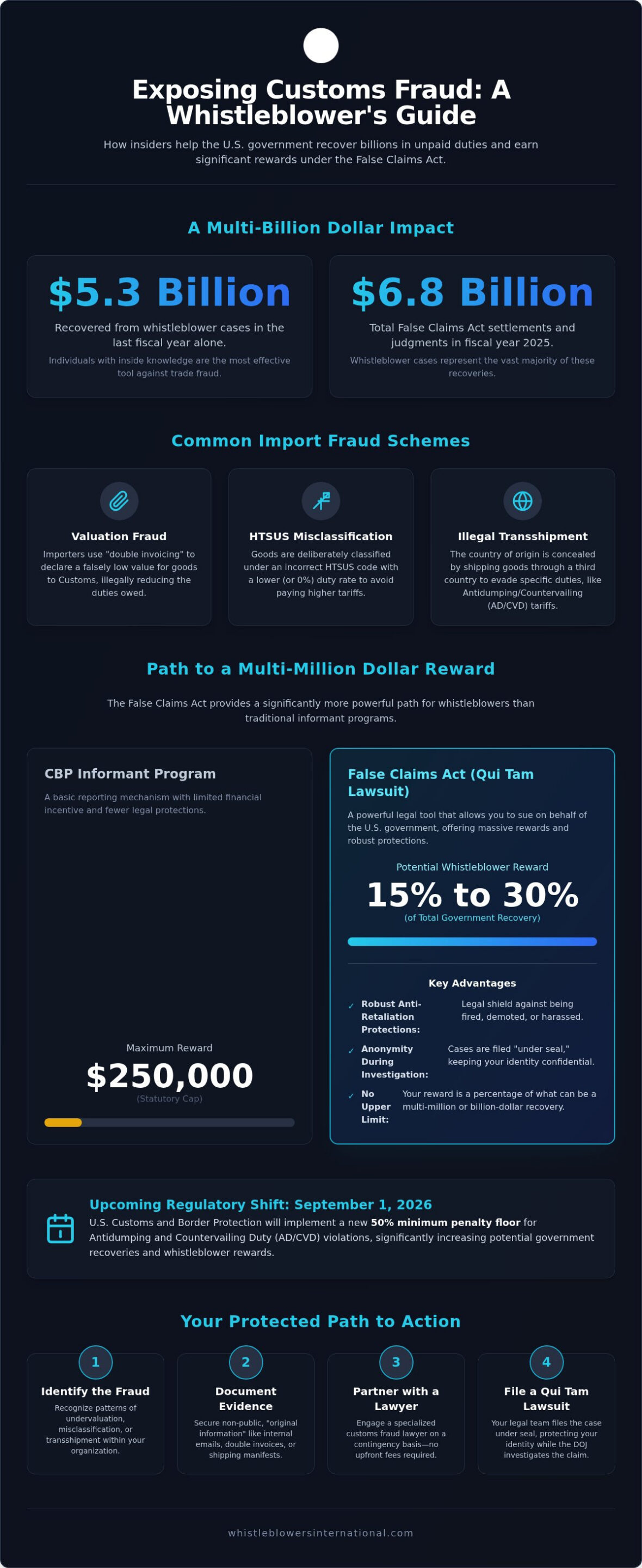
The U.S. government recovered more than $5.3 billion from whistleblower cases in the last fiscal year alone, proving that individuals with inside knowledge are the most effective weapon against international trade schemes. If you’ve uncovered evidence of undervaluing shipments or the misclassification of goods, you might be looking for a customs fraud lawyer to help you manage the immense personal and professional risks involved. It’s natural to feel overwhelmed by the density of HTSUS codes or the fear of retaliation. You recognize that these unfair practices harm the economy, yet the path to reporting them often feels buried under layers of legal bureaucracy.
This guide shows you how to navigate those complexities to secure a multi-million dollar reward under the False Claims Act. We’ll examine the 2026 regulatory shifts, such as the new 50% minimum penalty floor for violations, and explain why the 15% to 30% statutory reward through a qui tam lawsuit far exceeds the $250,000 cap of the CBP informant program. You’ll learn how to transform your observations into a protected legal action that ensures your anonymity while holding dishonest importers accountable.
Key Takeaways
- Understand how the False Claims Act transforms private knowledge into a powerful legal tool through Qui Tam lawsuits against trade violators.
- Identify sophisticated evasion tactics, including the manipulation of HTSUS codes and illegal transshipment, that qualify as actionable fraud.
- Partner with a seasoned customs fraud lawyer to pursue a whistleblower reward that typically ranges from 15% to 30% of the recovered funds.
- Master the specific protocols for documenting original information to ensure your evidence meets the high standards required by federal investigators.
- Leverage a risk-free contingency model that provides elite investigative resources and legal advocacy without any upfront financial commitment.
The Role of a Customs Fraud Lawyer in Protecting US Trade
Customs fraud is the intentional evasion of duties, taxes, or fees owed to the United States government during the importation of goods. It’s a deliberate effort to bypass federal revenue requirements through deception. This isn’t just an administrative error; it’s a sophisticated legal violation that undermines the financial integrity of the nation. A customs fraud lawyer serves as the bridge between an individual observer and the complex machinery of federal enforcement, ensuring that evidence of such evasion is presented effectively to the right authorities.
The False Claims Act (FCA) provides the primary legal framework for addressing these violations. It allows private citizens to file “Qui Tam” lawsuits on behalf of the government, essentially acting as private attorneys general. If the government recovers funds based on your unique information, you’re entitled to a significant portion of that recovery. Customs fraud, as defined under the False Claims Act, involves the knowing submission of false records or the use of deceptive statements to avoid, decrease, or conceal an obligation to pay legally mandated duties to the federal government.
Navigating the Department of Justice (DOJ) and Customs and Border Protection (CBP) requires a meticulous approach that only a seasoned professional can provide. Choosing a specialized customs fraud lawyer ensures that your disclosure meets the strict “original information” requirements necessary to qualify for a reward. These advocates manage the procedural hurdles that often discourage individuals from coming forward, translating raw evidence into a compelling legal narrative that triggers federal action.
The Impact of Trade Fraud on the National Economy
Trade fraud isn’t a victimless crime. It creates a skewed marketplace where honest domestic manufacturers cannot compete with entities that artificially lower their costs through illegal duty evasion. The Department of Justice reported over $6.8 billion in False Claims Act settlements and judgments in FY2025, with over $5.3 billion recovered from whistleblower cases. Billions in tariffs remain uncollected every year because these schemes are designed to be invisible to traditional audits, making insiders the government’s most valuable asset in recovering lost revenue. While whistleblowers address illegal evasion, legitimate businesses can also seek to recover funds through legal avenues like Trump Tariff Relief, which assists with IEEPA tariff refund claims.
Safety is a paramount concern for anyone considering this path. The FCA includes robust anti-retaliation provisions to protect employees from discharge, demotion, or harassment. This framework is reinforced by broader standards like the Whistleblower Protection Act, which establishes a culture of accountability for those exposing corruption. Cases are filed “under seal,” meaning the lawsuit remains secret while the government conducts its investigation. This protocol allows your identity to remain confidential during the most sensitive phases of the inquiry, shielding you from professional repercussions while the case develops.
Common Import Schemes: From Undervaluation to Transshipment
Sophisticated importers use a range of deceptive techniques to circumvent federal duties and gain an unfair competitive advantage. These schemes aren’t simple administrative errors; they’re calculated attempts to manipulate the Harmonized Tariff Schedule of the United States (HTSUS). By misclassifying a product under a code with a 0% duty rate instead of the correct 25% rate, a company can illegally retain millions in unpaid taxes. If you’ve observed these patterns, consulting a customs fraud lawyer is the first step in determining if the conduct constitutes a violation of the False Claims Act.
One of the most high-stakes areas involves Antidumping and Countervailing Duties (AD/CVD). These duties protect domestic industries from foreign goods sold at less than fair value or those subsidized by foreign governments. Evading these specific duties is a top priority for federal enforcement. As of September 1, 2026, U.S. Customs and Border Protection has implemented a minimum penalty floor of 50% for such violations, making the potential recovery for a whistleblower even more significant. Identifying these discrepancies requires a deep understanding of trade policy and financial auditing.
Valuation Fraud and Double Invoicing
Valuation fraud often involves “double invoicing” to deceive the government. In this scenario, an importer receives two sets of invoices from a supplier. The first reflects the actual purchase price, while the second shows a lower value intended for CBP scrutiny. Evidence of this fraud is typically found in side agreements or internal financial ledgers that contradict official entry documents. If you have access to wire transfer data showing payments that exceed the amounts listed on customs declarations, you possess the “original information” necessary to report suspected trade violations and qualify for a reward.
Transshipment and Country-of-Origin Fraud
Illegal transshipment is the process of routing goods through a neutral third country to disguise their true origin. This tactic is frequently used to avoid high Section 301 duties by moving products through nations like Malaysia or Vietnam before they reach the U.S. Importers may claim that “light assembly” in the intermediate country constitutes a substantial transformation, but if the work is merely cosmetic, the country of origin remains the same. Identifying these fraudulent supply chains requires an investigative mindset. For those ready to expose these practices, speaking with a customs fraud lawyer at whistleblowersinternational.com can help clarify the legal protections and financial incentives available to you.
Whistleblower Rewards: The Financial Incentives for Reporting
The financial incentives for reporting international trade violations are designed to reflect the significant personal and professional risks whistleblowers undertake. Under the False Claims Act, individuals who provide original information regarding customs fraud are eligible for a percentage of the government’s total monetary recovery. This isn’t a flat fee; it’s a statutory entitlement that recognizes the whistleblower’s role in restoring fair competition. Working with a dedicated customs fraud lawyer is essential to maximizing this percentage, as the government evaluates the quality of the evidence and the degree to which the whistleblower contributed to the case’s success.
The statutory range for rewards is clearly defined. If the Department of Justice chooses to intervene in the case, the whistleblower typically receives between 15% and 25% of the recovered funds. For example, the $54.4 million Ceratizit USA LLC settlement resulted in the whistleblower receiving approximately 18% of the recovery. If the government declines to intervene and the whistleblower proceeds independently with their legal team, the award can increase to a range of 25% to 30%. For a detailed breakdown of how these figures are calculated, you can review Whistleblower Award Percentages: What to Expect.
What Constitutes a Successful Recovery?
A successful recovery includes more than just the unpaid duties originally owed to the government. It encompasses the base duties, accrued interest, and substantial civil penalties. Under the FCA, the court can impose “treble damages,” which effectively triples the amount of the evaded duty. This multiplier significantly increases the potential award for the informant. While the financial results can be life-changing, it’s important to understand the timeline. Recoveries are paid out only after a final settlement is reached or a court judgment is satisfied, a process that requires patience and methodical legal strategy.
Representing Foreign Nationals in Trade Fraud Cases
You don’t need to be a U.S. citizen to qualify for a reward. The False Claims Act protects and rewards foreign nationals who report fraud against U.S. agencies, even if the deceptive acts occurred entirely outside of U.S. borders. Given the global nature of modern supply chains, many key witnesses work for foreign exporters or logistics providers. An elite customs fraud lawyer coordinates the collection of international evidence, ensuring that disclosures from abroad meet the rigorous standards of U.S. federal courts while prioritizing the whistleblower’s safety and confidentiality. In jurisdictions like Australia, for instance, firms such as Aquarius Lawyers provide the specialized commercial and property law expertise often required to navigate the local complexities of international trade investigations.
Reporting international trade violations requires a strategic approach that prioritizes your safety while preserving the integrity of the evidence. When you uncover evidence of duty evasion, the impulse is often to act immediately; however, a reckless approach can disqualify you from a reward or even create personal legal liability. A customs fraud lawyer provides the necessary oversight to ensure that the information you gather is “original,” meaning it’s not already known to the government or derived from public sources. You should avoid “self-help” discovery that involves unauthorized access to secure databases or the theft of physical files, as these actions can compromise the legal standing of a future case. To ensure you follow the correct protocols from the start, refer to our guide on How to Document Corporate Fraud Correctly.
Identifying Key Evidence for Customs Cases
Successful cases are built on concrete documentation that proves a deliberate intent to defraud. You should look for specific records that highlight discrepancies between what was imported and what was declared. With CBP on pace to conduct 543 audits in FY 2026, a 17% increase from the previous year, the government is actively seeking high-quality leads. Focus your efforts on the following materials:
- Financial Records: Double invoices, wire transfer confirmations, and side agreements that show the true purchase price of goods.
- Classification Data: Internal communications or HTSUS records that reveal a pattern of mislabeling products to avoid higher duty rates.
- Logistics Documents: Shipping manifests and bills of lading that show the actual route of a shipment, which is critical for proving illegal transshipment.
- Internal Communications: Emails or memos discussing “tariff avoidance” or “duty optimization” strategies that indicate a knowing violation of the law.
The Dangers of Reporting Without Legal Counsel
Many individuals mistakenly believe that reporting directly to a government tip line is the most efficient path. While well-intentioned, doing so without a formal qui tam filing under the False Claims Act can prevent you from receiving a statutory award. There’s also the risk of the “public disclosure” bar; if the details of the fraud become known through public channels before your filing, your case may be dismissed. An experienced customs fraud lawyer acts as a protective shield, managing all interactions with federal agencies to maintain your anonymity and ensure your filing is legally sound. If you’re ready to review your evidence with an expert, contact our team for a confidential evaluation.
Global Advocacy: Why Choose a Contingency-Based Attorney
The prospect of confronting a multinational corporation or a massive import entity is daunting, especially when considering the potential for high legal fees. This is why our firm operates on a contingency fee basis. We only receive payment if you successfully secure a whistleblower award. This model removes the financial barrier to justice, allowing individuals to pursue high-stakes claims without the burden of hourly consulting costs. A customs fraud lawyer at our firm doesn’t just provide legal advice; we become your strategic partner in a complex international investigation, aligning our success entirely with yours. We assume the financial risk of the litigation, ensuring that your path to justice is not restricted by your current financial resources.
Our firm is positioned as a powerhouse capable of handling massive trade complexities across multiple jurisdictions. We recognize that trade fraud often involves intricate webs of offshore accounts and shell companies designed to frustrate federal auditors. Because we represent clients globally, we’ve developed the infrastructure to manage evidence collection and legal filings regardless of where the fraud originated. This elite level of advocacy ensures that your case is treated with the gravity it deserves by the Department of Justice. We bridge the gap between local observations of fraud and the global enforcement mechanisms required to hold sophisticated violators accountable.
The Advantage of Elite Investigative Resources
Our team provides a unique perspective that few other firms can match. We leverage the expertise of former whistleblowers and seasoned investigators who understand the “insider” reality of these cases. By using advanced forensic accounting, we uncover hidden financial trails that standard audits often miss. Working with an elite customs fraud lawyer ensures that raw data is transformed into a compelling legal narrative. This meticulous case development is designed to maximize the value of your claim by highlighting the full scope of the government’s losses. We don’t just file papers; we build comprehensive investigative files that provide federal authorities with a clear roadmap to recovery.
Starting Your Claim: The Initial Consultation
Your journey begins with a confidential, risk-free consultation where we evaluate the strength of your evidence and the potential value of the case. It’s vital to act quickly because the False Claims Act follows a “first to file” rule. If another individual reports the same fraud before you do, you could lose your eligibility for a reward entirely. During this initial meeting, we assess the specific HTSUS violations involved and the likelihood of government intervention. We understand the professional risks you face, and our priority is to provide a protective shield while we build a formidable case on your behalf. This early assessment is critical for establishing a secure legal foundation for your future.
Contact Piacentile & Associates LLP for a confidential case evaluation to discuss your findings and learn how our contingency-based model can support your pursuit of a whistleblower reward.
Protecting Global Trade and Your Financial Future
Exposing sophisticated trade schemes requires more than just an observation of wrongdoing; it demands a strategic alignment with experts who understand the high stakes of federal litigation. You’ve seen how the False Claims Act provides a robust framework for recovering lost revenue while offering you a significant share of the proceeds. If you identify patterns of undervaluation or illegal transshipment, you’re positioned to stop practices that undermine honest domestic manufacturers and the broader economy.
Partnering with a specialized customs fraud lawyer ensures that your identity remains protected under seal while we utilize forensic accounting and global investigative resources to validate your claims. Our firm provides contingency-based representation, which means there’s no fee unless you win. With decades of experience in federal False Claims Act litigation and an elite investigative team, we’re prepared to manage the most complex trade violations. Secure Your Professional Future: Contact Our Elite Whistleblower Team Today. Your courage to act is the first step toward accountability and a life-changing reward.
Frequently Asked Questions
What is the definition of customs fraud under the False Claims Act?
Customs fraud occurs when an importer knowingly uses false records or deceptive statements to avoid, decrease, or conceal an obligation to pay mandated duties to the federal government. This is often called a “reverse false claim” because the fraud involves withholding money owed to the treasury. It includes actions like misrepresenting the value, origin, or classification of goods to evade tariffs, which directly violates the integrity of the U.S. trade system.
How much is the whistleblower reward for reporting customs duty evasion?
Whistleblowers are entitled to 15% to 30% of the total amount recovered by the government. The specific percentage depends on whether the Department of Justice intervenes in the case. If the government joins the lawsuit, the reward typically ranges from 15% to 25%. If you proceed independently with your customs fraud lawyer, the award can increase to 30%. These rewards are calculated based on the combined total of unpaid duties, interest, and penalties.
Can I report customs fraud anonymously?
You can report fraud with a high degree of confidentiality by filing your lawsuit “under seal.” This legal protocol ensures that the complaint remains secret while the government conducts its initial investigation, often for several years. Your identity isn’t disclosed to the defendant or the public during this period. An experienced attorney manages all communications with federal investigators to maintain this protective shield and prioritize your professional safety throughout the investigative process.
Do I need to be a US citizen to qualify for a whistleblower reward?
You don’t need to be a U.S. citizen or resident to qualify for a reward under the False Claims Act. The law has a global reach, protecting individuals worldwide who report fraud against U.S. government agencies. Many successful cases are initiated by foreign nationals who work for international exporters or logistics providers. As long as the fraud impacts U.S. federal revenue, you’re eligible for the same statutory rewards as a citizen.
How much does it cost to hire a customs fraud lawyer?
Hiring a customs fraud lawyer at our firm involves no upfront costs or hourly fees. We operate exclusively on a contingency fee basis, which means we only receive payment if we successfully secure a monetary award for you. Our fee is a pre-agreed percentage of the final whistleblower reward. This model ensures that elite legal and investigative resources are accessible to everyone, regardless of their personal financial situation or geographic location.
What are the most common types of import fraud reported by whistleblowers?
Whistleblowers frequently report schemes such as undervaluation, where importers submit false invoices to pay lower duties. Other common violations include the misclassification of goods using incorrect HTSUS codes and illegal transshipment to disguise a product’s true country of origin. Evasion of Antidumping and Countervailing Duties (AD/CVD) is also a high priority, especially following the 2026 implementation of a 50% minimum penalty floor for such trade violations.
How long does a customs fraud whistleblower case typically take?
A typical whistleblower case can take several years to reach a resolution. The process begins with a detailed investigative phase where the government evaluates your evidence while the case remains under seal. If the Department of Justice decides to intervene, negotiations or litigation can extend the timeline further. While the duration requires patience, your legal team handles the procedural complexities, allowing you to focus on your life while the case moves through the system.
What protections exist against retaliation for reporting trade fraud?
The False Claims Act provides robust protections against workplace retaliation. If an employer demotes, fires, or harasses you for participating in a whistleblower action, you’re entitled to legal remedies. These can include reinstatement at your previous seniority level, double back pay with interest, and compensation for litigation costs. These protections apply to employees, contractors, and agents, ensuring that those who stand up for trade integrity have a strong legal safety net.