
A whistleblower reward is not a lottery prize or a gift of government gratitude; it’s a calculated valuation of the investigative labor you’ve already performed. If you’re considering coming forward, you likely feel the weight of professional risk while wondering if the “percentage” mentioned in federal statutes will actually manifest as a life-changing recovery. It’s common to worry that your evidence might fall short of the threshold required for a maximum award, especially when you’re navigating the complexities of the False Claims Act or SEC programs. Understanding the specific factors that increase whistleblower reward percentages is the first step in mitigating that uncertainty.
This guide provides a clear roadmap to the highest possible reward tier by detailing the legal and strategic levers that drive percentages from the statutory minimum toward the 30% maximum. You’ll learn how the “cooperation multiplier” functions in 2026, why the SEC and CFTC now presume maximum awards for smaller cases, and how an elite legal advocate transforms raw data into a government-ready filing. We’ll validate the high-value nature of your information and explain how an attorney’s involvement directly influences the final percentage calculation. By the end of this analysis, you’ll understand exactly how to position your case for the most significant recovery possible.
Key Takeaways
- Understand the 2026 statutory ranges for programs like the False Claims Act and SEC, and how the government’s decision to intervene sets the baseline for your potential recovery.
- Identify the critical factors that increase whistleblower reward percentages, including the originality of your data and the presence of documented financial transactions that corroborate your claims.
- Maximize your “cooperation multiplier” by maintaining an active role in the investigation and providing technical clarity that conserves government resources.
- Align your reporting with current federal priorities, such as cybersecurity fraud or anti-money laundering violations, to increase the perceived deterrence value of your disclosure.
- Discover how an elite legal advocate builds a “government-ready” case and strategically negotiates for the maximum 30% payout during final award deliberations.
The Statutory Framework: Understanding Reward Ranges in 2026
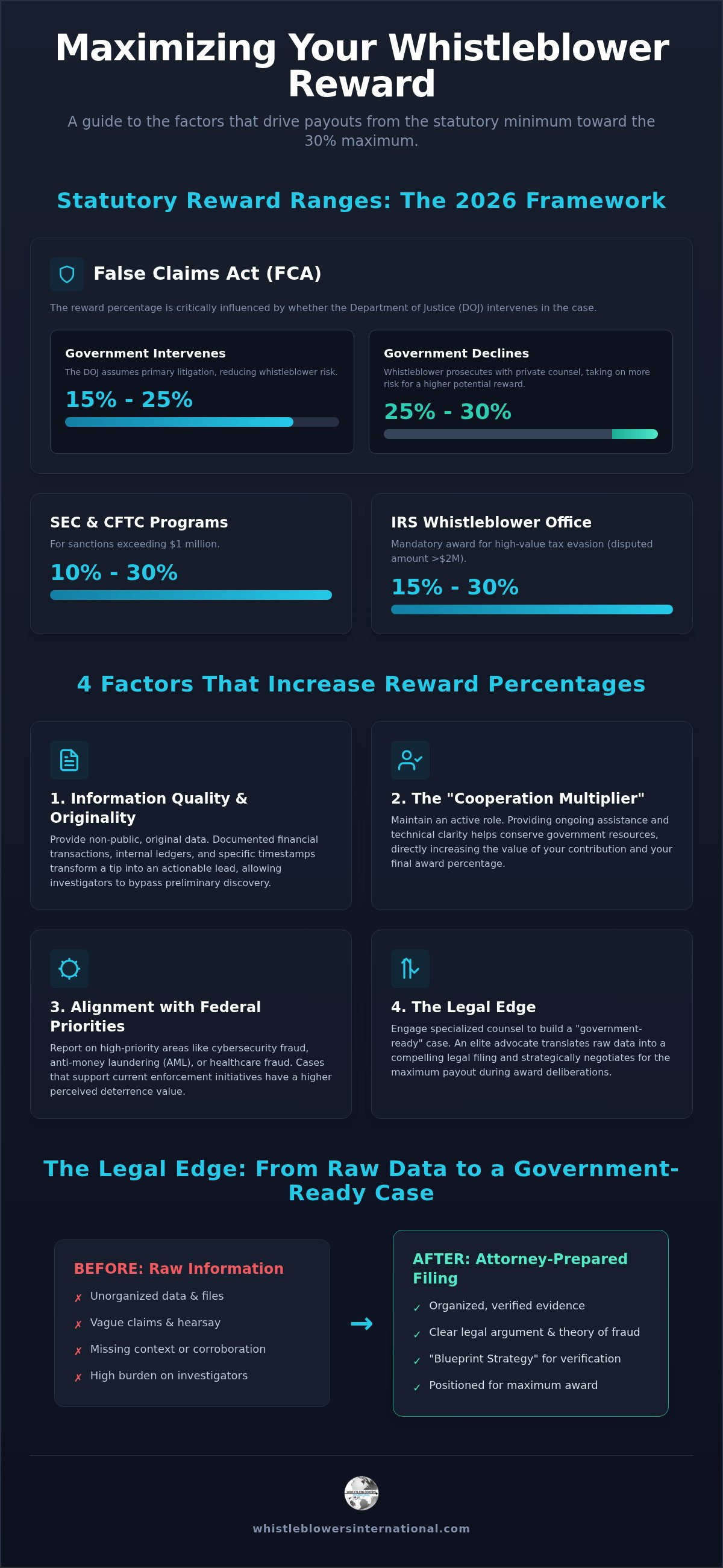
The legal landscape for whistleblowers in 2026 is defined by a series of statutory brackets that set the minimum and maximum recovery possible. Under the False Claims Act (FCA), which remains the cornerstone of government fraud litigation, whistleblowers are eligible for 15% to 30% of the total settlement or judgment. Other major programs, including those managed by the SEC and CFTC, generally offer between 10% and 30% of collected sanctions, provided the total recovery exceeds $1 million. The IRS Whistleblower Office operates under a mandatory award structure for high-value tax evasion, typically paying 15% to 30% when the disputed amount exceeds $2 million. Additionally, the April 2026 FinCEN proposal has aligned anti-money laundering rewards with these established 10% to 30% ranges, creating a more uniform incentive structure across federal oversight bodies. Understanding these brackets is the first step in identifying the specific factors that increase whistleblower reward percentages within those legal limits.
Intervened vs. Non-Intervened Cases
Government intervention is a critical variable that shifts both the floor and the ceiling of your potential recovery. If the Department of Justice (DOJ) chooses to “intervene” in an FCA case, the government assumes the primary burden of litigation, and the whistleblower’s share is typically 15% to 25%. However, if the government declines to intervene, and you choose to prosecute the case with private counsel, the reward range increases to 25% to 30%. This higher tier compensates for the increased risk and financial resources required to pursue a case without direct government backing. While government intervention brings massive investigative power, proceeding on a non-intervened basis often yields a higher percentage of the final recovery for the whistleblower.
The ‘Mandatory’ vs. ‘Discretionary’ Thresholds
Reward eligibility often hinges on specific monetary thresholds that dictate whether an agency is legally required to pay an award. For example, the IRS mandatory program requires the tax, penalties, and interest to exceed $2 million; if the taxpayer is an individual, their gross income must also exceed $200,000 for at least one of the tax years in question. Cases falling below these figures are considered “discretionary,” where the agency has more latitude in determining the payout. These rules are a fundamental component of Whistleblower Protection in the United States, ensuring that those who expose significant fraud are guaranteed a seat at the table. In 2026, regulatory updates have further protected the “reward floor” for whistleblowers who provide original information that was not previously known to the government, even in cases where agency discretion is involved.
Information Quality: How Evidence Drives Higher Reward Percentages
The core of any successful claim is the quality and “originality” of the evidence provided. Federal agencies prioritize information that isn’t derived from public sources like news reports or judicial hearings. If you provide data the government couldn’t have obtained through its own standard oversight, you’ve satisfied the most critical of the factors that increase whistleblower reward payouts. Moving beyond hearsay is essential; documented financial transactions, internal ledgers, and specific timestamps transform a vague tip into an actionable investigative lead. This level of specificity allows federal agents to bypass the preliminary discovery phase and move directly toward enforcement.
Industry-specific knowledge acts as a powerful multiplier for your recovery. When an insider can decode complex accounting fraud or technical “workarounds” that hide illicit activity, the government’s job becomes significantly easier. The SEC Whistleblower Program FAQ clarifies that the significance of the information is a primary factor in determining the final award percentage. By applying what we call the “Blueprint Strategy,” you organize your evidence so an investigator can verify the fraud in hours rather than months. Engaging a team that understands how to document high-value fraud ensures your evidence meets these elite evidentiary standards from day one.
The Hierarchy of Evidence
Not all evidence carries the same weight in a federal filing. Primary documents, such as internal emails, signed contracts, and unaltered financial ledgers, sit at the top of the hierarchy. Secondary testimony is valuable, but it’s the “insider perspective” used to interpret those primary documents that proves a scheme’s intent. It’s vital to document corporate fraud correctly without violating privacy laws or attorney-client privilege. An experienced advocate helps you navigate this line, ensuring you gather the “smoking gun” evidence while maintaining the legal integrity of the case.
Conserving Government Resources
Resource conservation is the practice of presenting evidence so thoroughly that it minimizes the time, personnel, and capital the government must expend to prosecute a case. This metric is the primary lever for upward award adjustments toward the 30% maximum. When you provide a “ready-to-file” complaint that includes a detailed roadmap of the misconduct, you’re essentially doing the government’s investigative work for them. Agencies are far more likely to grant a higher percentage to a whistleblower who conserves their limited resources by delivering a case that’s already reached a high level of validation and scrutiny.
The Cooperation Multiplier: Assistance as a Strategic Asset
Government agencies view a whistleblower’s ongoing cooperation as a primary indicator of the case’s value. While providing a high-quality tip is the initial step, your availability for depositions, interviews, and technical data clarification acts as a significant multiplier for the final payout. Statutory frameworks specifically reward individuals who provide continuous, high-level assistance that conserves federal investigative resources. If you remain actively engaged throughout the lifecycle of the case, you’re addressing one of the most influential factors that increase whistleblower reward percentages. This assistance often requires a bridge between your insider knowledge and the government’s legal requirements, where experienced counsel serves as a “translator” to ensure every technical nuance is correctly understood by federal agents.
Timeliness is another statutory factor that can significantly elevate or depress your recovery. Reporting misconduct immediately, rather than waiting for an investigation to begin independently, signals to the government that your motivations align with the public interest. In 2026, enforcement agencies have become increasingly sensitive to the “first-to-file” rule and the speed of disclosure. By authorizing others in your professional network to assist or provide corroborating evidence, you strengthen the government’s position and demonstrate a commitment to a comprehensive resolution of the fraud.
Proactive vs. Passive Assistance
The distinction between proactive and passive assistance often determines whether you receive the statutory minimum or the 30% maximum. Passive assistance involves simply answering questions when asked; proactive assistance involves identifying new leads, predicting defense arguments, and surfacing evidence the government hadn’t yet considered. Whistleblowers with specialized technical or financial expertise are particularly valuable in this regard, as they can guide investigators through complex proprietary systems. Many high-level insiders utilize a whistleblower lawyer contingency fee model to fund the investigative depth required to maintain this proactive stance without incurring upfront costs.
Mitigating Factors and Hardship
The government also considers the personal and professional toll of coming forward when calculating the final award percentage. If you’ve faced professional blacklisting, unique financial hardships, or significant personal risk, your attorney can use these factors to argue for a higher tier of compensation. Remediation efforts also play a role; if you attempted to stop the fraud through internal compliance channels before blowing the whistle, it demonstrates a high level of integrity. Even if you played a minor, non-leading role in the misconduct, self-reporting and providing full disclosure can mitigate your involvement and potentially increase your standing for a substantial award.
Enforcement Interests: Aligning with Government Priorities
The government’s decision to award a maximum percentage often rests on how well the case aligns with current federal enforcement priorities. Agencies like the SEC, IRS, and DOJ don’t merely evaluate the evidence; they assess the “deterrence” value of the action. If a case allows the government to send a powerful message to an entire industry, it’s viewed as a high-impact filing. Identifying these strategic priorities is one of the essential factors that increase whistleblower reward outcomes, as agencies are authorized to pay higher amounts for cases that serve a significant public interest or stop systemic fraud before it spreads. Furthermore, cases that present a “novel” legal theory or set a new judicial precedent are frequently rewarded at the higher end of the statutory range to compensate for the complexity and risk involved.
Reporting international bribery through an experienced FCPA whistleblower lawyer allows individuals to tap into a global framework designed to curb foreign corruption. In 2026, the reach of federal oversight has expanded, making international disclosures particularly valuable to agencies seeking to maintain the integrity of global markets. When a whistleblower provides a roadmap to overseas misconduct that the government could not have otherwise reached, the “originality” and “significance” of that information naturally drive the award percentage toward the 30% ceiling.
2026 Enforcement Trends
Current trends indicate a massive surge in AML and FinCEN priorities within the global banking sector. Following the April 2026 regulatory updates, the government has placed a premium on disclosures involving money laundering and Bank Secrecy Act violations. Similarly, targeting customs fraud lawyer priorities in import/export evasion has become a major focus for the DOJ as trade enforcement intensifies. Despite these newer areas of focus, healthcare and Medicare fraud remain the “gold standard” for high-percentage awards under the False Claims Act. The sheer volume of recovered taxpayer funds in these sectors ensures that whistleblowers who expose significant medical billing fraud are consistently positioned for top-tier recoveries.
The Public Interest Argument
Positioning your case as a “high-impact” action is a strategic necessity when arguing for a 25% to 30% payout. This involves quantifying the “harm prevented,” whether that harm is measured in lost tax revenue, investor losses, or risks to public health. Using the False Claims Act to highlight systemic risks to the government ensures that federal investigators recognize the broader implications of the fraud beyond the immediate dollar amount. If you possess information regarding high-priority federal violations, you should consult with a strategic whistleblower advocate to evaluate the potential impact and recovery tier of your case.
The Legal Edge: How specialized Counsel Maximizes the Payout
Specialized legal counsel acts as the final, and perhaps most significant, of the factors that increase whistleblower reward outcomes. While the government focuses on its own enforcement metrics, your attorney focuses exclusively on your recovery. An elite firm doesn’t just submit a tip; it constructs a comprehensive investigative packet that leaves little room for agency doubt. This “government-ready” approach ensures that federal investigators can validate the fraud efficiently, which is a primary driver for the maximum 30% payout. During the award determination phase, your advocate serves as a strategic negotiator, using the specific evidence of your cooperation and the “harm prevented” to argue for the highest possible tier. Counsel also provides a critical layer of anonymity, allowing you to file claims under the protection of an attorney-client relationship without immediately exposing your identity to the target of the investigation.
From Investigation to Litigation
The transition from uncovering fraud to successful litigation requires a roadmap that only those who’ve walked the path can provide. Piacentile & Associates LLP is led by Dr. Joseph Piacentile, a former whistleblower who understands the psychological and professional stakes involved. This insider perspective allows the firm to leverage advanced investigative techniques to uncover hidden fraud that standard audits might miss. Whether you’re navigating the complexities of IRS whistleblower lawyer filings or managing simultaneous SEC and FCA claims, this “Piacentile Advantage” ensures your case is built on a foundation of rigorous scrutiny. By translating your technical knowledge into a format that federal agents can immediately act upon, the firm reduces the government’s investigative burden and strengthens the argument for a top-tier award.
Securing Your Future
The final award determination process occurs after the government has successfully recovered the funds, often several years after the initial filing. During this phase, the agency evaluates the whistleblower’s contribution based on the specific criteria analyzed throughout this guide. Your attorney manages these expectations and protects your financial interests, ensuring the government’s final calculation reflects the true value of your assistance. Because elite firms operate on a contingency fee basis, their interests are perfectly aligned with yours; they’re incentivized to fight for every percentage point of the recovery. Protecting your privacy and financial future is the ultimate goal of high-stakes reporting. If you’re ready to explore your options, Contact Piacentile & Associates for a confidential evaluation of your case’s reward potential.
Securing Your Path to a Maximum Recovery
Achieving a top-tier payout in 2026 requires more than just a significant tip; it demands a strategic alignment of evidence quality, proactive cooperation, and a deep understanding of federal enforcement priorities. By focusing on the factors that increase whistleblower reward percentages, such as providing original documentation and conserving government resources, you move your claim from the statutory minimum toward the 30% maximum. This process is complex and carries inherent professional risks, but you don’t have to navigate the labyrinth alone. The right legal partner ensures that your disclosure is not just heard, but prioritized by the agencies capable of recovery.
Piacentile & Associates LLP offers the unique perspective of a firm led by Dr. Joseph Piacentile, a former whistleblower who has stood exactly where you are now. We specialize in high-value fraud across SEC, FCA, IRS, and FinCEN programs, operating on a contingency-fee basis where we only win if you win. Our team is dedicated to building government-ready cases that protect your anonymity while maximizing your financial recovery. Secure Your Maximum Whistleblower Reward: Speak with a Battle-Tested Attorney Today. Your decision to expose fraud is a profound service to the public interest, and we’re here to ensure you’re fully compensated for that courage.
Frequently Asked Questions
What is the average whistleblower reward percentage?
Statutory ranges for rewards typically fall between 10% and 30% of the government’s total recovery. In 2026, the SEC and CFTC often presume a 30% award for cases where sanctions are $5 million or less. For larger actions, the final percentage depends on specific factors that increase whistleblower reward tiers, such as the significance of the information and the level of assistance provided during the investigation.
Can my reward be decreased if I was involved in the fraud?
Yes, your reward can be reduced if you planned or initiated the misconduct. However, individuals with minor roles who provide full disclosure and proactive cooperation remain eligible for substantial awards. Total disqualification generally only occurs if you are criminally convicted for your role in the fraud. Strategic legal counsel helps frame your involvement as a mitigating factor while emphasizing the value of your testimony in stopping the scheme.
How long does it take to receive a whistleblower award after reporting?
The timeline for receiving an award typically spans several years. This duration accounts for the government’s investigative phase, any subsequent litigation or settlement negotiations, and the final award determination process. While 2026 regulatory updates aim to expedite certain filings, the complexity of high-stakes fraud means whistleblowers should prepare for a methodical progression. Your attorney manages this timeline, ensuring your interests are protected until the final distribution occurs.
Does the government always pay the maximum 30% reward?
The government does not automatically pay the 30% maximum; instead, it evaluates each case against a set of statutory criteria. While the SEC and CFTC have established presumptions for maximum payouts in smaller cases as of 2026, larger recoveries require a compelling argument. Factors such as the originality of your evidence and the resources saved by the agency determine whether you receive the minimum floor or the 30% ceiling.
Will I still get a reward if the government was already investigating the company?
You can still receive a reward if your information significantly contributes to an existing investigation. If your disclosure provides a new roadmap, identifies additional violations, or helps federal agents resolve the case more efficiently, you meet the criteria for a successful claim. The government recognizes that insider information often provides the technical clarity needed to turn a stalled investigation into a high-value enforcement action.
How much does a whistleblower lawyer cost?
Elite whistleblower law firms typically operate on a contingency fee basis. This structure means you don’t pay any upfront costs or hourly fees for legal representation. The firm only earns a fee if they successfully secure a monetary award for you, taking a predetermined percentage of that final recovery. This model ensures that high-level legal advocacy and investigative resources are available to individuals regardless of their current financial situation.
Can a foreign national receive a whistleblower reward from the U.S. government?
Foreign nationals are fully eligible for rewards under U.S. programs like the SEC, CFTC, and False Claims Act. As long as the misconduct involves violations of U.S. law or impacts U.S. markets, the whistleblower’s location or citizenship does not bar them from recovery. In 2026, international tips remain a top priority for federal agencies, especially those involving global banking, anti-money laundering violations, and foreign bribery schemes.
What happens to my reward if the case settles out of court?
Settlements are treated the same as court-ordered judgments for the purposes of whistleblower rewards. If a settlement results in the collection of monetary sanctions or the recovery of taxpayer funds, the whistleblower is entitled to their statutory share of that amount. Most high-value fraud cases in 2026 are resolved through settlements, yet these outcomes still trigger the same mandatory reward ranges and protection protocols as a trial victory.