
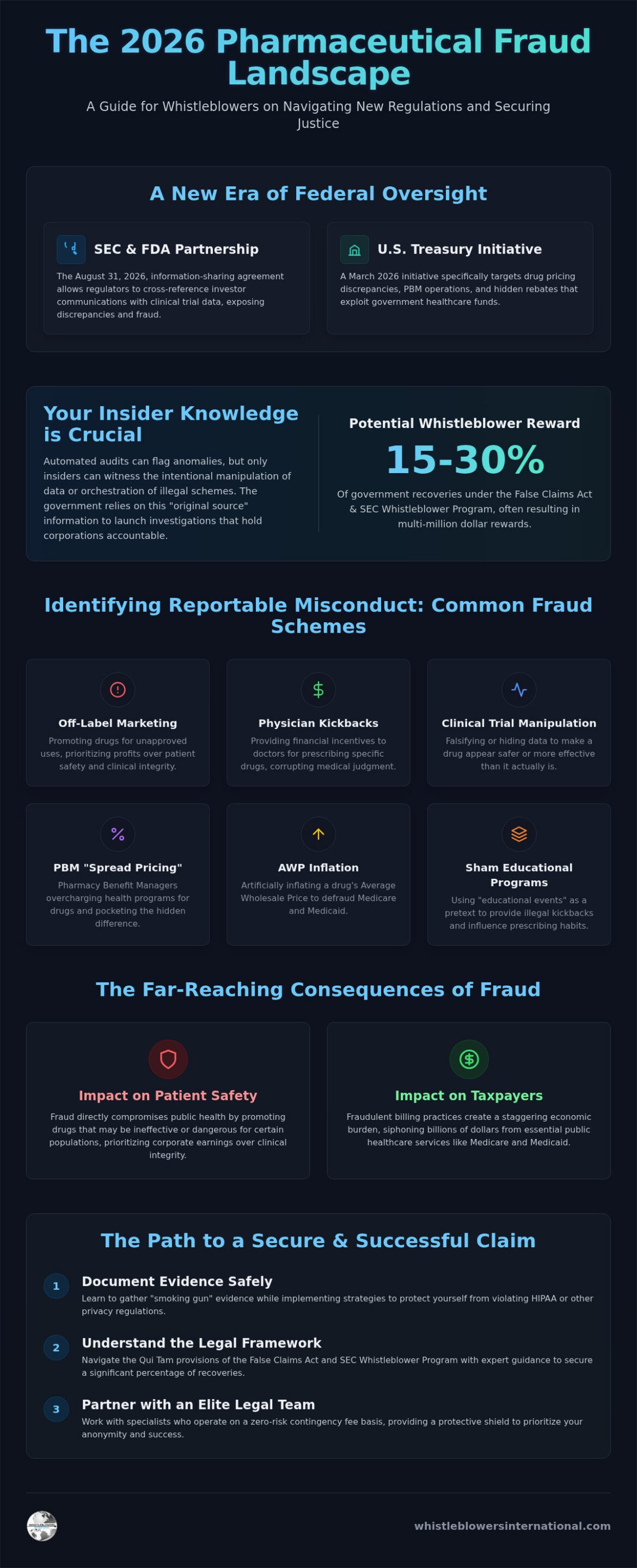
The formal information-sharing agreement signed between the SEC and FDA on August 31, 2026, has effectively stripped away the veil of secrecy that once protected fraudulent pharmaceutical practices. If you’ve uncovered evidence of clinical trial manipulation, off-label marketing, or sham educational programs, then you’re likely grappling with the fear of professional retaliation and the complexity of federal privacy laws. It’s a heavy burden to carry alone, especially when the stakes involve both public safety and your own career stability. By partnering with a specialized pharmaceutical fraud whistleblower lawyer, you can transform that internal conflict into a decisive legal action that secures your financial future while protecting your professional identity.
We understand that the decision to come forward is never simple, yet the potential for impact has never been greater following the U.S. Treasury Department’s 2026 healthcare fraud initiative. This guide provides a comprehensive roadmap for moving through the complexities of the False Claims Act and the SEC Whistleblower Program, ensuring you understand the path to securing rewards that typically range from 15% to 30% of government recoveries. You’ll learn how to document evidence without violating compliance protocols and how our firm’s unique insider perspective (rooted in our founder’s own experience as a whistleblower) provides a protective shield throughout the process. Our global reach and commitment to a contingency fee model mean you can pursue justice and multi-million dollar rewards without the weight of upfront legal costs.
Key Takeaways
- Understand how 2026 federal oversight has shifted toward Pharmacy Benefit Managers (PBMs) and drug pricing transparency, creating new avenues for reporting corporate misconduct.
- Learn to distinguish between standard business practices and illegal schemes, such as off-label marketing and physician kickbacks, that qualify for federal investigation.
- Discover how a pharmaceutical fraud whistleblower lawyer can help you navigate the Qui Tam provisions of the False Claims Act to secure a significant percentage of government recoveries.
- Identify the specific “smoking gun” evidence needed to build a case, while implementing strategies to protect yourself from violating HIPAA or other privacy regulations.
- Gain insight into the protective advantages of working with an elite legal team that operates on a zero-risk contingency fee basis to prioritize your anonymity and success.
The Evolution of Pharmaceutical Fraud in 2026: A High-Stakes Landscape
The pharmaceutical sector in 2026 is defined by a paradox of record-breaking innovation and unprecedented financial strain. As the costs associated with drug development continue to climb, corporate leadership often places unsustainable pressure on sales and marketing teams to deliver immediate returns. This environment creates a breeding ground for systemic misconduct. An experienced pharmaceutical fraud whistleblower lawyer recognizes that these pressures frequently manifest as sophisticated financial schemes designed to defraud government programs. Because pharmaceutical fraud remains the primary driver of recoveries under the False Claims Act, the federal government has intensified its scrutiny of corporate behavior.
Individual insiders remain the most effective weapon against these deep-seated practices. While automated audits can flag anomalies, they cannot replicate the nuance of an insider who witnesses the intentional manipulation of data or the orchestration of illegal kickbacks. If you’ve observed these activities, your perspective is the catalyst for holding massive corporations accountable. The government relies on this “original source” information to initiate high-stakes investigations that would otherwise remain hidden behind layers of corporate bureaucracy.
Emerging Fraud Trends in Drug Pricing and Rebates
In 2026, federal oversight has pivoted sharply toward the opaque operations of Pharmacy Benefit Managers (PBMs) and drug pricing transparency. One prevalent scheme involves “spread pricing,” where PBMs charge healthcare programs more for a drug than they pay the pharmacy, pocketing the undisclosed difference. Additionally, some manufacturers manipulate the Average Wholesale Price (AWP) to artificially inflate profits at the expense of Medicare Part D and Medicaid budgets. These hidden rebates and pricing distortions represent a massive drain on public resources, prompting a surge in Qui Tam and Whistleblower Reward Programs filings. The March 2026 U.S. Treasury Department initiative specifically targets these pricing discrepancies, signaling a new era of enforcement for those who exploit government healthcare funds.
The Consequences of Misconduct for Patients and Taxpayers
The impact of these schemes extends far beyond financial loss. When companies engage in off-label marketing or falsify clinical trial data, they directly compromise patient safety. These actions prioritize corporate earnings over clinical integrity, often leading to the prescription of medications that are either ineffective or dangerous for specific populations. The August 31, 2026, memorandum between the SEC and FDA highlights this risk, as it allows regulators to compare investor communications with clinical trial reports to uncover discrepancies. For taxpayers, the economic burden is staggering. Fraudulent billing practices siphon billions of dollars away from essential healthcare services. This dual threat to public health and the national treasury is why the Department of Justice continues to prioritize pharmaceutical interventions, relying on the expertise of a pharmaceutical fraud whistleblower lawyer to bring these cases to light.
Common Pharmaceutical Fraud Schemes: Identifying Reportable Misconduct
Identifying specific types of Common Pharmaceutical Fraud Schemes is the foundational step in building a viable legal case. While the industry is heavily regulated, corporations often develop complex methods to circumvent federal statutes to maintain market dominance. A pharmaceutical fraud whistleblower lawyer can help you determine if the irregularities you’ve observed constitute actionable fraud or merely aggressive business practices. Most reportable misconduct falls into four primary categories:
- Off-label marketing: Promoting medications for uses, dosages, or patient populations not approved by the FDA.
- Illegal kickbacks: Providing remuneration to physicians or organizations to influence prescribing habits.
- Manufacturing violations: Failing to comply with Current Good Manufacturing Practices (CGMP), which compromises drug safety.
- Best Price fraud: Withholding the deepest available discounts from the Medicaid program, which is legally entitled to the “best price” offered to private insurers.
Off-Label Marketing and Misleading Claims
It’s legal for a physician to prescribe a drug for an unapproved use, but it’s strictly illegal for a manufacturer to promote it for that purpose. Sales quotas often push representatives to use slanted clinical data to influence healthcare providers. In 2026, the legal standard for off-label promotion evidence requires proof of systemic corporate intent rather than isolated incidents by individual sales staff. If you have access to internal training manuals or emails that encourage reps to minimize risks or highlight unapproved benefits, you’ve likely uncovered a reportable scheme.
The Anti-Kickback Statute and Physician Incentives
The Anti-Kickback Statute prohibits any form of remuneration intended to induce the referral of patients or the prescription of specific medications. This often takes the form of sham consulting fees or speaker bureaus where physicians are paid for minimal work. More recently, electronic health record (EHR) software has been manipulated to provide “nudge” alerts that favor certain high-cost medications in exchange for manufacturer payments. Specialty pharmacies may also be used to facilitate these incentives through undisclosed volume discounts. These sophisticated arrangements are designed to hide the true nature of the financial relationship from federal auditors.
Manufacturing and FDA Approval Fraud
Falsifying clinical trial data during the FDA approval process is a direct violation of federal law that the government treats with extreme gravity. This “fraud on the FDA” compromises the entire regulatory framework and puts lives at risk. Similarly, failing to adhere to CGMP can lead to contaminated or ineffective products reaching the market. If you have evidence of data manipulation or purity failures, you’re observing misconduct that the Department of Justice prioritizes for intervention. Identifying these patterns is a complex undertaking, so you should speak with a legal professional to evaluate the strength of your evidence. Partnering with a pharmaceutical fraud whistleblower lawyer ensures your discovery is documented correctly without violating your professional obligations.
The Legal Mechanism: Qui Tam and Whistleblower Reward Programs
The primary legal instrument for addressing healthcare fraud is The False Claims Act. This statute includes a unique provision known as “Qui Tam,” which allows a private citizen to sue on behalf of the government. In this context, you aren’t just a witness; you’re an essential partner in federal enforcement. Engaging a seasoned pharmaceutical fraud whistleblower lawyer ensures that your filing meets the rigorous “original source” requirements necessary to qualify for a reward. This legal framework is designed to empower individuals with inside knowledge to bring corporate misconduct to light without bearing the financial burden of the litigation themselves.
Timing is paramount in these proceedings because of the “First to File” rule. Under this doctrine, if another individual reports the same fraud scheme before you do, you’re likely barred from receiving any portion of the recovery. This creates a high-stakes environment where early, decisive action is rewarded. Beyond the potential for a financial reward, the law provides robust safeguards against employer retaliation. Section 3730(h) of the False Claims Act protects employees from being fired, demoted, or harassed for investigating or reporting fraud. If an employer violates these protections, the whistleblower may be entitled to reinstatement, double back pay, and compensation for legal expenses.
Understanding the Qui Tam Lawsuit Process
When you initiate a case, you’re legally referred to as the “Relator.” The complaint is filed “under seal,” which means it remains confidential and is not served on the defendant while the Department of Justice (DOJ) conducts its initial investigation. This secrecy protects your identity and prevents the corporation from destroying evidence. The government then decides whether to “intervene” in the case. If the DOJ intervenes, it takes the lead in the litigation, which statistically increases the likelihood of a significant settlement. If they decline, you and your pharmaceutical fraud whistleblower lawyer can still pursue the case independently, though the risks and potential rewards shift accordingly.
Calculating Whistleblower Rewards and Percentages
Rewards are structured to incentivize the disclosure of high-quality evidence. For lawsuits filed under the False Claims Act that result in a government recovery, the Relator is eligible to receive between 15% and 30% of the total amount. The specific percentage depends on several factors, including the quality of the evidence provided and whether the government intervened. In cases where the government takes over, the reward typically ranges from 15% to 25%. If you proceed without government intervention and succeed, the reward can increase to 30%. You can consult our guide on whistleblower award percentages for a detailed breakdown of how these figures are determined in the 2026 regulatory environment.
How to Document Pharmaceutical Fraud Without Violating Privacy Laws
Gathering evidence against a multi-billion dollar corporation requires a surgical approach. If you overreach during the documentation phase, you risk violating HIPAA regulations or trade secret protections, which the corporation’s defense team will certainly use to discredit your testimony. A pharmaceutical fraud whistleblower lawyer acts as a strategic buffer, ensuring that your documentation process adheres to strict legal standards while maximizing the impact of your disclosures. It’s essential to understand that while you’re exposing corporate misconduct, you must remain compliant with the very laws designed to protect patient privacy and data integrity.
Identifying “smoking gun” documents is the key to a successful filing. These often include internal emails where management explicitly details sales targets for unapproved drug uses or spreadsheets tracking the return on investment for physician speaker bureaus. However, you should never remove original company documents or access files outside your normal job scope without direct legal guidance. Instead, maintaining a detailed, contemporaneous log of dates, names, and specific instructions provides a powerful narrative that corroborates your digital evidence. This log serves as a chronological record of the fraud as it unfolded, making it much harder for the defense to claim the misconduct was an isolated incident.
Evidence Checklist for Pharmaceutical Whistleblowers
Building a compelling case requires specific types of documentation that demonstrate systemic intent. Your evidence should ideally focus on the following areas:
- Direct evidence of off-label marketing directives, such as training manuals or internal memos that encourage sales reps to minimize drug risks.
- Financial spreadsheets highlighting discrepancies between reported Average Wholesale Prices and the actual rebates provided to Pharmacy Benefit Managers.
- Internal communications discussing the concealment of adverse side effects or falsified clinical trial data that was withheld from the FDA.
Protecting Yourself During the Investigation
Discretion is your greatest asset while your case is being built. You should use only secure, non-work communication channels to speak with your legal team, as work devices are likely monitored. Don’t discuss the investigation with colleagues, and avoid sharing details with family members until a formal strategy is in place. To ensure your documentation is admissible in court, you should organize all files by date and source before submitting them to a False Claims Act attorney for comprehensive review. This methodical preparation prevents the defense from claiming you’ve handled data improperly or violated company protocols. If you’re currently in possession of sensitive information and don’t know the next step, you should seek a secure evidence evaluation immediately to protect your status as an original source.
Strategic Legal Representation with Piacentile & Associates
Facing a multi-billion dollar pharmaceutical corporation requires more than standard legal counsel; it demands an ally with the investigative depth to match the complexity of the industry. Piacentile & Associates LLP operates as a specialized powerhouse, moving beyond the capabilities of traditional firms by integrating high-level investigation with elite legal strategy. As your pharmaceutical fraud whistleblower lawyer, we provide a protective shield that prioritizes your anonymity and security while aggressively pursuing the accountability of corrupt entities. Our firm’s global reach ensures that whether you’re located in the United States or reporting from an international pharmaceutical hub, you have access to the same level of sophisticated representation before U.S. regulatory bodies.
The decision to report misconduct is often accompanied by significant personal and professional anxiety. We recognize that the stakes are exceptionally high, which is why our approach is rooted in protective reassurance and methodical validation. By choosing a firm with a global footprint, you ensure that your evidence is evaluated through a lens of international compliance and high-level government oversight. We don’t merely file paperwork; we build a strategic investigative framework designed to withstand the intense scrutiny of corporate defense teams and federal investigators alike.
An Elite Investigative and Legal Powerhouse
The primary advantage of our firm lies in our unique insider perspective. Led by Dr. Joseph Piacentile, a former whistleblower and attorney, we function as a “battle-tested mentor” for those navigating the emotional and professional risks of reporting misconduct. We leverage a team of seasoned investigators who understand the specific nuances of drug pricing, clinical data manipulation, and illegal kickback schemes from the inside out. This deep industry knowledge allows us to evaluate the strength of your evidence with clinical precision, ensuring that your filing is positioned for maximum impact. When you’re standing against a corporation with nearly unlimited resources, having an advocate who has successfully walked the same path is an indispensable asset.
Contingency-Based Representation: Zero Upfront Cost
We believe that the financial risk of exposing fraud should never fall on the individual who has the courage to speak out. Consequently, our firm operates exclusively on a contingency fee basis, meaning we only succeed when a reward is secured for you. There are no hourly rates, retainer fees, or hidden costs; our interests are perfectly aligned with yours from the moment we accept your case. This model enables us to dedicate significant investigative resources to your claim without requiring any upfront capital from you. By removing financial barriers, we empower you to hold powerful corporations accountable while pursuing the multi-million dollar rewards you deserve. You can secure your future by partnering with an experienced whistleblower lawyer who understands how to maximize the value of your original information in the 2026 regulatory landscape.
Securing Your Future and Restoring Corporate Integrity
The 2026 regulatory environment, specifically the increased collaboration between the SEC and FDA, has created a narrow but highly rewarding window for those with the courage to report systemic pharmaceutical misconduct. You now understand that identifying schemes, such as off-label marketing or sophisticated PBM spread pricing, is only the first step in a complex legal journey. Success requires a meticulous approach to evidence collection that respects privacy laws while building a case strong enough to withstand intense federal scrutiny. By partnering with a pharmaceutical fraud whistleblower lawyer, you gain a formidable ally who understands the emotional and professional gravity of your decision.
Piacentile & Associates LLP offers a unique advantage because our firm is led by a former whistleblower who has navigated these exact pressures. We provide global representation for federal claims and operate entirely on a contingency-based fee structure, ensuring that elite advocacy is accessible without any upfront financial risk. Take the decisive step toward holding corrupt corporations accountable and securing the reward your original information deserves. Speak with a Pharmaceutical Whistleblower Lawyer Today to begin the process of protecting your career while serving the public interest. Your expertise is the catalyst for transparency, and we’re here to ensure you’re protected every step of the way.
Frequently Asked Questions
How do I know if I qualify as a pharmaceutical whistleblower?
You qualify if you possess original, non-public information regarding fraud against government healthcare programs like Medicare or Medicaid. This includes direct knowledge of illegal kickbacks, off-label marketing, or drug pricing manipulation. A pharmaceutical fraud whistleblower lawyer can evaluate whether your specific evidence meets the “original source” criteria required by the False Claims Act. Typically, insiders such as sales representatives, medical liaisons, or compliance officers are best positioned to provide this critical information.
Can I report pharmaceutical fraud anonymously?
Yes, you can maintain anonymity during the initial phases of a qui tam filing. When your attorney files a complaint under the False Claims Act, it’s submitted “under seal,” meaning it’s not a public record and the defendant isn’t notified. This allows the government to investigate while your identity remains protected. While your name may eventually be disclosed if the case proceeds to litigation, our legal team prioritizes your privacy throughout the investigative stage.
What is the average reward for a pharmaceutical fraud whistleblower?
Rewards are calculated as a percentage of the total government recovery rather than a fixed average amount. Under the False Claims Act, relators are eligible to receive between 15% and 30% of the recovered funds. In cases where the government intervenes, the reward is generally 15% to 25%. If the government declines and you succeed independently, the reward can reach 30%. High-stakes pharmaceutical settlements often result in multi-million dollar awards for the whistleblower.
Will I lose my job if I file a qui tam lawsuit?
Federal law provides robust protections against workplace retaliation for individuals reporting fraud. Section 3730(h) of the False Claims Act prohibits employers from firing, demoting, or harassing employees because of their whistleblower activities. If you face retaliation, you may be entitled to reinstatement, double back pay, and compensation for legal fees. It’s vital to consult a pharmaceutical fraud whistleblower lawyer to document any retaliatory actions as they occur to protect your legal standing.
Does the False Claims Act cover drug manufacturing violations?
Yes, the False Claims Act covers violations of Current Good Manufacturing Practices (CGMP) if those violations lead to the submission of false claims to the government. If a company sells drugs to Medicare or Medicaid that are contaminated, sub-potent, or manufactured in a non-compliant facility, it’s considered fraud. Reporting the falsification of stability data or purity tests is a critical way to protect public health while securing a significant whistleblower reward.
How long does a pharmaceutical whistleblower case typically take?
These cases are complex and often take several years to reach a final resolution. The initial “under seal” investigative phase by the Department of Justice can last anywhere from two to five years. Factors such as the volume of evidence, the number of jurisdictions involved, and whether the government decides to intervene influence the timeline. Patience is necessary, as these investigations are thorough to ensure the highest possible recovery and reward.
Do I need to be a U.S. citizen to file a claim under the False Claims Act?
No, U.S. citizenship isn’t a requirement to file a qui tam lawsuit or receive a reward. The False Claims Act allows individuals from around the world to report fraud that impacts U.S. government funds. Our firm represents international claimants who have uncovered misconduct within global pharmaceutical entities. As long as the fraud involves federal programs like Medicare, you’re eligible to file a claim regardless of your geographic location.
What happens if the government decides not to intervene in my case?
If the government declines to intervene, you still have the legal right to pursue the lawsuit independently with your private legal team. This is known as a “non-intervened” case. While these actions are more challenging to litigate, they also offer a higher potential reward percentage, capped at 30% of the recovery. We evaluate the merits of each case to determine the most strategic path forward, even when the government chooses not to lead.