

A whistleblower lawyer contingency fee is not a cost of doing business; it’s a strategic investment where your legal team assumes the entirety of the financial risk to ensure your evidence reaches the highest levels of government oversight. You likely feel the weight of the information you hold, balanced against the daunting prospect of facing a multibillion-dollar corporation and its endless legal resources. It’s natural to worry that seeking justice might leave you buried under hourly legal bills (a common fear for those navigating complex fraud cases) before a case even gains momentum.
This 2026 guide clarifies exactly how these partnerships function, detailing the standard percentages across federal programs like the False Claims Act, SEC, and the newly updated FinCEN rules. You’ll learn how a pure contingency model eliminates your personal financial exposure while maximizing your final net recovery. We’ll examine the specific mechanics of fee agreements to ensure you find an elite, battle-tested ally who prioritizes your protection and transparency above all else.
Key Takeaways
- Understand how a whistleblower lawyer contingency fee aligns your interests with your legal team, ensuring you face zero financial liability unless a recovery is achieved.
- Compare specific award percentage ranges across the False Claims Act, SEC, and IRS programs to evaluate your potential net recovery.
- Learn how fee-shifting provisions can mandate that defendants cover your legal expenses, potentially increasing the final portion of the award you retain.
- Identify critical red flags in fee agreements, such as hybrid hourly structures, to ensure absolute transparency and protect your financial interests.
- Discover why partnering with a firm that advances all litigation and investigative costs is essential for pursuing high-stakes fraud cases without personal risk.
What is a Whistleblower Lawyer Contingency Fee?
A whistleblower lawyer contingency fee represents a fundamental shift in the power dynamic between an individual and a corporate giant. At its core, this structure is a contractual arrangement where legal fees are calculated solely as a percentage of the final monetary award recovered from the government. If you’re considering reporting fraud, you likely find the prospect of legal expenses daunting. This model exists to remove that burden. Understanding What is a Contingency Fee? is vital because it explains how risk is transferred from the individual to the law firm. In 2026, the contingency fee stands as the ultimate alignment of attorney and client goals, ensuring that your legal advocate is as invested in the outcome as you are. This framework democratizes justice, providing whistleblowers with the high-level legal and investigative resources necessary to challenge multi-billion dollar entities without personal financial ruin.
No Upfront Costs vs. Retainer Models
Traditional hourly retainers often serve as an insurmountable barrier for individuals who witness significant corporate fraud. While some legal sectors require clients to pay thousands of dollars upfront, a pure contingency model operates on the opposite principle. The law firm acts as a strategic partner by advancing all initial filing and administrative costs required to build a high-impact case. This includes the expenses of specialized investigators and the complexities of global filings for programs like the SEC or FinCEN. By assuming these overhead burdens, the firm protects your personal assets throughout the duration of litigation, which can often span several years.
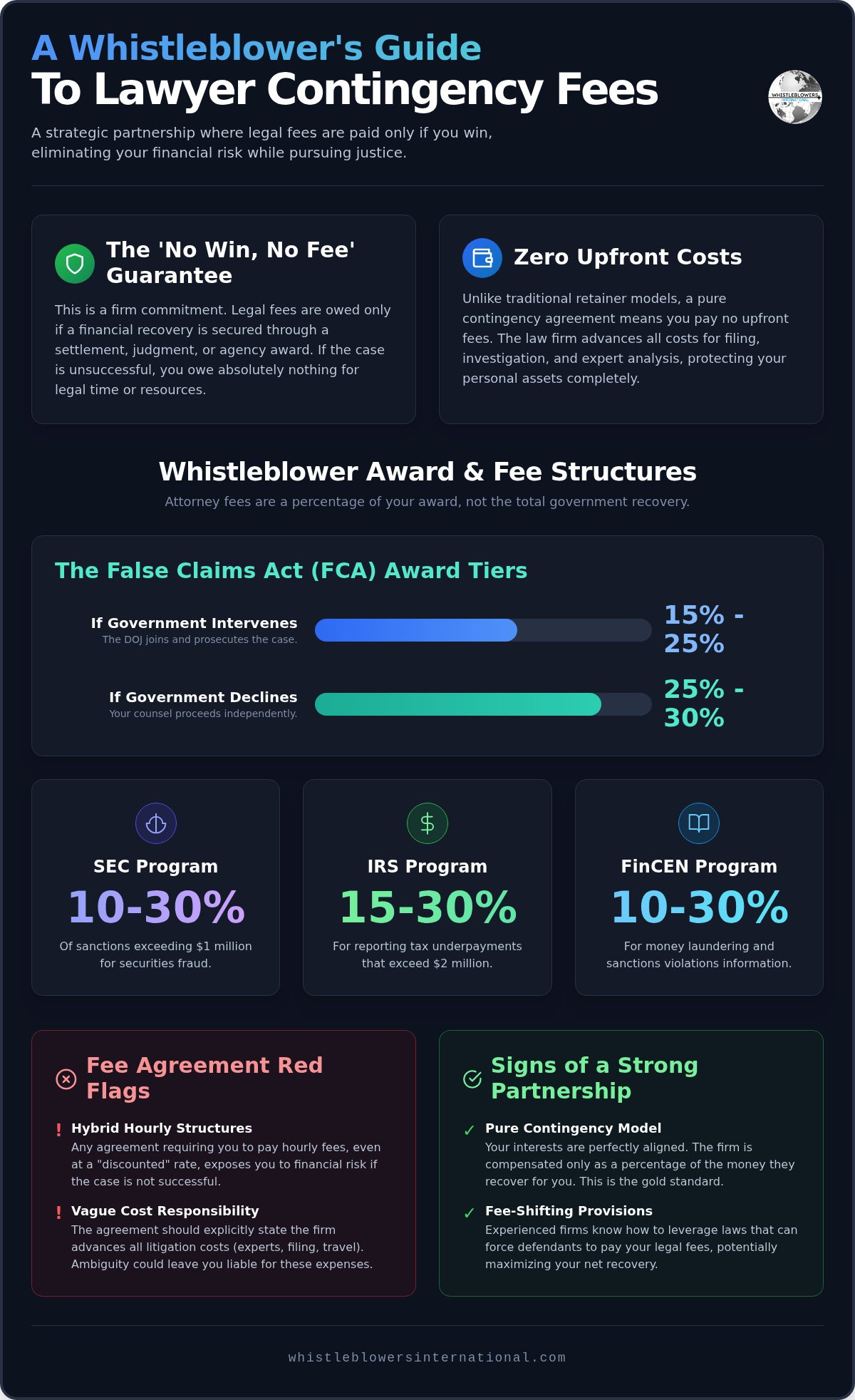
The ‘No Win, No Fee’ Guarantee
The promise of a “no win, no fee” arrangement is a resolute commitment to the whistleblower’s success. Success in federal programs is defined by a tangible financial result, such as a settlement, a court judgment, or a formal agency award. If the government declines to intervene or if the case is eventually dismissed, the client owes nothing for the legal time or resources expended. The firm absorbs the loss of time and investigative capital, reflecting a deep belief in the cases they choose to represent. This guarantee ensures that you’re never left with a massive bill for a case that didn’t reach a recovery, allowing you to act with confidence and integrity.
Award Percentages and Fee Structures by Program
The financial incentive for exposing corporate misconduct is governed by a series of statutory brackets that vary significantly across different federal agencies. While the whistleblower lawyer contingency fee is a standard mechanism for securing elite representation, the specific percentage you eventually receive depends on the “relator’s share,” which is the portion of the government’s recovery allocated to you. It is a vital distinction to recognize that the lawyer’s fee is a slice of the reward, not a slice of the total government recovery. This structure ensures that the attorney’s compensation remains proportional to the specific value they help you secure from the recovered funds.
The False Claims Act (FCA) Reward Tiers
The False Claims Act remains a cornerstone of qui tam litigation. In these cases, the reward percentage is largely dictated by the level of government participation in the proceedings. If the Department of Justice chooses to intervene in your case, the law typically provides for a reward between 15% and 25% of the total recovery. However, if the government declines to intervene and you proceed independently with your counsel, the reward bracket increases to between 25% and 30%. Securing the higher end of these brackets requires a meticulous presentation of high-quality evidence. Experienced False Claims Act lawyers understand how to navigate these complex negotiations, ensuring your contribution is fully recognized by federal investigators.
SEC, IRS, and FinCEN Award Ranges
Other federal programs utilize different thresholds and reward structures to encourage reporting. The SEC Whistleblower Program provides awards of 10% to 30% of the monetary sanctions collected in enforcement actions exceeding $1 million. Similarly, the IRS whistleblower program offers 15% to 30% for reporting tax underpayments that exceed $2 million. In 2026, the expansion of the FinCEN program has introduced similar 10% to 30% incentives for reporting money laundering and sanctions violations. These programs are particularly relevant for international claimants who often face higher personal risks. U.S. agencies frequently reward individuals regardless of their nationality or where the fraud occurred, provided the misconduct impacts U.S. markets. If you are reporting from abroad, you should evaluate your eligibility under these global enforcement frameworks to ensure your whistleblower lawyer contingency fee agreement is structured to maximize your final net payout.
Understanding Fee-Shifting and Litigation Costs
Fee-shifting provisions are a critical mechanism within federal statutes designed to punish wrongdoers while protecting the financial interests of those who expose fraud. When a court applies these provisions, it orders the defendant to pay your attorney’s fees directly. This payment is separate from the government’s recovery and your subsequent award. In many instances, this statutory recovery can significantly offset the whistleblower lawyer contingency fee, ensuring that a larger portion of the final award remains in your hands. It’s a strategic advantage that elite firms leverage to maximize your final net recovery.
The Role of Statutory Fee-Shifting
Under the False Claims Act (FCA), the law mandates that a losing defendant pays the relator’s reasonable attorney fees and costs. Courts often determine these fees by looking at established market rates, frequently utilizing tools like the Laffey Matrix, which serves as a recognized benchmark for specialized legal work in federal courts. If the court awards fees based on these high-level market rates, it reduces the amount that must be deducted from your personal reward to cover legal time. This ensures you aren’t penalized for hiring the most sophisticated counsel available to handle the complexities of your case.
Advancement of Litigation Costs
It’s essential to distinguish between legal fees, which cover attorney time, and litigation costs, which are the actual expenses incurred to build a case. Investigating complex pharmaceutical or defense contractor fraud requires more than just legal filing; it demands high-level forensic expertise, data analysis, and often international travel. These costs can be substantial, beginning with the standard $400 federal filing fee and scaling into hundreds of thousands of dollars for expert testimony and forensic audits.
A high-tier firm advances all of these investigative and litigation costs. We fund the entire investigation before the government even reviews the filing. If the case is successful, these costs are typically reimbursed from the recovery. If the case fails, the firm absorbs these losses entirely. This approach removes the financial barrier to entry, allowing individuals to challenge massive entities without risking their personal savings on expert witness fees or specialized investigative resources. By assuming this risk, the firm demonstrates a resolute commitment to the integrity of the evidence you provide.
Evaluating Your Fee Agreement: Red Flags and Best Practices
Absolute transparency serves as the hallmark of an elite whistleblower law firm. When you review a prospective contract, the language should be unambiguous regarding how your rewards are calculated and distributed. You should be cautious of “hybrid” fee structures that require you to pay a partial hourly rate alongside a whistleblower lawyer contingency fee. These arrangements are often risky for the client because they force you to assume financial liability while the firm receives payment regardless of the outcome. A pure contingency model is the only structure that truly aligns your interests with those of your legal counsel.
Reviewing the distinction between “net” and “gross” recovery calculations is equally vital for your long-term financial success. If an agreement takes a percentage from the gross recovery before litigation costs are deducted, your final take-home amount may be significantly lower than anticipated. Elite firms typically calculate their fee based on the net recovery after advanced costs are reimbursed, ensuring the math remains fair and transparent. You must also ensure the agreement explicitly covers potential appeals or secondary litigation. Fraud cases against major corporations often face years of procedural hurdles; if your contract only covers the initial filing, you could be left without representation during the most critical stages of a multi-year battle.
Common Pitfalls in Contingency Contracts
Identifying specific red flags early can prevent significant complications during the reward distribution phase. You should watch for “fee-priority” clauses that mandate the lawyer is paid their entire fee before you receive a single dollar of your share. This can be problematic if the government releases funds in installments. Additionally, be wary of hidden administrative charges for basic services like photocopies or internal database access, as these can accumulate and eat into a smaller award. Protecting your identity is another paramount concern. Your fee agreement should outline how the firm manages billing records to ensure your anonymity is maintained, particularly if you are still employed by the entity you are reporting.
Questions to Ask Your Potential Attorney
Engaging a “battle-tested mentor” requires you to vet their resources and strategic depth. Before signing any document, you should ask the following questions to gauge the firm’s capability:
- Does the firm possess the financial “war chest” required to fund a complex investigation for 5 or more years?
- How will the firm handle litigation costs if the government declines to intervene but we decide to proceed independently?
- Will the firm provide the specialized investigators needed for reporting pharmaceutical fraud anonymously under the FCPA?
These questions help determine if a firm is merely a filing service or a powerhouse capable of managing massive complexities. To ensure your interests are fully protected from the outset, you should request a comprehensive review of your potential fee agreement.
Why a Contingency-Based Partnership with Piacentile & Associates LLP Protects You
Piacentile & Associates LLP represents a sophisticated evolution in whistleblower advocacy. While earlier sections of this guide detailed the mechanics of the whistleblower lawyer contingency fee, the true value of this partnership lies in the firm’s ability to navigate the labyrinth of federal bureaucracy. Led by Dr. Joseph Piacentile, who navigated the qui tam process as a relator before becoming an attorney, the firm possesses an insider’s perspective that most general litigation firms lack. This experience ensures that every strategic decision is made with an empathetic understanding of the personal risks involved, coupled with the technical precision required by U.S. agencies. Because we operate on a pure contingency model, our interests are perfectly aligned with yours; we only accept cases that we believe have a legitimate path to government recovery.
The P&A Investigative Advantage
The primary reason many cases fail is a lack of investigative depth before the initial filing. Piacentile & Associates LLP addresses this by employing a dedicated team of specialized investigators to validate and expand upon your evidence. This investigative advantage is what transforms a simple report into a high-impact, government-ready case. By the time federal prosecutors review our filings, the evidence has already been scrutinized and organized for maximum impact. This rigorous preparation significantly reduces the likelihood of government declination and positions the case for the highest possible reward bracket. Our focus remains on uncovering systemic fraud while maintaining the highest standards of client privacy and data security. For international whistleblowers reporting to U.S. agencies, this level of investigative support is essential for bridging the gap between overseas evidence and domestic legal requirements.
Getting Started: The Confidential Case Evaluation
The path toward a successful recovery begins with a meticulous evaluation of your evidence. Piacentile & Associates LLP provides a no-cost, confidential review to assess the legal viability and monetary potential of your claim. This process is not merely a screening; it is a strategic consultation where we evaluate the evidence against the specific criteria of the False Claims Act, SEC, or IRS programs. If we proceed on a whistleblower lawyer contingency fee basis, we are committing our full investigative and financial resources to your success. This entry ensures that you have the backing of a global powerhouse from the very first day without any personal financial exposure. Contact Piacentile & Associates LLP for a confidential consultation to discuss your evidence with a battle-tested mentor who understands exactly what is at stake.
Strategizing Your Path to Justice
Navigating the complexities of federal fraud programs requires more than just legal knowledge. It demands a partner who assumes the full financial burden of the fight. A whistleblower lawyer contingency fee ensures that you don’t face the daunting resources of a corporate giant alone. By leveraging statutory fee-shifting and firm-advanced litigation costs, you can maximize your net recovery while maintaining absolute privacy. This structure transforms your evidence into a powerful tool for accountability without endangering your personal assets.
Piacentile & Associates LLP offers a unique perspective as a firm led by Dr. Joseph Piacentile, a former whistleblower and attorney. We provide pure contingency-based representation. This means zero financial risk to you. Our commitment is backed by global expertise in False Claims Act, SEC, and IRS programs. Our team of specialized investigators is ready to transform your evidence into a government-ready case that demands attention. Secure Your Elite Legal Advocate—Schedule a Confidential Case Review. Your decision to speak out is a courageous step toward integrity. We’re here to ensure you’re protected every step of the way.
Frequently Asked Questions
What is the standard percentage for a whistleblower lawyer’s contingency fee?
Standard percentages for a whistleblower lawyer contingency fee generally range between 30% and 40% of the total award recovered. This rate reflects the extensive financial and professional risk the firm assumes throughout the litigation process. If the government recovers funds, the lawyer takes a slice of your specific reward as payment. This structure ensures your interests are aligned with your counsel’s, as they only receive payment if you successfully secure a monetary award.
Do I have to pay any money upfront to file a qui tam lawsuit?
You don’t have to pay any money upfront to file a qui tam lawsuit when working with an elite contingency-based firm. The law firm advances all necessary capital to develop the case, including investigative resources and administrative costs. This model removes the financial barrier to entry, allowing individuals to challenge massive corporations without risking their personal savings. You only owe payment if and when a recovery is achieved through settlement or judgment.
What happens to the legal fees if the government decides not to intervene in my case?
If the government declines to intervene, you and your counsel may choose to proceed independently. In these instances, your whistleblower lawyer contingency fee remains in effect, and the firm continues to fund the litigation costs. While non-intervention increases the complexity of the case, it also potentially increases your reward bracket to 25% or 30%. If the case eventually fails after the government declines, you still owe zero in legal fees.
Can a whistleblower lawyer represent me if I live outside the United States?
A U.S. whistleblower lawyer can represent you regardless of your physical location or nationality. Federal programs like the SEC and False Claims Act have a global reach, allowing international claimants to report fraud that impacts U.S. markets or government spending. Piacentile & Associates specializes in assisting whistleblowers worldwide, ensuring that individuals from any country can access the protections and rewards offered by the American judicial system while maintaining their privacy.
Are litigation costs different from attorney fees in a contingency agreement?
Litigation costs are distinct from attorney fees in a contingency agreement. Attorney fees represent the payment for the lawyer’s time and expertise, while litigation costs cover hard expenses like court filing fees, expert witness testimony, and forensic audits. For an example of the specialized legal support services that facilitate these processes, check out Civil Process Solutions. Elite firms advance these costs on your behalf throughout the case. In the event of a successful recovery, these costs are typically reimbursed from the gross award before the final distribution is made to the relator.
Whistleblower awards are considered taxable income, but attorney fees are often deductible under specific federal provisions. For cases involving the False Claims Act or SEC, the law typically allows for an above-the-line deduction of legal fees and costs. This means you only pay taxes on the net amount you retain, rather than the total award amount. You should consult a tax professional to evaluate your specific 2026 obligations and ensure proper reporting.
What is fee-shifting and how does it affect my final reward?
Fee-shifting is a statutory provision that requires the losing defendant to pay the whistleblower’s legal expenses. When a court applies this rule, it orders the corporation to cover your attorney’s time at established market rates. This payment can significantly reduce the amount deducted from your personal reward, effectively maximizing your final take-home percentage. It acts as an additional penalty against the entity that committed the fraud while protecting your financial interests.
Can I switch lawyers if I am unhappy with my current contingency agreement?
You have the right to switch lawyers if you’re unhappy with your current representation or contingency agreement. However, your original firm may hold a lien on a portion of the eventual award to cover the work they already performed. It’s vital to review your initial contract’s termination clause before making a change. An elite firm can help you evaluate your existing agreement and manage the transition process securely to protect your potential award.