
You cannot legally remain an anonymous sec whistleblower unless you have an attorney standing between you and the federal government. This isn’t just a recommendation for safety; it’s a procedural requirement under the Dodd-Frank Act. If you attempt to file a tip directly, your identity becomes part of the record, leaving you vulnerable to the very workplace retaliation you’re trying to avoid.
We recognize that the decision to report high-level securities fraud is often paralyzed by the fear of a career-ending leak. It’s a heavy burden to carry, especially when you’re facing off against massive corporate entities. This guide provides the definitive 2026 roadmap for navigating the SEC Whistleblower Program with total discretion. You’ll learn the precise legal requirements to shield your identity while qualifying for a statutory reward of 10% to 30% of sanctions exceeding $1 million. We will break down the latest 2026 SEC Enforcement Manual updates and the specific investigative steps required to ensure your professional safety remains the top priority throughout the process.
Key Takeaways
- Learn why the Dodd-Frank Act mandates the use of legal counsel to maintain status as an anonymous sec whistleblower, effectively shielding your identity from federal investigators.
- Understand the critical strategic differences between anonymous and confidential reporting to ensure you select the specific privacy framework that best secures your professional future.
- Discover the methodical process of “cleansing” evidence of identifying markers before submitting Form TCR, ensuring no digital or physical breadcrumbs lead back to your position.
- Identify the eligibility criteria for securing a statutory award of 10% to 30% while maintaining a legal firewall between your identity and the public record.
- Explore how a contingency-based legal partnership provides a protective shield, allowing elite advocates to handle complex SEC communications while you remain safely in the background.
Understanding SEC Whistleblower Anonymity Under the Dodd-Frank Act
In the 2026 regulatory environment, an anonymous sec whistleblower is defined as an individual who provides original information regarding securities violations while their identity remains shielded from the Commission throughout the investigative phase. This status is a specific legal designation rather than a mere request for privacy. Following the February 2026 updates to the SEC Enforcement Manual, the criteria for maintaining this shield have become more rigorous, requiring precise adherence to procedural protocols from the moment of the initial filing.
It’s vital to distinguish between “anonymous” and “confidential” reporting. In a confidential filing, the SEC knows your identity but is legally obligated to protect it from public disclosure. In contrast, true anonymity ensures that even the SEC staff investigating the matter do not know who you are during the bulk of the process. Under federal law, SEC anonymity is a strictly regulated privilege that can only be invoked if a whistleblower is represented by legal counsel who serves as the formal intermediary for all communications with the Commission.
The Legal Shield: How the SEC Protects Your Identity
The SEC Whistleblower Program utilizes a sophisticated redaction process to ensure that no identifying markers are included in materials shared with subjects of an investigation. When your attorney submits Form TCR (Tip, Complaint, or Referral), they act as a procedural firewall. The Commission treats whistleblower information as highly confidential, applying strict limitations on disclosure even when coordinating with other regulatory bodies. While the SEC may share information with the Department of Justice or other “Authorized Agencies,” they typically do so without revealing the whistleblower’s identity unless it’s absolutely necessary for the proceedings.
There are, however, practical limits to this protection. If a case proceeds to a trial where your testimony is required, or if the SEC must produce documents that inherently reveal your identity, the shield may be challenged. Additionally, you must disclose your identity to the SEC before any award payment is finalized to satisfy tax and eligibility requirements. We view our role as managing these transition points with extreme care to minimize your exposure.
Identity Protection Beyond the SEC: Corporate Retaliation
The Dodd-Frank Act provides robust anti-retaliation protections that apply even if you choose to report as an anonymous sec whistleblower. These laws are designed to prevent the “blacklisting” effect that historically ended the careers of those who spoke out in the financial industry. By reporting through a legal intermediary, you create a layer of distance that makes it significantly harder for an employer to pinpoint the source of a government inquiry.
Our firm acts as a strategic partner in this effort, utilizing investigative techniques to “cleanse” evidence of metadata or specific internal references that could inadvertently reveal your department or seniority. We don’t just file paperwork; we build a defensive perimeter around your professional life. This methodical approach ensures that you can pursue a multi-million dollar reward while your current career remains intact and your reputation stays protected from corporate blowback.
The Mandatory Role of Counsel in Anonymous SEC Filings
Many potential tipsters assume that checking an “anonymous” box on a government website is enough to protect their identity. This is a dangerous misconception. Under the Dodd-Frank Act, the Commission will only accept an anonymous sec whistleblower submission if it is filed through a licensed attorney. If you attempt to report “pro se,” or without representation, your identity is required to be disclosed to the SEC at the outset, and it becomes part of the investigative record by default.
The SEC establishes this “Attorney Gatekeeper” rule to ensure that the tips they receive are vetted for quality and legal relevance. By requiring an attorney to certify the whistleblower’s identity and eligibility, the Commission can focus its limited resources on high-impact cases while maintaining a formal distance from the source. This legal structure isn’t just a hurdle; it’s a protective mechanism that allows you to provide evidence of securities fraud while keeping your name entirely off the radar of corporate counsel and federal investigators alike.
Why the SEC Requires an Attorney for Anonymous Claims
The SEC relies on legal counsel to serve as a critical quality control mechanism. Your attorney must verify your identity and eligibility privately, then certify to the Commission through Form TCR that the information provided is accurate to the best of their knowledge. As detailed in the SEC Whistleblower Program FAQs, this certification process allows the SEC to pursue high-quality leads while maintaining a legal firewall. This structure ensures that the Commission receives actionable intelligence while the whistleblower remains shielded by attorney-client privilege, which is the most robust privacy protection available in the American legal system.
The Hidden Risks of Reporting Without a Legal Shield
Reporting securities fraud is a high-stakes endeavor where small errors can lead to catastrophic exposures. Many insiders don’t realize that internal documents often contain “digital fingerprints,” such as metadata, unique tracking codes, or specific distribution patterns, that can instantly reveal a source’s identity to corporate IT departments. Without the technical and investigative oversight of an anonymous sec whistleblower firm, these markers can lead investigators or company retaliators straight to your door.
Relying on non-legal hotlines or “confidential” internal reporting channels often creates a false sense of security, as these entities don’t have the same statutory obligations to protect your identity as a law firm. If you’re considering coming forward, partnering with a seasoned whistleblower advocate is the only way to ensure your name never appears on a public docket. By filtering evidence through a strategic legal lens, we ensure that the focus remains on the fraud itself rather than the person who uncovered it.
Anonymous vs. Confidential Reporting: A Strategic Comparison
Choosing between anonymous and confidential reporting is the most critical strategic decision an insider will make. While these terms are often used interchangeably in casual conversation, they represent distinct legal frameworks with different levels of exposure. An anonymous sec whistleblower operates behind a procedural firewall where their identity is withheld from the government itself, whereas a confidential reporter is known to the SEC but protected from public disclosure. When you access the SEC’s official whistleblower submission portal, you must select a path that aligns with your specific risk profile and professional goals.
The decision typically hinges on the severity of potential retaliation and the complexity of the evidence. If you remain within the industry you are reporting, the absolute shield of anonymity is usually the superior choice. This status ensures that your name does not appear in internal government databases that could be subject to accidental leaks or discovery requests. We view anonymity not just as a preference, but as a mandatory defensive posture for high-level executives and financial professionals.
Comparing Privacy Tiers in SEC Actions
The 2026 regulatory landscape offers three primary tiers of privacy for those coming forward. Understanding these levels is essential for maintaining control over your career trajectory.
- Tier 1: Anonymous Filing (Maximum Protection): This requires representation by legal counsel. Your identity is never shared with the SEC during the investigation. Your attorney certifies your identity and eligibility, acting as the sole point of contact for federal authorities.
- Tier 2: Confidential Filing: You provide your name directly to the SEC. The Commission is legally bound to keep this information non-public, but your identity is known to government staff and may be shared with other authorized agencies during joint investigations.
- Tier 3: Public Filing: This is a rare path where a whistleblower chooses to go public, often for advocacy purposes. This offers no identity protection and relies solely on anti-retaliation laws for safety.
When Your Identity Must Be Revealed to the SEC
It’s vital to understand that anonymity has a specific expiration point tied to the financial outcome of the case. While you can remain an anonymous sec whistleblower throughout the multi-year investigative and litigation phases, the law requires you to disclose your identity before an award can be issued. This disclosure happens at the “Award Stage,” allowing the SEC to verify your eligibility and process payments through the Department of the Treasury.
If the investigation involves multi-agency cooperation, such as a parallel criminal case led by the Department of Justice, your identity is still shielded by your counsel’s certification. Even when the final award order is published, the SEC takes meticulous steps to ensure that the public version of the document is redacted to prevent “jigsaw identification,” where small details could allow the public to deduce who you are. Our methodology focuses on ensuring that even at the payment stage, your privacy remains the primary objective.
Step-by-Step: How to File an Anonymous SEC Whistleblower Claim
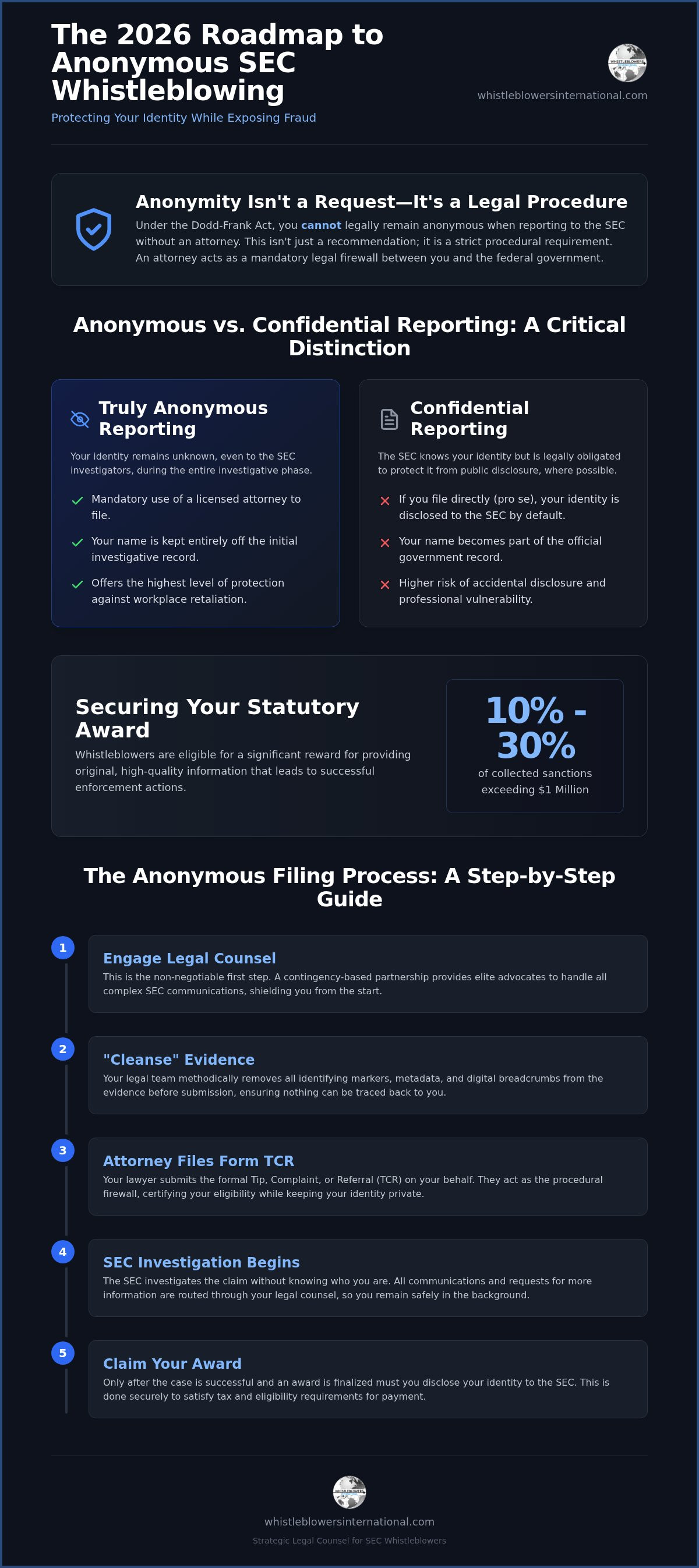
Filing a claim with the Commission is a methodical procedure that requires tactical precision. It isn’t merely about the quality of your information; it’s about the structural integrity of your submission. To succeed as an anonymous sec whistleblower, you must follow a four-phase protocol designed to maximize your reward potential while maintaining a total identity shield. This process ensures that your professional standing remains protected while the government investigates the underlying fraud.
Phase 1 begins with a secure consultation with an SEC whistleblower program expert. During this stage, we evaluate whether your evidence meets the statutory requirement of “Original Information” and if the potential sanctions are likely to exceed the $1 million threshold required for an award. Phase 2 involves the meticulous gathering and “cleansing” of evidence to ensure no digital breadcrumbs lead back to your desk. Phase 3 is the formal submission of Form TCR by your legal representative, followed by Phase 4, which involves long-term cooperation managed entirely through the attorney-client bridge.
Gathering Evidence Without Getting Caught
The most common mistake insiders make is using company-issued hardware or corporate networks to collect proof. Modern enterprise security software can detect unusual file transfers or printing patterns in real-time. You must avoid emailing documents to personal accounts or taking screen captures that might contain hidden watermarks or tracking codes. These “digital fingerprints” can compromise your anonymity before the SEC even opens the file.
When you document securities fraud without violating privacy laws, you must focus on factual data rather than privileged legal communications. The SEC’s 2026 criteria prioritize independent knowledge or independent analysis that isn’t already public. If your evidence is derived from internal audits or non-public financial records, it carries significantly more weight. Our investigative team helps you filter this data to ensure it remains actionable without being self-incriminating.
The Form TCR Submission Process
The formal filing happens via the “Counsel Certification” section of Form TCR. This is where your attorney signs a declaration stating they’ve verified your identity and eligibility under the Dodd-Frank Act. By doing so, the lawyer takes legal responsibility for your status, allowing the SEC to move forward without ever seeing your name. This legal firewall is what permits you to remain an anonymous sec whistleblower throughout the multi-year investigation.
Drafting the narrative is a delicate balancing act. We must provide enough granular detail to spark an investigation while omitting specific department names or dates that might narrow the source down to a few individuals. Once the submission is complete, the SEC Office of the Whistleblower may request additional clarification. These requests are routed through your counsel, ensuring you never have to speak directly to a federal agent. If you’re ready to begin this process, contacting a whistleblower firm is the first step toward securing your future.
Strategic Representation: Maximizing Rewards While Protecting Your Identity
Successfully navigating the SEC program requires more than just a legal filing; it demands a comprehensive investigative strategy. For a high-level insider, the decision to become an anonymous sec whistleblower involves weighing the potential for a life-changing financial reward against the significant risk of career disruption. This is why a whistleblower lawyer contingency fee model is the most secure path for reporting. It aligns the firm’s interests entirely with yours, ensuring that elite representation remains accessible to any individual with high-quality information, regardless of their personal financial standing at the start of the process.
At Piacentile & Associates, we don’t just act as legal intermediaries. We function as a strategic shield, combining deep investigative expertise with the authoritative legal standing required to challenge multi-billion dollar corporations. By building a case that is trial-ready from the moment of submission, we maximize the pressure on the Commission to act, which in turn increases the likelihood of a successful enforcement action and a subsequent award.
The Advantage of a Former Whistleblower on Your Team
Our firm is led by Dr. Joseph Piacentile, a former whistleblower who understands the psychological and professional weight of this journey. This unique perspective provides our clients with more than just technical legal advice; it offers a battle-tested roadmap for navigating the emotional toll of reporting. We know exactly how corporate legal teams attempt to unmask anonymous sources through internal audits and metadata analysis. Our strategy involves preempting these efforts by meticulously managing the flow of information to ensure you remain invisible.
We focus on the specific factors the Commission uses to determine the final award percentage, which typically ranges from 10% to 30% of collected sanctions. By demonstrating the significance of your information and the degree of assistance provided, we fight for the highest possible tier of recovery. This methodical approach ensures that your contribution is recognized and rewarded without compromising your safety.
Global Reach: Anonymity for Foreign Nationals
The SEC Whistleblower Program has a global reach, offering the same protections and reward opportunities to foreign nationals reporting on US-listed entities. If you are an employee of a foreign subsidiary or an international professional with independent knowledge of securities fraud, you can still file as an anonymous sec whistleblower through US-based counsel. We provide the mandatory legal bridge required for international tipsters to access the program safely from abroad. Whether you are reporting from London, Hong Kong, or Zurich, the legal firewall remains the same. To begin your journey toward justice and financial security, contact Piacentile & Associates for a confidential evaluation today.
Securing Your Professional Legacy Through Strategic Advocacy
Reporting systemic securities fraud is a transformative decision that requires a sophisticated legal shield. By following the 2026 procedural roadmap, you can maintain your status as an anonymous sec whistleblower while positioning yourself for a life-changing financial recovery. Success in this high-stakes environment depends on two factors: the quality of your original information and the strength of the legal firewall built around your identity. We’ve established that the mandatory role of counsel and methodical evidence cleansing provide the only reliable path to safety in the modern financial industry.
Piacentile & Associates offers the unique advantage of a firm led by former whistleblowers who’ve navigated these complexities firsthand. With decades of experience in federal fraud investigations, we provide elite, contingency-fee representation that removes all financial barriers to justice. If you possess evidence of corporate wrongdoing, you don’t have to face the risk of retaliation alone. Our team acts as your battle-tested mentor, ensuring that every communication with the Commission is handled with the highest level of scrutiny and discretion.
Speak with an SEC whistleblower attorney at Piacentile & Associates for a 100% confidential case evaluation. Your professional integrity deserves a formidable ally.
Frequently Asked Questions
Can I really stay 100% anonymous throughout the entire SEC process?
You can maintain anonymity throughout the investigative and litigation phases by using legal counsel as a formal intermediary. However, federal law requires you to disclose your identity to the Commission before any award payment is finalized. This disclosure is necessary for tax verification and eligibility checks conducted by the Department of the Treasury. During the investigation, the SEC uses rigorous redaction techniques to ensure your identity remains shielded from the public and the target corporation.
Do I need a lawyer to be an anonymous SEC whistleblower?
Yes, the Dodd-Frank Act explicitly mandates that any individual wishing to file as an anonymous sec whistleblower must be represented by an attorney. If you attempt to file a tip directly without counsel, the SEC requires your identity at the outset. Your lawyer acts as a critical gatekeeper, certifying your identity to the Commission while ensuring your name never appears in the official government investigative file or any public record.
What happens if the SEC wants to interview me?
If the SEC requests an interview, the entire process is managed through your legal representative to preserve your privacy. Your attorney coordinates the logistics and participates in the interview to ensure your anonymity isn’t compromised. In many instances, these interactions occur via secure channels or through written responses prepared by your counsel. This strategic layer of distance prevents accidental self-identification and ensures the focus remains strictly on the evidence of securities fraud.
Will my employer find out I filed a whistleblower claim if I stay anonymous?
No, the legal firewall created by your attorney is designed to prevent your employer from discovering your identity. The SEC is prohibited from sharing identifying information with the subjects of an investigation. By reporting anonymously, you avoid the professional retaliation and blacklisting that often follow named reports. Our firm also utilizes investigative techniques to cleanse your evidence of digital fingerprints, such as metadata, which corporations often use to unmask internal sources.
Is there a deadline for filing an anonymous SEC whistleblower claim?
While there isn’t a fixed expiration date for reporting fraud, the SEC prioritizes original information that is provided in a timely manner. If you delay reporting and the information becomes public or another whistleblower files first, you may lose your eligibility for an award. The SEC award structure also considers the timeliness of your report when determining the final recovery percentage. Acting quickly helps secure your status as the primary source of the tip.
How much does it cost to hire an anonymous whistleblower attorney?
Piacentile & Associates LLP operates on a contingency fee basis, meaning there are no upfront costs for our clients. We only collect a portion of the final monetary award if we successfully secure a recovery for you. This model removes financial barriers for high-level insiders and ensures that elite legal advocacy is available regardless of your personal finances. If no award is secured from the SEC, you owe the firm nothing for our services.
What kind of evidence do I need for an anonymous SEC report?
The SEC requires original information derived from your independent knowledge or independent analysis. This typically includes:
- Internal financial records or accounting ledgers
- Internal emails or memos documenting misconduct
- Audit reports or compliance logs
- Specific data showing insider trading or market manipulation
We assist you in documenting this information without violating privacy laws, ensuring the evidence is trial-ready while removing markers that could lead to your identification.
Can foreign nationals report anonymously to the SEC?
Yes, foreign nationals can report anonymously to the SEC and remain eligible for significant monetary awards. The program has global reach, protecting individuals who report on US-listed companies or violations with a sufficient nexus to US markets. Whether you’re an employee of a foreign subsidiary or an international professional, you must still follow the gatekeeper rule to be an anonymous sec whistleblower. Our firm specializes in providing the necessary legal bridge for international tipsters.