

If you hold evidence of systemic financial fraud, is your greatest risk the misconduct itself or the process of reporting it? You likely understand that silence feels like complicity, yet the fear of professional blacklisting or being caught in a multi-year bureaucratic maze often leads to hesitation. Choosing a seasoned SEC whistleblower attorney is the most critical decision you’ll make, as this choice determines whether your identity remains shielded and whether your information is presented with the investigative rigor necessary to trigger a formal enforcement action.
It’s natural to feel uncertain about whether your evidence meets the stringent standards required for a successful claim under the Dodd-Frank Act. This guide explains how an elite legal partner manages the heavy lifting of the investigative process, ensuring your submission is both anonymous and high-impact. You’ll learn the specific steps required to secure a reward between 10 and 30 percent of collected sanctions. By understanding the procedural requirements of the program, you can move forward with the confidence that your career and your future are protected by a battle-tested advocate who understands the stakes of your disclosure.
Key Takeaways
- To maintain absolute anonymity under the Dodd-Frank Act, you must file through an SEC whistleblower attorney, as the Commission only accepts anonymous submissions via legal counsel.
- The SEC is required to pay rewards between 10 and 30 percent of collected sanctions, provided the total recovery exceeds the $1 million statutory threshold.
- Reporting must be voluntary to qualify for an award, meaning you’ll lose eligibility if the government requests information from you before you’ve initiated a disclosure.
- Protecting your career requires a strategic approach to anti-retaliation laws, utilizing both Dodd-Frank and Sarbanes-Oxley protections to shield your professional standing.
- A successful claim relies on a partner who offers more than legal paperwork, providing deep investigative resources to build a case that the SEC can immediately act upon.
The Role of an SEC Whistleblower Attorney in 2026
The landscape of financial oversight has evolved into a high-stakes arena where the quality of your disclosure determines your future. A specialized SEC whistleblower attorney functions as far more than a simple legal representative; they serve as a strategic liaison between an individual and the Commission. This role requires a sophisticated understanding of how the SEC Office of the Whistleblower evaluates incoming tips. While a general employment lawyer focuses on workplace grievances and labor disputes, an SEC reward advocate is dedicated to the forensic validation of fraud and the maximization of statutory awards.
Effective representation involves a rigorous filtering process. The SEC doesn’t reward every tip; it’s the quality and specificity of the information that determines the outcome. The Commission has a high evidentiary threshold, and they prioritize “original information” that provides a clear roadmap for enforcement. Your attorney must be able to distinguish between mere suspicion and actionable evidence, ensuring that the submission is not only accurate but also formatted to capture the immediate attention of SEC staff. This investigative depth is what separates a successful claim from one that’s buried in the thousands of tips the Commission receives every year.
Why the SEC Requires Counsel for Anonymous Filings
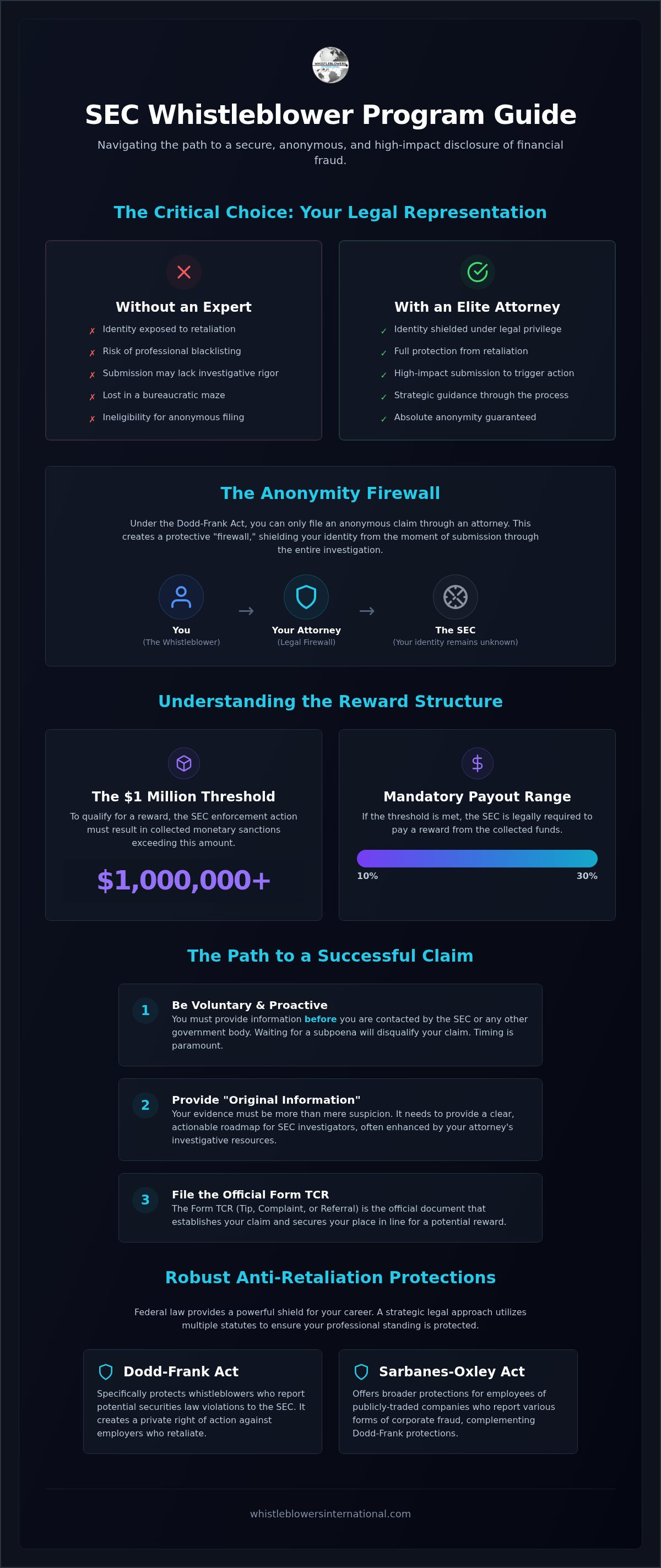
The Dodd-Frank Act provides a robust framework for identity protection, but it contains a specific mandate for those seeking to remain unnamed. If you intend to report misconduct anonymously, the law requires you to be represented by an attorney. This creates a protective “firewall” where your counsel knows your identity and verifies it for the Commission, while the government investigators only interact with the attorney. This structure is designed to prevent professional blacklisting and personal retaliation during the multi-year timeline of an investigation.
- Identity Shielding: Your attorney handles all correspondence, keeping your name off the formal record.
- Verification: Counsel performs the necessary due diligence to certify the truthfulness of the report.
- The Form TCR: The Form TCR is the official gateway to the SEC whistleblower program and the essential document for securing your right to a reward.
Maximizing the Value of Your Original Information
Securing a reward of 10 to 30 percent of collected sanctions depends on how “high-quality” your evidence is perceived by the SEC. Your attorney drafts a narrative that highlights the most egregious violations and aligns them with current regulatory priorities. Strategic timing is another critical factor. Filing as early as possible often leads to higher reward percentages, as the SEC recognizes the value of “first-in-time” reports that allow them to halt fraud before it scales. By building a comprehensive case file before the first submission, your SEC whistleblower attorney ensures the Commission has everything it needs to move toward a successful enforcement action.
Evaluating SEC Whistleblower Reward Eligibility
The SEC program operates on a success-only model where the financial outcome depends entirely on the recovery of sanctions. To qualify for a mandatory award, the enforcement action resulting from your tip must result in monetary sanctions exceeding $1 million. If this threshold is met, the SEC is legally obligated to pay an award between 10 and 30 percent of the collected funds. Determining the exact percentage within this range is a discretionary process handled by the Claims Review Staff (the body responsible for evaluating reward applications), who weigh factors such as the timeliness of your report and the degree of assistance provided by your SEC whistleblower attorney during the investigation.
Timing is paramount when establishing eligibility. To be considered voluntary, you must provide your information before the SEC, the Department of Justice, or any other regulatory body contacts you regarding the matter. If you wait until you receive a subpoena or a request for testimony, your disclosure is no longer considered voluntary, which typically disqualifies you from receiving a reward. This is why proactive engagement with counsel is essential; it ensures your claim is filed before the window of opportunity closes and your “original information” is superseded by a government inquiry.
Certain individuals face higher hurdles due to their professional roles. Compliance officers, internal auditors, and external accountants are generally excluded from rewards because their positions involve the detection of misconduct. However, exceptions exist. If you reported the fraud internally and the entity failed to act for at least 120 days, or if you have a reasonable belief that reporting would result in the destruction of evidence, you may still qualify for an award. Navigating these technical exceptions requires a precise legal strategy to ensure your status as a whistleblower is recognized.
Foreign Nationals and the SEC Program
The reach of the SEC is global, extending to any company that lists securities on U.S. exchanges or has a significant nexus to U.S. markets. Non-U.S. citizens are fully eligible for rewards under the Dodd-Frank program, even if the misconduct occurred entirely outside the United States. if you are an employee of a multinational corporation abroad, you can seek international whistleblower legal representation to navigate the complexities of filing from a foreign jurisdiction while ensuring your identity remains protected within the U.S. legal system.
Types of Securities Fraud Worth Reporting
The Commission prioritizes cases that threaten market integrity or cause significant investor harm. Common reportable offenses include accounting fraud (such as financial statement manipulation to inflate earnings), insider trading, and market manipulation schemes. Additionally, violations involving bribery of foreign officials are a major focus for the SEC. For those with evidence of cross-border corruption, our FCPA whistleblower lawyer guide provides a detailed breakdown of how these specific claims are processed. If you believe you have evidence of systemic fraud, you should consult with a strategic legal partner to evaluate the strength of your case before taking the next step.
The SEC Claim Process: From Form TCR to Final Award
Transforming raw evidence into a multi-million dollar award is a methodical journey that requires precision at every stage. Your SEC whistleblower attorney acts as the architect of this strategy, beginning with a rigorous investigative phase. Before the government is ever notified, counsel must vet your documents and testimony to ensure the information is “original” and “high-quality” as defined by the Commission’s standards. This internal due diligence is vital because it allows your legal team to build a forensic roadmap that SEC staff can follow with minimal friction, significantly increasing the likelihood of a formal investigation.
Once the case is built, the formal process follows a specific sequence of procedural milestones:
- Filing the Form TCR: This is the official “Tip, Complaint, or Referral” submission to the SEC Office of the Whistleblower. It must be drafted with legal precision to highlight the specific securities laws being violated.
- The SEC Investigation: If the Commission finds the lead credible, they’ll launch an investigation. Your attorney manages all communication with SEC staff, providing additional evidence or clarification while serving as a firewall to protect your identity.
- Notice of Covered Action (NoCA): After the SEC successfully settles or wins a case resulting in more than $1 million in sanctions, they post a NoCA on their website. This is the signal that the window to apply for an award is open.
- Award Application and Final Determination: You have a strict 90-day deadline from the NoCA date to file your award application. Your attorney then negotiates the final percentage, arguing for the 30 percent maximum based on the significance of your contribution.
Understanding the Investigation Timeline
Patience is a prerequisite for success in these matters, as SEC investigations are complex and resource-intensive. It’s common for cases to take between 2 and 4 years to reach a final resolution or settlement. Throughout this duration, your attorney provides status updates and manages the ongoing relationship with the Commission. If the SEC chooses not to pursue your specific lead, your counsel evaluates whether the information can be leveraged through other programs, such as the CFTC or FinCEN, ensuring no investigative effort is wasted.
The “No-Win, No-Fee” Contingency Model
The financial risk of taking on a massive corporation shouldn’t fall on the individual whistleblower. To remove this barrier, elite firms operate on a contingency basis, meaning they invest their own resources and time into your case. The firm only earns a percentage if a monetary award is secured for the client. This model aligns the interests of the whistleblower and the legal team, ensuring that every strategic move is focused on maximizing the final recovery. For a deeper look at how these arrangements work, consult our guide on whistleblower lawyer contingency fees to understand the standard structures used in 2026.
Anonymity and Protection: How Legal Representation Shields You
Anonymity is the cornerstone of the SEC program, yet it’s not an automatic right; it’s a procedural privilege that must be actively maintained. When you engage an SEC whistleblower attorney, you’re establishing a legal shield that prevents your name from appearing in any public or internal government records during the investigative phase. This relationship is governed by attorney-client privilege, which ensures that your identity remains confidential even under intense scrutiny from corporate legal teams. If an employer suspects a disclosure has occurred, your attorney manages all defensive maneuvers, ensuring you don’t inadvertently reveal your status through inconsistent statements or suspicious behavior.
A critical but often overlooked aspect of protection involves the technical handling of evidence. Modern digital files contain metadata (hidden data about when a file was created or edited) that can easily lead back to your specific workstation. A sophisticated legal partner employs forensic techniques to scrub this data before it’s submitted to the Commission. This prevents “leaks” that could expose your identity to internal IT departments or forensic investigators hired by the target company. Protecting your career requires this level of technical and legal foresight, as once your identity is compromised, the damage is often irreversible.
Dodd-Frank vs. Sarbanes-Oxley Protections
While both laws offer protections, they serve different strategic purposes. Dodd-Frank provides a direct cause of action in federal court for retaliation, offering remedies like double back-pay and reinstatement. Sarbanes-Oxley (SOX) involves an administrative process through the Department of Labor and has a strict 180-day filing window. Your attorney evaluates which framework offers the most robust defense based on your specific employment situation. If retaliation occurs, your counsel can file a separate legal action to secure your professional standing while the SEC claim continues in the background.
Maintaining Confidentiality in the Digital Age
The greatest threat to your anonymity often comes from your own digital footprint. You should never use company-issued devices, email accounts, or internal Wi-Fi networks to communicate with your SEC whistleblower attorney or to organize evidence. Corporate surveillance software can flag keywords or unusual file transfers in real-time. Instead, use personal, encrypted channels and store documents on secure, non-company hardware. Our firm utilizes high-level encryption and secure investigative protocols to ensure that every interaction remains invisible to outside eyes. If you are concerned about your exposure, you should consult with a strategic legal partner through a secure personal device to discuss your situation privately.
Why Piacentile & Associates for Your SEC Claim
Most legal practices approach whistleblower representation as a purely procedural task; Piacentile & Associates views it as a strategic investigative hunt. Led by Dr. Joseph Piacentile (a former whistleblower who understands the personal stakes of disclosure), our firm provides a unique insider’s perspective that generalist firms cannot replicate. This “whistleblower-first” philosophy informs every decision we make, from the initial forensic vetting of your documents to the final award negotiations with the Commission. We have built a formidable track record of high-stakes recoveries across the SEC, CFTC, and False Claims Act programs, representing clients globally in some of the most complex securities fraud actions of the last decade.
Our firm operates on the belief that a successful claim requires more than just a talented SEC whistleblower attorney; it requires a dedicated team of investigators who can speak the language of government auditors. We don’t merely relay your information to the SEC. Instead, we transform your raw evidence into a comprehensive, high-impact filing that minimizes the work required by government staff. This proactive approach ensures that your disclosure isn’t just another tip in the system, but a priority case for enforcement officials who are looking for actionable, well-organized leads.
Our Investigative Advantage
We utilize advanced forensic techniques to validate your original information before it ever reaches the SEC. If the Commission receives a “ready-to-go” case from a firm they trust, the likelihood of a formal investigation increases significantly. Our internal due diligence identifies evidentiary gaps early, allowing us to build a narrative that aligns with current regulatory priorities. This level of investigative depth is often applicable across multiple reward programs, such as those detailed in The False Claims Act guide, ensuring that every facet of corporate misconduct is leveraged for your maximum benefit.
Your Battle-Tested Mentor
The journey toward a successful award is often long and emotionally taxing. As your battle-tested mentor, we provide the strategic support you need to maintain your anonymity and professional standing throughout the process. We understand the nuances of high-level investigations from multiple angles, allowing us to anticipate the moves of corporate defense teams and protect you from potential pitfalls. Our goal is to secure the maximum statutory reward while ensuring the heavy lifting of the investigation is handled by our elite team of experts. If you are ready to take the next step with a partner who has been in your shoes, contact Piacentile & Associates for a confidential SEC case evaluation.
Protecting Your Future Through Strategic Disclosure
Reporting systemic securities fraud is a profound act of integrity that carries significant professional risks. The path to a 10 to 30 percent reward requires more than just raw evidence; it necessitates a sophisticated legal strategy that prioritizes your anonymity while meeting the Commission’s high evidentiary standards. By engaging an experienced SEC whistleblower attorney, you ensure that your original information is presented with the forensic clarity required to trigger a formal enforcement action.
Piacentile & Associates offers a unique investigative advantage because our firm is led by Dr. Joseph Piacentile, a former whistleblower who understands these high-stakes pressures from an insider’s perspective. Our elite investigative team handles the heavy lifting on a contingency-based model, which means we only receive payment if your disclosure results in a successful monetary award. You don’t have to navigate this labyrinthine process alone. Secure Your Confidential Consultation with an SEC Whistleblower Attorney today to discuss your case in absolute confidence. Your courage deserves the protection of a battle-tested ally.
Frequently Asked Questions
Do I need an SEC whistleblower attorney to file a claim?
You are legally required to retain an SEC whistleblower attorney if you intend to submit your information to the Commission anonymously. While an individual can technically file a claim in their own name, the complexity of the Form TCR and the high evidentiary threshold make professional counsel essential for success. An attorney serves as your formal representative, ensuring that all procedural requirements are met while keeping your identity shielded from government investigators and the target company.
How much does an SEC whistleblower attorney cost?
Piacentile & Associates operates exclusively on a contingency fee basis, meaning there are no upfront costs or hourly billing for our clients. We only receive a percentage of the final monetary award if the SEC successfully recovers sanctions based on your information. This model ensures that high-level legal and investigative resources are accessible to everyone, regardless of their financial situation, aligning our firm’s success directly with the results we achieve for you.
Can I remain 100% anonymous when reporting to the SEC?
You can maintain your anonymity throughout the entire investigative process provided you are represented by legal counsel. Your attorney acts as a firewall, submitting all evidence and communicating with SEC staff on your behalf. While the SEC must verify your identity before paying a reward, they have a long-standing commitment to protecting whistleblower confidentiality. They do not disclose a whistleblower’s identity to the public or the company under investigation except in very limited circumstances.
What is the average SEC whistleblower reward in 2026?
The SEC is legally mandated to pay awards between 10 and 30 percent of the total monetary sanctions collected in actions where recoveries exceed $1 million. The specific percentage depends on factors like the significance of the information and the level of assistance provided during the investigation. While individual rewards vary significantly based on the scale of the fraud, the program has historically paid out hundreds of millions of dollars to successful claimants since its inception.
How long does the SEC whistleblower award process take?
The timeline for an SEC investigation and subsequent award determination typically ranges from two to four years. This duration reflects the complexity of financial fraud cases, which require extensive document review, witness interviews, and legal proceedings. Once a Notice of Covered Action is posted, you must file an award application within 90 days. Your attorney manages this multi-year timeline, providing regular status updates and ensuring all deadlines are met as the case progresses toward a final settlement.
Can foreign nationals receive SEC whistleblower rewards?
Foreign nationals are fully eligible to receive rewards under the SEC program, regardless of their citizenship or where the misconduct occurred. If the fraud involves a company listed on a U.S. exchange or has a sufficient connection to U.S. markets, the SEC has jurisdiction to act. Many successful whistleblowers reside outside the United States and use U.S. legal counsel to navigate the reporting process while protecting their identities from overseas employers or foreign government interference.
What qualifies as “original information” for the SEC program?
Original information is defined as evidence derived from your independent knowledge or independent analysis that is not already known to the Commission. It cannot be based exclusively on public sources like news reports or judicial records unless you provide a unique analysis that uncovers the fraud. To qualify, this information must be provided voluntarily before a government inquiry begins. High-quality evidence often includes internal emails, financial ledgers, or specific details regarding deceptive accounting practices.
What happens if my employer retaliates against me for whistleblowing?
If you face retaliation, you are protected by robust anti-retaliation provisions under the Dodd-Frank Act and the Sarbanes-Oxley Act. These laws prohibit employers from discharging, demoting, or harassing employees who report securities violations. Remedies for retaliated whistleblowers can include reinstatement to your former position, double back-pay with interest, and compensation for legal fees. Your attorney can file a separate retaliation claim in federal court to hold your employer accountable while your SEC tip is being investigated.