
The Department of Justice recovered over $5.3 billion from whistleblower-initiated lawsuits in 2025, a figure that underscores the immense scale and gravity of modern federal fraud litigation. If you’ve uncovered evidence of systemic misconduct, you’re likely grappling with the weight of potential professional blacklisting and the labyrinthine nature of programs like the False Claims Act. It’s a high-stakes environment where your choice of counsel determines both your protection and your ultimate success. To secure your future, you must move beyond surface-level consultations and prepare a specific set of questions to ask a whistleblower attorney that test their investigative depth and federal experience.
We’ve developed this professional vetting framework to equip you with the scrutiny required to identify a powerhouse legal ally. You deserve an advocate who functions as a strategic investigator with real-world, insider perspectives rather than just a traditional litigator. This article outlines twenty-one critical inquiries designed to validate a firm’s elite capabilities and clarify the contingency fee model. By the end of this guide, you’ll possess the confidence to select a battle-tested mentor who can navigate the complexities of SEC, IRS, or FinCEN filings while prioritizing your privacy and professional integrity.
Key Takeaways
- Understand why the initial consultation represents your most critical window for protection and why the federal “one-shot” rule makes your choice of counsel a permanent decision.
- Learn how to evaluate specialized track records in False Claims Act and SEC programs by utilizing a specific framework of questions to ask a whistleblower attorney.
- Discover why elite investigative depth, including access to forensic accountants and former government investigators, is essential for documenting high-stakes fraud correctly.
- Gain absolute clarity on the contingency fee structure to ensure you aren’t responsible for out-of-pocket litigation costs unless your case results in a successful recovery.
- Establish realistic expectations regarding your ongoing role and communication frequency throughout the complex, multi-year timeline of a federal investigation.
Why the Consultation Phase is the Most Critical Step in Your Whistleblower Journey
Whistleblowing is not a casual legal endeavor. It’s a high-stakes investigation that requires precision from the very first interaction. Under federal law, particularly the False Claims Act, the “first-to-file” rule creates a one-shot environment. If another relator files a similar claim before you, your case might be barred regardless of the quality of your evidence. This reality makes the consultation phase the most critical window for your protection. This initial vetting process is the ideal time to develop a list of questions to ask a whistleblower attorney regarding their specific success rates with federal agencies. Choosing a general practitioner instead of an elite advocate can lead to catastrophic errors, such as lost anonymity or a dismissed claim. Transparency is mandatory. You need to provide full disclosure so your attorney can build a fortress around your identity and your evidence.
The Risk of the Referral Mill
Many websites that appear to be legal powerhouses are actually lead-generation services. These referral mills collect your sensitive information and sell it to the highest bidder, often a firm you haven’t vetted. This compromises your privacy and removes direct accountability. When formulating your questions to ask a whistleblower attorney, verify whether the person on the phone is the one who will actually handle the case. You need a firm that manages the investigative work in-house, ensuring that your data remains within a secure, professional circle. Direct accountability is non-negotiable in qui tam litigation because the relationship between you and your counsel will likely last for several years.
Establishing the “If-Then” Framework for Success
A seasoned mentor won’t give you a sales pitch; they’ll provide a rigorous, analytical evaluation of your evidence. They must apply conditional logic to your case: if the government intervenes, the litigation path changes; if they don’t, the firm’s independent investigative capabilities become paramount. Your advocate should be willing to discuss potential pitfalls, such as the public disclosure bar or statute of limitations, during the first meeting. This level of honesty ensures that you are entering a complex process with realistic expectations. A powerhouse firm focuses on the maximization of results through validation and scrutiny, not just filing paperwork. If the attorney cannot provide a clear “if-then” framework for your specific scenario, they may lack the strategic depth required for high-value federal fraud claims.
Questions to Ask About Specialized Experience and Track Record
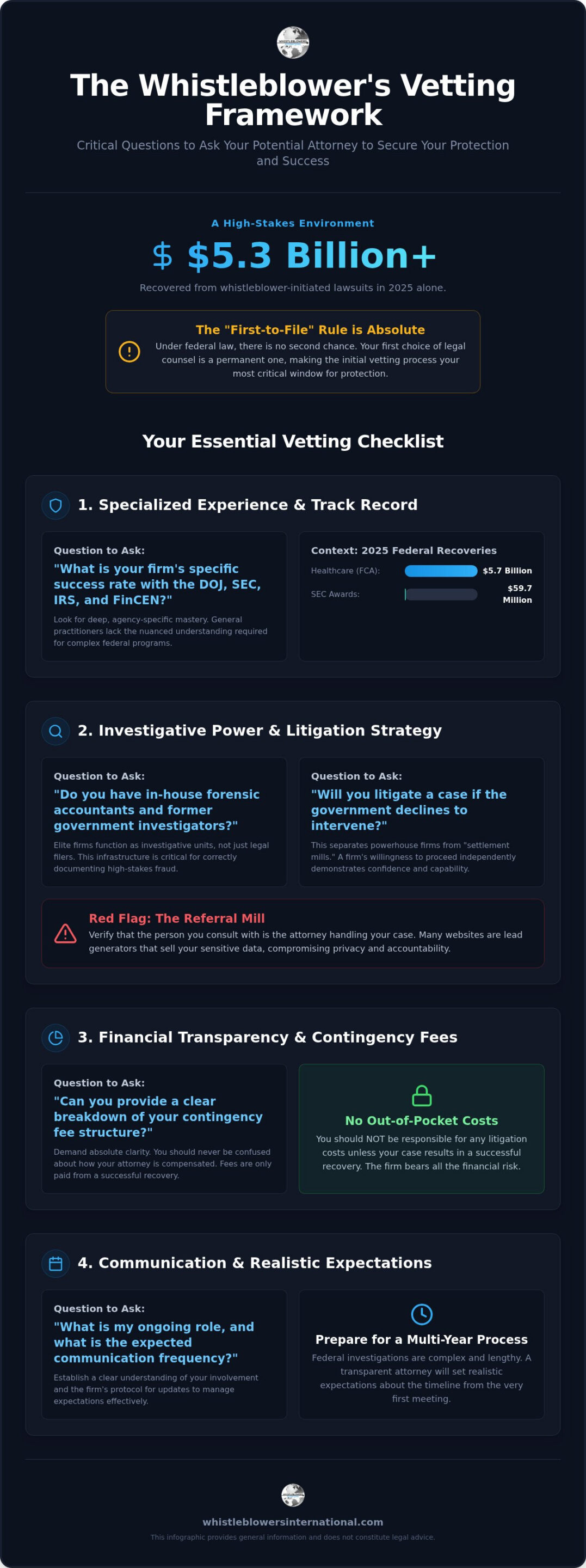
Elite advocacy requires more than a general understanding of the law; it demands a surgical knowledge of specific federal programs. When compiling your questions to ask a whistleblower attorney, focus on their history with the Department of Justice (DOJ) and the Securities and Exchange Commission (SEC). You need to know how many False Claims Act cases they have successfully resolved and their specific track record with the IRS or the FinCEN whistleblower program. A critical metric of a firm’s strength is their willingness to litigate cases even when the government declines to intervene. In the Fiscal Year 2025, whistleblowers filed a record 1,297 new qui tam lawsuits. The ability to proceed independently is often what separates a powerhouse firm from a settlement mill.
Agency-Specific Mastery
The nuances of whistleblower award percentages vary significantly between agencies. For instance, the SEC awarded $59.7 million in FY 2025, while healthcare fraud under the FCA accounted for $5.7 billion in recoveries. Your attorney should possess a deep relationship with the SEC Office of the Whistleblower and understand the specific evidentiary standards they require. Ask if they have handled cases in your specific industry, whether it’s defense contracting or pharmaceutical sales. Each sector has unique regulatory hurdles that require specialized scrutiny. Securing an insider perspective during this vetting process ensures your claim is built on a foundation of investigative excellence.
International and Global Reach
Fraud often crosses borders. If you are a non-citizen reporting US federal violations, you must seek whistleblower lawyers for foreign nationals who understand the Foreign Corrupt Practices Act (FCPA). Managing jurisdictional challenges in international trade or global bribery schemes requires a firm with a global reach. They must stay current with evolving FinCEN and Anti-Money Laundering (AML) regulations. This includes the proposed rules from April 2026 that offer awards of 10% to 30% for violations of the Bank Secrecy Act in cases where sanctions exceed $1,000,000. Ask how they protect the anonymity of international clients when dealing with foreign entities and US oversight bodies. A firm with a global mindset is essential for navigating the complexities of modern, cross-border financial crimes.
Vetting the Investigative Infrastructure and Case Development Strategy
A successful federal fraud case is built on the strength of its evidence, not just the eloquence of its legal arguments. While many firms claim to have resources, you must verify exactly how those resources translate into investigative action. When preparing your questions to ask a whistleblower attorney, inquire about the specific non-legal professionals who will be assigned to your case. Are there forensic accountants who can decipher complex billing cycles? Do they employ former government investigators who understand how the DOJ evaluates evidence? Elite case development requires a team that can document corporate fraud correctly without inadvertently violating privacy laws or corporate confidentiality agreements. This methodical approach ensures your evidence is validated through rigorous scrutiny before a single document is filed with the court.
The Insider Advantage
Having a legal team led by those who have walked this path provides a strategic edge that cannot be replicated. An attorney with an investigative mindset approaches a case by looking for the data that validates a tip. This process involves using forensic analysis to ensure your information meets the threshold of a covered action, which refers to the specific legal criteria required for a successful government intervention. It’s about moving from a suspicion to a verified investigative package that federal agents can immediately act upon. When a firm is led by a former whistleblower, the strategy is inherently protective and focused on the nuances of uncovering high-level corruption from the inside out.
Privacy and Retaliation Protection
Protecting your identity is the highest priority during the early stages of evidence gathering. You should ask about the specific technologies and secure communication channels the firm uses to prevent your employer from discovering your activities. If your identity is revealed, the firm must have a clear protocol for handling potential retaliation. While the Expanding Whistleblower Protections for Contractors Act, passed in July 2026, strengthens anti-retaliation provisions for government contractors, the best defense is a proactive strategy that keeps your name out of the public record for as long as possible. A powerhouse firm uses sophisticated encryption and methodical case management to shield you while they build the case. This level of security is essential for individuals facing significant professional risks during the investigative phase.
Financial Transparency: Questions About Contingency Fees and Costs
Financial clarity is the bedrock of a secure attorney-client relationship, particularly when the stakes involve multi-million dollar federal recoveries. Whistleblower litigation is inherently resource-intensive, often requiring years of investigative work and expert testimony. You must understand how your advocate funds these efforts and how those costs impact your final reward. When developing your questions to ask a whistleblower attorney, start with the exact percentage of the reward the firm takes as a fee. You need to know if this percentage remains static or if it scales based on the stage of the litigation. If the government settles the case early, the structure of whistleblower lawyer contingency fees should be clearly defined in your engagement letter to avoid any ambiguity during the distribution of funds.
Defining the Contingency Agreement
A transparent agreement ensures that the interests of the relator and the counsel are perfectly aligned. You should verify that there are no hidden hourly charges or administrative fees that could erode your portion of the recovery. It’s vital to distinguish between a “net” and “gross” recovery calculation; specifically, you must know if litigation expenses are deducted before or after the attorney’s percentage is applied. A “no-win, no-fee” structure is the industry standard for elite firms. This model shifts the entire financial risk of the investigation from you to the powerhouse firm. If you’re ready to align with a firm that possesses the capital and resolve to see your case through, consult with a battle-tested mentor today.
The Long-Term Commitment
Federal fraud cases are marathons, not sprints. Statistics from the 2025 Fiscal Year show that the DOJ recovered $6.8 billion under the False Claims Act, but these results often come after five to ten years of rigorous litigation. You need to ask if the firm has the financial stability to fund a multi-year battle against a massive corporation without seeking outside financing that might complicate your claim. Inquire about what happens to the fee structure if the case necessitates an appeal or reaches the Supreme Court. An elite advocate will provide a clear “if-then” framework for these scenarios, ensuring you aren’t surprised by shifting costs years down the line. This level of financial scrutiny is a non-negotiable requirement for any individual entering the federal whistleblower arena.
Communication and Logistics: Setting Realistic Expectations
The transition from a confidential investigation to an active federal filing marks a significant shift in your daily life. Because whistleblower cases often span several years, the logistical framework of your relationship with counsel must be robust enough to withstand long periods of government deliberation. When refining your questions to ask a whistleblower attorney, prioritize inquiries about the rhythm of communication. You need to know how often you will receive status updates, especially during the “under seal” phase when the government is conducting its primary investigation. A powerhouse firm acts as a strategic liaison between you and agencies like the DOJ or SEC, ensuring that your interests are protected while the government evaluates the merits of your evidence.
Timelines in federal fraud litigation are notoriously extended. While some cases reach a resolution within three years, others may require a decade of persistent advocacy. Your attorney should provide a realistic assessment of these durations based on the complexity of the fraud and the specific agency involved. They must also define your role after the initial filing. In many instances, you may become a “silent partner” to the government, providing additional clarification or data only when requested. Understanding these logistical realities early prevents frustration and ensures you are prepared for the methodical pace of the federal justice system.
The Client-Attorney Partnership
Maintaining your professional and emotional well-being throughout a multi-year case requires a partnership built on protective reassurance. You should establish who your primary point of contact will be and whether you have direct access to the senior lead attorney. An elite advocate prepares you for every contingency, including potential “proffer” sessions or interviews with government investigators. These meetings are high-stakes environments where your attorney’s experience as a battle-tested mentor becomes invaluable. They don’t just manage the law; they manage the stress of the process by providing a clear “if-then” framework for every interaction with federal authorities.
Next Steps: Moving from Inquiry to Action
Moving from the inquiry phase to active litigation begins with a formal retainer agreement and an immediate focus on evidence preservation. The firm must act swiftly to ensure that all digital and physical records are secured in a manner that complies with federal evidentiary standards. This phase is critical; any misstep in how evidence is handled can jeopardize the entire claim. If you are ready to transition from a position of risk to one of strategic action, contact Piacentile & Associates for a confidential, no-cost case evaluation. Securing an advocate with the investigative depth and global reach required for these cases is the most important step you can take toward a successful recovery.
Advancing Your Claim with Strategic Precision
Choosing an advocate is the single most consequential decision in your journey toward exposing federal fraud. By utilizing this framework of questions to ask a whistleblower attorney, you’ve shifted from a position of uncertainty to one of analytical control. You now understand that elite representation requires more than just legal knowledge; it demands deep investigative resources and forensic expertise to validate high-stakes evidence. Whether you’re reporting healthcare fraud or international bribery, your counsel must possess the global reach and financial stability to sustain a multi-year litigation effort.
At Piacentile & Associates, we offer a unique insider perspective because our firm is led by a former whistleblower who understands the professional and personal risks you face. Our team includes former government investigators who utilize advanced techniques to maximize your reward while shielding your identity. We operate on a contingency-only fee model, which ensures our interests are perfectly aligned with your success. Secure Your Professional Future: Schedule a Confidential Case Review Today. You don’t have to navigate this labyrinth alone; a powerhouse ally is ready to stand by your side.
Frequently Asked Questions
Do I have to pay a whistleblower attorney an hourly rate?
You don’t pay an hourly rate when engaging a specialized whistleblower firm. Instead, representation is typically provided on a contingency fee basis; this means the attorney only receives payment if they successfully recover a reward for you. This model aligns the firm’s financial interests with your own and ensures that individuals can pursue high-stakes federal fraud cases without the burden of upfront legal costs. If there is no recovery, you generally owe nothing for attorney time.
Can I fire my whistleblower lawyer if I am unhappy with their performance?
You have the legal right to terminate your relationship with your counsel at any time. However, your retainer agreement likely contains specific provisions regarding a lien on any future recovery for work already performed. Before making this decision, it’s essential to review the if-then logic of your contract. Switching lawyers mid-litigation can be complex because the first-to-file rule remains in effect, and your original attorney may still be entitled to a portion of the final award.
What happens if my whistleblower attorney thinks my case is weak?
If an elite advocate determines your evidence doesn’t meet the threshold for a covered action, they’ll provide a realistic assessment of the pitfalls. This scrutiny is a protective measure; filing a weak case can lead to professional exposure without the possibility of a reward. A powerhouse firm may suggest specific investigative steps to strengthen the documentation. This analytical approach ensures that only the most viable, high-value claims proceed to the Department of Justice or the SEC.
Is my initial consultation with a whistleblower lawyer confidential?
Your initial consultation is strictly confidential and protected by attorney-client privilege, even if you don’t ultimately hire the firm. This protection is a fundamental requirement for individuals preparing questions to ask a whistleblower attorney while still employed at the entity committing fraud. You can discuss sensitive evidence and potential professional risks with the assurance that your identity remains shielded. This confidentiality allows for a transparent evaluation of your case without the fear of immediate retaliation.
How much of my whistleblower award will go to my lawyer?
Attorney fees for federal whistleblower programs generally range between 15% and 30% of the final award. This percentage varies depending on whether the government intervenes or if the firm must litigate the case independently. For example, False Claims Act rewards are often structured differently than SEC or IRS payouts. You should ensure your retainer agreement clearly defines whether this fee is calculated from the gross or net recovery to maintain full financial transparency throughout the process.
Can a whistleblower lawyer represent me if I live outside the United States?
A US-based whistleblower firm can represent you regardless of your geographic location or citizenship status. Programs managed by the SEC, IRS, and FinCEN have a global reach and frequently reward international relators who uncover fraud affecting US markets or government interests. If you’re reporting foreign bribery under the FCPA, your attorney will manage the jurisdictional complexities from a US perspective. This allows foreign nationals to access the protections and rewards of the American federal justice system.
What is the difference between a whistleblower lawyer and an employment lawyer?
Whistleblower attorneys specialize in complex federal fraud programs, such as the False Claims Act, where the primary goal is recovering funds for the government. In contrast, employment lawyers focus on general workplace disputes, such as wrongful termination or discrimination. While a whistleblower case may involve retaliation, the core of the litigation is the investigative hunt for systemic fraud. Elite whistleblower firms function as strategic investigators who understand the nuances of agency oversight rather than just general labor laws.
How long does it typically take to hear back from the government after filing?
It’s common to wait several months, or even years, for a substantive response from the government after a case is filed under seal. The Department of Justice or the SEC must conduct a thorough, independent investigation before deciding whether to intervene. During this period, your attorney acts as a patient liaison, managing communication with federal agents while protecting your anonymity. This methodical pace respects the gravity of high-stakes fraud investigations and ensures all evidence is properly validated.