

Did you know that a single whistleblower tip regarding commodities fraud resulted in a record-breaking $200 million award? This figure represents more than just a life-changing sum; it serves as a testament to the Commodity Futures Trading Commission’s commitment to rewarding those who expose systemic corruption. If you’ve witnessed illicit trading patterns or artificial price inflation, you likely feel a profound sense of conflict between your professional integrity and the fear of personal retaliation. It’s a heavy burden to carry, especially when the regulations surrounding the CFTC program appear needlessly complex.
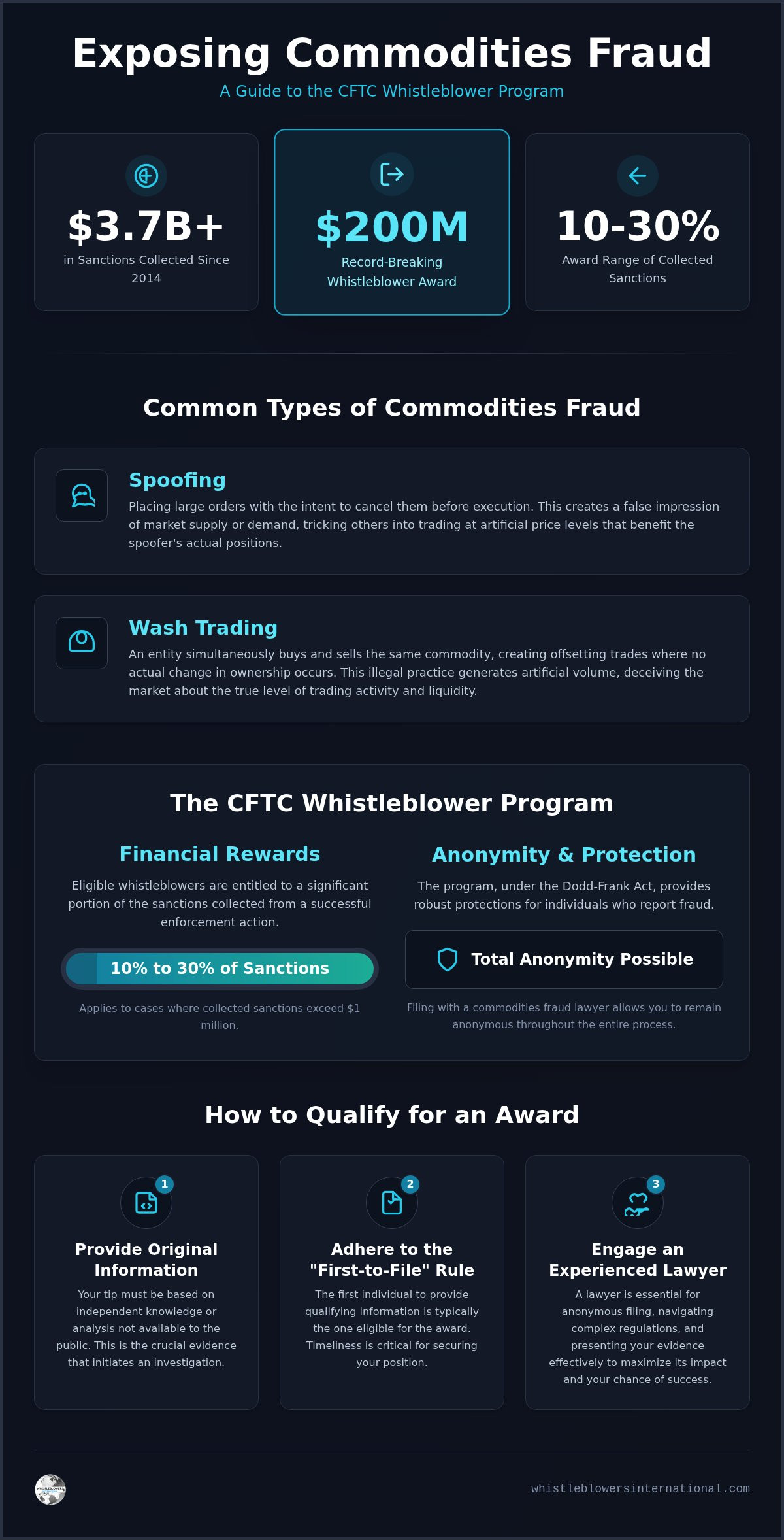
By reading this guide, you’ll learn how to identify specific forms of market abuse and navigate the reporting process to secure significant financial rewards. We’ll explore the criteria for original information that leads to successful enforcement actions, which have already resulted in over $3.7 billion in sanctions since the program’s inception in 2014. We’ll also discuss how a seasoned commodities price manipulation lawyer can help you maintain total anonymity throughout the investigation, ensuring your identity remains protected while you pursue an award of between 10% and 30% of collected sanctions.
Key Takeaways
- Identify the specific mechanics of commodities fraud, including spoofing and wash trading, to determine if the activity you’ve witnessed constitutes a reportable offense.
- Navigate the CFTC Whistleblower Program’s reward structure, which grants eligible individuals between 10% and 30% of total sanctions collected in cases exceeding $1 million.
- Learn why a commodities price manipulation lawyer is necessary to facilitate a completely anonymous filing while navigating the complexities of the Dodd-Frank Act.
- Secure your position in the investigative process by understanding the “first-to-file” rule and the critical importance of providing original, high-quality evidence.
What is Commodities Market Fraud and Price Manipulation?
Commodities market fraud involves intentional, illegal acts that distort the natural forces of supply and demand. These schemes interfere with the fair pricing of essential raw materials, ranging from energy products like crude oil and natural gas to agricultural staples and precious metals. When traders or institutions engage in What is Market Manipulation?, they create an artificial reality where prices no longer reflect genuine market conditions. The Commodity Futures Trading Commission (CFTC) is the federal body responsible for policing these activities, yet the sheer volume of global derivatives trading often exceeds the capacity of automated surveillance. This creates a dangerous information asymmetry where wrongdoers can hide within complex data sets that traditional algorithms struggle to interpret without context.
The impact of this manipulation isn’t confined to digital trading screens; it has real-world consequences for global economies. When energy or agricultural prices are artificially inflated, the costs are passed down to consumers at the pump and the grocery store. Because these markets are so vast, detecting the subtle “fingerprints” of fraud requires an insider’s perspective. A seasoned commodities price manipulation lawyer serves a vital role here, helping whistleblowers identify how specific trading behaviors violate federal law and preparing the evidence necessary to trigger a formal CFTC investigation.
The Legal Framework: The Commodity Exchange Act
The primary federal law governing these markets is the Commodity Exchange Act (CEA), which establishes the rules for exchange-traded commodity futures and options. While the CEA has existed for decades, the passage of the Dodd-Frank Act in 2010 fundamentally transformed the landscape by expanding whistleblower protections and creating the CFTC Whistleblower Program. This legislation didn’t just provide financial incentives; it extended the jurisdictional reach of U.S. law. Today, if an international trading desk engages in conduct that affects U.S. markets or involves U.S. counterparts, they may fall under the scrutiny of federal regulators. This global reach ensures that domestic and international traders alike are held to the same standards of transparency and integrity.
Why Whistleblowers are Essential to Market Integrity
Government surveillance has inherent limitations in the fast-paced world of complex derivatives. Federal investigators can’t always distinguish between high-frequency trading and predatory schemes like spoofing or wash trading based on raw data alone. Whistleblowers provide the missing link by offering “original information” that clarifies the intent behind the trades. The CFTC defines original information as non-public data derived from an individual’s independent knowledge or analysis that leads to a successful enforcement action. By bridging the gap between suspicious data patterns and actual evidence of misconduct, whistleblowers allow the CFTC to recover billions in sanctions, including over $3.7 billion since the program’s inception. Engaging a commodities price manipulation lawyer ensures this information is presented in a way that maximizes its value while protecting the whistleblower’s career and identity.
Common Types of Commodities Fraud Schemes
Commodities fraud often hides in plain sight, disguised as standard market volatility or high-frequency trading activity. For those working within financial institutions or trading houses, identifying these schemes requires a keen eye for patterns that deviate from legitimate economic activity. While some tactics are blatant, many involve sophisticated technical maneuvers designed to exploit the very infrastructure of the global markets. If you suspect your firm is engaging in these practices, speaking with an experienced advocate can help you determine the strength of your evidence.
Several common schemes frequently trigger CFTC enforcement actions:
- Spoofing: This involves placing large orders with the specific intent to cancel them before they are executed. The goal is to create a false impression of market depth, tricking other traders into moving the price in a direction that benefits the fraudster’s actual positions.
- Wash Trading: In this scenario, an entity enters into offsetting trades where no change in beneficial ownership occurs. This creates a deceptive appearance of liquidity and volume, which can be used to manipulate price indices or meet artificial performance targets.
- Front-Running: This occurs when a trader or broker executes orders on their own account while in possession of non-public knowledge regarding an impending large order from a client. By “running in front” of the client’s trade, they profit from the inevitable price movement the larger order will cause.
- Benchmark Manipulation: This is perhaps the most high-stakes form of fraud. It involves falsifying data or coordinating trades to influence global price indices, such as oil benchmarks or interest rate averages like LIBOR. Because trillions of dollars in contracts are tied to these benchmarks, even a minor distortion can result in massive illicit gains.
Price Manipulation and Cornering the Market
Dominant market players sometimes attempt to “corner” or “squeeze” the supply of a specific commodity, such as copper or natural gas. By controlling a significant portion of the available physical supply or futures contracts, they can force other participants to pay inflated prices to settle their obligations. A common tactic in this category is “banging the close,” where a trader executes a high volume of aggressive trades just before the market closes. This is done to influence the daily settlement price, which often dictates the value of related derivative contracts. A commodities price manipulation lawyer can help differentiate between aggressive, legitimate trading and these illegal efforts to distort market reality.
Insider Trading in Commodities
The rules for insider trading in commodities differ significantly from those in the securities markets. In this context, fraud often involves the misappropriation of confidential information. This might include using non-public government crop reports, private corporate merger data, or sensitive shipping logs to gain an unfair advantage. Additionally, commodities fraud can be linked to bribery or kickbacks in the procurement process, where insiders receive payments to steer contracts or overlook quality discrepancies. Reporting these actions requires a methodical approach to ensure that the “original information” provided to the CFTC is both comprehensive and legally protected.
The CFTC Whistleblower Program: Rewards and Protections
The CFTC Whistleblower Program isn’t just a regulatory mechanism; it’s a high-stakes financial engine for justice. Individuals who provide original information leading to successful enforcement actions are eligible for life-altering financial incentives. To qualify, your information must lead to an enforcement action resulting in monetary sanctions exceeding $1,000,000. Once this threshold is met, you’re eligible to receive between 10% and 30% of the total amount collected. This program’s reach is truly global. You don’t need to be a U.S. citizen to participate. Many significant awards have been granted to international traders who exposed fraud on global desks that impacted American markets.
Beyond financial gain, the program offers robust anti-retaliation protections. Under federal law, employers are prohibited from discharging, demoting, or discriminating against any employee who reports suspected commodities fraud to the CFTC. If you face professional repercussions, the law provides clear avenues for legal recourse, including potential reinstatement and double back pay. A commodities price manipulation lawyer can help you navigate these protections, ensuring your career is shielded while you pursue a claim against powerful institutional actors. Whistleblower protections extend across multiple federal programs — for example, those who uncover illegal billing schemes in the healthcare industry can similarly benefit from working with an experienced medicare fraud lawyer to report healthcare fraud to the government. Similarly, individuals in the pharmaceutical sector who wish to expose misconduct while preserving their careers can learn how reporting pharmaceutical fraud anonymously provides a powerful strategic shield under the False Claims Act.
How Award Percentages are Determined
Determining the final percentage within the 10% to 30% range is a methodical process. The CFTC considers several factors that can maximize your payout, such as the degree of assistance provided by you and your counsel, and whether you initially reported the fraud through internal compliance channels. Conversely, certain factors can decrease an award. These include any personal culpability in the underlying fraud or an unreasonable delay in reporting the misconduct after it was discovered. As of August 2026, new rule proposals are even seeking to create a presumption for the maximum 30% award on smaller claims to further incentivize reporters. For a deeper dive into these variables, you can read more about Whistleblower Award Percentages: What to Expect.
Confidentiality and Anonymity Rules
Fear of exposure is often the primary barrier for potential whistleblowers. The CFTC addresses this by allowing individuals to file claims anonymously, provided they are represented by a commodities price manipulation lawyer. Your attorney acts as a protective shield, submitting your information on your behalf so that your identity is never disclosed to the target of the investigation or the public. The agency is legally bound to protect your confidentiality, ensuring that your reputation remains intact while you seek justice. To separate fact from fiction regarding these safeguards, explore How a Whistleblower Lawyer Protects Your Identity: Myths vs. Reality.
How to Report Commodities Fraud and Price Manipulation
Reporting high-stakes financial misconduct is not a matter of simply sending an email to a regulatory tip line. It’s a strategic legal undertaking that requires precision, timing, and a deep understanding of federal evidentiary standards. The process begins with a confidential consultation with a commodities price manipulation lawyer. During this initial phase, your counsel will evaluate the viability of your information to ensure it meets the “originality” requirements set by the CFTC. If the case has merit, you’ll move through a methodical series of steps designed to maximize your award eligibility while shielding you from professional blowback.
- Step 1: Legal Evaluation. Your attorney reviews your data to confirm it identifies specific violations of the Commodity Exchange Act.
- Step 2: Evidence Organization. You’ll work together to compile a comprehensive narrative, ensuring all documentation is gathered legally.
- Step 3: Filing Form TCR. This “Tip, Complaint, or Referral” is the official document that initiates your claim with the CFTC.
- Step 4: Investigative Cooperation. As the CFTC conducts its inquiry, you and your lawyer provide ongoing assistance while maintaining strict attorney-client privilege.
- Step 5: Award Application. Once a successful enforcement action is announced, you must file Form WB-APP within the required 90-day window to secure your reward.
If you’re currently witnessing market abuse, taking the first step can feel daunting. However, you don’t have to navigate this labyrinth alone. To begin your journey toward justice and financial independence, contact our investigative team for a confidential case review.
Documenting the Evidence Correctly
The strength of your claim rests entirely on the quality of your documentation. Federal investigators look for “smoking gun” evidence such as internal spreadsheets, incriminating emails, recorded conversations, and detailed trading logs that show a clear pattern of manipulation. However, it’s critical to avoid the “self-help” discovery trap. This occurs when a whistleblower takes proprietary or privileged documents in a way that violates trade secret laws, potentially disqualifying them from an award or inviting corporate litigation. For a tactical overview of how to build your file safely, consult our guide on How to Document Corporate Fraud: A Strategic Guide for Whistleblowers.
The CFTC Claim Process Timeline
Patience is a fundamental requirement when dealing with federal oversight. A typical commodities investigation can span several years as the CFTC Office of the Whistleblower meticulously validates every data point. This timeline includes the initial review, the formal investigation, and the litigation or settlement phase. Understanding these milestones is essential for managing expectations and maintaining your professional focus during the process. We’ve outlined the entire lifecycle of a claim in The CFTC Whistleblower Claim Process: A Strategic Guide.
Why You Need a Commodities Fraud Whistleblower Lawyer
Navigating the CFTC whistleblower program without professional guidance is a risk that few individuals can afford to take. While the program is designed to be accessible, the legal and procedural hurdles are significant. The Dodd-Frank Act explicitly mandates that any whistleblower who wishes to remain anonymous must be represented by an attorney. This requirement isn’t just a formality; it’s a critical safeguard that ensures your identity is shielded from the target of the investigation. Without this legal buffer, your name could be exposed during the early stages of a federal inquiry, leaving you vulnerable to professional blacklisting or career-ending retaliation.
Beyond the necessity of anonymity, the “first-to-file” rule creates a high-stakes environment where timing and quality are paramount. If multiple individuals report the same fraudulent scheme, the CFTC typically prioritizes the one who provides the most comprehensive and actionable information first. A commodities price manipulation lawyer ensures that your submission is not only filed promptly but is also structured to meet the high evidentiary standards required by federal investigators. This level of preparation bridges the gap between suspicious activity and a compelling legal narrative that triggers immediate regulatory action.
One of the most reassuring aspects of this process is the contingency-based representation model. Elite legal and investigative services are provided with no upfront costs, ensuring that your pursuit of justice doesn’t become a financial burden. Our firm only receives compensation if you successfully secure a whistleblower award, aligning our interests directly with your success and protection.
Expert Analysis of Trading Data
Identifying price manipulation in modern markets requires more than just a hunch; it requires deep forensic analysis. Our team utilizes specialized investigators to scrutinize high-frequency trading logs and identify the specific markers of market distortion that automated government filters might miss. Piacentile & Associates leverages an investigative team that includes former whistleblowers who understand the internal culture and technical nuances of global trading desks. Our firm transforms raw market data into evidence of intent by contextualizing suspicious patterns within the broader framework of market manipulation laws. This level of scrutiny ensures that when your claim reaches the CFTC, it’s backed by rigorous validation.
Maximizing the Monetary Award
The role of your counsel continues long after the initial tip is filed. Strategic advocacy during the award determination phase is essential to ensure the CFTC recognizes the full extent of your contribution. We work to highlight the risks you’ve taken and the specific ways your information streamlined the federal investigation, pushing for a reward at the higher end of the 10% to 30% spectrum. If you’re ready to discuss the evidence you’ve gathered and explore your options for a life-changing award, consider contacting a commodities fraud whistleblower lawyer for a confidential evaluation.
Protect Your Career and Secure Your Financial Future
Exposing systemic fraud in the commodities markets is a decision that requires both courage and a strategic legal framework. We’ve explored how the CFTC Whistleblower Program transforms insider knowledge into a powerful tool for transparency, offering rewards of up to 30% for original information that leads to significant sanctions. Whether you’re witnessing spoofing in energy markets or benchmark manipulation on an international trading desk, the law provides a clear path to financial independence without compromising your professional safety.
Partnering with a seasoned commodities price manipulation lawyer allows you to navigate this labyrinth with total anonymity. Our firm represents whistleblowers on a contingency fee basis, which means we only get paid if you win. With deep expertise in CFTC litigation and a global reach that supports market participants worldwide, we provide the elite advocacy necessary to maximize your award while shielding your career from retaliation.
Take the first step toward securing your legacy and protecting the global economy. Get a Free, Confidential Case Evaluation with a Commodities Fraud Lawyer. Your integrity has the power to change the market, and we’re here to ensure you’re rewarded for it.
Frequently Asked Questions
What qualifies as commodities market fraud for a whistleblower claim?
Commodities fraud encompasses any deceptive practice that interferes with the fair operation of the markets, including spoofing, wash trading, and benchmark manipulation. It also involves the misappropriation of material, non-public information or the dissemination of false market reports. To qualify for a whistleblower claim, the information provided must lead to a successful enforcement action with sanctions exceeding $1 million.
Can I report commodities price manipulation anonymously?
You can maintain total anonymity during the reporting and investigative process provided you are represented by a commodities price manipulation lawyer. Under the Dodd-Frank Act, your counsel submits information on your behalf so that your identity is never revealed to the public or the target of the investigation. This ensures your career remains protected while you pursue a financial reward.
How much can a CFTC whistleblower earn in 2026?
Whistleblowers are eligible for a reward of between 10% and 30% of the total monetary sanctions collected by the CFTC. As of 2026, the agency has proposed rule changes that would create a presumption for the maximum 30% award for all claims resulting in $5 million or less. Since the program’s inception, individual awards have reached as high as $200 million.
Do I need to be a US citizen to report commodities fraud to the CFTC?
No, the CFTC Whistleblower Program is global in reach and does not require U.S. citizenship or residency. International market participants who provide original information about fraud that impacts U.S. jurisdictional markets are fully eligible for rewards. This global eligibility ensures that trading desks worldwide are held to the same standards of integrity and transparency.
What is the “first-to-file” rule in whistleblower cases?
The “first-to-file” rule generally dictates that the individual who provides the most comprehensive and actionable information to the CFTC first is prioritized for an award. If multiple whistleblowers report the same misconduct, the agency evaluates the timing and quality of each submission. Engaging a commodities price manipulation lawyer helps ensure your filing is both timely and methodically documented.
Can I be fired for reporting commodities price manipulation?
Federal law provides robust anti-retaliation protections that prohibit employers from discharging, demoting, or discriminating against whistleblowers. If you face professional repercussions for reporting fraud, the Commodity Exchange Act allows for legal recourse, including reinstatement and double back pay. These protections are designed to instill confidence in individuals who face significant personal and professional risks to expose wrongdoing.
What commodities are covered under the CFTC Whistleblower Program?
The program covers a diverse array of physical commodities and their related derivatives, including energy products like crude oil, agricultural staples like wheat, and precious metals. It also extends to financial interest rates and the rapidly evolving digital asset market. Any fraud involving Bitcoin, Ethereum, or other digital commodities falls under the regulatory oversight and protection of the CFTC.
How long does it take to receive a whistleblower reward from the CFTC?
The duration from the initial tip to the final reward payment often spans several years, reflecting the complexity of federal investigations and subsequent litigation. Once a “Notice of Covered Action” is posted, whistleblowers have 90 days to submit their award application. The CFTC then meticulously evaluates the contribution of the reporter before finalizing the percentage and issuing the payment.