
The decision to expose systemic corporate fraud is rarely a matter of simple ethics; it’s a high-stakes strategic maneuver where the margin for error is effectively nonexistent. Choosing to pursue a confidential whistleblower consultation is the first step in erecting a professional firewall between your integrity and the threat of career-ending retaliation. You’re likely grappling with the heavy burden of what you’ve uncovered, feeling the tension between your civic duty and the anxiety of navigating complex federal oversight programs (such as the SEC or False Claims Act) alone. It’s natural to worry if your evidence meets rigorous standards or if the cost of elite counsel is out of reach.
If you possess evidence of institutional misconduct, this guide outlines how a privileged legal assessment secures your anonymity and validates the strength of your evidence. It demonstrates how to position yourself for a potential government reward without any personal financial risk. We’ll explore the specific investigative frameworks used to vet claims, the protections afforded by various federal statutes, and the precise methodology for filing a claim that maximizes your potential recovery. This methodical approach ensures you move from a position of vulnerability to one of strategic influence.
Key Takeaways
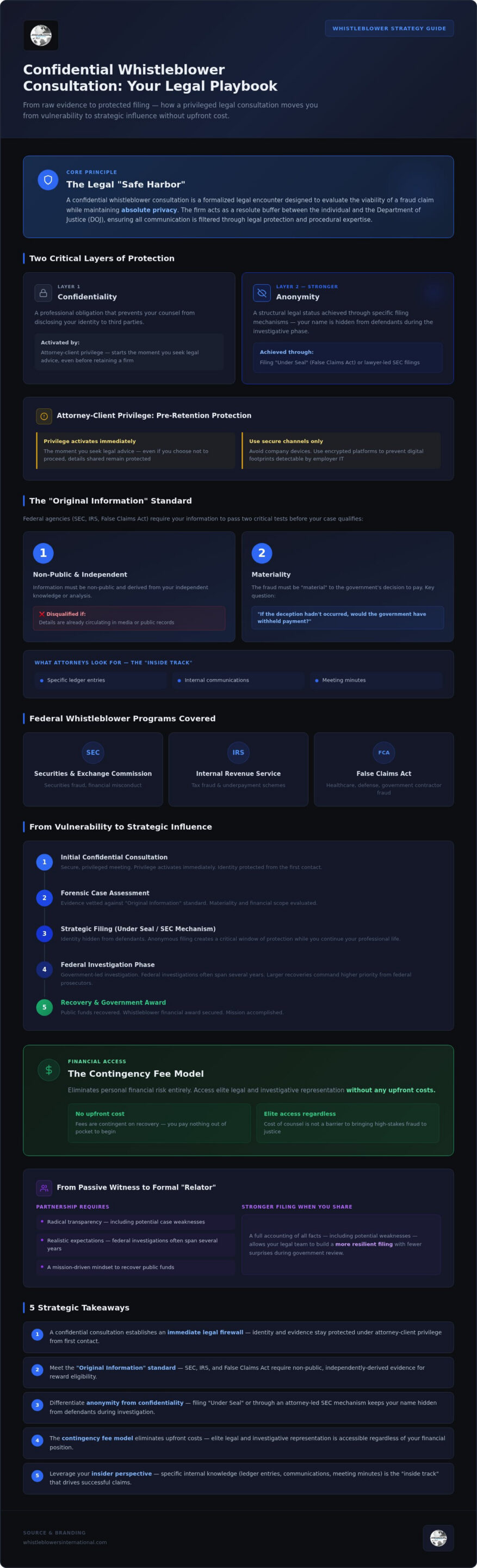
- Understand how a confidential whistleblower consultation establishes an immediate legal firewall, ensuring your identity and evidence remain protected under attorney-client privilege from the first point of contact.
- Identify the ‘Original Information’ standards required by the SEC, IRS, and False Claims Act to ensure your case meets the rigorous thresholds for federal investigation and reward eligibility.
- Differentiate between strategic anonymity and confidentiality to leverage filing mechanisms, such as filing ‘Under Seal,’ that keep your name hidden from defendants during critical investigative phases.
- Eliminate personal financial risk by utilizing a contingency fee structure, which provides access to elite legal and investigative representation without any upfront costs.
- Leverage an insider’s perspective to navigate the complexities of high-stakes fraud reporting, moving from initial discovery to successful recovery with a battle-tested strategic plan.
The Legal Architecture of a Confidential Whistleblower Consultation
A confidential whistleblower consultation is a formalized legal encounter designed to evaluate the viability of a fraud claim while maintaining absolute privacy. It serves as a strategic “safe harbor” where potential whistleblowers can disclose sensitive information without the immediate risk of professional exposure. Under the False Claims Act, this initial meeting is the pivot point where raw evidence is transformed into a structured legal strategy. The firm acts as a resolute buffer between the individual and the Department of Justice (DOJ), ensuring that any communication with the government is filtered through a lens of legal protection and procedural expertise. This protective posture is essential for those handling high-stakes evidence in sectors like healthcare, defense, or finance.
It’s vital to distinguish between confidentiality and anonymity. Confidentiality is a professional obligation that prevents your counsel from disclosing your identity to third parties. Anonymity, however, is a structural legal status achieved through specific filing mechanisms, such as submitting a case “under seal” or through a lawyer-led SEC filing. If a claim is filed under the right federal program, your identity remains hidden from the defendant during the government’s investigative phase, providing a critical window of protection while you continue your professional life. Understanding these nuances allows a whistleblower to make informed decisions about the timing and nature of their disclosure.
Attorney-Client Privilege and Initial Disclosure
Legal privilege is not a reward for hiring a firm; it’s a foundational right that activates the moment you seek legal advice. Even if you decide not to move forward after a confidential whistleblower consultation, the details shared remain protected. This “pre-retention privilege” ensures that potential relators can speak freely about complex financial schemes. To maintain this protection, don’t use company devices. Instead, use secure, non-employer-monitored channels like encrypted communication platforms to prevent digital footprints that an employer’s IT department might detect.
Establishing a Mission-Driven Partnership
Transitioning from a passive witness to a formal “relator” requires a shift in mindset. A successful partnership is built on radical transparency between the whistleblower and their counsel. If you provide a full accounting of the facts, including potential weaknesses, your legal team can build a more resilient filing. This process includes setting realistic expectations for federal investigations, which often span several years. The goal is a calculated, mission-driven effort to recover public funds and secure a financial award through a steady, guiding hand.
Evaluating Case Merit: What Happens During the Initial Assessment
The initial phase of a confidential whistleblower consultation involves a meticulous forensic examination of the facts. It isn’t merely a conversation; it’s a strategic vetting process designed to determine if your disclosure meets the “Original Information” standard. Federal agencies, including the SEC and IRS, require that information be non-public and derived from your independent knowledge or analysis. If the details are already circulating in the media or public records, the claim may be disqualified. We look for the “inside track”—the specific ledger entries, internal communications, or meeting minutes that provide a roadmap for government investigators.
Materiality is the second critical pillar of our assessment. The U.S. Department of Justice False Claims Act overview highlights that for the government to intervene, the fraud must be “material” to the government’s decision to pay. In simpler terms, if the deception hadn’t occurred, would the government have withheld payment? We evaluate the financial scope of the misconduct because larger recoveries often command higher priority from federal prosecutors and result in more significant whistleblower awards. This scrutiny ensures that we only advance cases with a high probability of success and substantial impact.
Evidence Review and Documentation
Strong evidence is the backbone of any successful filing. During your assessment, we scrutinize internal memos, encrypted emails, and proprietary spreadsheets that corroborate your claims. It’s vital to avoid “self-help” discovery, which involves taking documents in a way that violates privacy laws or employment contracts. We guide you on how to document corporate fraud without compromising your legal standing or the admissibility of the evidence. This methodical approach ensures that the proof you provide is both persuasive and legally sound.
Analyzing Federal Program Fit
Not all fraud is created equal. A healthcare kickback scheme falls under the False Claims Act, while a public company’s accounting deception belongs to the SEC Whistleblower Program. We also specialize in reporting trade fraud, which involves customs violations and tariff evasion. By identifying the correct jurisdictional fit early, we ensure your claim is filed with the specific agency best equipped to prosecute it. If you’re unsure where your evidence fits, a professional case review can provide the clarity needed to move forward with confidence.
Strategic Anonymity vs. Confidentiality in Federal Reporting
Strategic anonymity is the most potent weapon in a whistleblower’s arsenal, yet it’s often misunderstood. While confidentiality is a professional duty of your legal team, anonymity is a specific legal status that must be proactively secured through formal filings. During a confidential whistleblower consultation, we map out the specific procedural requirements for your case. For instance, the False Claims Act requires cases to be filed “under seal,” meaning the lawsuit remains hidden from the defendant and the public while the government investigates. This provides a multi-year window where you can maintain your career while federal agents build a case based on your evidence.
The SEC Whistleblower Program and the CFTC offer similar protections, but with a critical caveat: you can only remain anonymous if you are represented by counsel. In these programs, your attorney serves as the intermediary, submitting your information and shielding your identity from the commission itself until the point of reward distribution. Our battle-tested approach to data security ensures that all communications are handled through encrypted channels, preventing the digital leaks that often lead to accidental exposure in high-stakes corporate environments.
The Protective Power of Counsel
Your lawyer acts as the “filer of record,” a role that effectively sanitizes the evidence of your personal identifiers before it reaches government eyes. This is particularly vital when navigating the “public disclosure bar,” a legal hurdle that can disqualify cases based on information already in the public domain. By positioning the firm as the primary point of contact, we ensure that your identity is only revealed if and when it becomes legally necessary, such as during a deposition or trial. We prepare you for these eventualities early, ensuring there are no surprises in the years following your initial disclosure.
Preventing Workplace Retaliation
Retaliation prevention is a strategic exercise in timing and posture. We analyze your specific workplace dynamics to determine if it’s safer to remain in your role as an “inside” whistleblower or to secure a strategic exit before filing. If an employer does attempt to retaliate, federal statutes like the False Claims Act and the Dodd-Frank Act provide robust legal remedies, including double back pay and reinstatement. Beyond the legalities, we focus on the psychological survival of the process. Remaining hidden during a long-term federal investigation requires a steady, guiding hand to manage the stress of living a “double life” while the wheels of justice turn.
The Contingency Fee Model: Accessing Elite Representation Without Upfront Costs
The financial barrier to reporting systemic fraud shouldn’t be the reason misconduct goes unchecked. In high-stakes legal actions like those involving the False Claims Act or the SEC, the contingency fee model serves as a vital equalizer. This structure ensures that elite legal and investigative resources are available to individuals regardless of their personal net worth. By operating on a “no recovery, no fee” basis, the firm effectively absorbs the significant financial risk associated with multi-year federal investigations. This aligns the interests of the whistleblower and their counsel; the firm only succeeds if a reward is successfully secured for the client.
During a confidential whistleblower consultation, the specific terms of this partnership are outlined with absolute transparency. This meeting provides a space to discuss how the firm leverages its own capital to fund the complex infrastructure required for a successful claim. Unlike traditional law firms that charge by the hour, a contingency-based firm functions as a strategic partner. This mission-driven approach ensures that every tactical decision is made with the goal of maximizing the potential recovery while maintaining the highest standards of integrity and confidentiality.
Understanding the Contingency Framework
A successful whistleblower case often requires more than just legal filings. It demands a deep investigative dive involving forensic accountants, data analysts, and former government investigators who can validate complex financial evidence. Under a contingency agreement, the firm funds these high-level resources upfront. The eventual award is shared based on a pre-negotiated percentage of the “net recovery,” which is the total amount awarded by the government after certain litigation expenses are accounted for. For a detailed breakdown of how these agreements are structured, see our 2026 guide to whistleblower lawyer contingency fees.
International Whistleblower Representation
U.S. whistleblower programs have a remarkable global reach that many foreign nationals don’t fully realize. If a fraud affects U.S. markets or involves a company with a U.S. presence, the whistleblower may be eligible for a reward regardless of their citizenship or location. This is particularly relevant in cases involving the Foreign Corrupt Practices Act (FCPA) or import-export customs fraud. Engaging in a confidential whistleblower consultation allows international clients to navigate jurisdictional hurdles and secure U.S.-based counsel without the need for an upfront retainer. This global accessibility ensures that corporate transparency is enforced across borders. If you have evidence of international fraud, you can schedule a secure case evaluation to determine your eligibility for a U.S. federal reward.
From Consultation to Recovery: Partnering with Piacentile & Associates
The journey from witnessing corporate fraud to securing a federal recovery is a complex marathon that requires a formidable ally. Piacentile & Associates LLP provides more than just legal counsel; we offer a protective shield informed by personal experience. Led by Dr. Joseph Piacentile, a former whistleblower and attorney, the firm understands the visceral anxiety and professional risks involved in these high-stakes actions. This insider perspective ensures that every confidential whistleblower consultation is conducted with a deep empathy for the individual’s situation and a rigorous focus on the strategic maximization of results. We don’t just view you as a witness; we view you as a strategic partner in uncovering institutional misconduct.
Moving from the first call to a multi-million dollar filing requires a methodical approach to case development. Our firm leverages a global investigative reach to uncover fraud that often crosses international borders, particularly in customs and trade sectors. By the time your claim reaches the Department of Justice or the SEC, it has been vetted by a team that understands how to present evidence in a way that triggers government intervention. This total commitment to the investigative process is the firewall between a dismissed claim and a successful recovery. We prioritize your privacy at every stage, ensuring that the transition from discovery to filing is handled with absolute discretion.
The Piacentile & Associates Advantage
Our unique investigative methodology is rooted in uncovering patterns of fraud that others might overlook. We don’t just file cases; we build them from the ground up using forensic analysis and insider intelligence. Having handled massive complexities across the False Claims Act, SEC, and FinCEN programs, our firm acts as a battle-tested mentor for those facing significant risks. This experience with high-level government oversight allows us to navigate agency requirements with a steady, guiding hand, ensuring your evidence meets the highest standards of scrutiny before it ever reaches a prosecutor’s desk.
Taking the First Step Safely
Preparing for your consultation involves gathering key facts while maintaining strict digital hygiene. Avoid using company-owned hardware or networks to discuss your findings. In the first 48 hours after you reach out, our team initiates a preliminary assessment to determine the potential jurisdictional fit for your evidence. We focus on establishing a clear path forward that protects your identity while evaluating your eligibility for a federal reward. If you’re ready to move from a position of vulnerability to one of strategic influence, schedule your confidential consultation today and begin the process of securing your future.
Securing Your Legacy Through Strategic Disclosure
Navigating systemic corporate fraud requires more than just individual courage; it demands a calculated strategy that prioritizes your professional survival. By securing a confidential whistleblower consultation, you move from a place of isolated risk to a position of protected strength. You’ve learned how attorney-client privilege acts as an immediate firewall and how the contingency fee model ensures that elite investigative resources remain accessible without personal financial exposure. This methodical approach transforms raw evidence into a formidable legal asset while shielding your career from the threat of retaliation.
Whistleblowers International is led by Dr. Joseph Piacentile, a former whistleblower who provides the unique insider’s perspective necessary to navigate high-stakes federal actions. We offer global representation for individuals involved in U.S. government oversight programs, operating strictly on a contingency basis where we only get paid if you win. This mission-driven partnership is designed to maximize your reward potential while maintaining the highest standards of anonymity. It’s time to transition from a vulnerable witness to a strategic relator. Secure your future with a confidential consultation at Whistleblowers International. Your commitment to integrity deserves the protection of a battle-tested ally.
Frequently Asked Questions
Is a whistleblower consultation truly free and confidential?
A confidential whistleblower consultation is both free of charge and legally privileged. This means that the firm absorbs the initial assessment costs while the law protects the secrecy of your communications. Even if you don’t retain the firm, the details of your disclosure cannot be shared with third parties. This protective layer ensures you can explore the merits of your evidence without financial obligation or the risk of your information being leaked to unauthorized entities.
Can my employer find out that I spoke with a whistleblower lawyer?
Your employer cannot legally discover that you’ve sought legal advice because attorney-client privilege acts as a definitive barrier. To maintain this security, you must avoid using company-issued laptops, phones, or email accounts to contact a firm. By using personal devices and encrypted communication channels, you ensure that your professional life remains undisturbed while you evaluate your legal options. The firm serves as a resolute buffer between your identity and the corporate entity.
Do I need to have all the evidence before my first consultation?
You don’t need a complete evidentiary file to begin the process. The purpose of an initial assessment is to determine if the information you possess has the potential to meet federal standards. Counsel helps you identify which internal documents, such as ledger entries or emails, are most critical for a successful filing. Starting early allows for a strategic approach to documentation that avoids the common pitfalls of self-help discovery while the evidence is still accessible.
What is the difference between an anonymous and a confidential whistleblower?
Confidentiality refers to the ethical and legal duty of your lawyer to keep your identity private. Anonymity is a structural status achieved through specific filing mechanisms. For example, some programs allow a lawyer to file on your behalf without naming you to the agency initially. In False Claims Act cases, filing under seal keeps your identity hidden from the defendant and the public while the government conducts its investigation, providing a layer of strategic protection.
Can a foreign national receive a reward from the U.S. government?
Foreign nationals are absolutely eligible for rewards under most U.S. whistleblower programs. If the fraud involves a company traded on U.S. exchanges or affects U.S. government funds, you can file a claim regardless of your citizenship or location. Programs like those managed by the SEC and IRS have a global reach, frequently rewarding individuals for reporting international bribery or customs fraud. A confidential whistleblower consultation helps international clients navigate these complex jurisdictional requirements with precision.
How much does it cost to hire a whistleblower attorney on contingency?
Hiring an attorney on a contingency basis involves no upfront costs or hourly fees. The firm funds the entire investigation, including the work of forensic accountants and investigators. In exchange for this financial risk, the firm receives a pre-negotiated percentage of the final monetary award secured from the government. If the case doesn’t result in a recovery, you owe no legal fees. This model ensures that elite representation is accessible to everyone.
What happens if the government decides not to intervene in my case?
If the government declines to intervene, you still have the option to pursue the case independently. In qui tam actions under the False Claims Act, a relator can move forward with their own counsel to recover funds on behalf of the government. While government intervention increases the likelihood of success, many significant recoveries have been won in non-intervened cases. Your legal team will evaluate the strength of the evidence to determine if proceeding alone is a viable strategy.
How long does the typical whistleblower case take from consultation to reward?
Whistleblower cases are long-term commitments that typically span several years. The process involves an initial investigation, the filing of the complaint, and a lengthy period where the government evaluates the evidence. Federal agencies move methodically to ensure they can prove the fraud in court. While the duration can be taxing, the firm provides a steady, guiding hand throughout the labyrinthine process, managing expectations and ensuring that your claim remains active and prioritized by federal agents.