
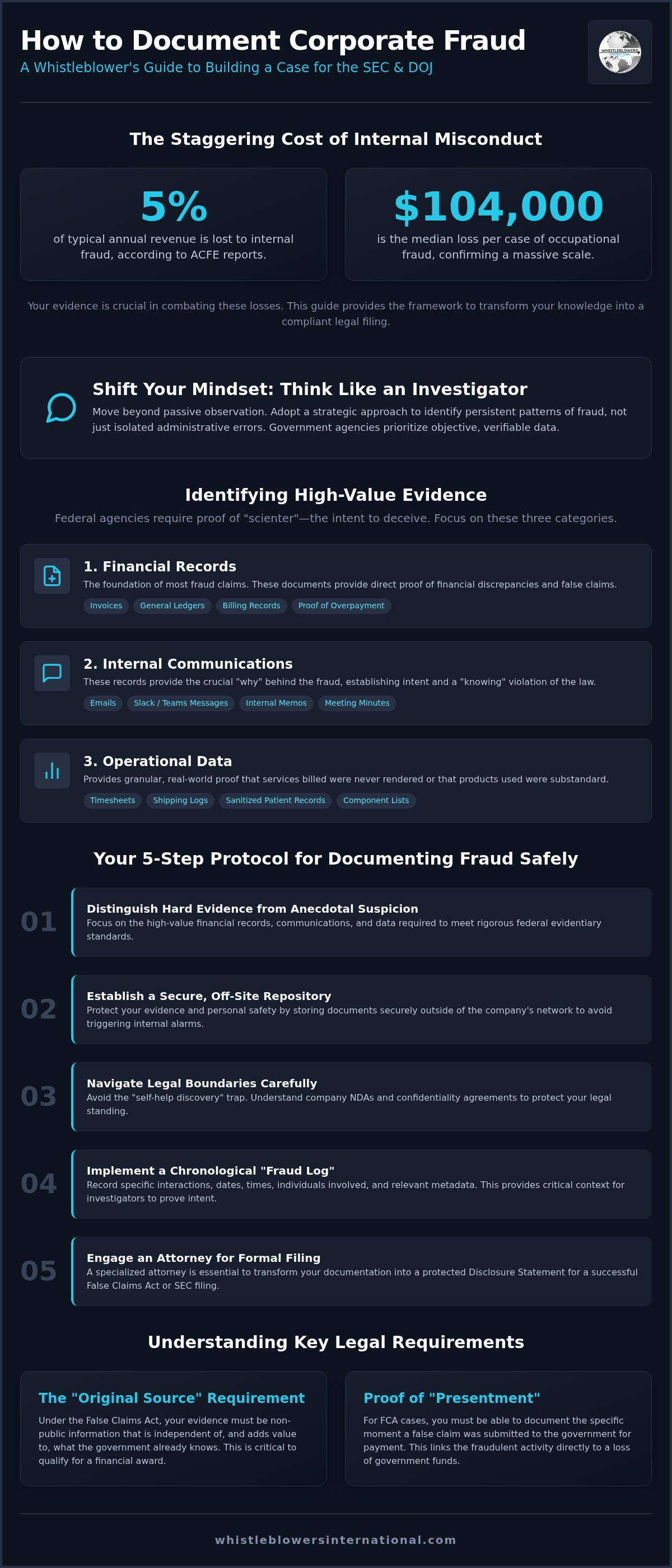
Did you know the typical organization loses 5% of its annual revenue to internal misconduct? According to the 2026 ACFE report, the median loss per case of occupational fraud has reached $104,000, confirming the massive scale of the corruption you’ve likely witnessed. You probably feel a heavy weight on your shoulders, caught between a duty to the truth and a legitimate fear of professional retaliation. It’s common to worry that your evidence is merely hearsay or that you’ll violate a non-disclosure agreement by speaking up.
This guide provides the definitive framework for how to document corporate fraud using methods that satisfy the Department of Justice and the SEC. You’ll learn exactly which documents to preserve and how to store them securely without triggering internal alarms. If you follow these precise protocols, you can transform raw data into a compliant legal filing that maximizes your potential award. We’ll examine how to evaluate your evidence through the lens of a strategic investigator, ensuring your documentation remains a shield for your career rather than a liability.
Key Takeaways
- Distinguish between anecdotal suspicion and the high-value financial records—such as invoices and ledgers—required to meet rigorous federal evidentiary standards.
- Master the precise protocols for how to document corporate fraud by establishing a secure, off-site repository that protects both your evidence and your personal safety.
- Avoid the “self-help discovery” trap by learning how to navigate company NDAs and confidentiality agreements without compromising your legal standing.
- Implement a chronological “Fraud Log” to record specific interactions and metadata, providing the critical context government investigators need to prove intent.
- Understand the essential role of an attorney in transforming your documentation into a protected Disclosure Statement for a successful False Claims Act or SEC filing.
The Critical Role of Documentation in Whistleblower Success
Documentation is the lifeblood of any successful federal fraud claim. While a whistleblower’s personal testimony is valuable, government agencies like the SEC and the DOJ prioritize objective, verifiable data over individual accounts. Understanding how to document corporate fraud effectively means shifting your focus from mere suspicion to the assembly of admissible evidence. This distinction is vital because federal courts operate on the principle of “particularity,” a standard that requires specific details regarding the who, what, where, and when of the alleged misconduct. Without these granular details, even the most well-intentioned claim may be dismissed for lack of specificity.
Robust records also serve as your primary defense against professional retaliation. If a company attempts to discredit you through “he-said, she-said” tactics, a contemporaneous paper trail provides an immutable record of the facts. This is especially relevant when invoking the Whistleblower Protection Act, as documented disclosures are much harder for a defendant to characterize as mere performance issues or interpersonal conflicts. When you understand how to document corporate fraud with technical precision, you move from being a witness to becoming a formidable ally for the government.
Understanding the ‘Original Source’ Requirement
Under the False Claims Act, your evidence must generally satisfy the “original source” requirement to qualify for a financial award. This means your documentation must provide non-public information that’s independent of, and adds value to, any information the government already possesses. If the fraud is already a matter of public record through news reports or administrative hearings, your claim may be barred unless your documentation offers unique, insider insights. Precise records directly influence the size of your potential award. The more “high-value” the evidence, the more leverage your attorney has when negotiating with federal agencies for a higher percentage of the recovery.
Why ‘Thinking Like an Investigator’ Matters
Successful whistleblowers move beyond passive observation to adopt the mindset of a strategic investigator. This involves identifying persistent patterns of fraud rather than isolated administrative errors. A single billing mistake is often viewed as a clerical lapse; however, ten identical “errors” across three departments suggest a systemic intent to defraud. Timing is equally critical. Documenting events in real-time is vastly superior to reconstructing them months later. Federal investigators place higher evidentiary weight on notes and logs created while events were unfolding, as these are less susceptible to the natural fading of human memory.
Identifying High-Value Evidence: What Federal Agencies Require
Federal investigators aren’t interested in simple clerical errors. They’re searching for evidence of “scienter,” a legal term denoting the intent to deceive or a reckless disregard for the truth. When you’re determining how to document corporate fraud, your focus should be on gathering materials that demonstrate a “knowing” violation of federal statutes. With a 2026 survey revealing that 76% of organizations experienced attempted or actual payments fraud in the previous year, agencies are inundated with reports. High-value evidence is what separates your claim from the noise. This evidence typically falls into three categories: financial records, internal communications, and operational data.
Financial records are the foundation of most claims. You should look for invoices, general ledgers, and proof of government overpayment. For instance, if a defense contractor bills for premium materials but uses substandard components, the delta between the invoice and the shipping log constitutes high-value evidence. Internal communications, including emails and Slack messages, are equally vital. These often provide the “why” behind the fraud. A manager’s instruction to “ignore the compliance report” or “book the revenue now” can transform a circumstantial case into a slam dunk. Operational data, such as timesheets or sanitized patient records, provides the granular proof that services billed were never actually rendered.
Documenting False Claims Act Violations
In False Claims Act (FCA) cases, the government requires proof of “presentment.” This is the specific moment a false claim was submitted to the government for payment. Whether it involves Medicare billing or large-scale infrastructure projects, you must link the fraud directly to federal funds. Utilizing a structured Evidence Needed for a False Claims Act Case framework ensures you don’t miss critical components like the “materiality” of the fraud. If you’re unsure if your findings meet this threshold, consulting with a specialized whistleblower attorney can help clarify the strength of your evidence.
SEC and IRS Specific Documentation
SEC investigations often hinge on “accounting cookery” or misleading financial statements that hide a company’s true health. Documentation should include internal audit reports that contradict public filings or logs showing illegal insider trading. For IRS claims, focus on underpayment records and details of offshore accounts or tax evasion schemes. The goal is to show a clear discrepancy between internal reality and external reporting. For those working within the public sector, referencing a whistleblower guide for federal employees can provide additional context on how to handle sensitive data safely. Success in these programs often requires sanctions exceeding $1 million, making high-quality documentation essential for a substantial award.
Navigating the Legal Boundaries of Evidence Collection
Gathering evidence isn’t a license to bypass the law. While federal statutes provide significant protections for those reporting misconduct, you must avoid the “Self-Help Discovery” trap. This occurs when a whistleblower takes company documents in a way that violates theft or trade secret laws, potentially leading to aggressive counter-suits. Understanding how to document corporate fraud requires a nuanced grasp of what courts consider “reasonable” behavior. Generally, judges are more lenient if you only take documents you had authorized access to during your normal job duties. If you overreach by downloading thousands of unrelated files, you risk shifting the legal focus from the company’s corruption to your own alleged misconduct.
Many individuals fear that a signed Non-Disclosure Agreement (NDA) or a third-party confidentiality clause prevents them from speaking out. It’s a common misconception. Federal law typically preempts these private contracts when the disclosure is made to a government agency like the SEC or the DOJ. However, you must still navigate privacy regulations such as HIPAA in healthcare or laws protecting Personally Identifiable Information (PII). Documentation should focus on the fraudulent transaction itself rather than the private data of uninvolved third parties. Strategically redacting sensitive personal info while preserving the evidence of the fraud is a critical skill in how to document corporate fraud without inviting unnecessary liability. For those operating in international business hubs like Dubai, where commercial laws have specific nuances, you can find out more about navigating legal obligations and protecting your rights.
The digital trail is often the most compelling, but it’s also the most dangerous to navigate. Don’t hack. Accessing password-protected areas where you lack explicit authorization can trigger violations of the Computer Fraud and Abuse Act (CFAA). It’s always safer to use personal devices for your own notes and logs rather than company equipment, which the employer can monitor or wipe remotely. If you’ve already gathered data, never delete company files to “cover your tracks.” Such actions can be interpreted as spoliation of evidence, which severely undermines your credibility and can lead to sanctions in a future “Qui Tam” lawsuit.
Protecting Attorney-Client Privilege
Attorney-client privilege is an absolute “No-Go” zone for whistleblowers. If you come across memos, emails, or reports between the company and its outside or in-house counsel, do not copy or take them. Taking privileged information is one of the few actions that can disqualify your entire case and even get your legal team removed. Always look for “Privileged and Confidential” markings on internal documents. If you’re unsure if a document is protected, stop immediately and seek guidance. A seasoned advocate can help you “launder” your evidence into a compliant filing without tainting the process with privileged material.
A Step-by-Step Protocol for Documenting Fraud Safely
Establishing a rigorous, methodical process for evidence collection is the only way to ensure your findings withstand the scrutiny of federal investigators. Ad-hoc record-keeping often leads to gaps in the narrative or, worse, the accidental inclusion of privileged material that could jeopardize your standing. To protect the integrity of your claim, you must follow a structured protocol for how to document corporate fraud that prioritizes digital security and legal admissibility. This approach transforms raw data into a strategic asset that an attorney can use to build a compelling case for the government.
- Step 1: Create a secure, off-site repository. Never store your evidence on company servers, laptops, or cloud accounts. Use a personal, encrypted external drive or a private, two-factor authenticated cloud service that has no connection to your employer’s network.
- Step 2: Maintain a chronological Fraud Log. Real-time documentation is significantly more persuasive than memory-based reconstruction. Record dates, times, specific interactions, and the names of individuals involved in the misconduct as they occur.
- Step 3: Capture metadata. Digital fingerprints are as important as the content itself. When saving files, preserve the “properties” or “header” information, which proves the file’s origin, creation date, and lack of subsequent alteration.
- Step 4: Organize by ‘Scheme’. Group your evidence according to the specific statutory violation it proves, such as upcoding in healthcare or kickbacks in government contracting. This makes it easier for federal agencies to evaluate the “materiality” of the fraud.
- Step 5: Secure professional legal review. Before you submit any documentation to a government agency, you must have it vetted by counsel. If you’re ready to move forward, contacting a national whistleblower attorney on a contingency basis ensures your evidence is “laundered” into a compliant legal filing without upfront costs.
Creating a Chronological Narrative
Your log should be a factual, objective account of events. Avoid emotional bias or speculative language; instead, focus on “just the facts” to maintain your credibility as a professional witness. It’s equally vital to identify other potential witnesses, including current and former employees who may have observed similar patterns. By linking each physical document or digital file to a specific entry in your narrative, you create a “chain of custody” that allows investigators to trace the fraud back to its source with absolute clarity.
Digital Security for Whistleblowers
Corporate IT departments often employ sophisticated monitoring tools that can flag unusual file transfers or access patterns. To mitigate this risk, avoid using company Wi-Fi or company-issued laptops to update your log or access your secure repository. Use personal tech and secure, private connections whenever possible. Maintaining a clean chain of custody isn’t just about proving the evidence is real; it’s about proving that you gathered it through authorized channels without compromising the company’s legitimate trade secrets or unrelated private data.
Transitioning from Evidence to a Formal Whistleblower Claim
Gathering evidence is a critical precursor, but even the most thorough documentation doesn’t constitute a legal claim on its own. In the federal system, particularly under the False Claims Act, a whistleblower must file a “Qui Tam” lawsuit under seal to trigger a government investigation. This means that while you’ve mastered how to document corporate fraud, you now need a seasoned advocate to “launder” that raw data into a formal Disclosure Statement. This document is a comprehensive narrative that synthesizes your evidence into a format the Department of Justice can investigate effectively. It’s the bridge between your internal observations and a government-led enforcement action.
Most elite whistleblower firms operate on a contingency fee model. This structure ensures that individuals facing high-stakes risks can access top-tier legal and investigative expertise without the burden of upfront costs. If your case is successful, the firm receives a percentage of the final award; if not, you owe nothing for the legal services rendered. Once you hand your evidence to a law firm, the focus shifts from collection to validation and strategic filing, moving your case through a labyrinthine process that requires patience and precision.
Maximizing Your Whistleblower Award
The quality and organization of your documentation directly impact the final whistleblower award percentage. For instance, in SEC or IRS programs, awards typically range from 10% to 30% of the collected monetary sanctions. If your evidence provides an “insider perspective” that significantly reduces the government’s investigative burden, you’re positioned to negotiate for the higher end of that scale. This is where knowing how to document corporate fraud pays dividends; the government rewards relators who provide information that leads to a substantial recovery without requiring extensive federal resources to decipher.
Protecting Your Future
Confidentiality is the cornerstone of a successful filing. Federal programs are designed to protect your identity, often allowing you to remain anonymous throughout the initial stages of an investigation. It’s vital to prepare for the long-term nature of these cases, as federal fraud investigations can span several years. During this period, your documentation remains your strongest shield. If you’re ready to transition from observer to advocate, the next step is a professional review. You should Contact Piacentile & Associates LLP for a confidential case evaluation to determine the strength of your evidence and explore your options for a secure, contingency-based filing.
Securing Your Path Toward Accountability
Mastering how to document corporate fraud is the fundamental first step toward achieving a successful outcome in a federal investigation. By maintaining a meticulous, secure repository and adhering to the legal boundaries of evidence collection, you protect your professional standing while building a formidable case for government agencies. Remember that the quality of your initial documentation directly influences the government’s willingness to intervene and, ultimately, the size of your potential award. You don’t have to navigate this high-stakes process alone.
If you’re ready to move forward, you can secure a confidential review of your evidence with our veteran whistleblower attorneys. Our firm is led by a former whistleblower who understands the personal and professional risks you face. We provide national expertise in FCA, SEC, and IRS programs on a contingency-fee basis; we only get paid if you win. Taking this step ensures your evidence is evaluated with the scrutiny of a strategic investigator. Your integrity has brought you this far; let our experience guide you the rest of the way.
Frequently Asked Questions
Can I be sued for taking company documents to prove fraud?
Yes, you can be sued for “self-help discovery,” but federal protections often mitigate this if the documents were accessed through your normal job duties. Taking documents you weren’t authorized to see can lead to counter-suits for theft or trade secret violations. It’s vital to only collect materials relevant to the fraud that you have legitimate access to. A specialized attorney can help “launder” this evidence into a compliant filing while minimizing your liability.
What should I do if my company asks me to delete evidence of fraud?
You should never comply with a request to destroy evidence, as this could be considered spoliation or obstruction of justice. If you receive such an instruction, document the request immediately in your off-site Fraud Log, noting the date, time, and individual who made the demand. Refusing to delete data protects your integrity and ensures that the government can eventually recover the truth through subpoenas or forensic audits during a formal investigation.
Do I need to have physical copies of documents, or are photos enough?
Digital photos or scans are generally sufficient, provided they are clear and capture the entire document including any metadata. When learning how to document corporate fraud, remember that the “properties” of a digital file, such as the creation date and original author, often carry as much weight as the content itself. Ensure your captures are high-resolution and stored in a secure, encrypted repository that is entirely separate from company-controlled systems or networks.
Is it legal to record conversations with my boss about the fraud?
The legality of recording depends on whether you are in a “one-party consent” or “all-party consent” jurisdiction. Recording a conversation without permission in an all-party consent state could lead to criminal liability or civil sanctions. Instead of recording, it is often safer to write detailed, contemporaneous notes in your Fraud Log immediately after the meeting. These notes serve as a factual record of what was said without the legal risks associated with unauthorized audio recording.
How much evidence do I need before I contact a whistleblower lawyer?
You don’t need a “smoking gun” or a complete case file before seeking legal counsel. If you have a reasonable belief that fraud is occurring and have access to some supporting data, it’s time to reach out. Piacentile & Associates LLP operates on a contingency basis, meaning we evaluate your existing evidence at no upfront cost. An early consultation helps ensure you understand how to document corporate fraud safely before the company becomes aware of your scrutiny.
Can I still report fraud if I was partially involved in the scheme?
Yes, you can still file a claim, though your involvement may affect the size of your final award. Federal programs like the False Claims Act allow “relators” who were involved in the misconduct to report it, provided they weren’t the primary planners or leaders of the fraud. Coming forward early and providing high-value documentation can often mitigate the impact of your participation and provide you with critical legal protections against retaliation.
How do I document fraud if I no longer have access to company systems?
If you’ve lost access, focus on what you can recall and any documents you legally retained before your departure. You should create a detailed chronological narrative identifying specific transactions, dates, and witnesses who still have system access. Government investigators have the power to issue subpoenas for the digital records you identify. Your role is to provide the “roadmap” that tells federal agencies exactly where to look for the evidence within the company’s internal servers.
What is the most important piece of evidence in a False Claims Act case?
The most critical evidence is proof of “presentment,” which is the actual submission of a false bill to the government for payment. While internal emails discussing fraud are helpful, federal agencies need to see the specific invoice or claim that resulted in the government paying out funds. Documentation that links a specific fraudulent act to a federal contract or program, such as Medicare or defense spending, is the cornerstone of a successful Qui Tam lawsuit.