If you’ve uncovered proof of fraud against the government, you’re holding the potential for a recovery that exceeded $6.8 billion in fiscal year 2025 alone. You likely feel the weight of this discovery, perhaps fearing that the files you have collected could lead to retaliation or wondering if your information is legally admissible. It’s natural to feel confused by technical terms like “scienter” or “materiality,” especially when the stakes for your career and reputation are so high.
Gathering effective evidence for False Claims Act cases requires more than just identifying a mistake; it requires proving that the defendant acted with knowledge or reckless disregard. If you understand the specific evidentiary standards required in 2026, you can build a high-impact case while ensuring your own legal standing remains protected. This guide provides a methodical roadmap for safe documentation and clarifies the complex requirements of the qui tam process. We will examine what documents you truly need and how to evaluate their strength before you take the next step of contacting a seasoned legal advocate to discuss your potential as a relator.
Key Takeaways
- Distinguish between direct and circumstantial evidence for False Claims Act cases to ensure your documentation effectively proves intentional government fraud.
- Learn to navigate the “Self-Help Discovery” doctrine to collect necessary proof without compromising your legal standing or exposing yourself to company retaliation.
- Master the chronological organization of evidence required for a robust disclosure statement that clearly illustrates the evolution of a fraudulent scheme.
- Identify specific fraud markers within healthcare, defense, and finance that satisfy the government’s strict materiality and scienter requirements.
- Evaluate the strength of your investigative leads through the lens of a seasoned advocate before initiating a formal qui tam filing.
Defining Admissible Evidence in False Claims Act Litigation
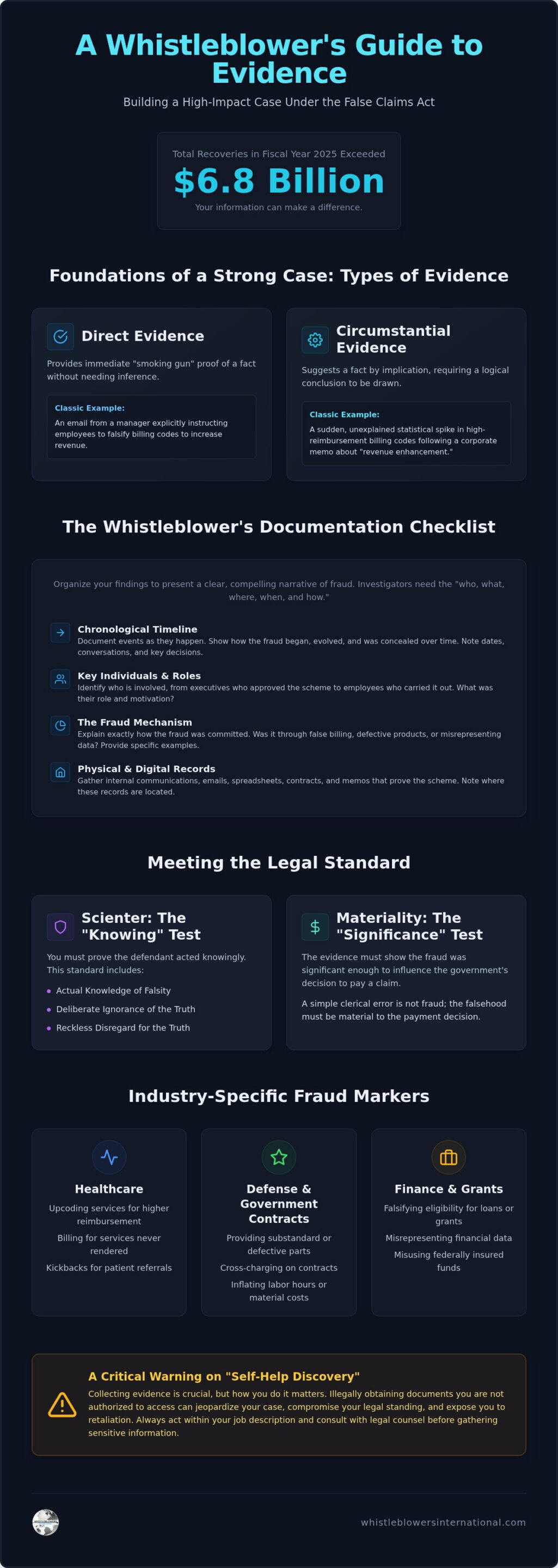
Under the False Claims Act, evidence serves as the foundation for proving that a person or entity knowingly defrauded the government. It’s not enough to simply identify a clerical error or a difference in clinical judgment. The information must demonstrate a “knowing” violation, which includes actual knowledge, deliberate ignorance, or reckless disregard for the truth. When evaluating evidence for false claims act cases, investigators look for a clear trail that links a specific action to a financial loss for the taxpayers. You are effectively the eyes and ears of the government, providing an internal perspective that federal agencies cannot see from the outside.
The “Original Source” Requirement
To qualify for a whistleblower reward, you must often prove you are an “original source” of the information. This means your evidence cannot be derived solely from public disclosures like news articles, government audits, or judicial hearings unless you were the one who provided that information to the public. Independent knowledge is information you acquired through direct perception or experience, whereas an independent investigation is the active discovery of fraud through the analysis of data that was not previously known to the government. If the government already knows about the fraud from public sources, your case may be barred unless you provide significant, non-public details that add value to the investigation.
Physical vs. Testimony-Based Evidence
While physical documents like spreadsheets, internal memos, and contracts are often viewed as the gold standard, your personal testimony is a powerful form of evidence in a qui tam filing. A relator’s sworn statement provides the necessary context to explain how a complex billing system was manipulated or how a corporate culture encouraged fraud. However, a clear hierarchy exists in litigation. Internal documents usually trump verbal recollections because they provide a contemporaneous record of the events that is harder for a defendant to dispute. Corroborating evidence, even if it isn’t a “smoking gun” on its own, strengthens your case by validating your testimony and creating a more persuasive narrative for the Department of Justice.
The Whistleblower’s Evidence Checklist: Essential Documentation
Building a high-impact case starts with a structured approach to documentation. When you prepare a disclosure statement for the government, you aren’t just handing over a pile of papers; you’re presenting a narrative of systemic fraud. The quality of your evidence for false claims act litigation determines whether the Department of Justice decides to intervene. According to the Department of Justice summary of the False Claims Act, the government needs specific proof of a “claim” to pursue a case. To maximize the chances of success, you must identify the specific individuals involved, the exact mechanism of the fraud, the location of the records, the timeframe of the activity, and the reason the conduct was knowingly wrongful.
If you provide a chronological timeline, it allows investigators to see how a small mistake evolved into a deliberate fraudulent scheme. This timeline should be supported by a log of events that you maintain personally. It’s vital to record your observations, dates of conversations, and the names of witnesses as they occur. In fiscal year 2025, a record 1,297 qui tam lawsuits were filed, which means your evidence must be exceptionally well-organized to stand out in an increasingly crowded field of investigative leads. Understanding the full legal process for qui tam whistleblower litigation can help you anticipate each stage of the journey and prepare your documentation accordingly.
Internal Communications and Directives
Emails often serve as the heartbeat of a whistleblower case. Memos that explicitly instruct staff to bypass safety regulations or falsify quality control records provide the “scienter,” or intent, that the government seeks. Training manuals can be equally powerful if they demonstrate a corporate policy of non-compliance. If you have meeting minutes where concerns about fraudulent activities were raised and subsequently ignored, you have proof that the organization was put on notice. These documents transform a single employee’s suspicion into a documented corporate strategy of deception.
Financial and Billing Records
Financial records provide the actual “claim” in the False Claims Act. You need invoices that were submitted to government agencies like Medicare or the Department of Defense. Internal “shadow books” or spreadsheets that track the difference between actual services rendered and what was billed provide irrefutable proof of inflated charges. In fiscal year 2025, healthcare fraud accounted for over $5.7 billion in recoveries, largely driven by this type of granular billing evidence. Proof of payment or reimbursement from government agencies completes the circle, showing that the fraud resulted in a specific loss to the public treasury.
Maintaining a personal log of events is vital, but you must do so without violating company data protocols. Taking physical files or downloading proprietary databases can sometimes jeopardize your legal standing or invite claims of theft. Instead, focus on what you have seen and heard in your daily role. If you’re unsure about which documents are safe to document, you should consult with an experienced investigator who can guide you through the evaluation phase while protecting your privacy.
Industry-Specific Evidence: Healthcare, Defense, and Finance
Fraud isn’t a monolith. The specific “fraud markers” that trigger a Department of Justice investigation vary significantly depending on the regulatory environment of the industry in question. When you are evaluating evidence for false claims act litigation, you must align your documentation with the specific statutes governing that sector. In fiscal year 2025, while healthcare continued to dominate recoveries, the defense industry saw a dramatic surge in enforcement, with recoveries rising from $98 million in 2024 to nearly $634 million. This shift underscores the government’s heightened scrutiny of procurement integrity and the need for sector-specific proof.
Because these cases often involve massive datasets or technical specifications, expert witnesses play a vital role in the investigative process. These specialists, ranging from clinical auditors to forensic accountants, help translate complex internal records into clear evidence of a “false claim.” If you are reporting healthcare and Medicare fraud, for instance, an expert might be needed to demonstrate how a hospital’s billing patterns deviate from standard medical necessity guidelines. Their analysis bridges the gap between a suspicious pattern and a legally actionable violation.
Evidence for Medicare and Healthcare Fraud
Healthcare fraud often leaves a trail in patient records and financial ledgers. To build a resolute case, focus on documentation that illustrates systemic manipulation of government programs. Key evidence types include:
- Phantom Billing: Patient charts and schedules that show no record of a service being performed, despite a claim being submitted to Medicare or Medicaid.
- Upcoding: Internal records showing that a provider consistently billed for a high-complexity visit when the actual treatment provided was routine or minimal.
- Kickbacks: Evidence of “remuneration,” such as cash payments, lavish gifts, or sham speaker fees, used to induce referrals in violation of the Anti-Kickback Statute.
Evidence for Defense and Procurement Fraud
In the defense sector, fraud typically involves the quality of goods or the integrity of the bidding process. The government focuses on whether it received exactly what it contracted for. Vital evidence includes:
- Substandard Testing: Internal reports or quality control logs showing that components, such as aircraft parts or tactical gear, failed to meet contract specifications but were certified as compliant anyway.
- Labor Mischarging: Timesheets and payroll records showing that employees billed hours to a “cost-plus” government contract while they were actually working on private, commercial projects.
- Collusion: Communications or meeting notes that prove “bid rigging,” where contractors conspired to inflate prices or rotate winning bids to ensure a guaranteed profit at the taxpayer’s expense.
The Legality of Evidence Collection: Avoiding “Self-Help” Discovery
Many potential relators hesitate because they fear the act of gathering evidence for false claims act litigation might expose them to criminal or civil liability. This concern is legitimate. While federal law protects whistleblowers, it does not grant them a license to commit theft or breach security protocols. The Department of Justice seeks high-quality information, yet it must also maintain the integrity of the judicial process. If you are systematically gathering evidence for false claims act filings, you must move with precision to avoid claims of corporate espionage. If you bypass password protections or access devices you are not authorized to use, you risk being accused of “self-help discovery,” a doctrine that can lead to the dismissal of your case or personal legal repercussions.
Recording conversations is another area where individuals often stumble. In states with “two-party consent” laws, recording a private conversation without the other person’s knowledge is a criminal offense. Even if the recording contains a confession of fraud, its illegal nature may render it inadmissible and put you at risk. It’s far safer to document the conversation in a contemporaneous log, noting the date, time, and participants, rather than attempting to capture audio surreptitiously. This methodical approach preserves your credibility while protecting you from wiretapping charges.
Navigating HIPAA and Trade Secrets
Whistleblowers in healthcare often worry about violating HIPAA by taking patient records. The law provides a pathway for disclosing Protected Health Information (PHI) to government investigators or legal counsel when reporting suspected fraud. Similarly, the Defend Trade Secrets Act (DTSA) provides immunity from liability for disclosing trade secrets to government officials for the purpose of reporting a violation of law. The “reasonable necessity” standard dictates that you should only take documents that are directly required to prove the fraudulent scheme, rather than conducting a wholesale sweep of company servers.
Protecting Attorney-Client Privilege
Attorney-client privilege is perhaps the most dangerous area for a whistleblower to navigate. If you provide your lawyer or the government with documents that reflect legal advice given to the company, you may unintentionally contaminate the case. The government frequently employs “taint teams,” which are independent sets of agents and prosecutors, to review such materials and ensure that the core investigative team is not exposed to privileged information. You should never take documents involving the company’s legal counsel. You also risk waiving your own privilege if you discuss the details of your case with friends, family, or non-legal colleagues. Before you take another step, you should evaluate the safety of your documentation with an expert who understands these boundaries.
Evaluating Case Strength: The Materiality and Scienter Tests
Possessing a collection of documents that reveal a lie is only the first step in a complex legal journey. To prevail in a qui tam action, your evidence for false claims act litigation must satisfy two rigorous legal standards: materiality and scienter. The Department of Justice does not pursue every instance of non-compliance. Instead, federal investigators focus on violations that are fundamental to the government’s decision to pay a claim. If the evidence merely shows a “technical” or “minor” infraction that would not have changed the government’s behavior, the case is unlikely to survive a motion to dismiss. Understanding these nuances is critical before you commit to the lengthy process of a federal filing.
A high-impact case requires a clear demonstration of intent. It isn’t necessary to prove that a CEO personally signed off on a fraud, but you must show that the entity acted with at least “reckless disregard” for the truth. This is why choosing the right False Claims Act lawyer is a vital strategic move. An experienced advocate evaluates your evidence through the eyes of a prosecutor, determining if the “fraud markers” you’ve identified are strong enough to trigger a federal investigation or a multi-million dollar settlement.
Proving Materiality After the Escobar Ruling
The Supreme Court’s ruling in the Escobar case established that materiality is a “rigorous” and “demanding” requirement. You must provide evidence showing that the government would have refused to pay the claim had it known about the non-compliance. This often involves looking at the government’s past behavior. If the government has a history of paying similar claims despite knowing about the specific type of violation you’ve uncovered, the court may rule the fraud was not “material.” Your evidence must go beyond the existence of a lie; it must prove that the lie was the “but-for” cause of the government’s financial loss.
The Role of Legal Counsel in Case Development
A firm like Piacentile & Associates LLP brings a unique perspective to this evaluation, utilizing a team of former whistleblowers and investigators to flesh out your initial leads. They move beyond the surface level, conducting a deep-dive analysis to ensure your evidence for false claims act requirements are fully met before the first document is filed. This process culminates in the drafting of a “Relator’s Disclosure Statement,” a comprehensive document that provides the DOJ with a roadmap of the fraud. With the DOJ’s May 2026 policy update aimed at accelerating case reviews, having “front-loaded,” high-quality evidence is more important than ever to move your case toward a successful intervention. If you are ready to evaluate the viability of your discovery, you should speak with an experienced False Claims Act attorney today to protect your standing and maximize your potential for a recovery.
Securing Your Future as a Relator
The path to a successful qui tam filing is defined by the precision of your documentation and the strategic timing of your disclosure. You now understand that gathering evidence for false claims act cases requires more than just identifying a lie; it demands proof of intent and a clear demonstration that the fraud was material to the government’s payment decisions. By organizing your records chronologically and respecting legal boundaries like attorney-client privilege, you position yourself as a credible and protected witness for the public interest.
Taking the next step requires an ally who has walked this path before. Piacentile & Associates LLP is led by Dr. Joseph Piacentile, a former whistleblower who intimately understands the professional and personal risks you face. Our firm operates with a global reach and an elite investigative team dedicated to validating your claims. Because we work on a contingency-based fee structure, we only earn a percentage if you receive an award. If you’re ready to transform your discovery into a high-impact case, you should Consult with a Battle-Tested Whistleblower Advocate. Your integrity is the first step toward accountability, and you don’t have to navigate this labyrinthine process alone.
Frequently Asked Questions
How much evidence do I need to file a False Claims Act case?
You need enough specific information to satisfy the “particularity” requirement of Rule 9(b), which means identifying the who, what, where, when, and how of the fraud. It isn’t about the sheer volume of pages, but rather the quality of proof showing that a person or entity knowingly submitted a false claim. A single well-documented invoice that illustrates a systemic billing fraud is often more valuable than thousands of irrelevant files.
Can I use stolen documents as evidence in a whistleblower lawsuit?
You should never take documents that you are not authorized to access or bypass security protocols to obtain files. Such actions can trigger “self-help discovery” sanctions and potentially lead to the dismissal of your case. However, courts often permit the use of documents you had legitimate access to during your normal job duties if they are reasonably necessary to prove the fraudulent activity to the government.
What happens if I don’t have physical evidence of the fraud?
Physical evidence is not strictly mandatory because your personal testimony is considered a valid form of evidence in a qui tam filing. If you witnessed the fraud firsthand, your sworn statement can be used to initiate a Department of Justice investigation. However, because the DOJ recovered over $6.8 billion in fiscal year 2025 by focusing on high-impact cases, your testimony is much more effective when supported by a detailed log of your observations.
Do I need a “smoking gun” email to win a qui tam case?
No, you don’t need a “smoking gun” email where a supervisor explicitly admits to fraud to succeed. While direct proof of intent is helpful, circumstantial evidence for false claims act litigation is frequently used to prove “reckless disregard” for the law. Statistical patterns, unexplained billing spikes, and deviations from industry standards can all be used to build a compelling narrative for investigators.
Is my testimony alone considered sufficient evidence for the DOJ?
Your testimony can be enough to start an inquiry, but the DOJ is far more likely to intervene if you provide corroborating records. In an era where a record 1,297 qui tam lawsuits were filed in a single year, the government must prioritize cases with the clearest path to recovery. Internal spreadsheets, invoices, or memos that validate your verbal account will significantly strengthen your position during the evaluation phase.
Can I record my boss or coworkers to get evidence of fraud?
Recording conversations is highly risky and depends entirely on the laws of the state where you are located. In “two-party consent” states, recording a conversation without everyone’s permission is a criminal offense. If you use illegal evidence for false claims act filings, the court may suppress that evidence and you could face personal legal liability. It’s always safer to keep a written log of conversations instead.
What is the “Materiality” standard in False Claims Act cases?
The materiality standard requires that the lie must have been important enough to influence the government’s decision to pay the claim. Under the Supreme Court’s Escobar ruling, if the government would have paid the invoice anyway even if it knew about the violation, the fraud might not be considered “material.” Your evidence must show that the violation was fundamental to the government’s payment criteria.
Can a company sue me for taking evidence to report fraud?
Companies often attempt to sue whistleblowers for breach of contract or theft of trade secrets to intimidate them. However, the Defend Trade Secrets Act (DTSA) provides specific immunity for whistleblowers who disclose information to government officials for the purpose of reporting a violation of law. If you limit your documentation to what is reasonably necessary for the case, you’re generally protected from such retaliatory litigation.