

Securing a financial recovery after exposing corporate fraud isn’t simply a matter of qualifying for a statutory percentage. If you’re asking how are whistleblower awards calculated, the reality is that federal agencies don’t just pick an arbitrary figure between 10% and 30%. Instead, regulators apply an exacting plus-and-minus balancing test where proactive cooperation and high-level analysis expand your share, while unaddressed reporting delays or minor culpability can compress it toward the statutory floor.
It’s entirely natural to feel anxious about where your potential recovery lands, particularly when trying to reconcile the conflicting rules of the SEC, the IRS, and the False Claims Act. In this 2026 guide, you’ll discover the specific statutory criteria, adjustment tiers, and evidentiary benchmarks that dictate your final payout across each major federal program. We provide a transparent framework to evaluate the strength of your disclosures and show how strategic legal advocacy turns raw evidence into the maximum possible award.
Key Takeaways
- Understand statutory baselines, from the False Claims Act’s 15% to 30% framework to SEC and CFTC 10% to 30% benchmarks.
- Discover how are whistleblower awards calculated using positive adjustment factors, including high-level analysis and ongoing substantial assistance.
- Identify critical downward adjustment traps, such as unreasonable reporting delays or personal culpability, that threaten to erode your award share.
- Learn the procedural differences governing SEC, IRS Section 7623(b), and qui tam actions, including distinct monetary thresholds and intervention rules.
- See how experienced counsel builds an evidentiary record and drafts a compelling award application to maximize your final percentage.
The Statutory Foundations: Understanding the Reward Ranges
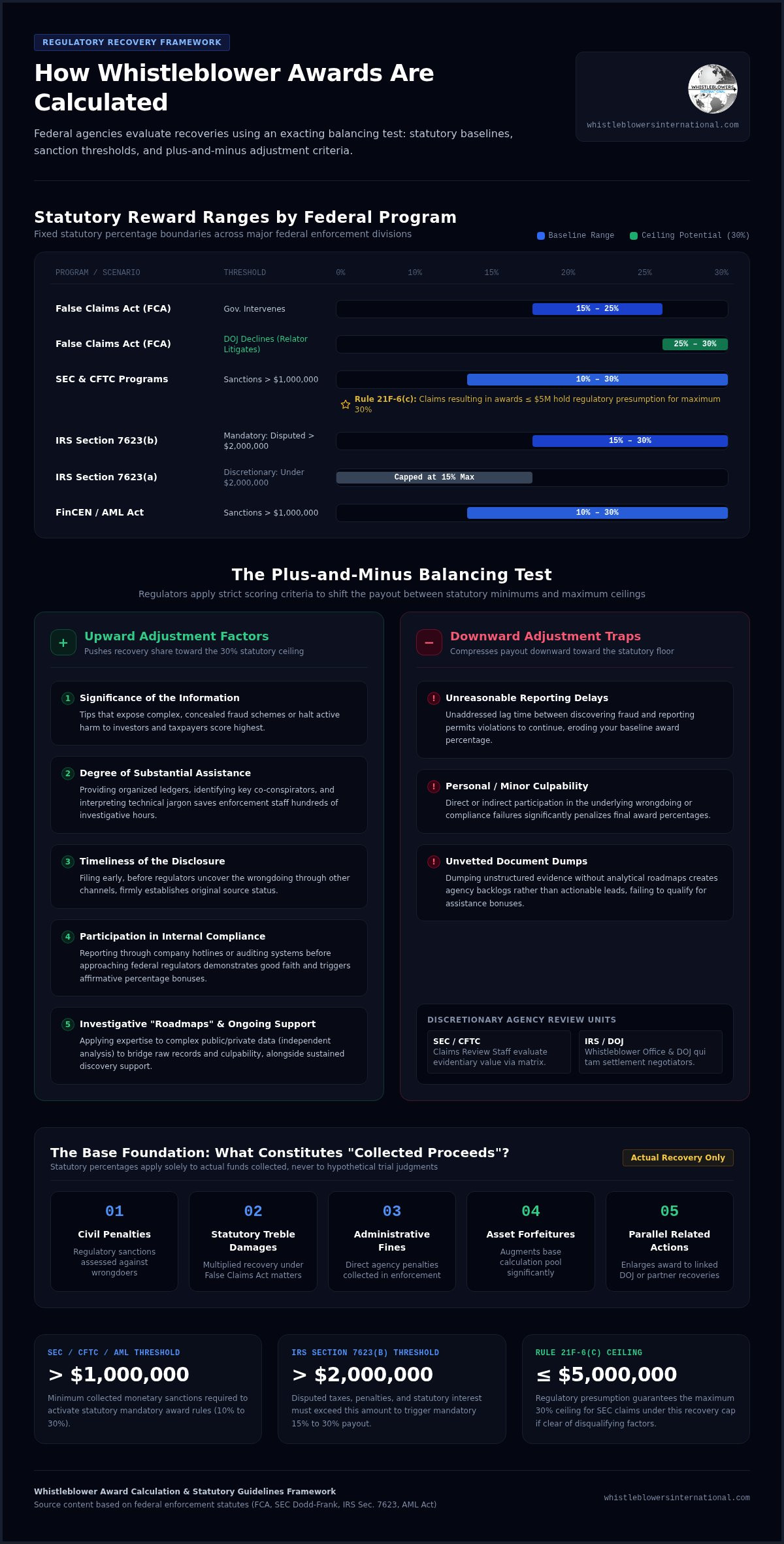
Federal whistleblower reward statutes establish strict percentage boundaries rather than arbitrary sums. When evaluating how are whistleblower awards calculated across different federal enforcement divisions, statutory formulas establish the baseline parameters:
- False Claims Act (FCA): Under the False Claims Act qui tam provisions, relators receive 15% to 25% of the proceeds if the government intervenes. If the Department of Justice declines intervention and counsel litigates independently, the statutory award rises to 25% to 30%.
- SEC and CFTC Programs: The Dodd-Frank Act dictates awards between 10% and 30% of monetary sanctions collected in judicial or administrative actions exceeding $1 million. Under SEC Rule 21F-6(c), claims resulting in awards of $5 million or less carry a regulatory presumption of receiving the 30% maximum if no disqualifying factors apply.
- IRS Whistleblower Program: Section 7623(b) mandates awards between 15% and 30% of collected proceeds when disputed taxes, penalties, and statutory interest exceed $2 million. Claims falling below this threshold remain discretionary under Section 7623(a), capped at 15%.
- FinCEN and Anti-Money Laundering (AML) Act: In 2026, the updated AML whistleblower framework mirrors Dodd-Frank, guaranteeing a mandatory statutory floor of 10% up to a 30% ceiling on sanctions surpassing $1 million.
What Constitutes ‘Collected Proceeds’?
Government percentages apply solely to actual funds collected, never to hypothetical trial judgments. Depending on the statute, the base calculation pool encompasses civil penalties, statutory treble damages, and administrative fines paid by the wrongdoer. Critically, asset forfeitures often augment this pool. If a federal investigation sparks successful parallel proceedings, known as related actions, by the DOJ or regulatory partners, your percentage cut can apply to those separate financial recoveries as well, dramatically enlarging your ultimate award foundation.
The Discretionary Power of the Agency
Statutes define the outer boundaries, but federal bodies retain ultimate discretion in setting your exact numerical tier. The SEC Claims Review Staff and the IRS Whistleblower Office utilize internal scoring matrixes to assess evidentiary value before issuing a preliminary determination. In qui tam actions, the DOJ actively negotiates percentages during settlement talks. Knowing how are whistleblower awards calculated within these agency review units allows seasoned counsel to strategically position evidence, anchoring the initial analysis at the higher ceiling rather than the statutory floor.
Upward Adjustment Factors: How to Maximize Your Percentage
Reaching the upper statutory boundary requires satisfying a formal balancing test. When regulators evaluate how are whistleblower awards calculated beyond the basic threshold, they look for specific criteria that justify moving an individual toward the 30% ceiling. Under the rules governing the SEC Whistleblower Program and related federal statutes, the government measures the real-world utility of your tip against four primary upward adjustment factors:
- Significance of the Information: Tips that expose complex, concealed fraud schemes or halt active harm to investors and taxpayers score highest.
- Degree of Substantial Assistance: Providing organized ledgers, identifying key co-conspirators, and interpreting technical jargon saves enforcement staff hundreds of investigative hours.
- Timeliness of the Disclosure: Filing early, before regulators uncover the wrongdoing through other channels, firmly establishes original source status.
- Participation in Internal Compliance: Reporting through company hotlines or auditing systems before approaching federal regulators demonstrates good faith and triggers affirmative percentage bonuses under modern regulatory guidelines.
The Value of Investigative ‘Roadmaps’
Unvetted document dumps create backlogs; structured roadmaps secure top awards. Government analysts rely heavily on relators who can bridge the divide between raw documents and actual culpability. You can qualify for an award through direct first-hand observation, known as independent knowledge, or through independent analysis. Independent analysis is the application of expertise to public or complex data to reveal hidden fraud. Transforming sprawling corporate transactions into a clear evidentiary roadmap directly drives your percentage upward.
Ongoing Cooperation and Trial Support
Sustained involvement during discovery, witness depositions, and trial preparation significantly increases your ultimate value. Remaining accessible to clarify emerging defenses helps federal attorneys keep the upper hand during settlement talks. Every technical briefing, document index, and interview must be documented meticulously to build an unassailable record of substantial assistance. If you are preparing to submit sensitive evidence to federal authorities, partnering with experienced counsel at whistleblowersinternational.com can help ensure your contributions are captured to claim the maximum allowable share.
Downward Adjustment Factors: Pitfalls That Reduce Awards
Understanding how are whistleblower awards calculated requires equal attention to the negative variables that push percentages down. Federal agencies systematically penalize conduct that compromises enforcement integrity, delays detection, or suggests opportunism. Under guidelines enforced by the Department of Justice, the SEC, and the IRS Whistleblower Office, several downward adjustments can rapidly reduce a preliminary 30% figure toward the statutory baseline:
- Personal Culpability: Active involvement in executing the fraudulent transactions triggers immediate downward revisions across all major programs.
- Unreasonable Delay: Postponing your filing while financial damage mounts against investors or taxpayers constitutes a primary basis for percentage compression.
- Interference with Internal Inquiries: Providing misleading statements to in-house compliance personnel or tampering with internal corporate audits severely diminishes your credibility before regulators.
- Public Disclosures: If the government relies principally on news reporting, administrative hearings, or public audits, statutory caps restrict the award to no more than 10%, even if you qualify as an original source.
The ‘Planned and Initiated’ Trap
Courts draw a strict distinction between mere operational involvement and active leadership. If a qui tam relator planned and initiated the fraud, the court possesses broad statutory discretion to reduce the award without any statutory floor. A formal criminal conviction results in complete statutory forfeiture, reducing the payout to zero. In contrast, under Treasury Regulation § 301.7623-4, the IRS applies stepped reductions (from 30% down to 26%, 22%, 18%, or 15%) depending on the relator’s degree of planning. Proactive disclosure through legal counsel remains the only viable mechanism to frame your conduct as non-managerial participation.
The Cost of Silence: Unreasonable Delay
Federal regulators treat timing as a core measure of intent. An unreasonable delay occurs when an insider observes ongoing misconduct, monitors the accumulation of fraudulent proceeds over several billing cycles, and only approaches law enforcement when detection becomes inevitable. This deliberate inaction allows ongoing financial harm to compound, prompting regulatory bodies to penalize the delay during percentage negotiations. Conversely, legitimate delays caused by consulting counsel, verifying complex documentation, or exhausting internal corporate escalation paths generally do not trigger punitive downward adjustments when properly established.
Program-Specific Variations: SEC, IRS, and False Claims Act Math
Cross-program exposure requires a clear understanding of distinct statutory mechanisms. While basic percentage bands overlap across agencies, how are whistleblower awards calculated in practice depends on specific regulatory thresholds, evidentiary burdens, and procedural pathways:
- SEC Dodd-Frank Actions: The statutory 10% floor provides a protective safeguard for securities whistleblowers, ensuring that meritorious tips that trigger over $1 million in sanctions yield guaranteed compensation even when minor negative adjustments apply.
- IRS Whistleblower Filings: The statutory framework strictly conditions mandatory payouts on meeting explicit financial benchmarks under Section 7623(b), including a $2 million tax liability threshold.
- Customs and Trade Fraud: Actions filed under the False Claims Act to recover evaded customs tariffs, misclassified goods, or antidumping duties generate recoveries that combine statutory treble damages with per-claim civil penalties, which range between $14,308 and $28,619 per violation in 2026.
Intervention vs. Non-Intervention in Qui Tam
Government intervention fundamentally alters both legal risk and financial calculations. When the Department of Justice intervenes, the relator share is set between 15% and 25%. While this percentage window is lower than the 25% to 30% range awarded when relators litigate declined cases independently, intervened cases historical yield vastly larger settlement pools because the full investigative weight of federal authorities forces corporate defendants to settle.
The IRS ‘Mandatory’ vs. ‘Discretionary’ Divide
The tax code creates a two-track recovery framework based on the total sum at stake. Mandatory awards under Section 7623(b) apply only when disputed taxes, penalties, and interest surpass $2 million, and, if an individual taxpayer is targeted, their gross income exceeds $200,000 for at least one relevant tax year. If these thresholds are not satisfied, the action falls under Section 7623(a), where payouts are capped at 15% and remain entirely within agency discretion. For an exhaustive breakdown of filing procedures, review The IRS Whistleblower Program Guide.
Every federal oversight body applies its own statutory formula to determine final compensation. To protect your rights and ensure your claim meets these complex statutory thresholds, consult with experienced whistleblower counsel to evaluate how are whistleblower awards calculated for your specific evidence.
The Strategic Role of Counsel in the Calculation Process
Submitting an initial tip merely initiates federal scrutiny; securing top-tier compensation demands deliberate legal advocacy at the conclusion of the case. When agencies resolve how are whistleblower awards calculated for a specific settlement, the final percentage hinges on the formal Award Application. This submission serves as an exhaustive accounting of your contributions, contrasting your evidentiary roadmap directly against the enforcement milestones achieved by federal investigators. Without an aggressive presentation of your substantial assistance, agency reviewers default toward the lower statutory bounds.
A battle-tested mentor anticipates government pushback before it surfaces. During settlement talks, Department of Justice attorneys often seek to minimize the relator share, arguing the government would have uncovered the misconduct through routine audits. Experienced counsel counters these positions with verifiable logs of your cooperation, turning what might have been a 15% baseline payout into a 25% recovery. Simultaneously, counsel safeguards your anonymity throughout SEC, CFTC, and IRS proceedings, ensuring confidential reporting protocols remain intact without diluting the documented weight of your cooperation.
The ‘Contingency Fee’ Alignment
Effective legal representation operates on complete alignment of interests. Whistleblower law firms represent clients exclusively on a contingency fee basis, meaning the legal team receives compensation only when the government successfully collects proceeds. This structure directly incentivizes counsel to commit elite forensic and investigative resources toward proving substantial assistance, shielding relators from negative adjustment traps, and maximizing the recovery percentage. To examine how this model operates without upfront retainer costs, explore the Whistleblower Lawyer Contingency Fees Guide.
Securing the Maximum Award
Forensic precision consistently separates multi-million-dollar payouts from discounted filings. In cross-border actions involving complex financial conduits, tariff evasion, or foreign bribery, international investigative capability becomes indispensable. Organizing vast cross-border data structures into coherent evidence allows investigators to pinpoint offshore accounts and quantify total losses swiftly. If you hold proprietary evidence of major federal violations and wish to understand how are whistleblower awards calculated for your situation, consult with a whistleblower attorney to evaluate your potential award under full statutory confidentiality.
Positioning Your Claim for the Highest Statutory Payout
Securing a top-tier percentage requires far more than meeting baseline statutory eligibility. The reality of how are whistleblower awards calculated is that federal agencies weigh the caliber of your evidence, the promptness of your filing, and the direct assistance you provide against potential reduction factors. Navigating these complex balancing matrixes across the SEC, IRS, or False Claims Act demands methodical preparation long before settlement discussions begin.
Piacentile & Associates LLP brings an insider’s perspective to high-stakes enforcement actions. Led by Dr. Joseph Piacentile, a former whistleblower and attorney, our team pairs deep forensic insight with global investigative capabilities to document your substantial assistance while shielding against downward adjustments. Because we operate strictly on a contingency fee basis, our interests remain entirely aligned with yours; we receive no fee unless the government recovers funds. When you’re ready to step forward, speak with an experienced whistleblower attorney about your case under complete statutory confidentiality.
Frequently Asked Questions
Is there a cap on the maximum dollar amount of a whistleblower award?
No statutory dollar cap exists under the False Claims Act, SEC, or IRS programs. If the government collects $500 million, a qualifying 30% relator share yields $150 million. In contrast, the DOJ Corporate Whistleblower Awards Pilot Program establishes a hard $50 million limit by restricting payouts to 30% of the first $100 million in net forfeited assets and 5% of proceeds up to $500 million.
Can my award be reduced if I was involved in the fraud?
Yes, your award can be reduced or eliminated depending on your level of responsibility. Regulators heavily penalize culpability when evaluating how are whistleblower awards calculated for insiders. Under the False Claims Act, orchestrating the scheme allows courts to cut rewards below statutory floors, while a criminal conviction bars any recovery. The IRS and SEC apply tiered percentage reductions for non-managerial participation.
How long does it take for the government to calculate and pay an award?
Award determination typically takes several months to multiple years following settlement. Under the IRS Section 7623(b) mandatory program, total resolution historically averages around ten years due to mandatory taxpayer appeal timelines. However, once all administrative and statutory appeal contingencies clear, post-resolution distribution processing through agency disbursement units averages approximately 48 days.
What happens to the award calculation if multiple whistleblowers file on the same case?
Under the False Claims Act’s “first-to-file” rule, the earliest relator generally receives the entire recovery, barring late filers from collecting. In SEC and CFTC proceedings, regulators can divide the total statutory pool (10% to 30%) among multiple independent tipsters. The Claims Review Staff apportions percentages to each individual based on the distinct evidentiary value and substantial assistance provided.
Does the government calculate the award based on the gross or net recovery?
Standard agencies calculate your percentage based on gross collected proceeds, which encompass restitution, statutory interest, treble damages, and civil monetary penalties. However, specific programs impose deductions. The DOJ Pilot Program evaluates strictly “net proceeds forfeited” after subtracting victim restitution and agency seizure expenses, while IRS distributions are subject to mandatory federal sequestration reductions.
What if the government settles for a non-monetary agreement?
Whistleblower recovery formulas require actual monetary collections before funds can be disbursed. If an agency resolves an investigation solely through corporate governance reforms, deferred prosecution agreements without financial penalties, or injunctive relief, no award base exists. However, if that non-monetary resolution leads to subsequent related actions with financial sanctions, experienced counsel can petition to link those monetary recoveries to your original filing.
Can I appeal the government’s award percentage if I think it is too low?
Your right to appeal depends entirely on the governing statute. In mandatory IRS Section 7623(b) actions, you can challenge award percentage determinations before the U.S. Tax Court. For SEC claims, you may appeal determinations to federal appellate courts, provided the dispute centers on how are whistleblower awards calculated under regulatory balancing factors rather than an agency decision resting within statutory bounds.
Are whistleblower awards subject to federal income tax?
Yes, the IRS classifies whistleblower recoveries as ordinary taxable income rather than capital gains or non-taxable personal injury settlements. Payouts are reported on Form 1099-MISC. Fortunately, whistleblowers who pursue claims under the False Claims Act or Dodd-Frank can generally claim an above-the-line tax deduction for attorney contingency fees and litigation costs, preventing double taxation on the full recovery.