
A device that harms a patient may warrant a safety report; a scheme that bills Medicare or Medicaid for it may call for a different path. If the facts point to both, medical device fraud reporting starts with separating product safety concerns from suspected misconduct while recognizing that they can overlap.
It’s understandable to be unsure which agency handles a concern, what details to share, or how to protect your identity and workplace information. A safety report is not the same as a fraud allegation, and neither automatically substitutes for the other.
This guide explains how to match suspected conduct with relevant U.S. reporting channels, including FDA pathways, the HHS Office of Inspector General (OIG), and a potential False Claims Act qui tam action when federal healthcare-program claims are involved. It also covers how to organize records that may help authorities assess a report without unnecessarily exposing confidential information.
If the facts suggest federal billing fraud or you’re concerned about retaliation, confidential legal guidance can help you evaluate your options before taking action. A useful first step is to identify what you observed, what the records show, and what remains uncertain.
Key Takeaways
- Distinguish a device defect or adverse event from suspected deception or improper billing. Some situations may involve both.
- For medical device fraud reporting, match the concern to the relevant channel: FDA for safety information, HHS OIG for suspected healthcare-program fraud, or a potential False Claims Act action.
- Build a factual chronology of dates, people, devices, programs, and transactions. Separate firsthand knowledge from assumptions and unresolved questions.
- Consider confidential legal guidance when the information may involve federal healthcare-program claims or raise concerns about retaliation.
- A legal review can help assess whether the facts may support a False Claims Act matter, but not every report leads to litigation.
Medical device fraud reporting: distinguish suspected fraud from a safety problem
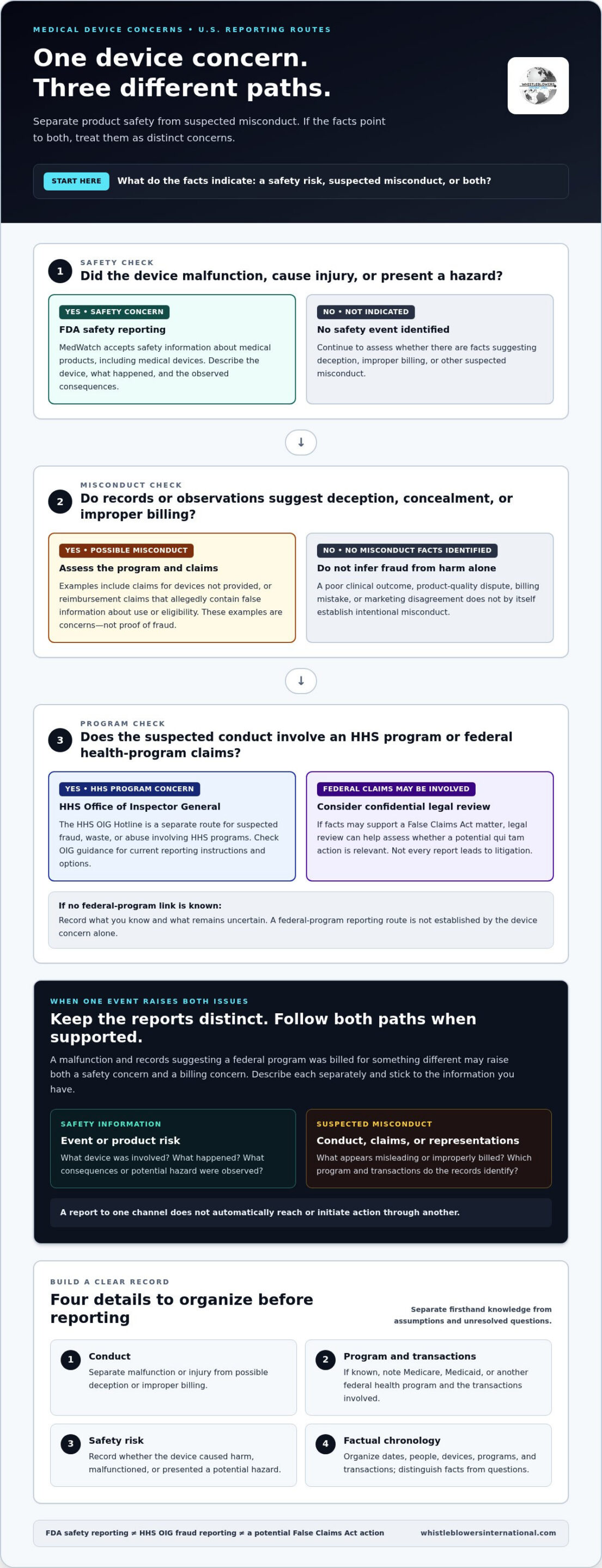
A device can cause harm without anyone committing fraud, and suspected fraud can exist even when no patient injury is known. The first step in medical device fraud reporting is to identify what the facts indicate: a malfunction or safety risk, potentially deceptive conduct, or both. The appropriate route depends on the concern, and a report to one channel doesn’t automatically address the other.
Safety reporting addresses harm or risk; fraud reporting addresses suspected misconduct. This distinction helps you describe what you observed without drawing conclusions the evidence doesn’t support. Medical device reporting (MDR), including the roles of different parties in submitting adverse-event information, is outlined in this Medical device reporting (MDR) overview.
What conduct may raise a medical device fraud concern?
A fraud concern may arise when information about a device is allegedly misrepresented or concealed in connection with marketing, purchasing, or payment. For example, records might appear to show claims to a federal healthcare program for devices that were not provided, or reimbursement claims that allegedly contained false information about a device’s use or eligibility. Other concerns may involve the alleged concealment of material facts from purchasers or government programs.
These are examples of concerns, not proof that fraud occurred. A billing mistake, poor clinical outcome, product-quality dispute, or disagreement about how a device was marketed does not, by itself, establish intentional misconduct. Relevant context may include what was represented, who made the representation, what records show, and whether federal-program claims were involved. Legal characterization depends on the facts and applicable requirements; assess examples against current FDA, DOJ, and HHS OIG guidance.
When is a concern about device safety instead?
A suspected malfunction, injury, or other risk associated with a device is primarily a safety concern. Examples include a device that appears to fail during use, causes an unexpected injury, or presents a hazard before harm occurs. The FDA’s MedWatch program is a channel for reporting safety information about medical products, including medical devices. Follow the FDA’s current instructions for submission options and requested information.
A safety report focuses on the event or risk: what device was involved, what happened, and what consequences were observed. It doesn’t, by itself, allege that a company knowingly misled buyers or improperly billed a federal program. Submitting safety information also doesn’t automatically initiate a False Claims Act case. If you have additional facts suggesting deceptive conduct or improper billing, treat that as a separate concern and consider whether it calls for a different route.
One event can raise both issues. Suppose a device malfunctions and you also find records suggesting the supplier billed a federal program for a product or service that may not match what was provided. Describe the safety event and billing concern separately, supporting each with the information you actually have. This makes the issues clearer for reviewers and helps prevent an inference from being presented as a confirmed fact.
How to report medical device fraud through the appropriate U.S. channel
Choose a reporting route based on the conduct you can describe, not simply because a medical device is involved. A safety concern, suspected fraud affecting a federal health program, and a potential False Claims Act case serve different purposes. A report to one channel doesn’t automatically reach or initiate action through another.
Use this sequence to identify the issue and a potential next step:
- Identify the conduct. Separate a device malfunction or injury from possible deception, improper billing, or both.
- Identify the affected program. If you have evidence that claims may have been submitted to Medicare, Medicaid, or another federal health program, note the program and the transactions you know about.
- Assess any safety risk. Record whether the device allegedly caused harm, malfunctioned, or presented a potential hazard.
- Match each concern to a route. Consider FDA reporting for safety information, HHS OIG for suspected fraud involving HHS programs, and legal review if the facts may support a False Claims Act action.
When to consider FDA or HHS OIG reporting
For adverse events, suspected malfunctions, or other device safety concerns, FDA reporting channels are relevant; MedWatch accepts safety information about medical products. For suspected fraud, waste, or abuse involving HHS programs, the HHS OIG Hotline is a separate route. Its HHS Office of Inspector General (OIG) fraud reporting page provides current reporting guidance. Review each agency’s instructions to understand its intake scope and submission options.
These channels aren’t interchangeable. FDA safety information helps address potential product risks, while an OIG report concerns suspected misconduct within programs under its oversight. If the same facts raise both issues, separate submissions may be appropriate. Describe each concern accurately, and don’t assume one report will trigger a review by another agency.
When a False Claims Act review may be relevant
The False Claims Act may be relevant if alleged device-related misconduct caused false claims to be presented for payment by the federal government. Under its qui tam provisions, a private person, called a relator, may bring an action on the government’s behalf. This is a legal action, not simply an agency safety or hotline report. Whether the route fits depends on the specific facts and evidence.
A lawyer can assess the relationship between the alleged conduct, federal-program claims, and available records before you decide how to proceed. For an overview of the statute and whistleblower process, see this False Claims Act whistleblower guide. If your information involves federal healthcare-program claims, confidential legal evaluation can help you consider whether a qui tam matter is appropriate. It doesn’t guarantee that a case will be filed or succeed.
Compare FDA, HHS OIG, and False Claims Act reporting routes
The right route depends on what you’re reporting and what you want the information to address. For medical device fraud reporting, the key distinction is between a safety submission to the FDA, a suspected healthcare-fraud report to HHS OIG, and a potential False Claims Act (FCA) action. These channels have different recipients and purposes; none should be treated as a substitute for the others.
| Route | Purpose and typical concern | Recipient | Legal action? |
|---|---|---|---|
| FDA safety reporting | Information about an adverse event, suspected malfunction, or other device safety problem. | FDA, through the applicable safety reporting channel. | No. It is a safety report, not a lawsuit. |
| HHS OIG fraud reporting | Suspected fraud, waste, or abuse involving HHS programs, such as potential improper billing to a federal health program. | HHS Office of Inspector General (OIG), through its reporting channels. | No. It is an agency report, not a qui tam complaint. |
| False Claims Act qui tam action | Alleged misconduct that may have caused false claims to be submitted for payment by the federal government. | A federal court through a statutory process that involves the government. | Yes. It is a legal action brought by a relator on the government’s behalf. |
The table is a starting point, not a determination that a particular event fits a legal category. If you’re reporting an injury or possible malfunction, FDA safety reporting is the primary route to consider, subject to current agency guidance. If your concern is suspected false billing involving a federal health program, HHS OIG may be an appropriate agency channel. Legal counsel can assess whether the facts also warrant consideration of an FCA action.
Which route fits a safety allegation, billing concern, or both?
Start with the underlying conduct. A device that appears to fail in use points toward safety reporting. Records suggesting that a supplier billed a federal program for a device or service that may not have been provided raise a payment concern. If an incident involves both possible patient harm and questionable billing, distinct reports or legal steps may be appropriate. Don’t assume agencies will coordinate or that one submission covers every concern.
What the reporting channels do not guarantee
Submitting information doesn’t prove wrongdoing, ensure an investigation, or guarantee enforcement, compensation, or an award. Agency reports and qui tam actions also follow different procedures. An FCA matter is not initiated by completing an ordinary agency complaint form; it follows statutory filing and confidentiality requirements that should be assessed against current law. Any potential award depends on applicable rules and the circumstances of the case.
How to prepare a medical device fraud report responsibly
A clear, careful record can help an agency or lawyer understand what you observed and what remains uncertain. You don’t need to prove a case before raising a concern. Focus on preserving information you’re lawfully permitted to access, keeping its original context intact, and describing events accurately rather than reaching conclusions beyond the evidence.
Organize what you know, distinguish what you suspect, and preserve records lawfully. This approach supports responsible medical device fraud reporting without turning an incomplete concern into an unsupported allegation.
Organize records and firsthand observations
Start a chronology. For each event, note the date or time frame, people involved, device and identifying details, relevant program, transaction, and what you personally observed. If a date is uncertain, say so. Mark statements you heard from someone else as secondhand, and list unresolved questions separately from documented facts.
Depending on what you’re authorized to access, relevant materials may include:
- Device names, model or lot identifiers, and related product documentation.
- Marketing materials, emails, meeting notes, or other communications relevant to the concern.
- Reimbursement or transaction records that you’re permitted to review.
- Internal policies or procedures that help explain how a process was supposed to work.
For each item, record where it came from, when you obtained it, and whether it is an original or a personal note. Preserve documents in their existing form. Don’t edit, annotate, or recreate an original in a way that could obscure its source or meaning. Avoid taking company or patient records out of authorized systems or sending them to personal accounts without appropriate legal guidance.
Protect privacy and avoid undermining a potential report
Patient information and workplace records can be subject to privacy, confidentiality, and employment obligations. Keep personal notes and preliminary summaries limited to what is needed to explain the concern. Avoid including patient names or other identifying details unless necessary and appropriate. Don’t access systems, accounts, or records beyond your permissions, even if you believe they may contain relevant evidence.
Confidentiality rules depend on the information, your role, and the circumstances. If you’re unsure whether a record can be copied, retained, or disclosed, pause before acting and seek legal guidance. Do not remove patient records or confidential materials without appropriate advice. A responsible report can identify the existence and location of relevant records without placing sensitive information in an unsecured personal file.
Before sharing materials, keep a separate list of what you have and how each item relates to your concern. This helps counsel assess potential significance while protecting private information and preserving context. Piacentile & Associates LLP represents whistleblowers in federal matters, including False Claims Act cases. If you’re weighing how to handle records connected to possible federal healthcare-program claims, seek a confidential legal evaluation before disclosing sensitive materials.
When legal counsel can help with medical device fraud reporting
Agency reporting and legal action are different steps. If your information suggests device-related claims may have been submitted to Medicare, Medicaid, or another federal health program, counsel can assess whether the facts may support a False Claims Act matter or point to another reporting route. That review can help clarify what the records show, what remains uncertain, and what procedural considerations may apply before you make consequential decisions.
Not every concern becomes a lawsuit. A legal assessment evaluates available information and possible options; it doesn’t predict that a claim will be filed, that the government will act, or that a particular outcome will follow.
What a legal assessment can clarify
Counsel can examine the alleged conduct, the federal program involved, the records available to you, and the relationship between the conduct and any claims for payment. The review may also identify gaps in the information and distinguish direct observations from assumptions. If the facts don’t appear to fit a False Claims Act matter, other reporting considerations may still warrant attention.
Confidentiality and filing procedures depend on the circumstances and applicable rules. Piacentile & Associates LLP represents whistleblowers in federal actions, including False Claims Act matters. The firm’s team includes former whistleblowers and uses investigative techniques to develop cases while protecting client privacy. These steps support careful case evaluation, but they don’t promise anonymity or determine in advance whether litigation is appropriate.
Consider a confidential conversation before consequential steps
Before sharing sensitive records outside authorized channels, making public allegations, or taking other consequential action, consider case-specific legal guidance. A lawyer can discuss how to describe the information accurately, what procedural considerations may apply, and whether the facts warrant further evaluation as a potential federal claim. This can be especially useful if records include confidential business or patient information, or if your role at work creates concerns about disclosure.
Piacentile & Associates LLP represents whistleblowers on a contingency-fee basis and is paid only when it secures a monetary award. That fee arrangement doesn’t guarantee a recovery or award. For a fuller explanation of how this structure works, review the guide to whistleblower lawyer contingency fees.
If your information may involve federal healthcare-program claims, a confidential legal evaluation can help you consider whether a potential False Claims Act matter merits further development. Discuss a potential whistleblower matter with the firm.
Take a measured next step with your information
Deciding what to do with a concern doesn’t require you to make public allegations or reach a legal conclusion on your own. A careful, case-specific review can help you consider whether the information may support a federal whistleblower matter and how to proceed responsibly. The aim of medical device fraud reporting is not simply to submit information, but to present a concern through a route suited to the facts.
Piacentile & Associates LLP represents whistleblowers in False Claims Act and other federal matters. The team includes former whistleblowers, bringing firsthand perspective to case development. Representation is on a contingency-fee basis, and the firm is paid only if it secures a monetary award. This arrangement doesn’t guarantee a recovery or award.
If you’re weighing whether your information warrants further legal evaluation, take a considered step before sharing sensitive records or making public claims. Discuss a potential whistleblower matter with the firm to evaluate your options.
Frequently Asked Questions
Can I report medical device fraud anonymously?
Not necessarily; anonymity depends on the channel and type of submission. A False Claims Act qui tam case follows specific procedures, and a relator’s identity may be protected during parts of the process, but that isn’t an absolute promise of anonymity. FDA and HHS OIG submissions have different practices. Before providing identifying details or records, get advice tailored to your intended route and the information you plan to share.
Is a defective medical device automatically fraud?
No. A defect, malfunction, or injury may indicate a safety problem without establishing fraud. Fraud generally involves alleged deception or misconduct, which may include conduct tied to false claims for federal healthcare-program payment. A device failure alone, for example, doesn’t show that a billing claim was false. The same circumstances can raise both concerns, but describe what you observed and avoid presenting suspicion as proven wrongdoing.
Can a patient report suspected medical device fraud?
Yes. A patient can share information about a suspected device safety issue or possible misconduct with an appropriate agency. A patient who experienced a malfunction may report safety information, while a concern about a charge submitted to a federal health program may warrant a different route. A patient’s report doesn’t automatically qualify them to bring a qui tam case or receive an award; those questions depend on applicable requirements and facts.
What evidence should I include when reporting medical device fraud?
A useful account may identify the device, relevant dates, people or organizations involved, suspected conduct, and any federal health program that may be implicated. Explain how you know each fact, such as whether you saw a record yourself or learned something from another person. Include only materials you’re authorized to access and share. The appropriate agency or legal process may call for different details, so avoid sending sensitive records indiscriminately.
Can I receive a reward for reporting medical device fraud?
Possibly, but an award depends on the applicable legal program, the information provided, statutory requirements, and the outcome of government action. A safety report about a malfunction doesn’t automatically create eligibility for a whistleblower award. If you believe false claims were submitted to a federal program, a lawyer can assess whether the facts may fit the False Claims Act. Don’t assume that submitting a report will result in compensation.
Can someone outside the United States report medical device fraud involving a U.S. program?
Potentially. A person living outside the United States may have information relevant to a U.S. federal whistleblower matter, depending on the alleged conduct and applicable program rules. For example, someone involved in a device supplier’s overseas operations may know about transactions connected to U.S. program claims. The reporting route and legal requirements depend on the facts and the person’s role. Preserve information lawfully and seek case-specific advice before disclosing sensitive records.
What should I do if my report includes patient information?
Handle patient information cautiously because it may be subject to privacy obligations. Keep an initial account focused on the relevant events and omit patient names or other identifiers that aren’t necessary to explain the concern. Don’t copy, transmit, or disclose identifiable records unless you’re authorized and understand the applicable requirements. What you may share can depend on your role, employer, and reporting process, so seek legal guidance before providing protected information.