

A fuel-tax discrepancy is not, by itself, proof of fraud. A motor carrier fuel tax fraud lawyer can assess whether the issue points to a compliance problem or suspected misuse, help organize the relevant records, and advise on responding to government inquiries or reporting suspected wrongdoing. The right steps depend on the facts and the agency involved.
Fuel records and tax filings can raise difficult questions, particularly when concerns involve dyed diesel or inconsistent documentation. The first step is to preserve the original records and distinguish facts you observed from conclusions about what happened.
This article explains how to organize fuel-tax records and distinguish a company’s compliance matter from a potential whistleblower filing. Piacentile & Associates LLP handles whistleblower actions involving fraud against the government, including False Claims Act matters, as well as filings with federal agencies such as the IRS. Whether a filing is appropriate depends on the specific conduct and evidence.
Key Takeaways
- Separate a recordkeeping or filing discrepancy from evidence of intentional fuel-tax fraud by examining the underlying transactions and documentation.
- Match the suspected conduct to the appropriate government contact, and prepare a clear, factual account before making a report.
- Understand why fuel mixing and dyed-diesel use can raise distinct compliance concerns, and what details may help clarify the circumstances.
- When suspected misconduct involves customs or broader financial fraud, consider whether legal action or a whistleblower filing may be a relevant next step.
Transportation tax and regulatory compliance
Fuel-tax compliance involves accurate records, timely reporting, and careful responses to agency inquiries. The relevant issues can span motor fuel taxes, carrier operations, and separate administrative or criminal allegations.
IRS and DOT Representation
IRS fuel compliance officers review fuel-related activity, while DOT compliance concerns may involve transportation operations and regulatory records. Historical figures reported on July 17, 2002, described approximately 140 IRS Fuel Compliance Officers monitoring 1,400 terminals and other fuel businesses and locations. Those figures provide context, not a current staffing count. For any agency contact, identify the subject, preserve the request, and distinguish tax questions from DOT-related challenges.
Civil Penalties and Criminal Charges
An IFTA audit or civil tax assessment is different from a criminal allegation of intentional deception. A discrepancy does not establish fraud: records may be incomplete or an accounting error may explain the difference. To understand what happened, organize fuel receipts, mileage records, tax filings, and transaction documents by date and compare the details.
The cost of legal representation depends on the case and is provided after a quote request; factors include the records involved, the agencies making inquiries, and the complexity of the allegations. To identify relevant experience in your state, assess familiarity with IFTA administration, transportation records, and the difference between civil proceedings and criminal allegations.
Audit Notice and Investigation Response
After receiving an IFTA audit notice or investigation request, preserve the notice and related records, including fuel receipts and filed returns. Note the agency, subject, and response deadline stated in the communication. Avoid altering records or sending an incomplete explanation before the underlying transactions have been reviewed. A structured response can help separate documentation gaps from disputed fuel activity.
Federal motor fuel excise tax liability was reported quarterly on Form 720, due one month after the quarter closed, under the July 17, 2002, description. The same historical account stated gasoline was taxed at 18.4 cents per gallon and diesel fuel and kerosene at 24.4 cents per gallon. These are historical rates, not current-rate guidance. For a suspected transportation fraud report, identify the conduct and agency involved before choosing a reporting route.
Contacting FMCSA, law enforcement, and government hotlines
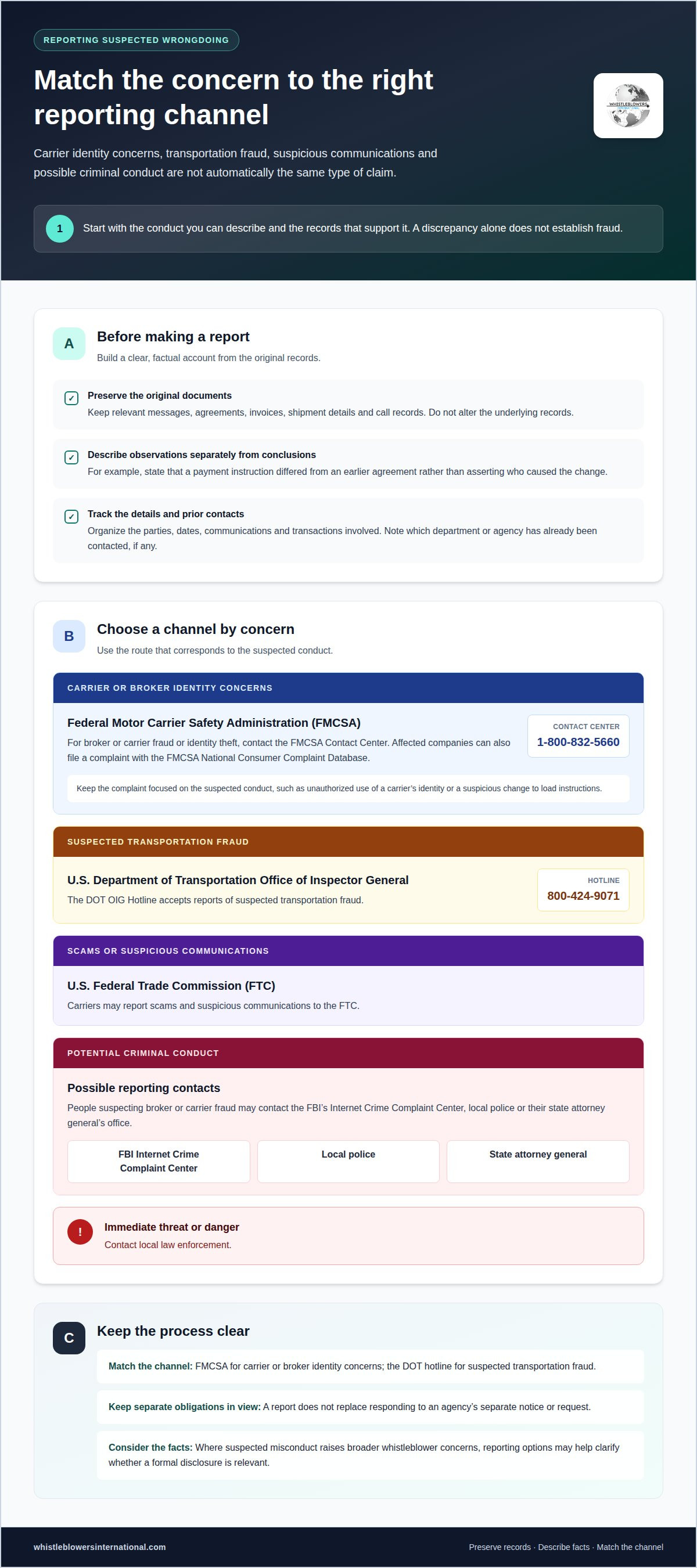
If you are considering reporting suspected wrongdoing, first identify the conduct and the federal program that may apply. A carrier identity issue, suspected transportation fraud, and a tax-related allegation are not automatically the same type of claim. Keep supporting records organized, including the parties, dates, communications, and transactions involved.
For broker or carrier fraud or identity theft, contact the Federal Motor Carrier Safety Administration (FMCSA) Contact Center at 1-800-832-5660. Affected companies can also file a complaint with the FMCSA National Consumer Complaint Database. Keep the complaint focused on the suspected conduct, such as an unauthorized use of a carrier’s identity or a suspicious change to load instructions.
- Suspected transportation fraud: The U.S. Department of Transportation’s Office of Inspector General Hotline accepts reports at 800-424-9071.
- Scams or suspicious communications: Carriers may report these to the U.S. Federal Trade Commission.
- Potential criminal conduct: People suspecting broker or carrier fraud may contact the FBI’s Internet Crime Complaint Center, local police, or their state attorney general’s office.
Organize relevant messages, agreements, invoices, shipment details, and call records. Separate firsthand observations from conclusions: for example, describe a payment instruction that differed from an earlier agreement rather than asserting who caused the change. Record which department or agency has already been contacted, if any, and preserve the original documents.
Use the FMCSA channel for carrier or broker identity concerns, and the DOT hotline for suspected transportation fraud. If the matter involves a direct threat or immediate danger, contact local law enforcement. A report does not replace responding to an agency’s separate notice or request. Where suspected misconduct raises broader whistleblower concerns, whistleblower reporting options may help clarify whether a formal disclosure is relevant.
Companies in the United States affected by broker or carrier fraud are encouraged to file a complaint with the FMCSA National Consumer Complaint Database. Carriers in the United States may also report suspected scams and suspicious communications to the U.S. Federal Trade Commission.
Adulterated fuel and cocktailing
Fuel allegations can turn on what entered a tank, how it was described, and how the transaction was recorded. “Cocktailing” describes mixing fuel products or components in ways that may obscure the fuel’s identity or tax treatment. A discrepancy alone does not establish intentional fraud; the records and surrounding conduct matter.
Motor carrier fuel tax fraud generally refers to alleged intentional conduct, such as concealing taxable fuel activity or knowingly misrepresenting transactions. IFTA audit findings may include mileage and fuel records that do not reconcile, missing purchase receipts, or inconsistent jurisdiction reporting. These issues warrant examination, but incomplete records or an accounting error may also explain them.
To review a freight transaction, trace it from purchase through use. Relevant records may include supplier invoices, fuel receipts, dispatch and trip records, tank documentation, and tax filings. Compare dates, quantities, locations, and product descriptions. If an invoice describes a different product from the internal records, preserve both documents and note who supplied each account of the transaction.
Fuel-tax rules and rates can differ by fuel type and jurisdiction. A July 17, 2002, example of motor fuel bootlegging contrasted Georgia’s rate of 7.5 cents per gallon with North Carolina’s 24.2 cents per gallon. Those historical figures illustrate why alleged movement or misdescription across state lines may draw scrutiny; they are not current rate guidance. The same testimony described more than 30 million gallons transacted daily in its industry context, underscoring the scale of fuel records involved.
Before responding to an allegation, preserve original records and map each questioned transaction to its source documents. Counsel can assess whether the issue concerns documentation, fuel identity, tax treatment, or alleged intent, and whether the evidence supports a response or litigation strategy. That distinction matters: operational liability should be evaluated against specific transactions, not inferred from a mismatch alone.
Dyed diesel fuel misuse
Dyed-diesel allegations require a careful review of fuel transactions, vehicle use, and supporting records. A mismatch between fuel purchases and operating records can prompt questions, but does not by itself establish intentional misuse. The transaction history and supporting documents are important to understanding the issue.
Historical figures illustrate enforcement attention: IRS Fuel Compliance Officers assessed more than 250 penalties totaling more than $500,000 for dyed diesel misuse since October 1, 2001. Seventy percent of those penalties involved taxpayers in construction and agriculture. These figures describe that earlier period, not current enforcement totals. They show why a fuel issue can arise beyond trucking, including when a carrier works with a construction customer or fuel broker.
For an internal review, organize records by transaction and preserve the originals. Compare supplier invoices, fuel receipts, dispatch records, vehicle assignments, and tax filings. Note who purchased the fuel, where it was delivered, and how the carrier recorded its use. If a broker or supplier provided information that conflicts with company records, preserve that communication rather than silently changing the file. A dated record of the discrepancy can help counsel assess the claims and advise on an accurate response.
An attorney can assist by separating a documentation problem from evidence suggesting deliberate conduct, then assessing what the records establish before the carrier responds. The review should also account for the role of company personnel and outside parties, including a broker, without assuming responsibility based on association alone. If evidence points to fraud affecting a government program, counsel can assess whether a False Claims Act or qui tam lawsuit is relevant. That is a distinct legal path, not a substitute for addressing an agency inquiry. Discuss a potential qui tam claim when the evidence suggests government fraud.
Piacentile & Associates LLP: Import Export Customs Fraud Legal Action
An IFTA discrepancy alone is not a customs-fraud claim. If you have strong information and evidence that import or export customs fraud affected the federal government, The Piacentile Law Firm, PLLC handles Import Export Customs Fraud Legal Action through whistleblower representation. The firm evaluates the evidence and the relevant federal process.
If the evidence instead concerns suspected tax fraud affecting federal tax administration, an IRS Whistleblower Program Filing may be relevant. The appropriate route depends on the conduct and evidence, which may include transaction records, shipping documents, and communications. A whistleblower filing is distinct from responding to an audit or defending against a tax allegation.
If you have strong information and evidence of suspected customs fraud or other federal wrongdoing, contact The Piacentile Law Firm, PLLC to discuss whether a whistleblower action may fit the facts.
Choose a Deliberate Next Step
Before deciding whether to report suspected wrongdoing, separate what the records establish from what remains an inference. A motor carrier fuel tax fraud lawyer can help assess the evidence, the agencies involved, and whether a whistleblower route fits the facts. That assessment can also clarify whether the concern belongs in a filing or requires a different response.
The Piacentile Law Firm, PLLC handles False Claims Act and Qui Tam lawsuits, as well as SEC and IRS Whistleblower Program filings. These options concern distinct types of alleged misconduct. The nature of the evidence and the government interest involved help determine which process may be relevant; a filing should accurately reflect what the documents show.
If you’re weighing whether suspected misconduct warrants a whistleblower filing or legal action, contact Piacentile & Associates LLP to discuss the matter. A careful, evidence-based next step can help you move forward with greater clarity.
Frequently Asked Questions
What laws and penalties apply to IFTA fuel tax fraud in the United States?
Consequences depend on the conduct and applicable law. An inaccurate IFTA report may lead to a civil tax assessment or penalty, while allegations of intentional deception can raise separate criminal issues. The evidence, including records and explanations for discrepancies, matters when distinguishing these situations. Do not assume one penalty applies to every case.
When should a motor carrier hire a fuel tax fraud lawyer?
Consider legal help when an agency requests records, an audit identifies disputed transactions, or authorities suggest intentional misconduct. A motor carrier fuel tax fraud lawyer can assess the allegations and evidence; the right counsel depends on whether the matter involves a tax dispute, a criminal accusation, or reporting suspected fraud. For a potential whistleblower filing, The Piacentile Law Firm, PLLC evaluates strong information and evidence for federal programs. Its cases are very complex and take a long time to resolve.