

What if you uncovered a sophisticated fraud scheme against the government, only to find that your right to a significant reward vanished because you waited one day too long to act? It is a scenario that keeps many potential whistleblowers awake at night, and for good reason. You likely feel the weight of the evidence you hold, yet you’re haunted by the fear that the qui tam lawsuit statute of limitations might expire before you can safely navigate the filing process. It’s common to feel confused by how the government’s knowledge of the fraud “starts the clock” or whether your specific situation falls under a six-year or a ten-year window.
This guide provides the clarity you need to move forward with confidence, ensuring your claim is filed before your legal rights expire. We’ll break down the “longer of” rule and the absolute ten-year hard cap that governs these high-stakes actions. By understanding the critical distinction between fraud deadlines and the three-year limit for retaliation claims, you can protect both your career and your potential recovery. If you’re ready to evaluate your timeline with the precision of a seasoned investigator, this comprehensive 2026 update is your essential roadmap.
Key Takeaways
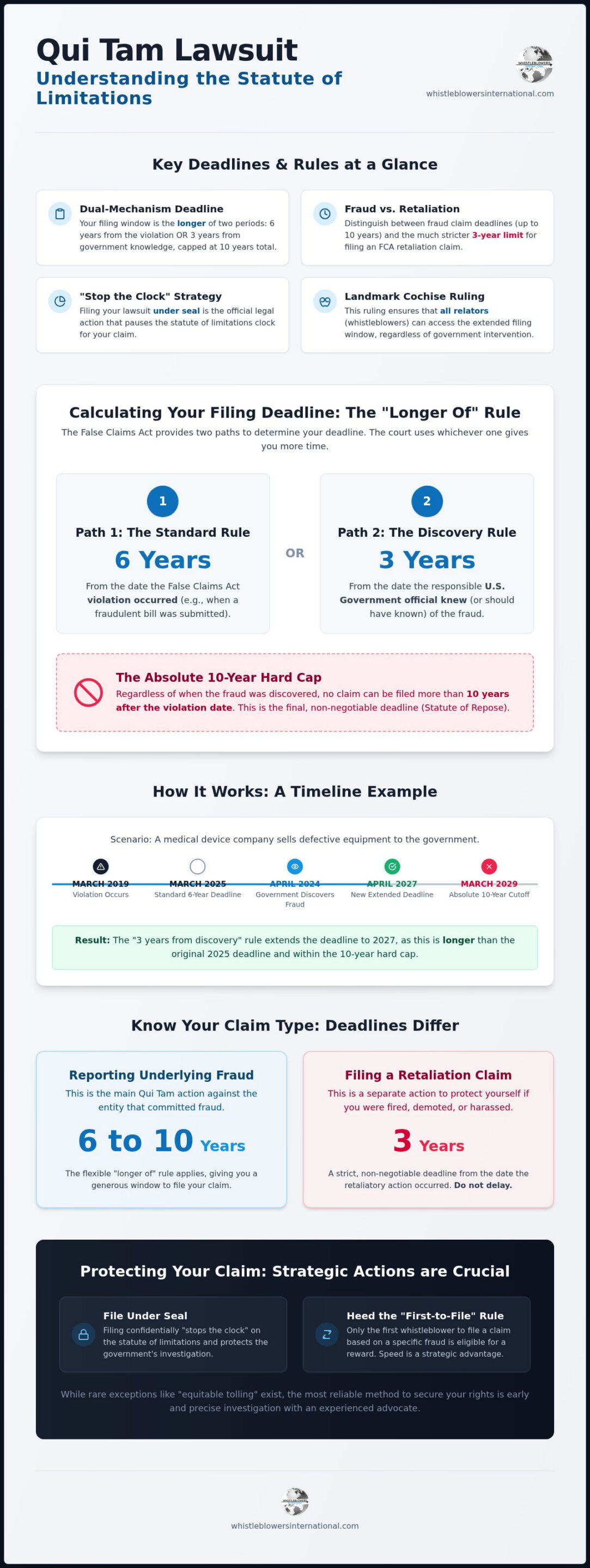
- Master the dual-mechanism calculation that determines your filing deadline, which can extend from six years after a violation up to a ten-year absolute hard cap.
- Learn how the landmark *Cochise Consultancy* ruling standardized the qui tam lawsuit statute of limitations, granting relators access to the extended window regardless of government intervention.
- Distinguish between the multi-year timelines for reporting underlying fraud and the stricter three-year limit specifically designated for filing an FCA retaliation claim.
- Understand the procedural importance of filing under seal, a strategic move that effectively “stops the clock” while maintaining the confidentiality of the investigation.
- Identify the rare legal exceptions for “equitable tolling” and why early investigation is the most reliable method to ensure your reward eligibility remains intact.
What is the Statute of Limitations for a Qui Tam Lawsuit?
A statute of limitations functions as a definitive expiration date for your right to seek judicial relief. If you wait too long, the courts will permanently bar your claim, rendering even the most compelling evidence of fraud useless. For whistleblowers, the qui tam lawsuit statute of limitations is established by Section 3731(b) of the False Claims Act. This provision is notably more complex than standard civil laws because it employs a “longer of” rule. This dual-track system ensures that if the fraud was hidden, you may still have standing to sue. If you miss this window, you forfeit your right to a relator’s share, which can range from 15% to 30% of the government’s total recovery.
Understanding Section 3731(b) of the False Claims Act
The literal language of Section 3731(b) can be daunting, but its core function is to balance fairness with accountability. It essentially offers two paths. The first is a straightforward six-year window from the date the violation occurred. A “violation” is the specific act of deception, such as the submission of a fraudulent claim for payment. The second path allows for three years after the government official responsible for acting on the fraud knew, or should have known, the “material facts” of the case. These material facts are the core pieces of evidence that make the fraud apparent. This structure makes the Qui tam framework more forgiving than other laws, acknowledging that sophisticated corporate fraud is often buried under layers of bureaucracy.
Why Time is of the Essence for Relators
While the law provides a generous window, strategic speed is vital. The “first-to-file” rule creates a literal race to the courthouse. If another individual files a complaint based on the same underlying facts before you do, your case will likely be dismissed. Beyond the legal technicalities, the practical reality of government intervention looms large. The Department of Justice is significantly more interested in cases where the evidence is fresh and the witnesses are still available. Because the False Claims Act is designed to incentivize early reporting, the “fresher” your case, the higher the likelihood of a successful outcome. Delaying your filing doesn’t just risk the qui tam lawsuit statute of limitations; it risks the government’s willingness to commit resources to your investigation.
The 6-Year vs. 10-Year Rule: Calculating Your Deadline
Determining your specific filing window requires a surgical analysis of two distinct “prongs” under the law. The qui tam lawsuit statute of limitations is not a single fixed date but a dual-track calculation where the court applies whichever period is longer. This flexibility acknowledges that corporate fraud is often hidden for years beneath layers of complex accounting. However, this generosity has a limit. The Statute of Repose acts as an absolute 10-year hard cap. Regardless of when the government discovers the fraud, no claim can be filed more than a decade after the violation occurred. If you suspect your window is closing, consulting with a strategic advocate can help clarify these complex dates.
Consider a hypothetical scenario to illustrate this “longer of” rule. Suppose a medical device manufacturer knowingly sold defective equipment to the government in March 2019. Under the standard six-year rule, the deadline would be March 2025. If the Department of Justice remains unaware of this fraud until April 2024, the three-year knowledge trigger extends the potential deadline to April 2027. Since 2027 is still within the ten-year absolute cap (March 2029), the relator gains two additional years to file beyond the standard limit. This mechanism ensures that whistleblowers aren’t penalized for the time a fraud remains successfully concealed.
The 6-Year Standard Limit
Under the False Claims Act, the primary clock begins the moment a violation is committed. A violation occurs when a person knowingly presents a false or fraudulent claim for payment. For example, every time a hospital submits an inflated Medicare invoice, a new clock starts for that specific claim. In complex, multi-year schemes, courts typically treat each fraudulent act as a separate event. This means that while some older claims in a decade-long scheme might be barred by the qui tam lawsuit statute of limitations, more recent violations remain actionable and eligible for recovery.
The 3-Year Knowledge Trigger and the 10-Year Cap
The secondary prong allows for filing within three years of when material facts are known, or should have been known, by the “official of the United States.” This official is defined as the Attorney General or specific designees within the Department of Justice. A critical nuance exists here: your personal knowledge as a whistleblower doesn’t trigger this three-year clock. Only the government’s awareness counts. The “should have known” standard is a high bar, requiring the government to exercise reasonable diligence. If the government had enough information to investigate but failed to do so, the clock may start earlier than you expect, making early legal intervention essential.
How the Cochise Consultancy Ruling Changed the Game
Prior to 2019, a significant legal hurdle known as a “circuit split” created a fragmented landscape for whistleblowers across the United States. Different courts disagreed on whether a private citizen could utilize the extended ten-year window if the government chose not to intervene in the case. This uncertainty often penalized relators who discovered long-running fraud schemes that had been carefully concealed for more than six years. The Supreme Court’s landmark decision in Cochise Consultancy Inc. v. United States ex rel. Hunt resolved this conflict, fundamentally shifting the qui tam lawsuit statute of limitations in favor of transparency and accountability.
The ruling established a uniform standard: the extended filing period applies regardless of whether the government takes over the litigation or allows the whistleblower to proceed independently. This is a monumental victory for private citizens. It ensures that the “longer of” rule is a universal tool rather than a privilege reserved solely for government-led actions. For cases where fraud was buried deep within corporate structures for nearly a decade, this decision provides the legal oxygen necessary to pursue justice and recover taxpayer funds that would otherwise be lost to time.
Leveling the Playing Field for Private Citizens
This judicial shift prevents dishonest corporations from “waiting out” the standard six-year clock. Before this ruling, a company could theoretically hide its tracks just long enough to escape liability under the primary statute. Now, a relator with a unique insider’s perspective can effectively argue for the ten-year window, even in non-intervened cases. As noted in the National Whistleblower Center FAQ, this expanded timeframe is essential for addressing systemic fraud that takes years to uncover. It empowers individuals to step forward even when they discover evidence of past misconduct that occurred well beyond the standard deadline.
Identifying the ‘Triggering Official’
A critical strategic advantage lies in the definition of whose knowledge actually starts the three-year extension clock. The Supreme Court clarified that the clock only begins when a “responsible official of the United States” becomes aware of the material facts. This typically refers to the Attorney General or their specific designees within the Department of Justice. Knowledge held by a low-level agency employee or a local auditor does not trigger the deadline. This distinction is vital; it gives whistleblowers and their legal teams more time to build a robust case before the government is formally put on notice. Navigating these investigative nuances requires significant resources, which is why a whistleblower lawyer contingency fee structure is so beneficial. It allows for the deep, elite-level scrutiny needed to prove when the government truly “knew” about the fraud, protecting your claim from premature expiration.
Tolling, Retaliation, and State-Level Variations
While the primary fraud claims under the False Claims Act offer a generous window, other aspects of your case are governed by much tighter deadlines. It’s a common misconception that every part of a whistleblower action follows the same ten-year timeline. In reality, the legal framework is a patchwork of overlapping rules that require meticulous management. If you are facing professional repercussions alongside your fraud discovery, contact our team to secure your legal action before these shorter windows close.
Deadlines for Whistleblower Retaliation
If you’ve suffered an adverse employment action, such as termination, demotion, or harassment, because of your efforts to stop a violation, you’re protected under Section 3730(h) of the FCA. However, the qui tam lawsuit statute of limitations for retaliation is significantly shorter than for the fraud itself. You have exactly three years from the date the retaliation occurred to file your claim. This deadline is strict and doesn’t benefit from the “knowledge of the government” extensions discussed earlier. Because these timelines diverge, filing your fraud and retaliation claims simultaneously is often the most effective strategy to ensure no part of your recovery is lost to a technicality.
In rare circumstances, the court may apply “equitable tolling,” which effectively pauses the clock. This usually requires proving that the defendant actively concealed their fraud in a way that made it impossible for even a diligent investigator to uncover. Similarly, the “Relation Back” doctrine allows you to add specific details or new claims to an existing, timely filed lawsuit. If your new allegations arise out of the same conduct described in your original sealed complaint, the court treats them as if they were filed on that first date, shielding them from expiration.
State vs. Federal Qui Tam Timelines
When facing such workplace challenges, seeking counsel from an experienced firm like Leon Legal Group can be essential in ensuring your employment rights are fully protected during a whistleblower action.
The complexity increases when a fraud scheme impacts both federal and state funds. Currently, 31 states have enacted their own versions of the False Claims Act to recover losses from state-level programs like Medicaid. While many of these laws mirror federal standards, states like New York and California have unique procedural quirks and differing statutes of limitations. For example, the Florida False Claims Act authorizes specific per-claim penalties ranging from $5,500 to $11,000, which may follow different tolling rules than federal actions. When a case involves multi-jurisdictional filings, you must satisfy the most restrictive deadline across all involved statutes to protect your global recovery rights. This requires a seasoned advocate who can orchestrate a filing strategy that spans multiple jurisdictions without missing a single beat.
Protecting Your Claim: How an Elite Advocate Stops the Clock
Filing a formal complaint is the only definitive way to freeze the qui tam lawsuit statute of limitations. This is achieved through the legal mechanism of filing “under seal,” which ensures the lawsuit remains confidential and hidden from the public and the defendant while the government conducts its investigation. This protective measure allows the relator to secure their place in line under the first-to-file rule without alerting the fraudulent entity prematurely. If a complaint is filed correctly, the clock effectively stops, preserving your right to a reward even if the government’s subsequent investigation takes years to conclude.
A critical component of this process is the “disclosure statement.” This document must contain substantially all material evidence and information the relator possesses. It serves as the primary tool for establishing exactly what the government knew and when they knew it. By providing a meticulous, professionally drafted disclosure, you create a clear record that supports the application of the extended 10-year window if the fraud was previously hidden. It’s the precision of this initial filing that often determines whether a case survives a motion to dismiss based on timeliness.
The Investigative Advantage
Piacentile & Associates LLP operates as a battle-tested mentor, leveraging a team that includes former whistleblowers and elite investigators. We don’t just file paperwork; we conduct deep-dive forensic analyses to uncover the exact “date of violation” for every fraudulent act. This level of scrutiny is vital for cases involving complex international fraud or customs duty evasion, where multiple clocks may be running simultaneously. If the evidence is gathered with strategic foresight, it maximizes the potential relator’s award by ensuring that every actionable claim is included before the qui tam lawsuit statute of limitations can expire. Our team understands the nuances of the field from multiple angles, prioritizing your privacy while building a formidable case.
Global Reach for International Whistleblowers
Foreign nationals often possess critical evidence of fraud against the U.S. government, particularly in sectors like international finance, defense, and cross-border trade. It’s a common misconception that you must be a U.S. citizen or located within the United States to act as a relator. The False Claims Act allows individuals worldwide to file actions if U.S. federal funds are involved. However, gathering evidence across borders presents unique logistical and legal challenges that must be addressed before the statute expires. The process of uncovering and validating international evidence requires a seasoned partner with global influence. To ensure your evidence meets the rigorous standards of U.S. federal courts, you should evaluate your case with Piacentile & Associates. Our global reach and insider perspective provide the strategic foundation necessary to navigate these high-stakes deadlines and protect your path to a successful recovery.
Securing Your Whistleblower Claim Before the Window Closes
The complexity of the qui tam lawsuit statute of limitations requires a strategic approach that balances legal precision with investigative urgency. You now understand that while the 10-year absolute cap offers a safety net for hidden fraud, the stricter three-year window for retaliation claims and the “first-to-file” rule demand immediate action. Success in these high-stakes federal actions depends on more than just having evidence; it requires filing under seal at the optimal moment to protect your rights and your potential reward.
Piacentile & Associates LLP provides the elite advocacy needed to navigate these labyrinthine deadlines. Led by a former whistleblower, our team brings decades of experience in high-stakes federal fraud investigations to every case we evaluate. We operate on a contingency fee basis, which means we only get paid if you win. Don’t let a technical deadline jeopardize the integrity of your discovery. Contact Whistleblowers International for a confidential case evaluation and ensure your claim is handled by a battle-tested mentor who understands the risks you face. Your courage deserves the protection of a seasoned legal ally.
Frequently Asked Questions
Can I still file a qui tam lawsuit if the fraud happened more than 6 years ago?
Yes, you can often file beyond the six-year mark if the government was previously unaware of the fraud. Under the False Claims Act, the “longer of” rule allows for an extension of up to three years from the date a responsible government official learned of the material facts. However, this is subject to an absolute ten-year hard cap from the date the violation occurred. Early investigation is crucial to determine if your specific timeline remains open.
Does the statute of limitations change if the government decides not to intervene?
No, the filing deadline remains consistent regardless of the government’s intervention status. Before 2019, some courts restricted the ten-year window to cases where the government intervened. The Supreme Court has since clarified that private relators have access to the same extended timeline as the Department of Justice. This ensures that your right to pursue a claim independently is protected, even if federal authorities decline to take over the litigation themselves.
What is the ‘hard cap’ for filing a False Claims Act case?
The absolute hard cap for any False Claims Act filing is ten years from the date the violation was committed. This is known as a statute of repose. Even if the government only discovers the fraud eleven years after the fact, the legal right to sue has expired. This deadline is immovable and applies regardless of how well the company concealed its actions. Understanding this qui tam lawsuit statute of limitations is vital for protecting your reward eligibility.
How long do I have to sue for whistleblower retaliation?
You have exactly three years from the date the retaliation occurred to file a claim under Section 3730(h). This clock begins the moment you experience an adverse action, such as termination, demotion, or a reduction in pay. Unlike fraud claims, retaliation deadlines don’t benefit from the “government knowledge” extension. It’s often strategic to file your retaliation and fraud claims simultaneously to ensure both windows are preserved under the law.
Does reporting the fraud to my company’s HR department start the statute of limitations clock?
No, reporting internally to your employer or Human Resources doesn’t trigger the three-year “government knowledge” clock. The False Claims Act specifically requires that a responsible official of the United States, typically within the Department of Justice, becomes aware of the material facts. Internal reports may actually complicate your case by alerting the defendant before you can file under seal. Professional guidance is essential to ensure you report the fraud correctly.
Can the statute of limitations be extended if the company actively concealed the fraud?
Yes, the clock can occasionally be paused through a legal principle called equitable tolling. This is a rare exception reserved for cases where a defendant’s active concealment made it impossible for a diligent whistleblower or the government to discover the fraud. Courts apply this standard very strictly. You must prove that you exercised reasonable diligence but were prevented from filing by the defendant’s deceptive conduct. Most whistleblowers find the ten-year cap provides sufficient time.
What happens if another whistleblower files the same case before I do?
If another relator files a complaint based on the same underlying facts before you, the “first-to-file” rule usually bars your claim entirely. The court will dismiss subsequent lawsuits to prevent duplicative recoveries. This creates a high-stakes race to the courthouse. Even if your qui tam lawsuit statute of limitations hasn’t expired, being second in line can result in the permanent loss of your right to a reward, regardless of your evidence’s quality.
Are the deadlines different for SEC or IRS whistleblower programs compared to qui tam?
Yes, the SEC, IRS, and FinCEN programs operate under different statutory frameworks than the False Claims Act. While qui tam actions allow for a dual-track timeline of up to ten years, SEC and IRS claims often align with the underlying statutes of the violations they report, which are frequently five or six years. These programs also don’t require filing a lawsuit in court. Each program has unique procedural requirements that demand specialized legal knowledge.