

A visible construction defect may be a contract dispute. A record showing that the government was billed for work that was not done may raise a different concern. If you’re considering reporting fraud on a government construction project, start by separating what you observed from what you suspect.
A defect or disputed invoice does not automatically prove fraud. Retaliation concerns, confidentiality, and rules for handling project records can also make it difficult to know what to do next. Reporting information to a government agency and pursuing a False Claims Act qui tam action are different routes, with different procedures and consequences.
This guide explains conduct that may warrant closer scrutiny, how to organize relevant information responsibly, and how agency reporting differs from a potential qui tam case. It also covers why a legal assessment can help you evaluate the facts and reporting strategy before taking consequential steps. The aim is to help you make an informed decision, not to jump to conclusions. Use only information you’re authorized to access, and keep in mind that confidentiality has limits.
Key Takeaways
- Learn how knowingly false statements or claims involving government funds differ from mistakes, delays, change orders, and workmanship disputes.
- Understand how an agency or inspector general complaint differs from a potential False Claims Act qui tam action, and why the project’s funding and alleged conduct matter.
- For reporting fraud on a government construction project, build a factual chronology and note project identifiers only when you’re lawfully able to access them.
- Follow a measured sequence: identify the contracting entity and funding source, organize the facts, assess the reporting route, and verify the appropriate official channel.
- See how whistleblower counsel can assess project facts, evidence context, and procedural considerations in a potential federal False Claims Act matter.
What counts as suspected fraud on a government construction project?
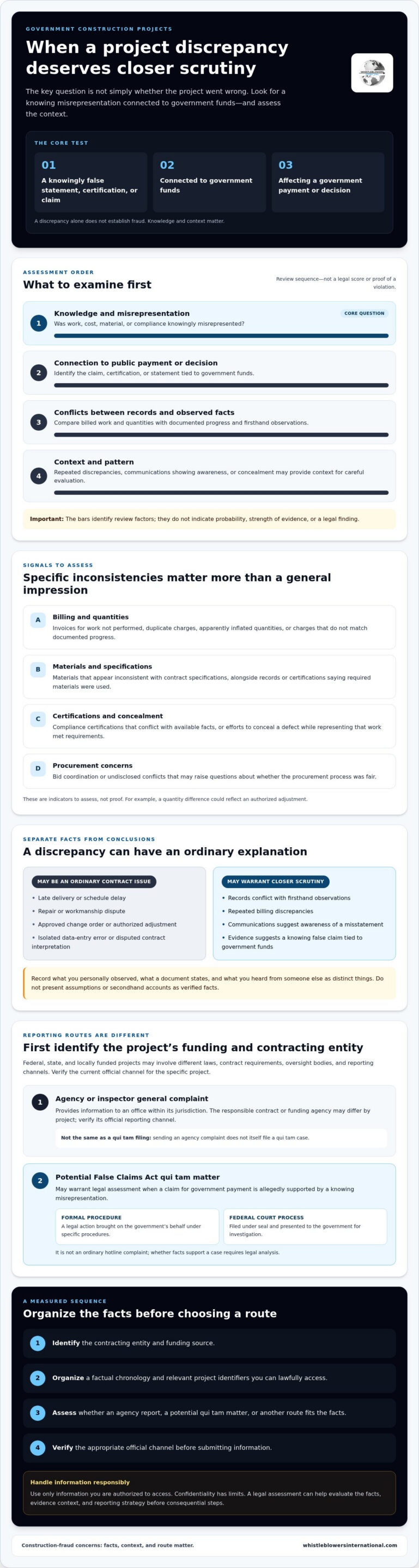
Suspected construction fraud generally involves a knowingly false statement, certification, or payment claim connected to government funds. The central question is not simply whether a project went wrong. It is whether someone knowingly misrepresented work, costs, materials, or compliance in a way that affected a government payment or decision. Context matters, and a discrepancy on its own does not establish fraud.
For example, an invoice for work that was not performed may warrant scrutiny, particularly if project records or firsthand observations conflict with the billed amount. A late delivery, repair dispute, or approved change order may have an ordinary explanation. Poor performance alone does not establish fraud; knowledge and context matter.
The source of the funding also matters. Federal, state, and locally funded projects may involve different laws, contract requirements, oversight bodies, and reporting channels. The False Claims Act is one federal legal framework associated with claims for government funds, but it is not a universal route for every public construction concern. The project’s funding and the conduct at issue help determine which rules may apply.
Construction project conduct that may warrant scrutiny
Focus on specific inconsistencies rather than a general impression that something seems wrong. Potential warning signs include:
- Invoices for work not performed, duplicate charges, quantities that appear inflated, or charges that do not match documented progress.
- Materials that appear to differ from contract specifications, alongside records or certifications stating that the required materials were used.
- Compliance certifications that conflict with available project facts, or efforts to conceal a defect while representing that the work met requirements.
- Bid coordination or undisclosed conflicts that may raise questions about whether the procurement process was fair.
These are indicators to assess, not proof of a legal violation. A difference in quantities, for example, might reflect an authorized adjustment. A certification that conflicts with inspection records may call for closer examination.
Fraud indicators versus ordinary contract problems
A billing discrepancy is something to clarify. Evidence that someone knowingly submitted a false claim raises a different concern. An isolated data entry error, a disputed interpretation of contract language, or a schedule delay may occur without intentional deception. Repeated discrepancies, records that conflict with firsthand observations, or communications showing awareness of a misstatement may provide important context, but they still need careful evaluation.
Keep your observations separate from your conclusions. Note what you personally saw, what a document states, and what you heard from someone else. Do not present an assumption or secondhand account as a verified fact. This distinction can help clarify whether the issue appears to be a performance or contract dispute, a possible misrepresentation involving public funds, or a concern that needs further assessment before you choose a reporting route.
Which reporting route fits suspected construction fraud?
The appropriate route depends on the alleged conduct, who funded the project, and which government entity holds or administers the contract. A federally funded project may raise different issues from one involving state or local funds. Before choosing where to report, identify the contracting entity and funding source as accurately as you can. Then verify the relevant agency’s current official reporting channel.
Two routes often come up in federal matters: a direct complaint to an agency or its inspector general, and a potential False Claims Act qui tam action. These are distinct processes, not interchangeable submissions. An agency complaint gives information to an office within its jurisdiction. A qui tam case is a legal action brought on the government’s behalf under specific procedures. Sending an agency complaint does not itself file a qui tam case.
When an agency or inspector general complaint may fit
Agencies and inspectors general receive allegations within their respective areas of responsibility. For example, HHS oversight channels address matters within HHS’s scope, while Treasury channels address matters tied to Treasury’s jurisdiction. These examples are not universal instructions for construction projects. The agency responsible for a contract or funding program may be different, so verify the current official channel for the specific project before submitting information.
When to assess a potential False Claims Act qui tam matter
A potential federal qui tam matter may warrant assessment if the concern involves a claim for government payment allegedly supported by a knowing misrepresentation. This is not an ordinary hotline complaint. A qui tam lawsuit has formal legal procedures, including filing in federal court under seal and presenting the matter to the government for investigation. Whether the facts support such a case requires legal analysis.
The distinction matters if you want to alert an oversight office, pursue a legal action on the government’s behalf, or consider both options. A direct complaint does not automatically preserve or initiate a qui tam action. Neither route guarantees anonymity, eligibility for an award, or a particular outcome. Before taking steps that may affect your position, consider how the facts, evidence, and reporting strategy fit together.
For a fuller explanation of the federal framework and qui tam process, consult the firm’s False Claims Act guide for whistleblowers in 2026. If you’re weighing a potential federal claim, whistleblower counsel can assess the project facts and procedural considerations before you choose a route. That assessment can help you approach reporting fraud on a government construction project deliberately, without treating an agency complaint and a qui tam filing as the same step.
What should you consider before reporting construction fraud?
Careful preparation can help you explain your concern clearly without overstating what you know or improperly exposing information. Start with a factual chronology: record dates, project phases, participants, and what you personally observed. If you can lawfully access them, note contract identifiers, the funding or contracting agency, and where the work took place. Mark estimates as estimates, and distinguish firsthand knowledge from information you learned elsewhere.
There is no universal rule for retaining or sharing project information. Privacy, privilege, contract terms, workplace policies, and disclosure obligations can all affect what you may keep or provide. Do not access restricted systems, remove confidential files, alter records, or breach legal duties. If you are unsure whether material can lawfully be retained or shared, get legal guidance before acting.
Organizing project facts without overstating them
A concise chronology is more useful than a broad accusation. Separate direct observations, documents you lawfully hold, and information reported by other people. Describe the specific inconsistency, such as an invoice listing a quantity that appears greater than the work you observed, without assuming why it occurred. Keep original records unchanged. Avoid unnecessary annotations, duplication, or circulation of sensitive material.
A simple working format can help you maintain that distinction:
- Date and project phase: Note when the event occurred and what work was underway.
- Observation or record: State what you saw or what a document says, without presenting an interpretation as fact.
- Source and limits: Identify whether the information is firsthand, documented, or secondhand, and note what remains uncertain.
Use this as a private organizational aid, not as a reason to gather material you are not authorized to access. Do not edit, annotate, or forward original project files to build a case. If records contain sensitive information, avoid creating extra copies or sharing them broadly. The appropriate handling depends on the circumstances.
Considering confidentiality, retaliation, and timing
Identity handling can differ between an agency complaint and formal legal proceedings. A reporting channel may collect identifying details, while a legal action may involve procedures that affect when information becomes public. Do not treat either route as a guarantee of anonymity. Potential legal protections against retaliation also depend on the governing law and the facts. Do not assume that every person, project role, or reporting step is covered in the same way.
If you’re weighing reporting fraud on a government construction project, consider speaking with whistleblower counsel before making a public disclosure, confronting an employer, or taking another step that may be difficult to reverse. Counsel can assess the facts, the lawful handling of records, and possible reporting routes in context. Timing may matter, but avoid relying on general assumptions about deadlines or protections. Have the applicable rules evaluated for your situation.
How to report suspected fraud on a government construction project
A careful report starts with the project, not the accusation. Identify the funding and contracting entity as best you can, organize the facts you are lawfully able to access, and assess which reporting route fits. The appropriate agency channel depends on the contract, funding source, and conduct involved. Verify the channel on the responsible agency’s official website before submitting information. Do not assume a familiar hotline handles every public project.
Use this sequence to prepare:
- Identify the project and oversight context. Record the contract or project identifiers, contracting entity, funding agency, relevant time period, and project phase, if you know them lawfully. If details are uncertain, mark them as unverified rather than filling gaps with assumptions.
- Organize the specific concern. Describe what you observed or what a record states, how it relates to a government funded project, and what remains unclear. Keep firsthand observations distinct from information you received from others. Do not obtain or share restricted material to strengthen the report.
- Match the concern to a route. For an agency complaint, determine which agency or inspector general has responsibility and follow its current official process. For a potential False Claims Act matter, seek a legal assessment before treating an agency submission as a substitute for a qui tam filing.
- Keep a submission record. Retain a copy or confirmation of what you submitted and note the date and channel, provided you can do so lawfully. This can help you track your steps, but it does not predict whether the agency will respond or what action it may take.
A practical sequence for an agency complaint
Agency complaint channels are specific to each office’s jurisdiction. Verify that the office handles the contract, funding program, or alleged conduct at issue, then follow the process described on its official website. Provide relevant facts clearly, avoid unnecessary sensitive information, and keep a lawful record of the submission. A direct complaint alerts an oversight office. It does not by itself begin a qui tam case.
A separate legal assessment for a possible qui tam case
A lawyer can assess whether the allegations and available information may fit a federal False Claims Act claim. A qui tam action has formal legal procedures and restrictions, so it is not simply another complaint form. Counsel can evaluate the facts, evidence context, and filing requirements before you decide whether to file. Do not assume that an agency report preserves or satisfies those separate procedures.
If you’re considering reporting fraud on a government construction project and are unsure whether your facts may support a federal whistleblower matter, discuss whether your facts warrant legal evaluation before taking consequential steps.
How whistleblower counsel can help assess a construction-fraud report
Construction projects generate extensive records and involve overlapping contracts, funding sources, and compliance requirements. Whistleblower counsel can help examine how the facts fit together: what was represented to the government, whether a claim for payment may have relied on a knowing misrepresentation, and what the available information does and does not show. A legal assessment can also identify procedural considerations before you submit information or take another consequential step.
Piacentile & Associates LLP represents whistleblowers in federal False Claims Act matters. The firm is led by Dr. Joseph Piacentile, Esq., an attorney and former whistleblower. Representation is contingency-based: the firm is paid from a monetary recovery or award it secures. This arrangement does not mean every matter qualifies or that a recovery is guaranteed. For more context on the fee model, see Whistleblower Lawyer Contingency Fees: A Comprehensive 2026 Guide.
What a legal assessment can clarify
A focused review can help distinguish a contract performance problem from facts that may raise a separate legal concern. Counsel can assess whether the issue involves an allegedly knowing false claim, a statement about contract compliance, or another matter requiring a different analysis. The review can also consider the context of records and observations, the project’s connection to government funds, and whether the facts point toward an agency complaint, a potential qui tam action, or further evaluation before choosing a route.
That analysis is not a promise of eligibility, anonymity, protection from retaliation, or recovery. Outcomes and available protections depend on applicable law and the specific facts. A legal assessment can identify questions and procedural issues, but it cannot predetermine what a government agency or court will do.
Taking a careful next step
You do not need to arrive with a complete case file. Be ready to describe the project, the conduct that concerned you, when it occurred, and what you personally observed. Explain which details come from records you lawfully hold and which came from other sources. Do not post sensitive project information publicly or send confidential records through an unprotected channel. Counsel can discuss how to handle relevant materials and what additional information may be appropriate to review.
If you’re considering reporting fraud on a government construction project, you can discuss whether your facts warrant legal evaluation before making public disclosures or submitting information. A conversation does not guarantee a particular outcome or remove every privacy concern, but it can help clarify the issues and possible next steps. A careful evaluation can help distinguish a reportable concern from a project dispute, grounding decisions in evidence and procedure rather than assumption.
Make your next step deliberate
Deciding whether to speak up can carry professional and personal weight. You do not need every answer before seeking an informed assessment, but consider how your information was obtained and what could follow from sharing it. A measured conversation can help you evaluate the significance of your observations before making a public disclosure or taking another consequential step.
Piacentile & Associates LLP represents whistleblowers in federal False Claims Act matters. The firm is led by Dr. Joseph Piacentile, Esq., a former whistleblower and attorney. Its representation is contingency-based, with payment tied to a monetary award or recovery it secures. This does not guarantee that a matter qualifies or that a recovery will result.
If you’re considering reporting fraud on a government construction project, take the next step with care. Discuss a potential government construction fraud matter with our whistleblower team to explore whether your circumstances warrant legal evaluation. A thoughtful assessment can help you move forward with greater clarity.
Frequently Asked Questions
Can I report fraud on a government construction project anonymously?
Possibly, but anonymity depends on the reporting channel and its procedures. Some agency channels may accept anonymous complaints, while a False Claims Act qui tam action follows formal court procedures that can involve identity related requirements. Do not assume your identity will remain undisclosed throughout either process. Before providing names, documents, or other identifying details, consider how the information may be handled and get legal advice about confidentiality limits and potential consequences.
What counts as construction fraud on a government project?
Potential construction fraud may involve knowingly billing for work not performed, inflating quantities, charging twice for the same work, misrepresenting substituted materials, or submitting false certifications tied to government payment. A payment disagreement or defective work, by itself, does not establish fraud. An invoice difference may reflect an approved adjustment, or it may merit closer scrutiny if other facts suggest deliberate misrepresentation. Describe what you know without presenting a suspicion as a proven violation.
Can a subcontractor report suspected fraud on a government construction project?
A subcontractor with relevant information may be able to raise a concern, though the appropriate route depends on the project, funding, facts, and applicable law. You do not need to make a definitive legal judgment before describing what you observed. For example, distinguish work you personally witnessed from instructions relayed by a supervisor. Keep records within your lawful access, and seek legal guidance before sharing material or taking action that could affect a potential claim.
Should I report construction fraud to an agency or under the False Claims Act?
These are separate routes, and one does not automatically substitute for the other. An agency complaint follows the relevant government office’s process. A potential False Claims Act qui tam action involves distinct legal procedures. The contract, alleged conduct, and facts may affect which option is appropriate. Before submitting, verify that an agency channel covers the project and consider whether legal advice is needed to assess a separate claim or its procedural requirements.
What information is useful when reporting suspected government contract fraud?
Useful information may include a project or contract identifier, the relevant agency, the time period, people involved, and a clear account of what raised concern. For instance, note the difference between a quantity shown on a progress report and what you observed at the project site, without guessing why it differs. Separate firsthand knowledge from assumptions, and provide only material you are legally entitled to share. The receiving office may request additional details under its process.
What if the suspected construction fraud involves a state or local project?
Reporting options may differ for state or local projects. Federal funding can also be part of a project involving multiple public entities. Identify who awarded or administers the contract and what funding sources are apparent from information you may lawfully access. Then verify the relevant entity’s current official reporting channel. Do not assume a federal procedure applies simply because public funds or a government contractor are involved.
Can I receive a reward for reporting construction fraud?
A reward is not automatic, and a report alone does not establish eligibility. Any potential award depends on the applicable law or program, the information provided, government action, and other requirements. Agency complaints and qui tam actions can follow different processes, so do not treat reward claims as a prediction of what your matter may yield. A lawyer can assess whether the facts may fit a program and explain the relevant considerations without guaranteeing an award.