
What if the greatest barrier to your multi-million dollar recovery isn’t the complexity of the fraud you’ve uncovered, but the quiet fear that your identity will eventually surface in a corporate boardroom? For many professionals, the prospect of reporting securities violations is overshadowed by the anxiety of career-ending retaliation and the digital breadcrumbs left behind during the reporting process. It’s essential to understand that under the current SEC whistleblower anonymity rules, your identity is not merely a preference; it’s a protected legal status that requires a precise procedural handshake between you and your counsel.
You’re right to feel cautious, as the stakes in high-level finance have never been higher. This guide will show you how to navigate these complexities to protect your professional standing while securing your eligibility for a life-changing reward. If you provide original information through the proper channels, then the law provides a robust framework to shield your identity from the targets of the investigation. We’ll examine the 2026 SEC Enforcement Manual updates that strengthened confidentiality protocols and outline a clear strategy to ensure you remain unidentified. By the end of this analysis, you’ll have a full understanding of the protocols required to move from an internal observer to a protected, anonymous advocate for integrity.
Key Takeaways
- Learn the critical distinction between confidentiality and anonymity under the Dodd-Frank Act to ensure your identity remains protected during the initial investigative phase.
- Understand why the SEC whistleblower anonymity rules require formal legal representation to file a Tip, Complaint, or Referral while remaining unidentified.
- Identify the “small circle trap” and other de facto identification risks that can compromise your professional safety even when formal protocols are strictly followed.
- Clarify the precise procedural timing for award applications and the specific reasons why identity disclosure is eventually required to verify eligibility for multi-million dollar payouts.
- Discover how to leverage a battle-tested legal ally to navigate the complex 2026 enforcement landscape on a 100% contingency basis.
The Core Mechanics of SEC Whistleblower Anonymity Rules
The Dodd-Frank Act established a revolutionary framework for financial transparency by creating a statutory mandate for reporter protection. These SEC whistleblower anonymity rules aren’t merely internal guidelines; they’re federal requirements designed to encourage high-level insiders to come forward without fear. If a reporter follows the specific filing protocols, the commission is legally prohibited from disclosing any information that could reasonably be expected to reveal their identity. The SEC’s duty to protect an individual’s identity is further reinforced by the Privacy Act, which mandates that the agency maintain the highest standards of record security and non-disclosure for personal information.
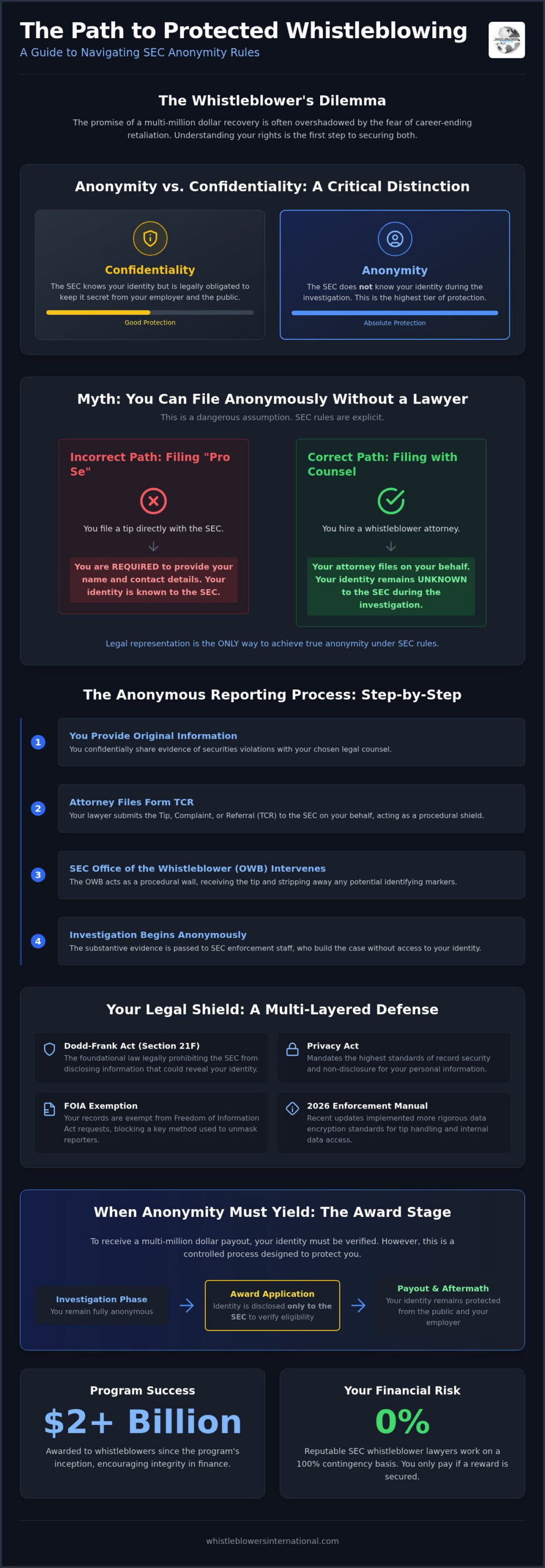
It’s vital to distinguish between confidentiality and anonymity within this program. Confidentiality implies that the SEC knows your identity but agrees to keep it secret from your employer and the public. Anonymity, however, is a higher tier of protection where the SEC itself doesn’t know who you are during the investigation. This is only possible if you’re represented by an attorney who submits the information on your behalf. The shield is absolute. Process matters. Without the correct legal intermediary, true anonymity is impossible under current commission rules.
The Role of the SEC Office of the Whistleblower
The SEC Office of the Whistleblower (OWB) serves as the central clearinghouse for all incoming tips. When an anonymous Form TCR (Tip, Complaint, or Referral) arrives, the OWB acts as a procedural wall. They strip away identifying markers before passing the substantive evidence to enforcement staff. This internal division ensures that the investigators building the case don’t have access to the whistleblower’s personal data. Additionally, these records are exempt from Freedom of Information Act (FOIA) requests, preventing third parties or corporate defendants from using public records laws to unmask reporters.
Statutory Protections Under the Dodd-Frank Act
Section 21F of the Exchange Act provides the legal teeth for these secrecy requirements. Unlike the False Claims Act, where a whistleblower’s name eventually appears on a court docket, the SEC program allows for permanent anonymity through the final judgment. As of the February 2026 update to the SEC Enforcement Manual, the commission has implemented even more rigorous data encryption standards for tip handling. These updates remind all staff that whistleblower information is highly confidential and subject to strict limitations. If the SEC fails to maintain these standards, it compromises the integrity of the entire program, which has already awarded over $2 billion to individuals since its inception.
Myth: You Can File Anonymously Without a Lawyer
Many individuals mistakenly believe they can simply check a box on a government website to remain hidden. This is a dangerous assumption. Under current SEC whistleblower anonymity rules, the commission will not process a tip anonymously unless the reporter is represented by counsel. If you attempt to file “pro se”, which means without an attorney, you’re required to provide your name and contact details directly on the Form TCR. There is no middle ground. The system is designed this way to ensure that while the reporter stays hidden, a licensed officer of the court remains accountable for the submission’s integrity.
The Legal Requirement for Counsel
The SEC requires an attorney to serve as the procedural bridge between the whistleblower and the agency. This ensures that the commission has a point of contact who has verified the reporter’s identity, even if that identity remains unknown to the enforcement staff. It’s a system of accountability that protects the program from frivolous or bad-faith filings. For international reporters, this “Attorney-as-Shield” model is the only way to engage with the SEC Whistleblower Program without immediate exposure to corporate retaliation. Because SEC whistleblower lawyer fees are structured on a 100% contingency basis, the cost of this protection isn’t a barrier. You only pay if a multi-million dollar reward is secured.
Privilege vs. Anonymity
Legal representation provides a dual-layered defense that goes beyond simple non-disclosure. While the SEC whistleblower anonymity rules provide a statutory shield, attorney-client privilege creates a second, private barrier that the government cannot breach. A seasoned advocate does more than just submit a form; they actively scrub your evidence. This involves removing identifying metadata from digital files and redacting references to specific meetings or conversations that only a handful of people attended. This “filtering” process is essential to prevent de facto identification. When your lawyer speaks to the SEC on your behalf, they manage the narrative to ensure the focus remains on the fraud, not the source. If you’re considering coming forward, it’s prudent to consult with an elite advocate who understands how to maintain your shield from the very first interaction.
The Reality of ‘De Facto’ Identification and How to Avoid It
The technical protections of the SEC whistleblower anonymity rules are formidable, but they’re not infallible against the human element of corporate investigation. Even when your name is never spoken, the specific nature of the information you provide can act as a fingerprint. This is known as “de facto” identification. If the evidence is so granular that only one or two people in an organization could have accessed it, your identity is effectively revealed through a process of elimination. While the SEC Whistleblower Program provides the legal framework for secrecy, it cannot prevent an employer from making logical deductions based on the evidence presented during an enforcement action.
The “Small Circle” trap is perhaps the most common way reporters inadvertently expose themselves. If a specific fraud was discussed only during a closed-door meeting between the CFO, the auditor, and one senior analyst, the circle of suspicion is dangerously narrow. Mosaic theory describes the analytical process where an employer aggregates multiple non-confidential data points to derive a conclusion about a source’s identity. To counter this, your legal team must act as a strategic filter, ensuring that the evidence is presented in a way that points to the crime without pointing to the person.
Sanitizing Your Evidence
Effective sanitization is a technical art. It goes beyond redacting names; it requires the removal of digital footprints and metadata from every internal document. Many professionals don’t realize that a simple PDF or Excel file can contain a history of who created, edited, and saved the document. Unique data sets that point directly to your specific department or geographic region must be generalized to maintain your shield. In fact, common mistakes in SEC whistleblower claims frequently stem from a failure to recognize how specific data patterns can reveal a reporter’s department or seniority level.
Strategic Timing of the Report
Timing is a critical component of identity protection that many whistleblowers overlook. If you file a report within forty-eight hours of a heated performance review or a direct confrontation with management, the temporal proximity acts as a beacon. Building a temporal buffer is essential. By using historical data to mask current involvement, you can create a narrative that suggests the information could have come from a former employee or a different division. An elite investigator will work to corroborate your facts through third-party sources, such as public filings or industry benchmarks, to ensure the SEC has the evidence it needs without relying solely on your direct testimony. This methodical approach respects the gravity of the process and prioritizes your long-term professional safety.
When Anonymity Must Yield: The Award Stage and Testimony
The transition from a confidential source to a rewarded claimant represents a pivotal shift in the reporting process. While SEC whistleblower anonymity rules provide a robust shield during the investigative phase, you eventually reach a “Point of No Return” where your identity must be disclosed to the commission. This is a mandatory procedural step for reward distribution. The SEC is legally required to verify that a claimant is not a prohibited person, such as a government employee or an individual who obtained the information through a prohibited audit. If the commission cannot verify the source of the information, then they cannot legally authorize a payout from the Investor Protection Fund, which has already distributed over $2 billion to successful reporters.
It is important to understand that even when your identity is revealed to the SEC for payment purposes, the commission’s duty to maintain your confidentiality remains in effect. Your name is not published in the final award order, and the public record typically refers to claimants by an assigned whistleblower number. The revelation is internal to the agency’s vetting staff and does not equate to a public unmasking. We manage this transition with extreme care to ensure that your professional standing remains protected even as you secure your financial future.
The Award Application Process
The clock begins ticking the moment the SEC posts a “Notice of Covered Action” on its website, which occurs after an enforcement action results in more than $1 million in sanctions. You have exactly 90 calendar days from that posting to file Form WB-APP. If you fail to submit this application within the window, you forfeit your right to a reward, regardless of the quality of your original information. Understanding how the SEC whistleblower statute of limitations applies to your specific case is vital for a successful recovery. During this vetting process, only a small, specialized group within the Office of the Whistleblower will have access to your identifying documents, maintaining the internal wall between your data and the broader investigative staff.
Testimony and Public Enforcement
A primary concern for many insiders is the prospect of being called as a witness in a public trial. In practice, this scenario is quite rare because over 95% of SEC enforcement actions are settled through administrative proceedings or consent decrees without ever reaching a courtroom. If the SEC does litigate and requires your testimony, your legal team can negotiate for protective measures. These may include “John Doe” status in court filings or the use of protective orders to seal sensitive portions of the record. Our strategy focuses on building such a compelling evidentiary trail that the SEC can prove its case through documents alone, making your personal testimony unnecessary. If you have concerns about the long-term implications of coming forward, you should speak with our battle-tested advocates to explore the specific protections available for your situation.
Securing Your Future with Piacentile & Associates LLP
Choosing the right advocate is the most consequential decision you’ll make after discovering corporate misconduct. At Piacentile & Associates LLP, our approach is informed by a unique insider’s perspective that most law firms cannot replicate. Led by Dr. Joseph Piacentile, a former whistleblower himself, our firm understands the profound psychological and professional weight of these proceedings. We don’t just view SEC whistleblower anonymity rules as a checklist of regulations; we treat them as a mission-critical mandate to protect your livelihood. If you’re standing at a crossroads of conscience and risk, then you deserve an ally who has navigated these high-stakes waters from your side of the table.
A Global Shield for Whistleblowers
The reach of the SEC is global, and our representation reflects that reality. We specialize in representing international clients who uncover fraud in multinational corporations, often without the need for the whistleblower to ever set foot in the United States. Our 2026 protocol for anonymous international reporting is designed to harmonize SEC requirements with complex cross-border data privacy laws, such as the GDPR. If your evidence originates in a jurisdiction with strict data export rules, then we implement specific technical safeguards to ensure compliance while maintaining your shield. Our commitment to 100% contingency representation means that we assume all the financial risk of the investigation. You’ll never face hourly billing or upfront costs; our interests are perfectly aligned with yours in securing a multi-million dollar reward.
Strategic Investigation and Advocacy
A successful filing requires more than just submitting evidence; it requires an investigative powerhouse that can transform raw data into a compelling enforcement narrative. Our team of seasoned investigators works in the shadows to corroborate your findings through independent analysis and third-party validation. This methodical approach ensures that the submission is “clean” and high-quality, which is a primary factor the commission considers when determining award percentages. If you’re reporting foreign bribery or corruption, then engaging an elite FCPA whistleblower lawyer is essential to navigating the specific complexities of the Foreign Corrupt Practices Act.
We invite you to take the first step toward resolution with a confidential, no-obligation case evaluation. This initial consultation is a secure space where we can assess the viability of your information and outline a strategy to protect your identity under the SEC whistleblower anonymity rules. We prioritize your privacy above all else, ensuring that your transition from an observer of fraud to a protected claimant is handled with the precision and gravity it deserves. Contact Piacentile & Associates LLP today to begin your journey toward a secure and rewarded future.
Taking the Next Step Toward Protected Disclosure
Exposing corporate fraud is a high-stakes undertaking that demands both courage and a sophisticated legal strategy. We’ve explored how the SEC whistleblower anonymity rules function as a critical shield, provided you navigate the “Attorney-as-Shield” requirement and avoid the pitfalls of de facto identification. While the law offers robust protections, the difference between a secure recovery and professional exposure often lies in the precision of your filing and the quality of your evidence sanitization.
Piacentile & Associates LLP brings a unique perspective to this process as a firm led by a former whistleblower who understands the personal risks involved. We offer global expertise in SEC, IRS, and False Claims Act filings on a 100% contingency basis. We only get paid if you win. You don’t have to navigate this labyrinthine process alone or at your own expense. Secure your future and your anonymity; contact Piacentile & Associates LLP for a confidential consultation today. You can move forward with the confidence that your identity is guarded by a battle-tested advocate committed to your long-term success.
Frequently Asked Questions
Can the SEC guarantee that my identity will never be revealed?
The commission provides robust statutory protections but cannot offer an absolute guarantee in every conceivable scenario. If a case proceeds to litigation rather than settling, a whistleblower might be required to testify. However, since over 95% of SEC enforcement actions are settled without a trial, the risk of public exposure remains statistically low for those who follow the correct filing protocols.
Do I have to tell my employer that I am filing an SEC whistleblower claim?
You’re under no legal obligation to notify your employer of your intent to file a claim. Under the SEC whistleblower anonymity rules, you can bypass internal reporting channels entirely if you fear retaliation or believe the company will destroy evidence. Reporting through an attorney allows you to maintain a complete shield between your professional life and the ongoing commission investigation.
What happens if the company figures out I am the whistleblower?
If your identity is compromised, the Dodd-Frank Act provides powerful anti-retaliation protections that prohibit firing, demoting, or harassing you. You may be entitled to reinstatement, double back pay with interest, and compensation for legal fees. If a company attempts to use “gag clauses” in severance agreements to stop you from reporting, the SEC has a history of taking direct enforcement action against such firms.
Can foreign nationals remain anonymous when reporting to the SEC?
Foreign nationals have the same rights to anonymity as U.S. citizens when reporting securities violations. The SEC program has a global reach, and many multi-million dollar awards have been issued to international reporters. To maintain your shield from abroad, you must still be represented by an attorney who can verify your identity to the commission while keeping it hidden from the public and your employer.
Is there a difference between anonymity and the SEC’s confidentiality rules?
There’s a distinct procedural difference between these two levels of protection. Confidentiality means the SEC knows your identity but is legally bound to keep it secret from the public. Anonymity is a more rigorous standard where the SEC itself does not know who you are during the investigation. This higher tier of protection is only accessible if you file through a legal representative who acts as your intermediary.
Can I lose my anonymity if I talk to the media about the fraud?
Speaking to the media carries a high risk of compromising your anonymity through the disclosure of specific details. Even if a journalist protects your name, the unique facts you share can lead to de facto identification by your employer. We generally advise against public statements, as they can complicate the legal strategy and inadvertently provide the “mosaic” of information needed to unmask your identity.
Will my name appear on the check when I receive my SEC whistleblower award?
Your name will not appear on a public check or in published award orders. When an award is granted, the SEC typically transfers the funds to your attorney’s trust account. From there, your legal counsel handles the distribution to you. This process ensures that the financial transaction remains private and consistent with the SEC whistleblower anonymity rules that protected you throughout the investigation.
What protections do I have if I am retaliated against after reporting anonymously?
If retaliation occurs, you have the right to file a private lawsuit in federal court under the Dodd-Frank Act. The SEC also has the authority to bring its own enforcement actions against companies that retaliate against whistleblowers. These protections apply even if you reported anonymously, provided that the retaliatory action was motivated by your protected activity. Having an elite advocate ensures these rights are vigorously defended.