
Is a multi-million dollar reward worth a decade of your life? The reality of the SEC whistleblower claim timeline is often a sobering revelation for those standing on the precipice of reporting corporate fraud. While the potential for a life-changing payout is significant, the path to that result is a strategic marathon rather than a sprint. It’s completely understandable to feel a mix of anxiety and frustration as the years pass without a clear update from the Commission. You are likely concerned about career retaliation or the long-term financial uncertainty that accompanies such a high-stakes decision.
This article provides a detailed phase-by-phase breakdown of the investigative and award process to give you a realistic expectation of the 5 to 10 year journey. We will examine how the quality of your initial filing can act as a catalyst to move your case to the top of the investigative pile. By understanding the nuances of the SEC’s internal review, you can better prepare for the wait and find the right partner to manage the heavy legal burden on your behalf.
Key Takeaways
- Realize that the SEC whistleblower claim timeline is a multi-year marathon, often requiring five to ten years to move from the initial tip to a final award payout.
- Learn how “SEC-ready” filings can help your disclosure stand out among thousands of competing tips, potentially accelerating the Commission’s internal review process.
- Understand the strict procedural requirements of the post-settlement phase, including the 90-day deadline that’s critical for maintaining your eligibility for a financial reward.
- Identify the specific factors, from jurisdictional overlap to the nature of the financial fraud, that determine whether an investigation moves at a steady pace or stalls.
- Explore how a contingency-based legal partnership mitigates the personal and financial risks inherent in a multi-year federal investigation.
The SEC Whistleblower Program: Why Timelines are Measured in Years
The SEC Whistleblower Program operates as a sophisticated, multi-stage federal enforcement mechanism rather than a simple reporting hotline. It’s designed to incentivize the disclosure of high-level securities fraud by offering substantial financial rewards to those who provide a roadmap to hidden violations. However, the SEC whistleblower claim timeline is notoriously lengthy; most successful claimants wait between five and nine years from their initial submission to the final receipt of funds. This duration is a direct consequence of the immense volume of tips handled by the SEC Office of the Whistleblower (OWB). In fiscal year 2025, the OWB received approximately 27,000 tips, representing an 8% increase from the previous year. To manage this massive queue, the Commission prioritizes information that is specific, timely, and credible, ensuring that limited investigative resources are directed toward the most egregious violations.
The Role of the Dodd-Frank Act in Claim Processing
Under the statutory framework established by the Dodd-Frank Wall Street Reform and Consumer Protection Act of 2010, the SEC is granted the authority to pay awards for original information. If an individual’s disclosure leads to a successful enforcement action resulting in more than $1 million in sanctions, the Commission is legally mandated to pay an award between 10% and 30% of the total monetary sanctions collected. This isn’t a discretionary payout but a legal right for those who meet the strict eligibility criteria. Throughout this entire timeline, the Act ensures that confidentiality remains a cornerstone of the process. If a whistleblower is represented by an attorney, they can submit their tip anonymously (a critical protection for those facing significant professional risks), ensuring their identity remains shielded from the public and the target company during the years of investigation.
Why “Original Information” Dictates the Pace
Providing “original information” remains the most effective way to influence the speed of an investigation. This is defined as data derived from an individual’s independent knowledge or analysis that isn’t already known to the Commission from other sources. High-quality tips that are “SEC-ready” tend to bypass initial triage filters much faster than vague or speculative reports. If a tip provides a clear, documented roadmap of fraud, such as internal emails, ledger entries, or specific transaction logs, it allows investigators to skip months of preliminary discovery. The SEC specifically prioritizes tips that involve ongoing investor harm, as these cases demand immediate intervention to prevent further financial loss. By ensuring your filing is comprehensive from day one, you provide a strategic advantage to the Enforcement Division, which can significantly shorten the time it takes for an investigator to open a formal matter.
Phase-by-Phase: The SEC Whistleblower Claim Journey
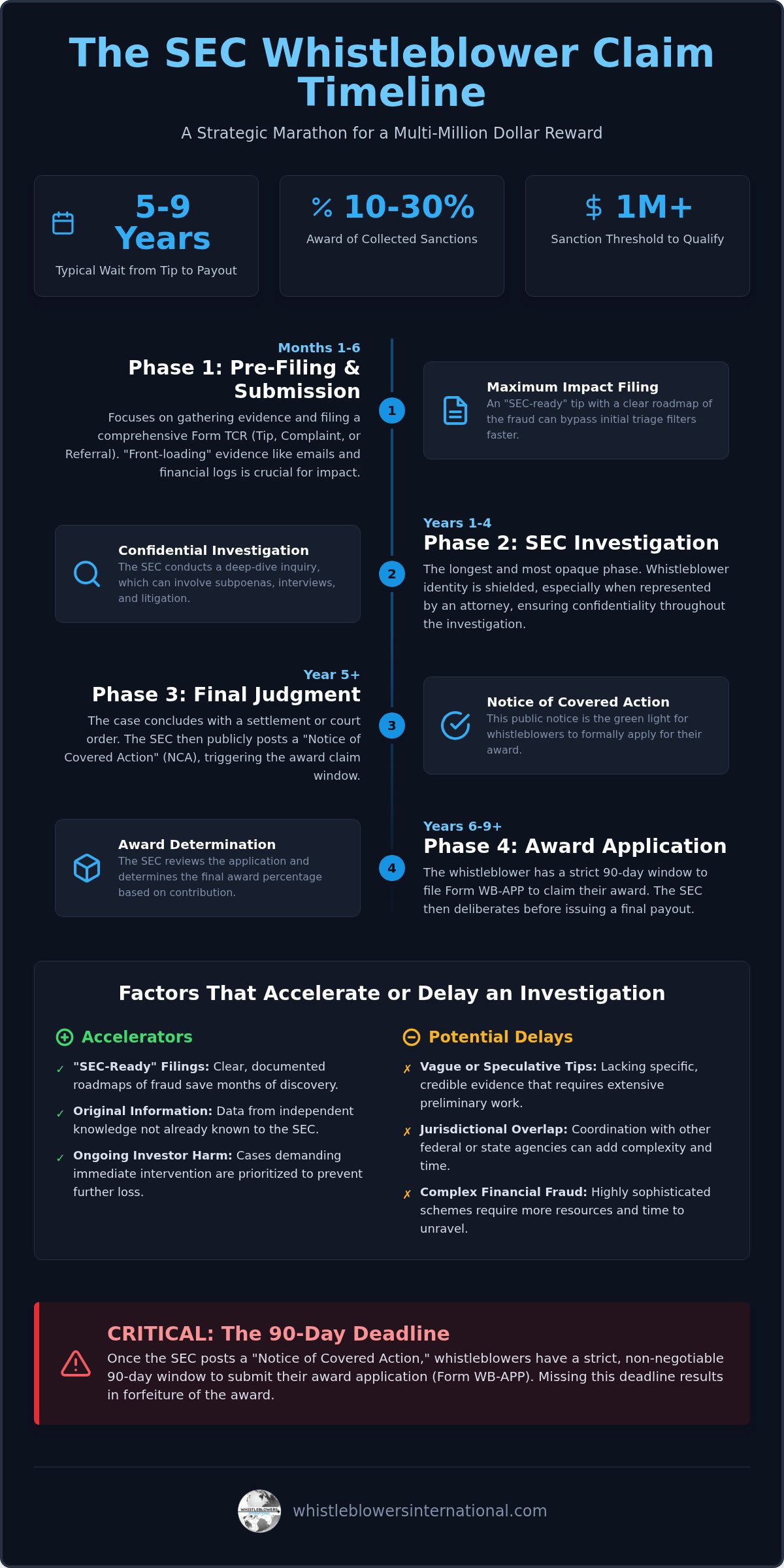
The SEC whistleblower claim timeline follows a rigorous chronological path that requires both patience and precision. It’s not a linear progression where you’ll see immediate results; rather, it’s a sequence of distinct phases that can span nearly a decade. Understanding these phases helps manage expectations and ensures that every action taken contributes to a successful outcome. The journey generally breaks down into four primary stages, moving from the initial submission to the final award determination.
- Phase 1: Pre-Filing and Form TCR Submission (Months 1–6): This initial stage focuses on evidence gathering and the formal filing of your tip.
- Phase 2: The SEC Investigation and Enforcement Action (Years 1–4): The Commission conducts its deep-dive inquiry, which may involve subpoenas, interviews, and litigation.
- Phase 3: Final Judgment and Notice of Covered Action (Year 5+): The case concludes with a settlement or court order, and the SEC publicly posts the case for award claims.
- Phase 4: Award Application and Final Determination (Years 6–8+): The whistleblower applies for their reward, and the SEC calculates the final payout percentage.
Phase 1: Preparing the Form TCR for Maximum Impact
During the first six months, the focus remains on the Form TCR (Tip, Complaint, or Referral). This document is the bedrock of your claim. “Front-loading” evidence, such as submitting a comprehensive package of internal emails, financial logs, and a clear narrative of the fraud, can save years of investigative back-and-forth later. If you choose to file anonymously, the Commission mandates that you’re represented by counsel from the moment of submission. Working with a qualified legal team ensures your filing is “SEC-ready” and meets all procedural thresholds from day one.
Phase 2: Navigating the Investigative “Black Box”
Once the tip is submitted, the case often enters a “Black Box” period lasting between one and four years. During this time, the SEC conducts its formal investigation. It’s a challenging phase because the Commission doesn’t provide regular status updates to protect the integrity of its work. You may be interviewed or asked for additional documents, but long periods of silence are standard. An experienced attorney maintains a “pulse” on the case by monitoring related enforcement actions and maintaining professional contact with the assigned investigators, providing a vital bridge between you and the federal bureaucracy.
The journey culminates when a final judgment is reached and the SEC posts a “Notice of Covered Action” (NoCA). This triggers the formal award application process. While the wait is significant, this methodical approach ensures that awards are calculated accurately based on the total sanctions collected from the violators.
Factors That Accelerate or Delay an SEC Investigation
While the structural phases of the SEC whistleblower claim timeline provide a general framework, the actual velocity of a case is dictated by a specific set of variables. No two investigations move at the same speed because the nature of the underlying fraud varies significantly. A Ponzi scheme, which often involves a clear trail of cash moving from new investors to old ones, might be resolved faster than complex accounting fraud that requires a forensic deep-dive into GAAP compliance and internal controls. Beyond the type of fraud, the level of cooperation from the whistleblower and the strategic maneuvers of the defendants play pivotal roles in how long the matter remains open.
Case Complexity and Resource Allocation
The SEC is a resource-constrained agency that must choose which tips to pursue with its limited staff. Well-packaged cases that provide a clear roadmap of the violation require fewer agency resources to prosecute, making them highly attractive to investigators. If a whistleblower provides documented evidence of “scienter,” which is the legal term for a defendant’s intent to deceive or defraud, the Commission is more likely to accelerate its interest. Conversely, multi-national investigations involving the Foreign Corrupt Practices Act (FCPA) often add years to the clock. These cases require coordination with foreign regulators and the translation of thousands of documents, which naturally slows the pace of discovery and validation.
The Impact of Parallel Proceedings
It is common for the Department of Justice (DOJ) or the FBI to file a criminal case alongside the SEC’s civil enforcement action. When these parallel proceedings occur, the criminal case almost always takes precedence. In many instances, the court may grant a “stay” in the civil proceedings, which temporarily halts the SEC timeline until the criminal matter is resolved or reaches a specific milestone. This coordination is essential to prevent civil discovery from interfering with a criminal prosecution, but it can leave whistleblowers waiting in the wings for years. For individuals reporting international bribery or cross-border securities violations, consulting an FCPA whistleblower lawyer is crucial for understanding how these overlapping jurisdictions impact the total duration of a claim.
Defendants also utilize specific legal tools to manage their exposure, such as Tolling Agreements. These agreements pause the statute of limitations, allowing the defendant to conduct an “internal investigation” while the SEC waits. While this can sometimes lead to a settlement, it often serves as a tactical delay that extends the investigative phase by months or even years. If your legal team remains proactive during these delays, they can ensure the SEC stays focused on the primary evidence rather than getting bogged down in defensive diversions.
The Post-Settlement Wait: Understanding the Award Claim Process
Reaching a successful enforcement action is a monumental victory, yet it does not trigger an immediate payout. Instead, it initiates the final, often most bureaucratic, phase of the SEC whistleblower claim timeline. This administrative period can easily extend the journey by another two to three years as the Commission evaluates the relative contributions of all claimants involved in the matter. Patience remains a prerequisite even after the fraudster has been held accountable in a court of law. The process moves from the litigation phase into a rigorous internal review where the specific value of your information is quantified.
The Notice of Covered Action (NoCA) Milestone
The formal trigger for the reward process is the posting of a “Notice of Covered Action” (NoCA) on the SEC’s official website. The Commission only posts these notices for enforcement actions where the resulting sanctions exceed $1 million. It’s common for the SEC to aggregate multiple related judicial or administrative actions into a single NoCA, which can complicate the application process if you aren’t certain which specific action corresponds to your original tip. Once a NoCA is published, the clock starts ticking:
- Whistleblowers have exactly 90 calendar days to submit Form WB-APP to apply for an award.
- Missing this deadline is a jurisdictional bar that cannot be waived.
- The law is unyielding on this point; failure to file within this window results in a total loss of award eligibility.
From Preliminary Determination to Final Award
After the application window closes, the SEC Claims Review Staff (CRS) begins an exhaustive evaluation of the case. They eventually issue a Preliminary Determination, which outlines whether the claim is recommended for an award and the proposed percentage, which ranges between 10% and 30%. If the proposed percentage feels insufficient based on your level of cooperation or the personal risk you took, you have a limited window to submit a written rebuttal to the CRS. This is a high-stakes negotiation where your legal counsel presents a detailed argument to maximize your share of the recovery.
Following this review, the Commission issues a Final Order. This document represents the agency’s ultimate decision and is generally not subject to further internal appeal. However, a Final Order does not mean a check is in the mail. The SEC must actually collect the monetary sanctions from the violator before payment can be disbursed. If the fraudster’s assets are frozen or tied up in bankruptcy proceedings, the wait for actual funds can lengthen significantly. To ensure you navigate the final hurdles of the SEC whistleblower claim timeline without error, you should partner with an experienced whistleblower law firm that understands how to advocate for the highest possible award percentage.
Managing the SEC Timeline with a Contingency-Based Law Firm
The SEC whistleblower claim timeline is not just a legal challenge; it is a significant endurance test for the individual reporter. When a process stretches across five to ten years, the psychological and financial burden can become overwhelming. Engaging a legal partner who understands the nuances of federal investigations is essential for maintaining both the integrity of the claim and the whistleblower’s personal well-being. A sophisticated law firm acts as a protective shield, managing the exhaustive administrative requirements while the whistleblower focuses on their professional and personal life. By allowing an elite advocate to handle the “Black Box” of SEC correspondence, you ensure that your case remains active and prioritized without it consuming your daily existence.
Why Contingency Representation is Essential for Long Timelines
Because most individuals cannot afford the astronomical hourly legal fees required to sustain a case for seven years or more, the contingency fee model becomes a critical equalizer. Under this arrangement, the law firm absorbs all investigative and administrative costs, effectively sharing the “time risk” with the client. If the case does not result in a successful recovery, the whistleblower owes nothing in legal fees. This alignment of interests ensures that the firm is deeply invested in the long-term success of the claim, providing the resources necessary to fight through years of defendant delays and SEC procedural hurdles. For a deeper understanding of how these structures work, you can review our whistleblower lawyer contingency fee guide.
The Insider Advantage: Working with Former Whistleblowers
Piacentile & Associates LLP brings a unique perspective to the table by utilizing a team that includes former whistleblowers and seasoned investigative experts. This “battle-tested mentor” approach is vital for managing client expectations during the long periods of silence inherent in the SEC investigative process. We employ advanced investigative techniques to “uncover” the specific data points that the Commission needs to see, performing a strategic triage of evidence before the Form TCR is even filed. By ensuring a filing is “SEC-ready” from day one, we help our clients move to the top of the investigative pile, potentially shaving years off the total duration of the case. Our global reach allows us to represent individuals in high-stakes securities fraud matters regardless of their jurisdiction, providing a formidable alliance against complex corporate wrongdoing.
If you are considering reporting securities fraud but are concerned about the length of the process, professional guidance can provide the clarity you need. Contact our SEC whistleblower attorneys for a confidential case evaluation. We are prepared to handle the complexities of your claim so you don’t have to face the federal bureaucracy alone.
Master the Journey Toward Accountability
Navigating the SEC whistleblower claim timeline requires a blend of strategic foresight and disciplined patience. By ensuring your initial filing is comprehensive and understanding the specific milestones of the investigative process, you transform a daunting federal procedure into a manageable path toward justice. While the journey often spans several years, the impact of uncovering corporate fraud and the potential for a life-changing reward make the marathon worthwhile. You’ve already taken the hardest step by deciding to report; now, it’s about seeing the process through to its conclusion.
Piacentile & Associates LLP offers a unique perspective led by a former whistleblower who understands the emotional and professional stakes of this journey. We provide elite expertise in SEC, IRS, and False Claims Act actions on a contingency basis. Because we operate on a “no recovery, no fee” model, we share the time risk with you entirely. Secure your future with elite whistleblower representation and take the first step toward holding violators accountable with a partner who stands by you until the final determination. You don’t have to face the complexities of federal enforcement alone.
Frequently Asked Questions
How long does the average SEC whistleblower investigation last?
A formal SEC investigation typically lasts between two and four years, though the total SEC whistleblower claim timeline often spans five to ten years before a final payout is issued. This duration is influenced by the complexity of the financial fraud and whether the case involves parallel proceedings with other agencies. While the Commission strives for efficiency, the exhaustive process of gathering evidence and litigating enforcement actions requires significant time to ensure a successful outcome.
Can I speed up the SEC whistleblower claim process?
You can potentially accelerate the process by submitting a “SEC-ready” filing that provides a clear, documented roadmap for investigators. When a tip is front-loaded with specific evidence, such as internal emails or ledger entries, it reduces the resources the Commission must spend on preliminary discovery. High-quality submissions are more likely to be prioritized by the Office of the Whistleblower, as they allow the agency to move directly to formal investigative steps.
What happens if the SEC decides not to investigate my tip?
If the SEC declines to investigate your tip, the matter generally ends without the possibility of a financial award. The Commission receives thousands of tips annually and must prioritize those involving the most significant investor harm or systemic fraud. If your initial submission is rejected, it’s often due to a lack of specific, original information. This highlights the importance of working with an expert firm to ensure your disclosure meets the agency’s high threshold for credibility.
Do I get paid as soon as the SEC settles with the company?
You don’t receive payment immediately after a settlement is reached. The conclusion of an enforcement action merely triggers the award application phase, which involves posting a Notice of Covered Action and evaluating all claims. This post-settlement review often takes an additional two to three years. Furthermore, the SEC must successfully collect the monetary sanctions from the violator before any funds can be disbursed to the whistleblower, which can be delayed by bankruptcy or asset freezes.
What is a Notice of Covered Action (NoCA) and why is it important?
A Notice of Covered Action (NoCA) is a formal announcement posted by the SEC when an enforcement action results in sanctions exceeding $1 million. It’s the critical milestone that opens the 90-day window for whistleblowers to file Form WB-APP. Monitoring this list is essential; failing to submit your application within this strict timeframe will result in a permanent loss of your eligibility for a financial reward. It’s the only way to officially claim your share of the sanctions.
Can I still claim an award if I wait several years to report the fraud?
You can still claim an award if you wait to report, but unnecessary delays can significantly reduce your final payout percentage. The SEC’s award criteria specifically reward “timely” reporting and may penalize individuals who allowed the fraud to continue for an extended period. If another whistleblower reports the same fraud before you, or if the information becomes public through other channels, you may lose your eligibility for a reward entirely because your information is no longer original.
Will the SEC tell me the status of my claim during the investigation?
The SEC generally does not provide status updates during an active investigation to protect the confidentiality and integrity of its work. This “Black Box” period can be challenging, as whistleblowers often go years without hearing from the Commission. However, if you’re represented by counsel, your attorney can maintain professional contact with the Enforcement Division and monitor public filings to provide you with a general sense of the case’s progression and any related judicial developments.
How much does a whistleblower lawyer cost during a 5-year case?
At Piacentile & Associates LLP, we represent whistleblowers on a contingency fee basis, meaning there are no upfront costs or hourly fees regardless of how long the case lasts. We absorb all investigative and administrative expenses throughout the multi-year SEC whistleblower claim timeline. We only earn a fee if we successfully secure a monetary award for you, ensuring our interests are perfectly aligned with the long-term success of your claim and your eventual financial recovery.