

You shouldn’t have to mortgage your future to hold a multi-billion dollar corporation accountable for systemic fraud. If you’ve uncovered evidence of wrongdoing, your primary concern is likely the financial risk of coming forward. It’s natural to feel apprehensive about legal bills or worry that fees will consume your hard-earned reward. You’re looking for a direct answer to the question: what percentage do whistleblower lawyers take?
This 2026 fee guide provides a clear roadmap of how attorney fees function within the False Claims Act and SEC whistleblower programs. You’ll understand the industry standard of 33% to 40% and why these contingency agreements protect you from any out-of-pocket expenses. We’ll also explain how an elite legal team increases your total net recovery; often, the defendant is even required to pay your legal costs through fee-shifting provisions. By the end of this guide, you’ll have the clarity needed to pursue justice with a battle-tested mentor by your side, ensuring your financial interests remain as protected as your identity.
Key Takeaways
- Discover why the industry standard for what percentage do whistleblower lawyers take typically ranges between 33% and 40%, and how this fee is only deducted from a successful financial reward.
- Learn how the 100% contingency model eliminates personal financial risk, ensuring you never face upfront legal bills or hourly rates while holding powerful entities accountable.
- Understand the impact of statutory fee-shifting provisions under the False Claims Act, which may require the defendant to pay your legal costs directly and preserve more of your award.
- Explore how specialized counsel manages critical procedural hurdles like “first-to-file” rules and public disclosure bars to maximize the likelihood of a successful government intervention.
- Gain insight into the specific fee structures of major federal programs, including the SEC, IRS, and FinCEN, to help you prepare for the complexities of high-stakes litigation.
The Financial Reality of Whistleblowing: How Legal Fees Work
Reporting high-stakes corporate fraud involves more than just moral courage; it requires significant financial stamina. Most individuals possess the evidence but lack the hundreds of thousands of dollars necessary to litigate against a multinational corporation’s defense team. This is why the modern legal industry operates on a model where the firm acts as your financial engine. When you ask what percentage do whistleblower lawyers take, you’re really asking how the firm evaluates the risk of your case. In 2026, reputable firms handle these actions on a 100% contingency basis, meaning they only receive compensation if you successfully secure an award. You should never be asked to pay upfront hourly rates to report fraud; doing so would create a barrier to justice that few could overcome.
The Risk-Sharing Partnership
A whistleblower attorney doesn’t just provide advice; they become a strategic partner. This partnership begins with a rigorous evaluation of your evidence to determine the potential for a government recovery. Because these cases often involve complex financial schemes, the law firm must absorb the costs of hiring forensic accountants and industry-specific expert witnesses. These contingency fee arrangements ensure that the lawyer’s incentives are perfectly aligned with yours. They’re motivated to maximize the total reward because their own compensation depends on it. This structure is the industry standard for False Claims Act cases, where the litigation can span several years before a settlement is reached.
Protecting Your Personal Assets
The primary goal of a contingency agreement is to ensure that doing the right thing won’t lead to personal bankruptcy. A professional firm assumes the entire financial burden of the investigation and filing process. This includes court costs, filing fees, and the substantial expense of e-discovery hosting. At Piacentile & Associates LLP, we leverage an insider’s perspective to streamline this process. Because our leadership includes a former whistleblower, we understand how to evaluate a case’s strengths early, which reduces the risk of protracted, fruitless litigation. This methodical approach protects your personal assets while positioning your claim for the highest possible scrutiny by federal authorities. You can move forward with confidence, knowing that the firm’s resources are fully committed to your success without any out-of-pocket drain on your household finances.
Standard Percentages: What Do Whistleblower Lawyers Typically Charge?
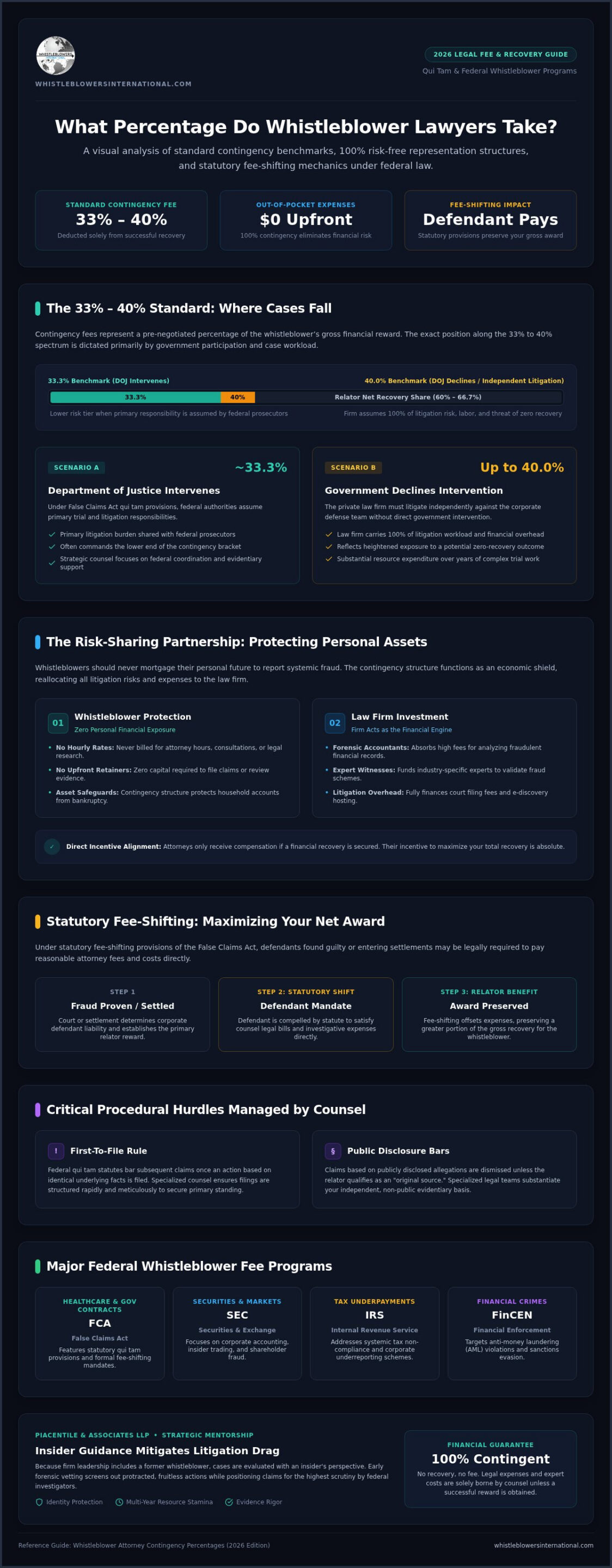
The prevailing industry benchmark for whistleblower representation in 2026 is between 33.3% and 40% of the total financial reward secured by the relator. This range reflects the high-stakes nature of federal investigations and the years of specialized labor required to see a case through to completion. When potential clients ask what percentage do whistleblower lawyers take, they are essentially looking for the market rate for high-level legal and investigative talent. A contingency fee is defined as a pre-negotiated percentage of the whistleblower’s gross recovery, which ensures that the firm’s compensation is directly proportional to the results they achieve. While some agreements calculate fees after litigation expenses are deducted, it is standard practice for the percentage to apply to the total award before costs like expert testimony or forensic analysis are reimbursed.
Factors Influencing the Fee Percentage
Several variables dictate where a case falls within the 33% to 40% spectrum. The most significant factor is whether the Department of Justice decides to intervene in the matter. Under the False Claims Act qui tam provisions, the government takes over the primary responsibility for litigation if they intervene, which may result in a lower contingency percentage for the relator’s counsel. Conversely, if the government declines intervention and the law firm must litigate the claim independently, the firm assumes 100% of the risk and workload. In these “declined” cases, a 40% fee is common to account for the increased resource drain and the heightened possibility of a zero-recovery outcome. Complexity also plays a role; a case involving a decade of systemic healthcare fraud requires significantly more investigative hours than a straightforward procurement violation.
Standard Multi-Tier Fee Structures
Sophisticated firms often utilize tiered agreements to provide transparency and fairness based on the case’s progression. For instance, a retainer might specify a 33.3% fee if the case settles during the initial government investigation phase, but increase to 40% if the matter proceeds to a full jury trial. These whistleblower lawyer contingency fees are clearly documented in the initial retainer agreement to prevent any ambiguity at the time of payout. Because high-risk Qui Tam cases can last seven years or longer, these tiers reflect the escalating investment the firm makes in your success. This documentation ensures you know exactly what percentage do whistleblower lawyers take at every potential stage of the litigation process. If you are ready to evaluate the specific merits of your evidence, discussing your case with an experienced advocate can clarify how these structures apply to your situation.
Fee Variations Across Federal Programs: FCA, SEC, and IRS
While the industry standard range provides a baseline, the specific federal program governing your claim significantly impacts your final net recovery. Understanding what percentage do whistleblower lawyers take requires a nuanced look at how different statutes allocate legal costs. Some programs allow for fees to be shifted onto the fraudulent entity, while others require the attorney’s compensation to be deducted entirely from the government-issued award. These distinctions are critical when evaluating the long-term financial implications of your case.
The False Claims Act Statutory Fee Shift
Under the False Claims Act, a unique “fee-shifting” provision exists to protect the whistleblower’s share of the recovery. If a case is successful, the defendant is legally obligated to pay the whistleblower’s reasonable legal fees and costs in addition to the government’s recovery. This means your False Claims Act attorney may receive a substantial portion of their compensation directly from the fraudster. In many settlements, these statutory fees are used to offset the contingency percentage outlined in your retainer agreement. This mechanism often reduces the effective percentage taken from the whistleblower’s personal award, ensuring the individual who exposed the fraud retains a larger portion of the proceeds.
SEC and IRS Program Fee Mechanics
In contrast, programs managed by the SEC and the IRS Whistleblower Office do not feature statutory fee-shifting. For these claims, the attorney’s fee is paid strictly out of the whistleblower’s 10% to 30% reward. It’s important to recognize that for the SEC program, retaining counsel is a mandatory legal requirement if you wish to file anonymously and protect your professional identity. Even without fee-shifting, the expertise of an IRS whistleblower lawyer is essential for navigating the multi-year delays often associated with high-value tax fraud collections. These professionals ensure your submission meets the rigorous “collected proceeds” criteria required for a mandatory 15% to 30% award. Ultimately, while the mechanics vary, the question of what percentage do whistleblower lawyers take is always balanced by the attorney’s ability to secure a higher tier of reward than an unrepresented individual could achieve alone. In 2026, the IRS continues to prioritize claims where the noncompliant taxpayer’s gross income exceeds $200,000, making expert legal vetting a prerequisite for a successful filing.
Beyond the Percentage: Evaluating the Total Value of Legal Help
Choosing a legal representative based solely on a lower fee is a strategic error that often results in a lower net recovery. While it is natural to focus on what percentage do whistleblower lawyers take, the ultimate value of a firm lies in its ability to secure a successful outcome in an increasingly competitive environment. Elite counsel provides more than just administrative support; they offer a protective shield and a strategic roadmap to navigate “first-to-file” rules, which disqualify any relator who isn’t the first to document the fraud. Sophisticated advocates also identify and bypass “public disclosure bars” that could otherwise render your claim ineligible for a reward, ensuring your case survives initial government scrutiny.
Maximizing the Gross Award
A high-level legal team doesn’t just report fraud; they build a comprehensive evidentiary package that compels the government to take action. By utilizing advanced investigative techniques, an experienced firm can uncover the full breadth of a scheme, which often leads to higher government multipliers and larger overall sanctions. The difference between an unrepresented filing and a professionally drafted complaint is stark. Government investigators prioritize cases where the evidence is organized, verified, and presented with a clear path to recovery. Because the relator’s share increases significantly when the government intervenes, the firm that produces a superior work product often yields a higher net payout for the client, even if their percentage is slightly higher.
Understanding Litigation Expenses
You must distinguish between the contingency fee and litigation expenses. Expenses include the tangible costs of the case, such as court filing fees, travel for depositions, and the retention of high-level expert witnesses. In a standard 2026 agreement, these costs are advanced by the law firm and only reimbursed if the case is successful. This protects the whistleblower from personal financial loss if the government fails to recover funds. For instance, customs fraud lawyers often face higher investigative costs because they must track complex international shipping logs and conduct overseas inquiries to validate the fraud. When evaluating what percentage do whistleblower lawyers take, you must ensure your retainer clearly states that you are not responsible for these expenses unless a recovery is obtained. If you possess evidence of significant fraud and require a partner with the resources to pursue it, contact our team for a confidential case evaluation to protect your interests.
Securing Your Award with Piacentile & Associates LLP
The decision to report high-level fraud is among the most significant choices a professional will ever make. To succeed, you need an advocate who possesses more than just technical legal knowledge; you require a partner who has navigated the same high-stakes environment you currently face. Piacentile & Associates LLP is led by Dr. Joseph Piacentile, a former whistleblower who understands the personal and professional weight of these proceedings. This unique insider’s perspective transforms our firm from a simple legal service into a battle-tested mentor for our clients. We operate on a 100% contingency model, ensuring that our commitment to your case is absolute and that you never face hidden costs or upfront financial burdens. When you consider what percentage do whistleblower lawyers take, it’s vital to remember that our firm only recovers a fee if we successfully secure a financial reward for you.
Global Reach for US Federal Claims
Corporate fraud is rarely confined within a single set of borders, and neither is our investigative reach. We represent whistleblowers globally in actions involving US federal programs, including the SEC, IRS, and FinCEN. Our team is particularly adept at managing the complexities inherent in international evidence gathering and cross-border litigation. As an FCPA whistleblower lawyer, we provide the specialized expertise needed to report foreign bribery and corruption while strictly maintaining client privacy. We understand the logistical and legal hurdles of obtaining documentation from foreign jurisdictions, and we implement rigorous security protocols to protect your identity throughout the entire investigative process.
Take the Next Step Without Financial Risk
The journey toward a successful whistleblower reward begins with a clear, honest assessment of your evidence. We provide a free, confidential case evaluation to help you understand the potential value of your claim and the likelihood of government intervention. During your initial consultation, we will walk you through the procedural timeline and clarify exactly what percentage do whistleblower lawyers take based on the specific federal program governing your case. This methodical approach ensures that you have realistic expectations and a steady, guiding hand leading you through the labyrinth of federal fraud reporting. You don’t have to face the risk of corporate retaliation alone. To initiate a secure discussion regarding your evidence, contact Piacentile & Associates for a confidential case review and secure the powerhouse advocacy your case deserves.
Empowering Your Path to Justice and Recovery
Navigating the complexities of federal fraud reporting requires a partner who understands both the legal mechanics and the personal stakes involved. We’ve explored the 33% to 40% industry standard and how fee-shifting provisions in the False Claims Act can preserve more of your reward. Ultimately, understanding what percentage do whistleblower lawyers take is only one part of the equation; the caliber of your advocate determines whether your evidence translates into a successful recovery. By choosing a firm with worldwide representation and an insider’s perspective, you ensure that your claim is positioned for maximum impact.
Piacentile & Associates LLP remains committed to a 100% success-based contingency model, meaning you never face upfront costs while holding powerful entities accountable. Led by a former whistleblower, our team provides the battle-tested mentorship necessary to navigate these high-stakes investigations with confidence. You don’t have to shoulder this burden alone. Take the first step toward securing your award and protecting your professional integrity today.
Request a Free, Confidential Case Evaluation with Piacentile & Associates
Frequently Asked Questions
What is a contingency fee in a whistleblower case?
A contingency fee is a success-based arrangement where the law firm earns a pre-negotiated percentage of the final monetary award recovered from the government. If the case does not result in a financial recovery, the client owes nothing for legal services. This model aligns the firm’s interests with yours, as the attorney only receives payment after successfully securing a settlement or agency reward. It effectively transforms legal expertise into a risk-free investment for the whistleblower.
Do I have to pay my lawyer if the government does not recover any money?
No, you are not responsible for legal fees if the government fails to recover funds. Piacentile & Associates LLP operates strictly on a 100% contingency basis, which means we assume the entire financial risk of the investigation. If your claim does not result in a monetary award, you don’t owe any attorney fees. This structure ensures that individuals can report fraud without the fear of personal financial ruin or upfront legal bills.
Are legal expenses different from the lawyer’s percentage?
Yes, legal expenses are separate from the contingency fee and cover the tangible costs of building your case. These costs include court filing fees, travel for depositions, and the retention of specialized expert witnesses or forensic accountants. In our success-based model, the firm advances these costs during the litigation process. Expenses are typically reimbursed from the gross award only after a successful recovery is obtained, protecting you from any out-of-pocket financial exposure.
Can I negotiate the percentage a whistleblower lawyer takes?
While the industry standard typically ranges from 33% to 40%, specific terms can be discussed during the initial evaluation based on the case’s complexity. When determining what percentage do whistleblower lawyers take, factors such as the volume of evidence and whether the case requires independent litigation are considered. A transparent retainer agreement will outline the exact percentage, ensuring you understand the fee structure before the investigative process begins with our battle-tested mentors.
Does the lawyer take their percentage before or after taxes?
The attorney’s contingency fee is generally calculated based on the gross amount of the whistleblower’s award before taxes are withheld. Under federal tax law, specifically sections related to the False Claims Act and IRS awards, whistleblowers can often claim an above-the-line deduction for legal fees. This prevents you from being taxed on the portion of the reward paid directly to your counsel. You should always consult a tax professional to discuss your specific financial situation.
What happens to the fee if the government takes over my case?
If the government intervenes in a False Claims Act case, the lawyer still plays a critical role in assisting federal investigators and maximizing the reward. The contingency fee remains in effect as your attorney continues to protect your interests and advocate for the highest statutory percentage. In many instances, government intervention increases the likelihood of a successful recovery, which ultimately secures the financial future for both the whistleblower and their elite legal representation.
Why do SEC whistleblowers need a lawyer to remain anonymous?
SEC rules mandate that individuals who wish to submit a tip anonymously must be represented by legal counsel. Your attorney serves as the intermediary between you and the Commission, ensuring your identity is shielded from public record and the target of your report. Beyond privacy, an experienced firm handles the technical filing requirements of Form TCR, which is essential for maintaining eligibility for a 10% to 30% reward under the federal program.
Is the lawyer’s fee taken from the total recovery or just my reward share?
The lawyer’s fee is taken specifically from the whistleblower’s share of the recovery, not the total amount returned to the government. For example, if the government recovers $10 million and awards you 20%, your lawyer’s percentage is calculated from that $2 million reward. When asking what percentage do whistleblower lawyers take, it’s important to remember that the firm’s compensation is a subset of your individual award, ensuring the government receives its full restitution first.