

In the current regulatory climate, reporting bank secrecy act violations has evolved from a matter of professional conscience into a sophisticated legal strategy where the precision of your disclosure determines the magnitude of your statutory reward. You likely recognize the systemic risks of money laundering within your institution, yet the prospect of coming forward often feels like a precarious gamble with your career. It’s natural to feel overwhelmed by the labyrinth of Anti-Money Laundering (AML) statutes or to worry that your evidence might not meet the million-dollar threshold required for a FinCEN payout.
This guide provides the definitive roadmap for navigating the 2026 FinCEN Whistleblower Program, ensuring you understand how to secure your anonymity while positioning yourself for a mandatory reward of 10% to 30% of government recoveries. We’ll examine the specific filing requirements under the latest Treasury Department rules, the critical role of legal counsel in maintaining your shield of privacy, and the strategic steps necessary to transform internal observations into a successful enforcement action. By the end of this analysis, you’ll possess a clear, methodical framework for protecting your professional reputation while holding financial institutions accountable for systemic non-compliance.
Key Takeaways
- Discover the specific statutory criteria that mandate financial rewards between 10% and 30% for successful enforcement actions exceeding $1 million.
- Learn the strategic advantage of reporting bank secrecy act violations that demonstrate systemic patterns rather than isolated technical errors.
- Identify the precise legal requirements for maintaining total anonymity while filing your disclosure with FinCEN.
- Understand the essential components of a Disclosure Statement and how it serves as the primary tool for securing government interest in your case.
- Recognize the procedural risks of unrepresented filings and the value of an investigative partner in maximizing your potential recovery.
What Constitutes a Bank Secrecy Act (BSA) Violation?
The Bank Secrecy Act (BSA) serves as the foundational architecture for the United States’ efforts to combat money laundering and terrorism financing. At its core, the statute imposes a strict obligation on financial institutions to assist government agencies in detecting and preventing financial crimes. This isn’t a passive requirement. It demands active monitoring and reporting to the Department of the Treasury, the Office of the Comptroller of the Currency (OCC), and the Financial Crimes Enforcement Network (FinCEN). When institutions fail to uphold these duties, they don’t just commit a technical error; they jeopardize national security and the integrity of the global financial system.
If you’re considering reporting bank secrecy act violations, it’s vital to distinguish between minor “foot-faults” and systemic failures. A single data entry mistake is rarely the basis for a successful whistleblower claim. Instead, federal investigators look for patterns of non-compliance or intentional gaps in oversight. Systemic violations occur when an institution’s entire framework for detection is compromised, either through inadequate resources or a deliberate choice to ignore red flags. These are the cases that command government attention and lead to significant monetary sanctions.
Common Types of Reportable BSA Failures
Most successful whistleblower cases involve clear, repetitive failures in mandatory reporting. Financial institutions must file Suspicious Activity Reports (SARs) for any transaction involving $5,000 or more that they suspect involves illicit funds or lacks a clear business purpose. Similarly, they’re required to submit Currency Transaction Reports (CTRs) for cash transactions exceeding $10,000. Beyond these specific filings, the law requires a robust Anti-Money Laundering (AML) program. A reportable failure often involves the absence of a designated AML officer or a total lack of internal controls designed to flag suspicious movement of capital.
Modern Violations: Crypto and FinTech
The rise of digital finance has expanded the scope of the BSA significantly. Virtual currency exchanges and digital asset platforms are now classified as money services businesses, meaning they must adhere to the same rigorous standards as traditional banks. Many of these entities struggle with Know Your Customer (KYC) and Customer Due Diligence (CDD) protocols, often failing to verify the true identity of their users or the source of their wealth.
In the context of high-volume digital transactions, willful blindness occurs when a platform deliberately remains ignorant of its users’ identities or the illicit origins of their funds to maintain operational speed or market share. These failures represent a high-value opportunity for whistleblowers. Reporting bank secrecy act violations in these emerging sectors often uncovers the systemic negligence that FinCEN is most eager to penalize in 2026.
The FinCEN Whistleblower Program: Rewards and Protections
The landscape for reporting bank secrecy act violations changed fundamentally with the passage of the Anti-Money Laundering Act (AMLA) of 2020 and the subsequent Whistleblower Improvement Act. Before these legislative shifts, the government held broad discretion over whether to pay whistleblowers, which created a climate of uncertainty for those risking their careers. Today, the FinCEN Whistleblower Program mandates that eligible individuals receive an award if their information leads to a successful enforcement action with monetary sanctions exceeding $1 million. This transition from a “discretionary” to a “mandatory” reward structure ensures that your contribution is recognized as a statutory right rather than a bureaucratic favor.
The reward structure is substantial. It ranges from 10% to 30% of the total monetary sanctions collected by the government. Following the Notice of Proposed Rulemaking on March 30, 2026, the procedural path for these payouts has become even more defined. This program isn’t restricted by geography or citizenship; anyone with original information about violations can qualify, regardless of where the misconduct occurred or where the whistleblower resides. Because the fund for these payments is independent of the federal appropriations process, the government’s ability to pay is guaranteed even in complex, multi-year cases.
Anonymity and Confidentiality Rules
Maintaining your privacy is a cornerstone of the program’s success. You can submit information anonymously to FinCEN, provided you are represented by an attorney throughout the process. This legal buffer ensures that your identity remains shielded from your employer and the public during the investigation. Understanding what is FinCEN and its data handling protocols is critical for any insider considering a filing. By utilizing counsel, you create a professional distance that protects your career while the government evaluates your evidence.
Anti-Retaliation Provisions
The law provides a formidable shield against workplace blowback. If an employer takes adverse action because you participated in reporting bank secrecy act violations, you have the right to seek recourse in federal court. Protections extend to termination, demotion, or any form of subtle harassment intended to silence you. Remedies often include reinstatement to your former position and double back-pay with interest. These provisions are designed to make the whistleblower whole and penalize institutions that attempt to subvert the law through intimidation. If you believe your rights have been compromised, it’s vital to consult with a specialized whistleblower firm to evaluate your legal standing and secure your future.
Identifying High-Value Evidence for Reporting
The success of any whistleblower claim hinges entirely on the quality and exclusivity of the evidence provided to federal investigators. FinCEN is not interested in speculative rumors or information already circulating in the public domain. To qualify for a reward, you must provide “original information,” which refers to non-public data derived from your independent knowledge or analysis that isn’t already known to the government from another source. While news reports or public litigation might hint at misconduct, the government prioritizes insiders who can provide the internal “roadmap” of how the violations occurred.
When you are considering reporting bank secrecy act violations, focus on systemic failures rather than isolated technical errors. A single missed filing might be attributed to human error, but a consistent pattern of disregarding suspicious activity suggests a fundamental breakdown in compliance. High-value evidence typically includes internal audit reports that were suppressed, emails where compliance officers were overruled by executive leadership, and transaction logs showing a clear bypass of established AML protocols. These documents prove that the institution’s leadership was aware of the risks and chose to prioritize profit over legal obligations.
Documentation Best Practices
Effective documentation requires a methodical approach to building a narrative that the government can easily validate. You should focus on creating a chronological timeline of events, noting specific dates when compliance warnings were issued and subsequently ignored. Identifying the key decision-makers who authorized these deviations is just as critical as the data itself. For a deeper dive into organizing your evidence, see our guide on How to Document Corporate Fraud Correctly. Clear, well-organized transaction logs that highlight suspicious patterns will significantly accelerate the government’s ability to initiate an enforcement action.
Evidence Collection Without Trespass
While gathering evidence is essential, you must navigate the process without violating federal laws or compromising your legal standing. Many financial institutions use broad “proprietary information” clauses to intimidate employees, but these cannot legally block you from reporting bank secrecy act violations to the government. However, you must avoid illegal acts such as hacking into restricted servers or exfiltrating data you don’t have authorized access to. Unauthorized data collection can jeopardize your reward eligibility and expose you to personal legal risk. It’s vital to seek legal guidance before copying or removing any internal documents to ensure your actions remain within the “protected disclosure” framework established by federal whistleblower laws.
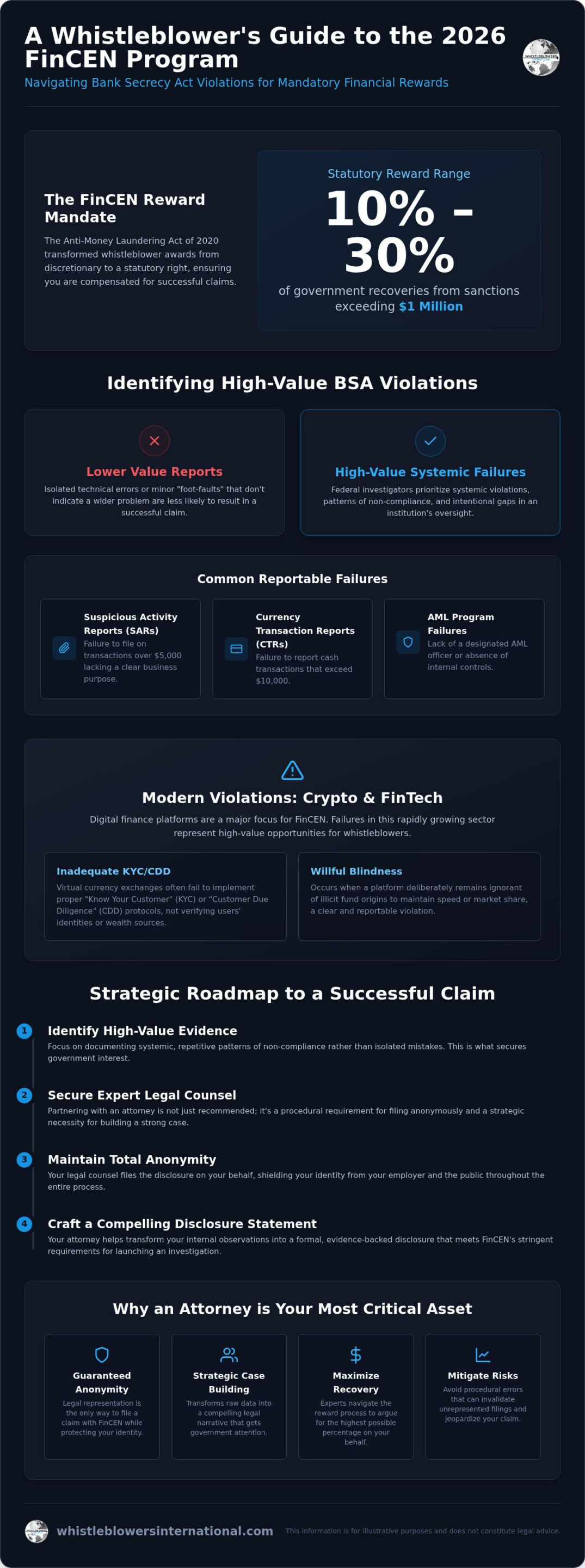
How to Report BSA Violations: A Strategic Step-by-Step Roadmap
The process of reporting bank secrecy act violations isn’t a single event but a multi-stage legal campaign that requires patience and precision. Success isn’t determined by the sheer volume of data you provide; it’s defined by how effectively that data is synthesized into an actionable narrative for federal investigators. Because the FinCEN program is highly competitive, the government prioritizes submissions that provide a clear “roadmap” to recovery, allowing agents to bypass months of preliminary discovery. This journey is a marathon that demands a sophisticated understanding of both financial regulations and the internal mechanics of federal enforcement agencies.
Step 1: The Confidential Case Evaluation
The first critical step involves a rigorous assessment of your evidence to determine if it meets the statutory requirements for a mandatory reward. You must evaluate whether the alleged misconduct is likely to result in monetary sanctions exceeding the $1 million threshold required for eligibility. During this phase, an experienced attorney will help you weigh the risks of disclosure against the potential rewards, ensuring that your “original information” is truly unique and non-public. It’s also the appropriate time to review Whistleblower Lawyer Contingency Fees so you can secure elite representation without shouldering upfront costs.
Step 2: Preparing the Submission
Once the case viability is established, the focus shifts to drafting the Disclosure Statement. This is the most vital document in your filing; it’s the narrative that “sells” the case to the government by connecting raw evidence to specific violations of the Bank Secrecy Act. You must organize your transaction logs and internal communications into a coherent story that highlights systemic failures or willful blindness by bank leadership. This statement is then submitted alongside Form TCR (Tip, Complaint, or Referral) to the FinCEN portal, officially initiating your claim for a statutory reward.
Step 3: Filing and Post-Filing Advocacy
After your report is filed, the case enters a period of intense scrutiny often referred to as the “FinCEN Black Box.” During this time, the government evaluates the merits of your claim, a process that can take significant time depending on the complexity of the financial patterns involved. Your legal team acts as an essential bridge, maintaining ongoing communication with the Department of Justice or Treasury investigators to provide clarifications or additional evidence as needed. Managing expectations is key; while the timeline for recovery is often long, persistent advocacy ensures your evidence remains at the top of the investigative pile. If you’re prepared to move forward with a claim, secure a confidential case review with our legal team today.
Why Partner with a Whistleblower Attorney for BSA Claims?
The decision to move forward with reporting bank secrecy act violations is a high-stakes undertaking that requires more than just a collection of evidence. While FinCEN provides a portal for submissions, the program’s complexity makes unrepresented (pro se) filing a significant risk to both your anonymity and your potential recovery. A sophisticated whistleblower firm doesn’t just act as a legal representative; it serves as a strategic investigative partner that validates your evidence and translates it into the formal register required by federal enforcement agencies. By leveraging a firm’s established reputation, you ensure that your disclosure isn’t lost in a sea of lower-priority tips but instead moves to the top of the investigative pile.
One of the most critical benefits of elite representation is the contingency fee model. This structure ensures that you have access to a powerhouse legal team without the burden of upfront costs or hourly billing. Because Piacentile & Associates LLP only receives a fee if the government successfully collects monetary sanctions, our interests are perfectly aligned with yours. This alignment creates a resolute commitment to maximizing the result of every case we handle. It allows individuals to challenge massive financial institutions with the backing of a formidable ally that possesses the resources and reach to handle immense legal complexities.
The ‘Former Whistleblower’ Advantage
At Piacentile & Associates LLP, our approach is informed by a unique insider’s perspective that few other firms can offer. The firm is led by Dr. Joseph Piacentile, a former whistleblower who understands the profound psychological and professional toll this process can take on an individual. This background allows us to act as a battle-tested mentor, providing protective reassurance while navigating the labyrinthine federal landscape. We understand exactly how the government evaluates whistleblower tips; therefore, we can anticipate the scrutiny your evidence will face and proactively address any potential weaknesses in the narrative.
Maximizing Your Statutory Reward
Securing a successful enforcement action is only part of the challenge. The final reward percentage (ranging from 10% to 30%) is often influenced by the “significance” of the information provided and the level of cooperation maintained throughout the investigation. We work tirelessly to argue for the highest possible percentage by highlighting the unique value of your contribution. If the information leads to related enforcement actions by other agencies, we ensure those recoveries are included in your reward calculation. If you’re ready to secure your future and protect your reputation, contact Piacentile & Associates LLP for a confidential case evaluation. We’ll help you evaluate the strength of your evidence and determine the most effective path for reporting bank secrecy act violations while maintaining your absolute privacy.
Securing Your Future as a FinCEN Whistleblower
The 2026 regulatory framework has fundamentally transformed the landscape for financial insiders. By recognizing that FinCEN now mandates rewards of 10% to 30% for successful enforcement actions exceeding $1 million, you can move forward with the confidence that your contribution carries statutory weight. Success in this arena depends on your ability to identify systemic patterns of misconduct and present them through a rigorous, evidence-backed legal narrative. Reporting bank secrecy act violations is no longer an uncertain risk; it’s a strategically protected path toward financial integrity and significant recovery.
Partnering with a firm that possesses national expertise in federal fraud actions is the most effective way to ensure your evidence receives the priority it deserves. Piacentile & Associates LLP is led by a former whistleblower who understands the gravity of your situation from a unique, personal perspective. Our contingency fee model ensures that we only win when you do, providing elite advocacy without any upfront financial exposure. If you’re ready to hold non-compliant institutions accountable while protecting your career, Secure Your Anonymity and Start Your FinCEN Claim Evaluation today. Your courage deserves a formidable ally.
Frequently Asked Questions
What is the minimum reward for reporting a Bank Secrecy Act violation?
The statutory minimum reward for eligible whistleblowers is 10% of the monetary sanctions collected in a successful enforcement action. This mandatory floor ensures that participants are fairly compensated for the significant professional risks they assume. Depending on the significance of the information provided and the extent of the whistleblower’s cooperation, the total award can reach as high as 30% of the government’s recovery.
Can I report BSA violations anonymously?
You can submit your tip anonymously to FinCEN, but the law requires that you’re represented by an attorney to do so. This legal shield ensures your identity remains confidential during the initial filing and throughout the subsequent investigation. By utilizing a firm like Piacentile & Associates LLP, you create a professional buffer that protects your career while agents evaluate your evidence regarding reporting bank secrecy act violations.
Do I need to be a U.S. citizen to receive a FinCEN whistleblower reward?
U.S. citizenship isn’t a requirement to qualify for a reward under the FinCEN program. The statute is designed with a global reach, allowing any individual who voluntarily provides original information about covered violations to be eligible for a payout. This includes foreign nationals working for international branches of U.S. financial institutions. The focus remains on the quality of the evidence rather than the whistleblower’s nationality or residency.
What happens if my bank retaliates against me for reporting?
If an institution retaliates against you for reporting bank secrecy act violations, you’re entitled to formidable legal protections under federal law. These safeguards allow you to seek recourse in federal court for adverse actions such as termination, demotion, or harassment. Potential remedies include reinstatement to your former position, double back-pay with interest, and compensation for litigation costs, ensuring whistleblowers aren’t penalized for their integrity.
How long does the FinCEN whistleblower process typically take?
The FinCEN whistleblower process is typically a multi-year journey rather than a quick settlement. Investigating complex money laundering schemes or systemic compliance failures requires extensive time for federal agents to validate evidence and build a case. Whistleblowers should expect the process to take several years from the initial filing to the final collection of sanctions and the subsequent distribution of the statutory reward.
What is the $1 million threshold for FinCEN rewards?
To qualify for a mandatory reward, the information you provide must lead to a successful enforcement action where the total monetary sanctions exceed $1,000,000. This threshold applies to the aggregate amount collected by the government, including penalties and forfeitures. If the total sanctions fall below this million-dollar mark, the award remains at the discretion of the government rather than being a mandatory statutory requirement for the whistleblower.
Can I report a violation if I was partially involved in the activity?
You may still be eligible for a reward even if you had some involvement in the underlying activity, provided you weren’t convicted of a crime related to the violation. However, the government will carefully evaluate your level of culpability when determining the final reward percentage. Participation often results in a lower payout within the 10% to 30% range, making it essential to consult with counsel to navigate self-disclosure.
Does a ‘Suspicious Activity Report’ (SAR) count as a whistleblower report?
A standard Suspicious Activity Report (SAR) filed through internal bank compliance channels isn’t the same as a formal whistleblower submission to FinCEN. While SARs are routine regulatory requirements, a whistleblower report involves providing original information directly to the government to uncover systemic misconduct. For individuals in compliance or audit roles, the law typically requires a 120-day waiting period after internal reporting before they can file a claim.