
Anonymity in the pharmaceutical industry isn’t just a safety precaution; it’s the most powerful tactical advantage a whistleblower can hold. You’ve likely witnessed practices that compromise patient safety or drain public funds, yet the fear of being blacklisted by industry giants often feels like an insurmountable barrier to action. It’s a heavy burden to carry, especially when you’re uncertain if your evidence is sufficient to stand up against a multi-billion dollar corporation. We understand that reporting pharmaceutical fraud anonymously is about more than just doing the right thing; it’s about ensuring your professional survival through a strategic legal shield.
This guide will show you how to expose corruption and secure a significant financial reward while maintaining absolute confidentiality through the False Claims Act. We’ll explore the specific legal mechanisms that keep your identity under seal and the rigorous investigative steps required to secure a percentage of the government’s recovery. In 2025 alone, the Department of Justice recovered over $5.7 billion from healthcare-related fraud cases. By following this framework, you can ensure the fraud is stopped and maximize your results without inviting personal professional ruin.
Key Takeaways
- Learn why reporting pharmaceutical fraud anonymously through a structured legal filing is the only way to ensure your identity remains protected under seal while pursuing a claim.
- Identify the high-value violations, including off-label marketing and illegal kickback schemes, that carry the most significant weight in federal recovery efforts.
- Compare the limitations of government hotlines with the strategic advantages of a qui tam lawsuit to determine the best path for your specific evidence.
- Master the methodical roadmap for navigating complex federal reporting requirements with the guidance of a battle-tested mentor.
- Understand how the contingency fee model provides you with elite legal advocacy and investigative support at no personal financial risk.
The Strategic Power of Anonymity in Pharmaceutical Fraud Reporting
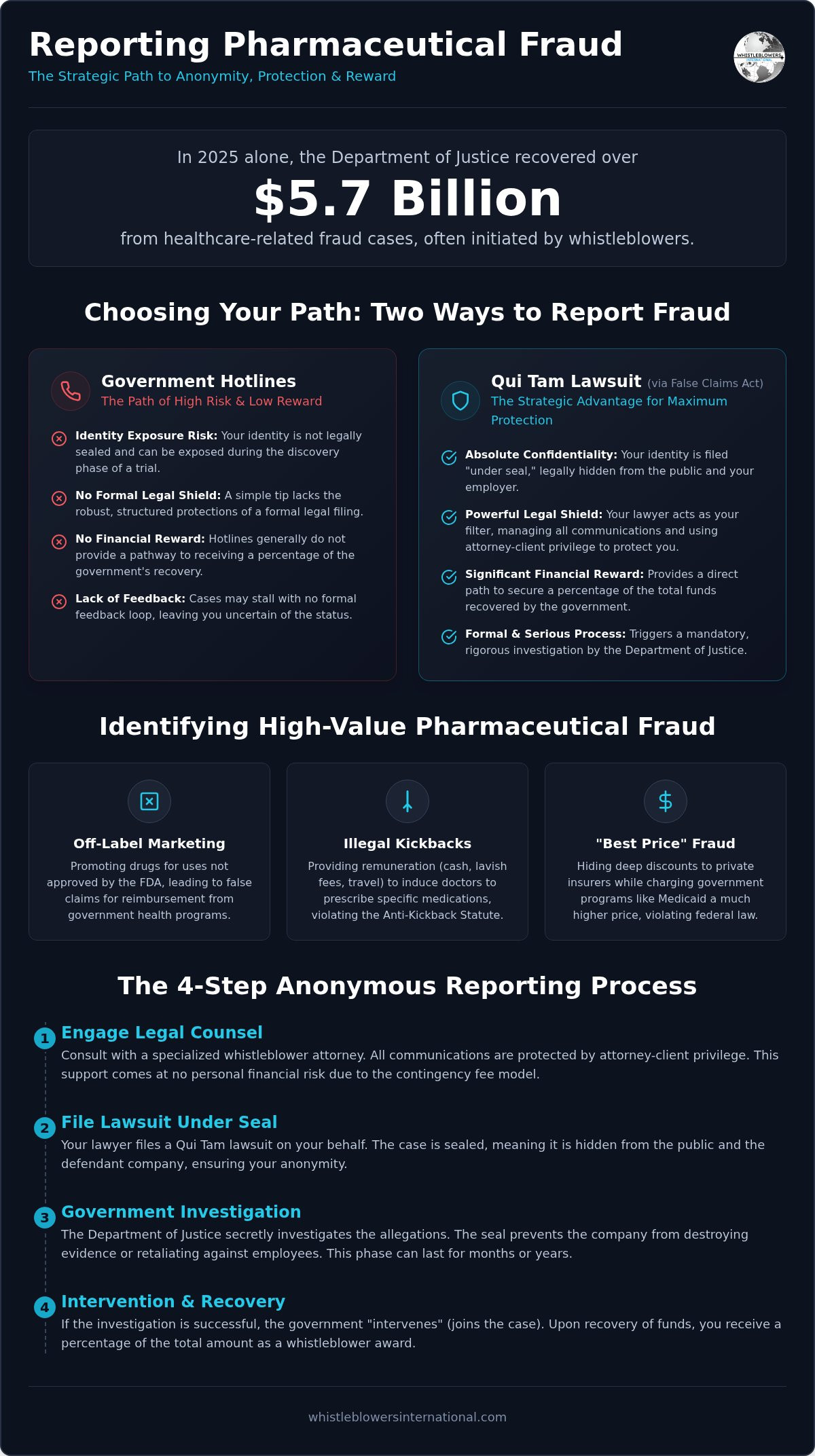
Reporting pharmaceutical fraud anonymously is often misunderstood as a simple, untraceable tip left on a government hotline. In reality, true anonymity is a structured legal process designed to protect your career while the government builds its case. If you provide information through a hotline, your identity may be exposed during the discovery phase of a trial. A formal legal filing provides a layer of protection that a phone call cannot match. When you prioritize reporting pharmaceutical fraud anonymously through legal channels, you gain access to protections that prevent your company from even knowing an investigation exists.
How a Lawyer Acts as Your Identity Shield
Your legal counsel serves as the formal relator on the public docket, effectively keeping your name out of the initial court records. Through the use of John Doe filings, your identity is known only to your legal team and the government’s investigative agents. It’s essential to understand how a whistleblower lawyer protects your identity by utilizing attorney-client privilege to shield all early disclosures. The firm acts as a filter, managing every communication with the Department of Justice so that your personal details never reach the pharmaceutical company’s defense team during the critical early stages.
Every Qui Tam case begins under seal, a mandatory period where the court file is hidden from the public and the defendant. This phase allows the government to investigate the claims without tipping off the pharmaceutical company. It prevents the company from destroying evidence or retaliating against employees while the fraud is still being validated. This period can last for months or even years, providing a significant window of safety for the whistleblower.
The Legal Framework of the False Claims Act
The False Claims Act serves as the gold standard for individuals looking to expose corporate wrongdoing. While other programs like those managed by the SEC or CFTC offer specific provisions for anonymity, the False Claims Act provides a direct pathway for individuals to initiate litigation on the government’s behalf. The Qui Tam provision allows a private citizen to sue on behalf of the government and, in 2026, remains the most effective mechanism for securing a portion of federal recoveries while ensuring the whistleblower is shielded from immediate public exposure. This framework ensures that your evidence is evaluated by the Department of Justice with the seriousness it deserves, moving beyond the limitations of anonymous hotlines that often lack a formal feedback loop.
Identifying High-Value Pharmaceutical Fraud: From Kickbacks to Off-Label Marketing
High-value fraud isn’t just about small clerical errors; it’s about systemic corporate strategies designed to inflate profits at the taxpayer’s expense. The U.S. Department of Justice focuses heavily on these cases because they represent the largest drain on public healthcare funds. One frequent mechanism is “Best Price” fraud. Under federal law, manufacturers must offer Medicaid the lowest price they give to any private customer. If a company hides deep discounts or rebates to private insurers while charging the government full price, they’ve violated the law. Reporting pharmaceutical fraud anonymously allows insiders to expose these complex accounting schemes without immediate career risk.
Kickbacks are another pillar of high-stakes fraud. These violate the Anti-Kickback Statute, which prohibits any remuneration to induce the referral of business. Remuneration isn’t just cash. It includes:
- Lavish speaking fees for “consulting” that involves no actual work.
- Expensive meals, travel, or entertainment disguised as educational seminars.
- Research grants that are contingent on prescribing specific medications.
Off-Label Marketing and Misbranding
While physicians can prescribe drugs for non-FDA-approved uses, pharmaceutical companies cannot legally promote them for those purposes. Corporate leadership often creates internal sales quotas that are impossible to meet through approved indications alone. This pressure forces sales reps to use illegal marketing tactics. Major settlements, such as the historic multi-billion dollar resolutions seen in the last few fiscal years, often stem from companies targeting vulnerable populations or promoting drugs for conditions they were never intended to treat.
Medicare and Medicaid Fraud Schemes
Institutional pharma sales often rely on a “spread” between what the government reimburses and what the provider actually pays. Manipulating this spread is a core component of reporting healthcare fraud to the government. In 2025, over $5.7 billion of federal recoveries were linked to healthcare fraud, much of it originating from these systemic overbilling practices. Elite firms use advanced data analytics to validate these claims, ensuring that the evidence is ironclad before it reaches the government. Identifying these patterns is the first step toward reporting pharmaceutical fraud anonymously and securing a relator’s award. If you’re observing these patterns, it’s wise to consult with an expert advocate who can evaluate the potential value of your evidence.
Government Hotlines vs. Qui Tam Filings: Choosing the Path to Maximum Protection
When an individual decides to move forward with reporting pharmaceutical fraud anonymously, they typically face a choice between two primary avenues: calling a government hotline or filing a formal Qui Tam lawsuit. While the option to Report a Problem to the FDA or the HHS-OIG may seem like the path of least resistance, it often lacks the robust protections and financial incentives provided by the False Claims Act. Government hotlines are frequently described as a “black hole” for information. Tips are ingested by intake clerks, but the whistleblower is rarely given a feedback loop or a status update on the investigation. This lack of transparency can leave you in a state of professional limbo, uncertain if your disclosures are being acted upon or if your identity is truly secure.
The Risks of the ‘Hotline’ Approach
Choosing the hotline approach carries significant legal and professional risks that are often downplayed. Without personal legal representation, you lack the protection of attorney-client privilege during your initial disclosures. If you speak directly to government agents, those statements aren’t shielded by a private advocate, making it much harder to maintain your anonymity if the investigation expands into broader discovery. Perhaps most critically, hotline tipsters aren’t recognized as formal “relators.” This means that even if your information leads to a multi-billion dollar recovery, you’re legally excluded from receiving a share of the proceeds, as the law only rewards those who file a formal complaint through the court system.
The Qui Tam Advantage
A Qui Tam filing transforms you from a mere tipster into a central partner in the government’s enforcement action. Under the False Claims Act, successful relators are entitled to an award of 15% to 30% of the government’s total recovery. This isn’t a discretionary gift; it’s a statutory right that acknowledges the personal and professional risks you’ve taken. If the government intervenes in the case, the award is typically between 15% and 25%. If the government declines to join and the whistleblower proceeds independently with their own counsel, the award can increase to a range between 25% and 30%.
Beyond the financial reward, the Qui Tam path provides access to elite investigative resources that a government intake clerk simply cannot match. An elite law firm brings a team of former federal prosecutors and strategic investigators to the table to do the heavy lifting required to validate your evidence. They present the case to the Department of Justice in a way that maximizes the chances of intervention. By reporting pharmaceutical fraud anonymously through a formal lawsuit, you ensure that the government is legally compelled to investigate your claims within a specific timeframe, providing a level of accountability that hotlines don’t offer. Understanding the full landscape of federal whistleblower reward programs can help you determine which legal avenue offers the strongest protections and highest potential compensation for your specific evidence.
The Step-by-Step Process for Reporting Fraud Anonymously
Success in reporting pharmaceutical fraud anonymously depends largely on speed and precision. Federal courts follow a strict “first to file” rule, meaning that only the first individual to bring a specific fraud to the government’s attention is eligible for a relator’s award. If a colleague or competitor files a similar claim just hours before you, your case may be dismissed regardless of the quality of your evidence. This creates a high-stakes environment where early intervention by specialized counsel is the most critical factor in securing your future. The same urgency applies across all forms of government contracting abuse; understanding how to report procurement fraud through the proper legal channels can be equally decisive when contractor misconduct intersects with pharmaceutical supply chains.
Gathering and Preserving Evidence
The foundation of any successful Qui Tam action is a robust evidentiary record. You must understand how to document corporate fraud without overstepping legal boundaries or violating trade secret protections. High-weight documents typically include internal emails discussing off-label promotion, spreadsheets showing price manipulation, and memos outlining kickback structures. You should store all digital evidence on a private, encrypted device that is never connected to your company’s network or hardware.
The Initial Consultation and Case Evaluation
Once you have identified a pattern of misconduct, the next step is a confidential evaluation with a battle-tested mentor. During your first meeting with Piacentile & Associates, we focus on determining the legal viability and potential financial value of the claim. This assessment moves beyond the surface-level facts to analyze whether the fraud has a direct impact on federal programs like Medicare or Medicaid. We’ll guide your transition from an employee to a protected whistleblower, ensuring that every move you make is shielded by attorney-client privilege.
The timeline for these cases often spans several years, making a methodical approach essential. After the initial filing, the case remains under seal while the government conducts its investigation, a process that requires patience and absolute discretion. By reporting pharmaceutical fraud anonymously through this structured legal framework, you protect your career while the investigative heavy lifting is handled by experts. If you are ready to evaluate the strength of your evidence, contact our team for a confidential case review.
Securing Your Future: How Elite Legal Representation Maximizes Whistleblower Awards
Reporting pharmaceutical fraud anonymously is a high-stakes endeavor that requires more than just legal knowledge; it demands a strategic partner who has navigated these waters from the inside. At Piacentile & Associates LLP, we operate on a contingency fee model, ensuring that elite advocacy remains accessible without any personal financial risk to the whistleblower. This structure aligns our interests perfectly. We only succeed if you secure an award. As your battle-tested mentor, we handle the investigative heavy lifting, deploying a global team to uncover the full scale of the corporate misconduct and maximize the potential settlement value.
Maximizing the Monetary Award
The difference between receiving the statutory minimum of 15% and the maximum of 30% of the government’s recovery often depends on the quality of the investigative work performed before the case is even filed. When the Department of Justice evaluates a case, they prioritize filings that provide a clear, data-driven roadmap of the fraud. Our firm’s role involves meticulously validating your evidence and negotiating directly with federal prosecutors to highlight the unique value of your contribution. If the fraud involves multi-jurisdictional operations, we leverage our global reach to ensure that every violation is accounted for, significantly increasing the total “pot” from which your percentage is calculated.
Several factors influence the final award percentage, including:
- The timeliness of the report and whether it preceded other filings.
- The extent to which the whistleblower’s counsel assisted the government’s investigation.
- The significance of the information in stopping ongoing harm to public health programs.
- The degree of personal risk and cooperation provided by the relator throughout the litigation.
Life After Whistleblowing
The resolution of a multi-year pharmaceutical fraud case is as much a psychological milestone as it is a financial one. While the financial reward provides a significant safety net, the transition to a post-whistleblower life requires careful planning and a formidable ally. We provide long-term career protection strategies and transition planning to ensure that your professional reputation remains intact. Having a mentor who understands the nuances of this industry from multiple angles offers a level of reassurance that goes beyond traditional legal advice. We focus on your privacy and success from the first consultation until the final award is distributed. If you are ready to take the next step toward justice and financial security, Contact Piacentile & Associates LLP for a confidential case evaluation.
Taking the First Step Toward Accountability and Security
Choosing to expose systemic corruption is a decision that defines a career. You’ve learned that reporting pharmaceutical fraud anonymously is not a matter of chance; it’s a meticulously managed legal process. By utilizing the False Claims Act and the mandatory seal period, you can trigger a federal investigation while your identity remains shielded from public view. This strategic approach ensures that you don’t have to choose between your integrity and your professional future.
Piacentile & Associates LLP offers a unique insider’s perspective, led by a former whistleblower who understands the gravity of your situation. We provide global investigative reach and elite advocacy on a contingency-based fee structure, meaning we only succeed when you do. If you’re ready to move from observation to action, it’s time to partner with a mentor who has navigated these high-stakes waters before. Secure your anonymity and start your claim with Piacentile & Associates. Your courage can stop the fraud and secure your future.
Frequently Asked Questions
Can I truly remain anonymous while reporting pharmaceutical fraud?
You can maintain total confidentiality by filing a Qui Tam lawsuit under seal with the assistance of legal counsel. This process ensures your identity is known only to your attorneys and the government while the case remains hidden from the pharmaceutical company and the public. Reporting pharmaceutical fraud anonymously through this structured legal shield prevents the defendant from learning of the investigation until the government decides to intervene or the seal is lifted.
What is the average reward for a pharmaceutical whistleblower in 2026?
Successful whistleblowers are entitled to an award ranging from 15% to 30% of the total government recovery. In fiscal year 2025, the Department of Justice recovered over $5.7 billion from healthcare fraud cases, illustrating the high stakes involved. If the government joins your case, you typically receive 15% to 25%; if you proceed with private counsel after a government declination, the award can increase to 25% or 30%. For a comprehensive breakdown of eligibility thresholds and award structures across all major programs, reviewing the latest guidance on federal whistleblower reward programs is an essential step before filing.
Do I need to still be employed by the company to report the fraud?
You don’t need to be a current employee to file a claim under the False Claims Act. Former employees, contractors, or even industry competitors often have the critical insider evidence required to initiate an investigation. As long as you possess original, non-public information regarding the fraudulent activity, you can seek a relator’s award. Early intervention is vital, as the “first to file” rule applies regardless of your current employment status.
What happens if my company retaliates against me for whistleblowing?
The False Claims Act provides robust legal protections against employer retaliation, including discharge, demotion, or harassment. If you’ve suffered adverse actions due to your whistleblowing, you may be entitled to “make whole” relief. This can include reinstatement with the same seniority status, two times the amount of back pay plus interest, and compensation for litigation costs and attorney fees. Your legal team will prioritize these protections to ensure your professional survival.
How long does a Qui Tam pharmaceutical fraud case typically take?
A typical pharmaceutical fraud case often spans three to five years from the initial filing to a final settlement or judgment. The mandatory seal period alone frequently lasts several months or years as the Department of Justice conducts a thorough investigation. Because these cases involve massive complexities and global operations, they require a patient, methodical approach. Your counsel handles the investigative heavy lifting throughout this duration to maintain the momentum of the case.
Can non-U.S. citizens report pharmaceutical fraud and receive a reward?
Non-U.S. citizens are eligible to report fraud and receive financial rewards under U.S. federal whistleblower programs. If the fraudulent activity impacts U.S. government funds, such as Medicare or Medicaid, the False Claims Act applies regardless of the whistleblower’s nationality or residency. We represent clients globally who have uncovered corruption within international pharmaceutical firms. Reporting pharmaceutical fraud anonymously is a viable path for any individual with credible evidence of theft from the American taxpayer.
What if I was partially involved in the fraudulent activity?
You can still file a claim even if you were involved in the fraud, provided you weren’t the primary architect or convicted of a crime related to the scheme. The court has the discretion to reduce the award percentage based on your level of involvement. However, coming forward as a whistleblower is often the most effective way to mitigate personal risk and ensure the corruption is stopped. We evaluate these nuances during your initial confidential case review.
Is there a deadline or statute of limitations for reporting pharma fraud?
A Qui Tam action must generally be filed within six years of the date the fraud occurred. In some circumstances, this can be extended to three years after the government knew or should have known the facts, but never more than ten years after the violation. Because the “first to file” rule is so strict, waiting can jeopardize your eligibility for an award. It’s essential to act as soon as you have documented the misconduct.