
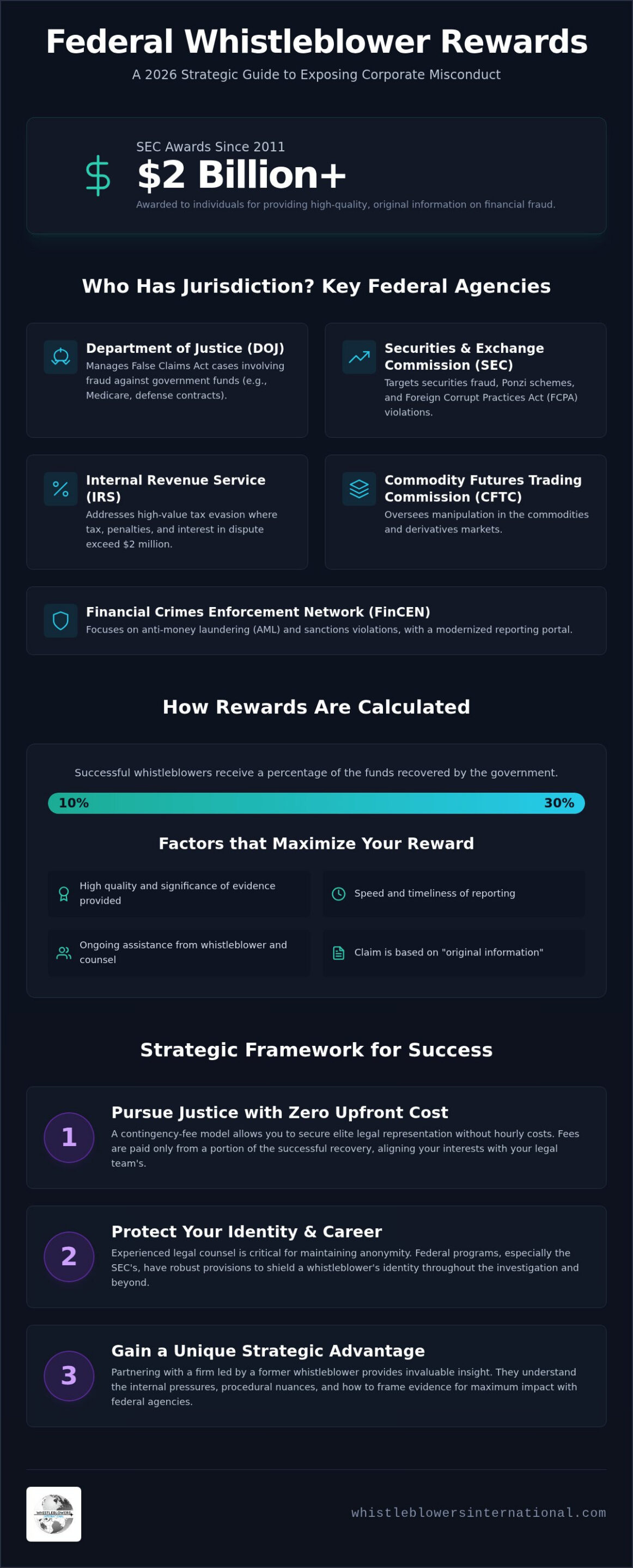
With over $2 billion awarded to individuals by the SEC since 2011, the financial incentive for exposing corporate misconduct via federal whistleblower reward programs has never been more substantial. You likely feel a profound sense of duty to report what you’ve seen, yet you’re also weighed down by the fear of professional retaliation and the uncertainty of which agency has jurisdiction over your claims. It’s a high-stakes environment where a single procedural error can disqualify even the most compelling evidence.
If you’re currently holding information regarding financial fraud, tax evasion, or money laundering, then understanding the nuances of these statutes is your first step toward protection and compensation. This 2026 guide provides the clarity required to move through this complex landscape with the confidence of a seasoned insider. We’ll examine the specific eligibility thresholds for programs like the SEC and the recently updated FinCEN portal; simultaneously, we’ll outline a strategic framework for securing elite legal representation to maintain your anonymity and maximize your potential recovery.
Key Takeaways
- Learn how the U.S. government leverages federal whistleblower reward programs to incentivize private citizens to uncover complex financial and corporate misconduct.
- Identify which specific federal agency, whether the SEC, IRS, or DOJ, has jurisdiction over your evidence to ensure your claim meets the necessary statutory requirements.
- Discover the critical factors, such as reporting speed and the quality of evidence, that determine whether your reward falls at the higher end of the 10% to 30% scale.
- Understand the importance of a contingency-fee model, which allows you to pursue high-stakes legal action without the burden of upfront hourly costs.
- Gain insight into how partnering with a firm led by a former whistleblower provides a unique strategic advantage in protecting your anonymity and professional future.
Understanding the Landscape of Federal Whistleblower Reward Programs
Federal whistleblower reward programs represent a strategic alliance between the United States government and private citizens. These frameworks are designed to incentivize the reporting of systemic fraud that might otherwise remain buried within corporate ledgers or complex institutional hierarchies. By offering a percentage of recovered funds, the government empowers individuals to step forward despite significant personal and professional risks. These individuals are often referred to as “relators” in False Claims Act litigation or “whistleblowers” when filing through specific agency programs.
Primary oversight for these actions is distributed across several key federal entities, each with distinct jurisdictional boundaries:
- Department of Justice (DOJ): Manages False Claims Act cases involving government funds.
- Securities and Exchange Commission (SEC): Targets securities fraud and Foreign Corrupt Practices Act (FCPA) violations.
- Internal Revenue Service (IRS): Addresses high-value tax evasion and underpayment.
- Commodity Futures Trading Commission (CFTC): Oversees commodities and derivatives market manipulation.
- Financial Crimes Enforcement Network (FinCEN): Focuses on anti-money laundering and sanctions violations.
The Incentive Structure: Why the Government Pays for Information
The government’s decision to pay for information is rooted in a pragmatic cost-benefit analysis. It’s often impossible for federal agencies to monitor every transaction in the massive U.S. economy; therefore, they rely on insiders to provide the investigative roadmap to the fraud. These rewards are not funded by taxpayer dollars. Instead, they’re paid directly from the sanctions and penalties collected from the wrongdoers. This self-sustaining model has been bolstered by the evolution of Whistleblower Protection in the United States, particularly through the modernization of the False Claims Act and the 2026 operational updates to the FinCEN portal.
Scope of Federal Programs: From Healthcare to Wall Street
The reach of federal whistleblower reward programs is extensive. In the healthcare sector, reports often focus on Medicare or Medicaid billing fraud and pharmaceutical kickbacks. Within defense contracting, relators uncover overcharges or substandard equipment. Financial programs, such as those run by the SEC and CFTC, target Ponzi schemes and market manipulation. More recently, increased focus has shifted toward anti-money laundering and sanctions violations. Additionally, customs and trade fraud involving the evasion of tariffs remains a high-priority area for federal enforcement, as the government seeks to protect domestic markets from illicit import practices.
Comparing Key Programs: SEC, IRS, and the False Claims Act
Selecting the correct venue for your disclosure is a strategic decision that dictates both your legal protections and your eventual recovery. While the False Claims Act remains the gold standard for fraud involving government expenditures, such as healthcare or defense billing, other federal whistleblower reward programs target specific market sectors. The SEC Whistleblower Program, for instance, focuses on securities fraud and Ponzi schemes, while the CFTC handles commodities manipulation. For those uncovering systemic tax evasion, the IRS Whistleblower Office manages claims where the tax, penalties, and interest in dispute exceed $2 million.
A sophisticated legal strategy often involves navigating overlapping jurisdictions. For example, a financial institution’s failure to maintain proper controls might trigger both SEC securities violations and FinCEN anti-money laundering sanctions. In such cases, filing under multiple programs can maximize the potential award. If you’re unsure which agency applies to your evidence, consulting with an experienced advocate can help clarify the path forward. You can discuss your specific scenario to determine which statutes offer the strongest leverage.
Eligibility and Thresholds for Federal Rewards
To qualify for a mandatory award, your disclosure must consist of “original information.” This means the evidence cannot be derived from public sources like news reports or judicial hearings unless you are the primary source of that data. Additionally, specific monetary thresholds apply. While the SEC and FinCEN require enforcement actions to result in sanctions exceeding $1 million, the IRS generally requires the amount in dispute to exceed $2 million. For individual tax cases, the taxpayer’s gross income must also exceed $200,000 for at least one year in question. You should also be aware that while some programs encourage internal reporting, it is not always a strict prerequisite for eligibility.
Anonymity and Protection Differences Across Agencies
Anonymity is a primary concern for most whistleblowers. The SEC and CFTC programs allow you to file anonymously through legal counsel, ensuring your identity remains shielded from the agency and the public throughout the investigation. Conversely, False Claims Act lawsuits are filed “under seal,” meaning the complaint is hidden from the defendant while the government investigates. While this provides temporary privacy, your identity may eventually become public if the case proceeds to litigation. Regardless of the program, federal law provides robust anti-retaliation protections to shield you from workplace blowback, though these protections are most effective when invoked by a seasoned legal team.
Evaluating Your Claim: How Rewards are Calculated
The determination of a reward is not a fixed calculation but a discretionary range. Most federal whistleblower reward programs operate within a statutory bracket of 10% to 30% of the total government recovery. For instance, the IRS Whistleblower Office typically awards between 15% and 30% when the collected proceeds exceed $2 million. The specific percentage often depends on the level of “substantial contribution” the whistleblower provides to the investigation. It’s a high-stakes negotiation where the quality of your counsel directly impacts the final figure.
Government agencies evaluate several criteria to move an award from the minimum to the maximum threshold. High-quality, non-public evidence that leads directly to a successful enforcement action is the most significant factor. Assistance provided during the investigation, such as clarifying technical jargon or identifying key witnesses, also pushes the percentage higher. If you delayed reporting the misconduct or were personally involved in the underlying fraud, the agency may reduce the award. Speed is of the essence; being the first to file is often a prerequisite for eligibility in these competitive programs.
Maximizing the Value of Your Evidence
Your ability to secure a maximum reward depends on the precision of your initial disclosure. The government prioritizes information that is specific, timely, and credible. Vague allegations without supporting documentation rarely lead to successful interventions. To build a formidable case, you must learn how to document corporate fraud effectively before the evidence is altered or destroyed. This investigative groundwork is where elite legal counsel provides the most value, transforming raw observations into a structured legal complaint that demands agency attention.
The Timeline of a Federal Whistleblower Case
Patience is a requirement for anyone entering this process. Federal investigations are thorough and often span several years. Once you file, the government must decide whether to “intervene” in the case. An intervention significantly increases the likelihood of a successful recovery, though you can still proceed independently in certain programs if the government declines. Throughout this multi-year journey, your lawyer acts as your strategic shield, managing communications with federal agents and ensuring that the final award percentage reflects the true value of your contribution during settlement negotiations.
Securing Legal Help for Reporting Fraud: A Selection Framework
The choice of a legal partner is the most consequential decision a whistleblower makes. While many firms claim to handle federal whistleblower reward programs, few possess the specialized resources to conduct a comprehensive investigative audit before the government ever sees the case. You should prioritize firms that operate on a contingency fee basis. This model ensures the firm’s interests are perfectly aligned with yours; they only receive compensation if you successfully secure a reward. If a firm requests hourly fees or upfront retainers, they’re likely unequipped for the high-stakes, long-term nature of these proceedings.
Domain-specific knowledge is equally vital. A firm that understands the technical intricacies of medicare fraud will navigate different regulatory hurdles than one focused on pharmaceutical fraud. Similarly, if your evidence involves a contractor inflating invoices or misrepresenting compliance on a government project, understanding how to report procurement fraud through the correct federal channels is essential to protecting your claim. You need a battle-tested mentor who understands the “insider” perspective, ideally led by someone who has walked this path themselves. This unique perspective allows the firm to anticipate government inquiries and corporate defense strategies with surgical precision.
Questions to Ask Your Potential Whistleblower Attorney
Before committing to representation, you must conduct your own due diligence. These questions reveal whether a firm has the elite infrastructure required to handle massive complexities while protecting your individual privacy:
- How many cases have you successfully settled with the DOJ, SEC, or other federal agencies?
- What specific, battle-tested protocols do you use to maintain my anonymity during and after the filing?
- Do you have former government investigators or individuals who have served as whistleblowers on your staff?
The Strategic Advantage of Specialized Counsel
General employment lawyers often lack the tactical depth needed for federal reward programs. While they may understand retaliation laws, they frequently struggle to “package” a complex fraud case in a way that compels government intervention. An elite firm acts as a strategic investigator, uncovering and validating evidence to present a trial-ready case to the DOJ or SEC. This preparation is the primary driver of successful outcomes. You can learn more about how a whistleblower lawyer protects your identity to understand the defensive measures available to you throughout this process.
If you’re ready to evaluate your evidence with a firm that understands the high stakes of your journey, contact our team for a confidential assessment of your claim.
Partnering with Piacentile & Associates for Strategic Advocacy
The efficacy of your claim depends on more than just the evidence you possess; it relies on the strategic depth of the advocate you choose. Piacentile & Associates LLP is an elite firm defined by a unique insider’s perspective. Led by Dr. Joseph Piacentile, a former whistleblower and attorney, we understand the professional gravity and personal risks inherent in these actions. We don’t just provide legal advice; we act as a battle-tested mentor for individuals navigating the most complex federal whistleblower reward programs available today.
Our firm functions as a strategic investigative powerhouse. While many practitioners simply file existing documents, we conduct rigorous forensic audits to uncover and validate fraud that others frequently miss. This methodical preparation ensures that when your case is presented to federal authorities, it is structured to command immediate scrutiny. We possess the global reach necessary to represent individuals worldwide in U.S. federal actions, ensuring that geographic boundaries don’t limit your ability to report misconduct occurring within the American financial or governmental systems.
We operate on a commitment rooted in mutual success. By utilizing a contingency fee model, we ensure that our firm only receives compensation if you successfully secure a reward. This structure removes the financial barriers to high-level legal representation, allowing you to focus on the integrity of your claim without the burden of hourly costs. It is a high-stakes partnership where our resources are fully deployed to protect your anonymity and maximize the results of your disclosure.
Our Success in Federal Whistleblower Actions
Our investigative expertise spans the full spectrum of federal oversight. We maintain a dedicated team focused on client privacy while pursuing proven results in diverse sectors. Our history includes significant work in defense contractor fraud and cases involving commodities manipulation. Whether your evidence pertains to the False Claims Act, the SEC, or the evolving FinCEN program, we possess the technical terminology and procedural knowledge required to navigate these distinct jurisdictions effectively.
Take the First Step Toward a Federal Reward
If you’re holding information regarding systemic fraud, the window for reporting is often narrow. We provide confidential consultations to evaluate the strength of your evidence and determine the most viable path toward a reward. This process is designed to be accessible and secure, prioritizing your professional future at every stage. You don’t have to face the complexities of federal litigation alone. Contact Piacentile & Associates LLP for a confidential case evaluation to begin the process of securing the protection and compensation you deserve.
Securing Your Future Through Strategic Advocacy
The landscape of federal whistleblower reward programs offers a path toward justice and financial security for those with the courage to report systemic misconduct. Success in these high-stakes actions requires more than just evidence; it demands a strategic alignment with the specific statutory requirements of agencies like the SEC, IRS, or DOJ. By identifying the correct jurisdiction and documenting fraud with investigative precision, you maximize your potential for a maximum award while shielding yourself from professional retaliation.
Piacentile & Associates LLP provides the elite representation necessary to navigate these complexities. Led by Dr. Joseph Piacentile, a former whistleblower who understands your journey from an insider’s perspective, our firm offers a global reach for U.S. federal claims. We operate on a strictly contingency-based model, which means we only win when you do. This ensures that our interests are perfectly aligned with your success and protection throughout the multi-year investigative process.
Take the first step toward protecting your integrity and your future. We invite you to secure a confidential case evaluation with Piacentile & Associates to discuss the strength of your evidence. You don’t have to walk this path alone.
Frequently Asked Questions
How much is the average reward for a federal whistleblower?
Whistleblower rewards are calculated as a percentage of the government’s total recovery, typically ranging from 10% to 30%. Payouts vary based on the scale of the fraud; however, the SEC has awarded over $2 billion to 444 individuals since 2011. The final amount depends on the quality of your evidence and the level of cooperation you provide during the ensuing investigation. High-value cases often result in multi-million dollar rewards.
Can I report fraud anonymously to the government?
You can report fraud anonymously to agencies like the SEC and FinCEN, provided you’re represented by legal counsel. This allows your attorney to submit information on your behalf without disclosing your identity to the government during the initial phases. Under the False Claims Act, cases are filed “under seal.” This keeps your identity hidden from the defendant while the DOJ conducts its preliminary investigation, though your name may eventually become public if litigation proceeds.
Is it possible to receive a reward if I was involved in the fraud?
It’s possible to receive a reward even if you had a minor role in the misconduct, though your percentage may be reduced. Federal agencies use their discretion to decrease awards for individuals who participated in the underlying fraud. However, if you planned or initiated the illegal scheme, you’ll likely be disqualified entirely. Seeking legal advice is critical to evaluate how your specific actions impact your eligibility for federal whistleblower reward programs.
How long does a federal whistleblower case typically take?
Federal whistleblower cases are complex and frequently take several years to reach a resolution. The process involves a thorough government investigation followed by potential litigation or settlement negotiations. While some SEC awards were issued as recently as April 2026, the average duration from filing to payout often spans three to five years. Patience is essential as federal agencies verify every detail of your disclosure and navigate the judicial system.
What happens if the government decides not to intervene in my case?
If the government declines to intervene in a False Claims Act case, you still have the legal right to pursue the litigation independently. In this scenario, your potential reward percentage actually increases, often ranging from 25% to 30% of the recovery. While proceeding without government support is more challenging, an elite legal team with deep investigative resources can still secure a successful outcome on your behalf through private litigation.
Can non-U.S. citizens apply for federal whistleblower rewards?
Non-U.S. citizens are eligible to apply for federal whistleblower reward programs if the fraud has a sufficient nexus to U.S. markets or government funds. Many programs, including those managed by the SEC and CFTC, provide worldwide representation for individuals reporting violations of U.S. law. In scenarios where whistleblowing involves cross-border legal complexities, such as financial crimes in South America, consulting an abogado penalista experto chile can provide the necessary criminal defense expertise to navigate local statutes. The focus remains on the integrity of the information provided rather than the nationality or residency of the person reporting the misconduct to federal authorities.
Do I need a lawyer to file a whistleblower claim?
While you aren’t strictly required to have a lawyer for all programs, filing through an attorney is the only way to remain anonymous in SEC and FinCEN actions. Beyond privacy, specialized counsel is necessary to “package” your evidence according to complex statutory requirements. An experienced advocate ensures your claim isn’t dismissed on a technicality and helps maximize the final reward percentage through strategic negotiation with federal enforcement agencies.
What types of evidence are most valuable in a whistleblower case?
The most valuable evidence consists of specific, non-public documents that clearly demonstrate a pattern of systemic fraud. This includes internal emails, financial ledgers, spreadsheets, and memos that name specific individuals involved in the misconduct. Agencies prioritize “original information” that they couldn’t have obtained through public sources. Providing a clear roadmap of how the fraud was executed significantly increases the likelihood of a successful and rewarded enforcement action.