

Choosing to expose systemic fraud shouldn’t require you to mortgage your future just to pay for an attorney’s time. You’ve likely realized that the most formidable barrier to uncovering corporate misconduct isn’t the complexity of the evidence (which is often vast); it’s the paralyzing fear that seeking justice will result in personal financial ruin. A whistleblower lawyer contingency fee transforms this dynamic by shifting the entire financial burden of litigation onto the law firm. This model ensures that elite legal representation remains accessible; if the government recovers funds based on your information, then and only then does the firm receive a portion of the reward.
It’s understandable to feel overwhelmed by the prospect of facing a massive corporation while your own livelihood hangs in the balance. We’ll show you how a structured contingency agreement aligns your legal team’s investigative depth with your potential reward from programs like the SEC or the IRS. This guide provides a comprehensive look at how these fee structures work in 2026. You’ll learn how to evaluate different agency reward percentages, protect yourself from unexpected costs, and leverage a partnership that prioritizes your protection and success.
Key Takeaways
- Learn how a whistleblower lawyer contingency fee removes the barrier of hourly billing and creates a strategic partnership based on results.
- Understand how reward ranges for federal programs like the False Claims Act and SEC are determined by the quality of your evidence and your attorney’s advocacy.
- Explore fee-shifting provisions that may require the defendant to pay your legal costs, which keeps more of the recovery in your pocket.
- Clarify the distinction between attorney fees and advanced litigation expenses to ensure you’re protected from financial liability throughout the process.
- Recognize why investigative depth and a firm’s internal expertise are the most critical factors in maximizing your final reward percentage.
What is a Whistleblower Lawyer Contingency Fee?
A whistleblower lawyer contingency fee is a performance-based arrangement that replaces the traditional billable hour with a success-driven model. Under this structure, an attorney’s compensation is entirely dependent on securing a financial reward for the client from a government agency. If the legal team fails to recover funds, the client owes nothing for the professional time invested in the case. This “no-win, no-fee” guarantee is the bedrock of whistleblower litigation, as it allows individuals to pursue justice against massive entities without the fear of accumulating unmanageable legal debt.
This model functions as a complete transfer of financial risk from the individual to the law firm. Investigative efforts in these cases are often exhaustive, requiring the analysis of complex financial records and the preparation of detailed disclosure statements. By operating on contingency, the firm assumes the cost of this labor and the risk that the government may decline to intervene. This creates a powerful alignment of interests; your legal team is naturally motivated to maximize the final reward because their own success is inextricably linked to yours.
The Mechanics of a Contingency Fee Agreement
A standard whistleblower contract clearly outlines the percentage of the final recovery that will be allocated to the legal team. While traditional firms might charge by the hour, creating a perverse incentive to prolong proceedings, a contingency agreement prioritizes efficiency and results. These contracts also address “market rates,” which are the standard hourly values used by courts to calculate additional fees that a losing defendant might be ordered to pay. In high-stakes qui tam actions, hourly billing is rarely appropriate because it places an unsustainable financial burden on the whistleblower while providing no guarantee of a successful outcome.
Why Whistleblower Law Favors Contingency Models
The legal framework surrounding fraud recovery is designed to encourage “Private Attorneys General” to step forward. These are private citizens who act on behalf of the government to uncover misconduct that would otherwise remain hidden. Contingency models are essential to this mission for several reasons:
- Equalizing Power: It levels the playing field, allowing a single individual to command the same level of elite legal firepower as a multi-billion dollar corporation.
- Access to Justice: It ensures that the strength of your evidence, rather than your personal net worth, determines your ability to secure high-level representation.
- Mission Alignment: It focuses the legal strategy on uncovering the maximum amount of fraud, which serves both the public interest and the whistleblower’s potential reward.
By removing the barrier of entry, the whistleblower lawyer contingency fee ensures that the most significant cases of corporate fraud are brought to light by those best positioned to see them, regardless of their financial circumstances.
Reward Percentages and Fee Structures Across Federal Programs
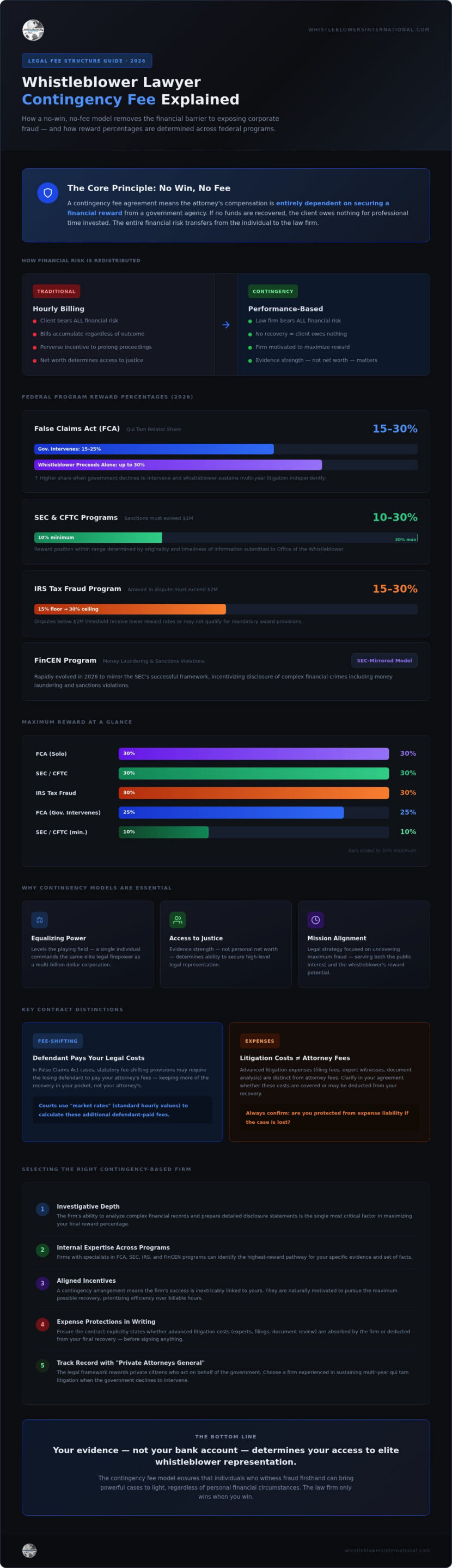
The statutory framework governing whistleblower rewards varies significantly between federal agencies. While the False Claims Act (FCA) typically offers a relator’s share between 15% and 25% in intervened cases, this can rise to 30% if the government declines to join and the whistleblower proceeds independently. In these high-stakes scenarios, a whistleblower lawyer contingency fee ensures that the individual has the investigative resources required to sustain a multi-year litigation effort without personal financial exposure.
The SEC and CFTC programs operate under a different mandate, providing 10% to 30% of collected sanctions when those sanctions exceed $1 million. The Office of the Whistleblower evaluates the originality and timeliness of the information when determining where a case falls within that bracket. IRS tax fraud cases follow a similar 15% to 30% structure, provided the amount in dispute exceeds $2 million. For those reporting money laundering or sanctions violations, the FinCEN program has evolved rapidly in 2026, mirroring the SEC’s successful model to incentivize the disclosure of complex financial crimes.
Factors Influencing the Attorney’s Percentage Share
The specific percentage agreed upon in a contingency contract is not arbitrary. It reflects the level of risk and labor the firm must commit to the matter. Several key variables typically determine the final structure:
- Complexity and Evidence: Cases involving intricate fraud schemes that require forensic accounting or extensive data analysis demand more firm resources.
- Litigation Duration: If a case is expected to last five to ten years, the firm must have the financial resilience to carry all operational costs for that decade.
- Risk of Dismissal: The firm evaluates the likelihood of government intervention and the potential for the case to be dismissed before reaching a settlement.
International Considerations for Global Whistleblowers
One of the most powerful aspects of the US system is its extraterritorial reach. Foreign nationals who uncover fraud against US programs are often eligible for the same reward structures as domestic citizens. This is particularly relevant for the SEC whistleblower program for non-US citizens 2026, which continues to attract high-level disclosures from across Europe, Asia, and South America. Navigating the complexities of US federal law under a whistleblower lawyer contingency fee arrangement allows international whistleblowers to pursue justice without worrying about cross-border legal fees or currency fluctuations. If you are considering reporting misconduct from abroad, it is vital to discuss your case with an experienced investigator who understands the nuances of global filings.
The False Claims Act and Statutory Fee-Shifting Provisions
The False Claims Act (FCA) provides a unique financial protection mechanism known as fee-shifting. This provision requires a defeated defendant to pay the whistleblower’s legal fees directly, which is a separate obligation from the actual settlement or judgment amount. It ensures that the costs of elite representation don’t solely deplete the whistleblower’s reward. By shifting the financial burden to the entity that committed the fraud, the law protects the integrity of the whistleblower’s personal recovery.
Understanding the distinction between the “Relator’s Share” and “Statutory Fees” is crucial for any potential client. The relator’s share is your specific percentage of the funds recovered by the government. Statutory fees are the hourly costs calculated for the professional work performed during the case. When a whistleblower lawyer contingency fee agreement is structured correctly, these statutory fees can often be used to offset the firm’s percentage. This strategic arrangement potentially increases your net recovery, ensuring you retain a larger portion of the final award.
How Fee-Shifting Works in Successful Qui Tam Settlements
In successful settlements, attorney fees are typically negotiated as a distinct line item. Courts use a “lodestar” calculation to determine these fees, multiplying the number of hours reasonably spent on the litigation by a reasonable hourly rate. In 2026, the Laffey Matrix remains a vital benchmark for determining these rates in complex federal litigation. For example, a government contract fraud lawyer will meticulously document every hour spent investigating procurement fraud to ensure these costs are fully recoverable from the defendant. This methodical approach protects your award from being unnecessarily reduced by legal expenses.
Maximizing the Award Through Strategic Lawyering
The quality of your legal representation directly influences whether the Department of Justice decides to join your action. This decision is paramount. Intervention is the critical turning point in a False Claims Act case because it signifies the government’s commitment to the litigation. Statistics consistently show that cases with government intervention result in higher success rates and often command reward percentages at the higher end of the statutory scale. Elite firms focus on building an undeniable evidentiary package that makes intervention the logical choice for federal prosecutors, thereby maximizing both the recovery and the subsequent reward.
Litigation Expenses vs. Attorney Fees: What You Need to Know
It’s essential to recognize that the professional labor of your legal team and the tangible costs of a lawsuit are two distinct financial categories. While a whistleblower lawyer contingency fee covers the thousands of hours spent on legal strategy and advocacy, “litigation expenses” represent the actual out-of-pocket costs required to move a case through the federal court system. These include court filing fees (currently $405 for a federal civil action in 2026), deposition transcript costs, and travel for investigative interviews. Most elite firms operate on an “advanced costs” model, where the firm pays these expenses as they arise so the whistleblower doesn’t face a monthly bill for expert consultations or database access.
If the case is unsuccessful, the firm typically absorbs these advanced costs, which reinforces the “no-risk” nature of the partnership. However, you should always verify this provision in your specific agreement to ensure you aren’t liable for costs in the event of a dismissal. To keep these investigative costs manageable and improve your case’s viability from the start, we recommend reviewing our how to document corporate fraud guide, which helps you gather evidence efficiently.
Common Out-of-Pocket Costs in High-Stakes Fraud Cases
Specialized fraud cases require specialized testimony. For instance, a medicare fraud lawyer must often hire medical billing experts or former agency auditors to prove systemic overcharging. Modern litigation also involves terabytes of data; electronic discovery (e-discovery) platforms and forensic data analysis are expensive but necessary to uncover the digital trail of misconduct. Additionally, court-mandated mediation or arbitration involves neutral third-party fees that the firm must advance to keep the case moving toward a resolution.
Transparency in Expense Reporting
Transparency is the foundation of a successful legal partnership. Your legal team should maintain a rigorous ledger of all advanced costs and provide periodic reports so you understand the financial resources being deployed on your behalf. These expenses are reimbursed from the final settlement or reward before the net award is distributed to you. When you are evaluating a potential firm, you should ask these specific questions about their expense policy:
- Do you advance all litigation costs, or will I be billed for certain items?
- Am I responsible for reimbursing advanced costs if we don’t win the case?
- How often will I receive an itemized report of the expenses incurred?
A firm’s willingness to assume these costs is a strong indicator of their confidence in your evidence. If you’re ready to have your evidence reviewed by a team that assumes the full financial risk of litigation, contact us for a confidential case evaluation.
Selecting the Right Contingency-Based Whistleblower Firm
Selecting a firm based solely on the lowest percentage is a strategic error that can compromise the outcome of your case. The true value of a whistleblower lawyer contingency fee arrangement lies in the firm’s capacity to survive a war of attrition against corporate legal departments. You need a partner who possesses the investigative depth to turn raw data into a compelling narrative for government investigators. A firm’s track record with specific agencies, such as the SEC or FinCEN, serves as a critical indicator of their ability to navigate the unique procedural requirements and evidentiary standards of those specific programs.
Because privacy is often the paramount concern for individuals facing significant professional risks, a firm must have robust protocols to ensure your identity is protected during the initial filing and subsequent government interactions. You can explore the how a whistleblower lawyer protects your identity guide to understand the specific legal safeguards that shield your personal and professional reputation from retaliation. These protections are not automatic; they require a legal team that understands how to utilize anonymous filing provisions where available.
The Piacentile & Associates Advantage
By leveraging a team that includes former whistleblowers, we bring a unique perspective to this field because we’ve stood exactly where you are standing now. This battle-tested mentality means we don’t just understand the law from a theoretical standpoint; we understand the strategic and emotional complexities of the entire process. Whether you’re reporting from within the United States or acting as a global whistleblower uncovering fraud against US programs, our firm provides the international reach and technical expertise required for high-stakes litigation. We maintain an unwavering commitment to integrity and client privacy, ensuring that every case we accept meets the rigorous standards required to secure government intervention.
Next Steps: Initiating a Confidential Consultation
Initiating a confidential consultation is the first step toward securing your reward and your future. Before your first meeting with a contingency lawyer, you should organize your evidence chronologically and identify key witnesses or internal documents that support your claim. Remember that attorney-client privilege applies even during this initial evaluation phase, providing a safe environment to discuss sensitive information without fear of disclosure. This phase is about more than just checking boxes; it’s about evaluating if the firm has the strategic vision to maximize your reward. If you’re ready to align your case with a team that possesses the investigative depth and real-world experience to succeed, contact Piacentile & Associates for a confidential case evaluation.
Securing Your Financial Future Through Strategic Partnership
Exposing systemic fraud requires more than just courage; it demands a legal strategy that protects your livelihood while pursuing maximum recovery. We’ve explored how a whistleblower lawyer contingency fee eliminates the threat of hourly billing, ensuring that elite representation is accessible regardless of your current financial standing. By leveraging fee-shifting provisions and the specific reward structures of federal programs, you can focus on the integrity of your evidence while your legal team assumes the full financial risk of the investigation.
At Piacentile & Associates, we offer pure contingency-based representation led by former whistleblowers who understand the gravity of your decision. Our team possesses the investigative depth required for multi-billion dollar fraud recoveries, providing you with a battle-tested mentor throughout this complex process. Secure Your Elite Legal Advocate—Schedule a Confidential Consultation
You don’t have to face corporate giants alone. With the right partnership, you can turn your insider knowledge into a powerful instrument for justice and secure the reward you deserve. Your path to accountability starts with a team that is as invested in the outcome as you are.
Frequently Asked Questions
Do I have to pay anything upfront to hire a whistleblower lawyer?
No, you do not pay upfront when working with a firm on a pure contingency basis. The firm assumes the total financial risk of the investigation and litigation, providing you with elite legal representation at no initial cost. If the case does not result in a government recovery or a whistleblower reward, you are not responsible for the professional hours invested in your matter. This ensures that the strength of your evidence, rather than your personal bank account, dictates your access to justice.
What is the standard percentage for a whistleblower contingency fee in 2026?
Standard percentages are negotiated based on the anticipated complexity and the level of risk the firm assumes. While the specific whistleblower lawyer contingency fee varies by case, it always represents a portion of the final reward recovered from the government. Factors such as the volume of evidence and the projected duration of the litigation influence these rates. A transparent agreement will clearly define how this share is calculated before you sign any contract.
What happens if my whistleblower case is dismissed?
If your case is dismissed, you generally owe nothing for the professional services provided by your legal team. The firm absorbs the loss of its time and labor as part of the contingency risk. This protective structure ensures that whistleblowers aren’t left with massive legal debts after a failed litigation attempt. It’s a fundamental aspect of the “no-win, no-fee” model that aligns the firm’s success directly with your own.
Are litigation expenses different from attorney fees?
Yes, litigation expenses and attorney fees are distinct categories within a legal contract. Attorney fees represent the payment for the firm’s professional time and expertise. Expenses cover tangible costs like the $405 federal filing fee, expert witness testimony, and forensic data analysis. Most contingency firms advance these costs during the life of the case and seek reimbursement only from the final settlement or reward, protecting you from out-of-pocket liabilities.
Can I hire a US whistleblower lawyer if I live outside the United States?
You can absolutely hire a US-based firm if you live abroad, provided your information concerns fraud against US government programs. Agencies like the SEC and FinCEN have global jurisdiction and frequently issue rewards to international whistleblowers. Working with a US firm on a contingency basis allows you to navigate complex federal laws without worrying about international legal bills or currency exchange risks. Your location is not a barrier to seeking justice.
Does the government pay my attorney’s fees in a False Claims Act case?
The government does not pay your attorney’s fees; however, the False Claims Act requires the defendant to pay them if you win. This is known as a fee-shifting provision. These statutory fees are calculated separately from your whistleblower reward and are paid by the entity that committed the fraud. In many cases, these court-ordered fees can help cover the firm’s costs, which may increase the net amount you personally receive from the recovery.
Can I switch lawyers if I’m unhappy with the contingency agreement?
You have the right to switch legal counsel, but you must carefully review the termination clause in your existing agreement first. If you move to a new firm, your previous lawyer may be entitled to a portion of the final fee for the work they already performed. This is often handled through a legal lien on the eventual recovery. It’s vital to discuss these implications with a new attorney before making any formal changes to your representation.
How do I know if my evidence is strong enough for a contingency firm to take the case?
Strong evidence typically consists of specific, non-public documents or data that prove systemic misconduct rather than an isolated error. A contingency firm evaluates your case by looking for original information that the government hasn’t already discovered. They also assess the likelihood of government intervention, as this is the primary driver of successful outcomes. If your evidence can clearly demonstrate a significant loss to the government, it’s likely strong enough for a formal evaluation.