
While many potential whistleblowers believe a trial attorney’s courtroom record is the most critical factor, the reality is that the success of a False Claims Act case is often determined long before a judge hears the first motion. You’re likely facing immense pressure, balancing the moral imperative to report fraud with the very real fear of workplace retaliation or the concern that the government won’t intervene in your case. Understanding what to look for in a qui tam attorney requires moving beyond basic litigation skills to find a partner who operates as a high-level investigator; someone capable of translating complex corporate malfeasance into a compelling narrative for federal authorities.
If you choose an advocate who lacks a deep understanding of federal oversight (the specific mechanisms the Department of Justice uses to validate evidence), your claim may languish under seal without the momentum it deserves. We promise to help you identify the essential criteria for selecting a battle-tested mentor who can navigate labyrinthine filing requirements while safeguarding your professional future and anonymity. This guide provides a methodical framework for evaluating legal counsel, ensuring your evidence receives the scrutiny it needs to secure a significant recovery in 2026’s increasingly complex legal environment.
Key Takeaways
- Understand why your legal counsel acts as the critical gatekeeper to the Department of Justice, where the precision of your initial disclosure determines if the government will intervene.
- Learn exactly what to look for in a qui tam attorney by prioritizing firms with multi-program expertise across the SEC, IRS, and FinCEN to ensure your evidence is filed in the correct jurisdiction.
- Discover why an elite whistleblower firm must function as an investigative powerhouse, utilizing specialized techniques to validate your claims before they reach federal authorities.
- Identify the specific questions you must ask during a consultation to verify an attorney’s direct experience with complex federal filing requirements and successful recovery history.
- Gain a strategic “insider perspective” on how a battle-tested mentor can maximize your potential award while prioritizing your professional anonymity and protection from retaliation.
Why Your Choice of Qui Tam Attorney Determines Your Case Outcome
The decision to initiate a Qui tam legal action is one of the most consequential choices a professional can make. Your attorney serves as the primary gatekeeper between your evidence and the Department of Justice (DOJ). They don’t just file paperwork; they translate your observations into a legal framework that federal investigators can act upon. If you’re wondering what to look for in a qui tam attorney, start with their ability to build a bridge to the government. A poorly drafted disclosure statement (the document outlining your evidence) often leads to immediate dismissal, leaving you exposed to workplace retaliation without the protection of an active case.
The “First to File” rule adds a layer of intense pressure. Under this rule, only the first person to file a claim regarding a specific fraud is eligible for a reward. However, rushing to file with an inexperienced firm is a dangerous gamble. Speed must be balanced with meticulous evidence validation. If your filing is premature or lacks investigative depth, you risk losing your “original source” status. This choice carries heavy emotional weight. Selecting the wrong firm can result in career-ending consequences while the fraud continues unchecked.
The Critical Link Between Legal Counsel and DOJ Intervention
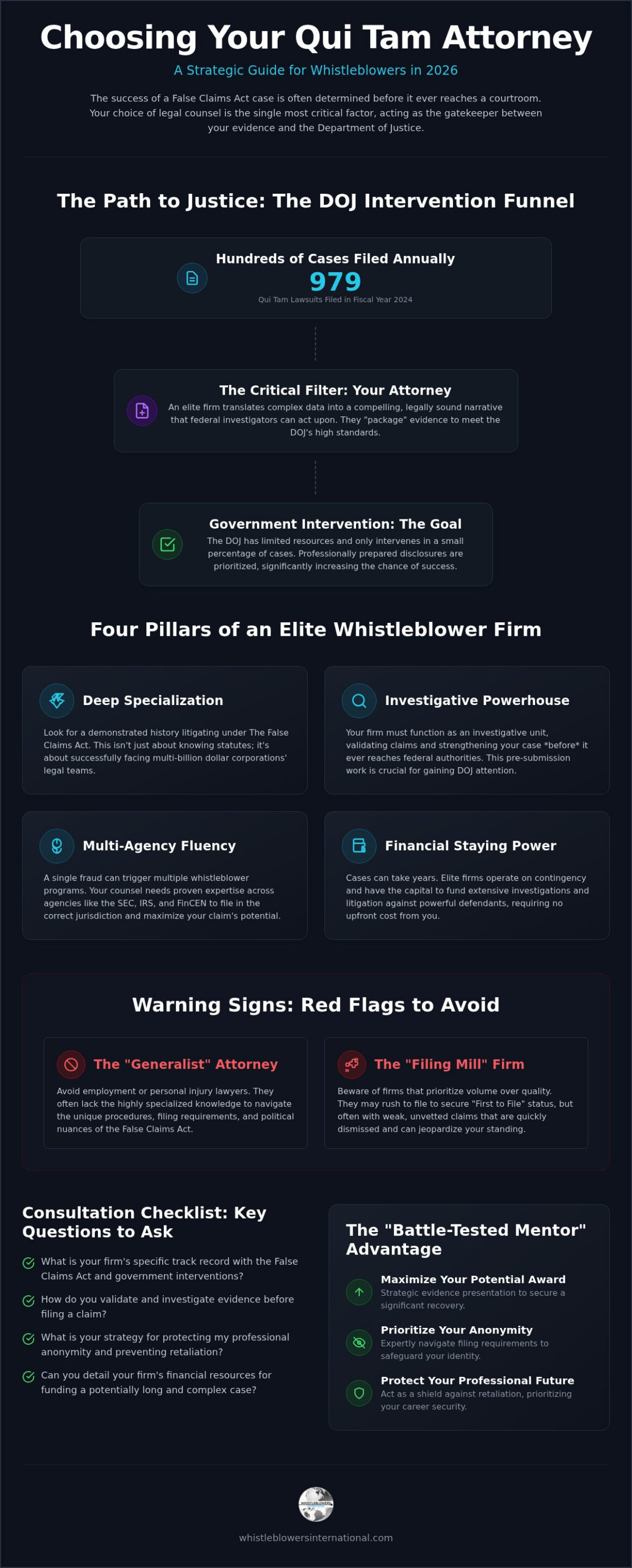
The DOJ only intervenes in a small percentage of the hundreds of cases filed each year. In fiscal year 2024, for instance, a record 979 qui tam lawsuits were filed, but the government’s resources are finite. They prioritize cases where the evidence is “packaged” professionally, making the investigative path clear for federal agents. An elite firm understands how to present data so it meets the DOJ’s internal thresholds for scrutiny. Intervention is the formal decision by the government to take over the litigation of the case, and it remains the primary goal for any successful False Claims Act recovery.
The Risks of “Generalist” Legal Representation
Many whistleblowers mistakenly turn to general employment or personal injury lawyers. These generalists often lack the specialized knowledge required to navigate the specific nuances of the False Claims Act. When considering what to look for in a qui tam attorney, avoid “filing mills” that prioritize a high volume of cases over the depth of individual investigations. These firms may file cases quickly to secure a spot in line, but they often lack the resources to support a relator through years of complex litigation. A specialized firm provides a protective shield, ensuring your professional future is as much a priority as the monetary award.
Core Criteria: Experience, Specialization, and Global Reach
Distinguishing a seasoned professional from a novice is the first step in protecting your future and your potential award. When evaluating what to look for in a qui tam attorney, you must look beyond general legal degrees and focus on a demonstrated history of litigating under The False Claims Act. This isn’t just about knowing the statutes; it’s about having the financial resources to stand against multi-billion dollar corporations that use every delay tactic available. In fiscal year 2025, the DOJ recovered a record-breaking $6.8 billion, a figure that underscores the massive scale of these cases and the level of opposition you’ll face.
Identifying what to look for in a qui tam attorney also involves assessing their capacity for cross-agency filings, as a single instance of fraud might trigger multiple whistleblower programs. A firm must possess the financial “staying power” to support a case that could take years to resolve. Because most elite firms operate on a contingency fee basis, they should be transparent about their ability to fund extensive investigative costs without requiring upfront payments from you.
Specialization in Federal Whistleblower Programs
Whistleblower law has evolved into a highly fragmented field where agency-specific rules dictate success. A firm that excels in healthcare fraud might lack the technical infrastructure to handle FinCEN and anti-money laundering claims. Each federal program, from the SEC to the IRS, operates with its own set of evidentiary standards and reward structures. If your evidence involves complex financial instruments or tax evasion, your legal team must understand these specific “buckets” to ensure your filing isn’t rejected on a technicality. Specialized knowledge in sectors like defense or trade is non-negotiable for a successful outcome.
National and International Capability
Fraud often crosses borders, requiring a firm with a truly global perspective. Modern Customs fraud cases frequently involve complex supply chains and foreign entities that attempt to circumvent U.S. trade laws. You require a customs fraud lawyer who understands the intricacies of international trade violations and the unique rights afforded to foreign nationals reporting fraud against the U.S. government. Since these programs are federal, your attorney’s physical office location is less important than their national reach and their ability to manage investigations across different jurisdictions. If you’re ready to discuss your evidence with a firm that possesses this global perspective, you can contact our team for a confidential review.
Investigative Depth: Beyond the Legal Filing
Success in a False Claims Act case is rarely won in the courtroom; it’s secured during the exhaustive investigative phase that precedes the filing. When you’re evaluating what to look for in a qui tam attorney, you must look past the legal degree and examine the firm’s investigative infrastructure. An elite practice doesn’t simply wait for the government to do the work. Instead, it employs former federal agents, forensic accountants, and industry-specific experts who can vet your claims with the same level of scrutiny as the Department of Justice. This proactive approach ensures that your disclosure is “battle-ready” the moment it’s submitted.
The “Relator’s Statement” shouldn’t be a mere summary of allegations. It must function as a comprehensive investigative report that speaks the specific language of the fraud, whether that involves medical billing codes, defense procurement specifications, or complex tax law. By presenting the government with a “turn-key” investigation, a seasoned firm significantly increases the likelihood of federal intervention. Understanding the legal framework of the False Claims Act is only the starting point; the real value lies in a firm’s ability to uncover and validate the granular details that prove intent and materiality.
The Role of Internal Investigators
Having an in-house investigative team leads to significantly stronger presentations to federal authorities. These professionals understand how to scrutinize evidence to ensure it meets the strict “original source” requirement, which prevents your case from being dismissed due to prior public disclosures. They act as a filter, identifying the most potent evidence while discarding noise that could distract investigators. Investigative depth is the most effective shield against corporate counter-attacks.
Data Security and Privacy Protections
Handling sensitive corporate documents involves immense risk, both legally and professionally. You need to ensure your chosen firm utilizes encrypted communication channels and secure, restricted-access data rooms for evidence storage. A sophisticated firm understands the high-stakes nature of these materials and has protocols to prevent data leaks. Furthermore, your attorney must expertly manage the “Seal” period (the time during which the lawsuit remains confidential by law). They must ensure that the government’s investigation proceeds without premature disclosure, as any leak could jeopardize your anonymity and trigger the very retaliation you fear. When considering what to look for in a qui tam attorney, prioritize those who treat your data with the same gravity as a national security matter.
Consultation Checklist: Questions to Ask a Potential Attorney
Your initial consultation is more than a legal intake; it’s a rigorous vetting process where you determine if a firm possesses the strategic depth required for your case. If you’re analyzing what to look for in a qui tam attorney, you must ask direct questions that go beyond surface-level legal credentials. Specifically, you should demand to know how many cases the attorney has personally guided from the initial filing to the final reward. Experience in the middle phases of litigation, where the government evaluates the evidence, is where the most significant value is added.
To ensure your advocate is a powerhouse capable of handling massive complexities, utilize the following checklist during your meeting:
- What is your specific experience with the federal agency involved in my case, such as the SEC, IRS, or FinCEN?
- Do you employ an in-house investigative team to help validate and package my evidence for the Department of Justice?
- How does your firm handle potential workplace retaliation or other employment-related issues that may arise during the case?
- What is your contingency fee structure, and are there any litigation costs I’m responsible for if the case is unsuccessful?
Evaluating the “Insider” Perspective
A truly elite advocate understands the professional weight of blowing the whistle. You should ask if the firm has experience from the whistleblower’s side of the table, as this insider perspective is vital for managing the psychological and professional pressures of a multi-year case. If your attorney doesn’t provide a steady, guiding hand through the emotional labyrinth of a federal investigation, the process can become overwhelming. You need a battle-tested mentor who recognizes that your career and reputation are just as important as the eventual monetary recovery.
Understanding the Contingency Fee Agreement
Clarifying the whistleblower lawyer contingency fee is essential for transparency and trust. This arrangement ensures you face no upfront costs, aligning the firm’s success directly with your own. You must confirm that the agreement is structured to maximize your share, which typically ranges from 15% to 30% of the total amount recovered. Ask how the firm handles the costs of litigation if the case fails; a reputable firm should typically absorb these risks. If you’re ready to put these questions to a team with a global reach and an insider’s perspective, you can schedule a private consultation to discuss the specifics of your evidence.
The Piacentile & Associates Advantage: Battle-Tested Advocacy
Choosing the right legal partner is the final, most critical step in your journey toward justice. When you consider what to look for in a qui tam attorney, the most valuable asset is often an insider’s perspective that spans both sides of the investigative process. Dr. Joseph Piacentile leads Piacentile & Associates with the unique authority of a former whistleblower who transformed his personal experience into a national legal powerhouse. This dual background ensures that every strategic decision (from the initial vetting of evidence to the final negotiations with federal authorities) is informed by a deep understanding of the risks and rewards inherent in the False Claims Act.
Our firm doesn’t just process claims; we function as a strategic investigative entity. This elite approach has earned the respect of the Department of Justice and other federal oversight agencies, which recognize the Piacentile & Associates name as a hallmark of verified, high-quality evidence. By prioritizing the maximization of your reward while maintaining an ironclad commitment to your privacy, we ensure that your decision to come forward results in both personal protection and professional success. This unique perspective clarifies what to look for in a qui tam attorney: a partner who sees the case as a shared mission rather than a mere transaction.
A Mission-Driven Approach to Integrity
We are dedicated to uncovering systemic fraud and protecting the public purse from corporate malfeasance. This mission-driven purpose means we act as a formidable ally against corruption, regardless of the size or influence of the defendant. The “battle-tested mentor” persona we project isn’t just a title; it’s a commitment to standing by your side during long, labyrinthine legal processes that can span several years. If the government faces a complex web of international trade violations or medical billing fraud, we provide the clarity they need to intervene, ensuring the focus remains on the integrity of your claims and the protection of your future.
Your Next Steps Toward Justice
Initiating a claim doesn’t have to be an overwhelming experience when you have the right guidance. We encourage a confidential, no-obligation case evaluation to assess the strength of your evidence and determine the most effective filing strategy. Our initial intake process is designed for ease and absolute discretion, allowing you to share sensitive information within a secure environment. We understand the gravity of your situation and prioritize your peace of mind from the very first conversation. If you are ready to hold fraudulent entities accountable and secure your rightful share of the recovery, Contact Piacentile & Associates for a confidential consultation.
Securing Your Professional Legacy and Recovery
Choosing a legal representative for a False Claims Act case is a decision that dictates the trajectory of your professional future. You now understand that investigative depth and a firm’s ability to package evidence for federal authorities are the primary drivers of Department of Justice intervention. When evaluating what to look for in a qui tam attorney, prioritize those who offer a sophisticated blend of technical expertise and protective reassurance. This journey requires a partner who understands the high stakes from every angle, moving beyond simple legal filing to provide a comprehensive investigative report.
Piacentile & Associates stands as a formidable ally; we are led by a former whistleblower who provides a unique insider perspective on every strategic decision. Our firm maintains a global reach for all major federal reward programs, ensuring your evidence is handled with the gravity it deserves regardless of the jurisdiction. Because we operate on a contingency-fee basis, we only get paid if you win, aligning our success naturally with yours. Secure your future with an elite qui tam advocate; contact Piacentile & Associates for a confidential case review today. You have the evidence; we provide the strategic shield and battle-tested mentorship to help you bring it to light safely.
Frequently Asked Questions
What is the difference between a qui tam attorney and a regular lawyer?
A qui tam attorney specializes in the False Claims Act and federal reward programs, acting as a strategic investigator rather than a general litigator. While regular lawyers handle broad legal disputes, qui tam specialists possess the technical infrastructure to package complex evidence for the Department of Justice. They understand the specific evidentiary standards required for government intervention. This specialization is essential because a single procedural error in the initial disclosure can result in an immediate dismissal of your case.
Do I have to pay an attorney upfront to file a qui tam lawsuit?
You don’t have to pay upfront legal fees. Most elite firms operate on a contingency fee basis, meaning the attorney only receives payment if they secure a monetary recovery for you. This structure ensures that individuals with high-quality evidence can seek justice without financial risk. If the case is successful, the defendant is typically required to pay the whistleblower’s reasonable legal costs, further protecting the relator’s final award percentage from being diminished by expenses.
How much of the whistleblower reward does the attorney take?
The attorney’s fee is a negotiated percentage of the whistleblower’s award, which ranges from 15% to 30% of the total government recovery. If the government intervenes, the relator typically receives 15% to 25%. If the government declines and the attorney litigates successfully, the share increases to 25% to 30%. The specific fee arrangement is outlined in your contingency agreement, ensuring transparency and aligning the firm’s incentives with the goal of maximizing your recovery.
Can a qui tam attorney help me if I am a foreign national?
Foreign nationals are eligible to file claims and receive awards under most U.S. federal programs. When evaluating what to look for in a qui tam attorney, it’s vital to find a firm with the global reach to handle international evidence. Fraud against the U.S. government often involves complex supply chains or overseas accounts. An experienced attorney will understand the jurisdictional nuances required to protect an international whistleblower’s identity while maximizing their potential recovery under federal law.
What happens if I hire an attorney and the government chooses not to intervene?
If the government declines to intervene, you and your attorney have the option to litigate the case independently. This is a high-stakes decision that requires a firm with significant financial staying power. While the burden of proof becomes more difficult without government resources, the potential reward percentage for the whistleblower increases to a range of 25% to 30%. Your attorney will evaluate the strength of the evidence to determine if a private action remains a viable path to success.
How do I know if a qui tam lawyer is experienced enough for my case?
You can determine if a lawyer is experienced by examining their history of recoveries specifically under the False Claims Act. When considering what to look for in a qui tam attorney, ask for concrete examples of cases they have handled from the initial filing through the multi-year investigation period. A qualified advocate should possess specialized knowledge in your industry, whether it involves medical billing or customs fraud, to ensure they can validate your evidence properly.
Can my attorney protect me from being fired for blowing the whistle?
While an attorney cannot physically stop an employer from acting, they provide a powerful legal shield through the False Claims Act’s anti-retaliation provisions. If an employer fires, demotes, or discriminates against you for reporting fraud, your attorney can sue for reinstatement and double back pay. They manage these employment-related claims alongside the qui tam action, ensuring you are protected from the financial and professional consequences of your decision to come forward with evidence.
What is the first thing a qui tam attorney will do with my evidence?
The first step is a rigorous internal investigation to validate your evidence and ensure it meets the “original source” requirement. The attorney will analyze your documents to determine if the fraud has already been publicly disclosed, which could disqualify you from a reward. They then begin drafting the “disclosure statement,” a comprehensive report that translates your observations into a legal narrative designed to convince federal authorities to launch a formal investigation into the alleged misconduct.