

Crypto fraud doesn’t automatically qualify for an SEC whistleblower reward. A cryptocurrency fraud whistleblower may be eligible when original information reveals a securities-law violation and leads to a successful enforcement action. According to the U.S. Securities and Exchange Commission, that action must result in monetary sanctions of $1 million or more.
It’s understandable to ask whether misconduct involving a digital asset falls under securities law, or whether reporting it could lead to an award. The answer depends on the facts. Some crypto-related conduct, such as misleading investment offerings or market manipulation, may involve securities violations, while other cases may fall under a different agency’s authority.
This article explains what cryptocurrency fraud can involve, how whistleblowers support SEC enforcement, and when rewards may apply. You’ll also learn how the SEC’s award framework works: eligible whistleblowers may receive 10 to 30 percent of monetary sanctions collected, according to the SEC. The key issue is whether the information is original, relevant to an enforceable securities violation, and useful in a successful action.
Key Takeaways
- Learn how crypto-related misconduct may qualify as securities fraud, and why the specific facts determine which agency may have authority.
- Understand how an attorney can assess information, organize supporting materials, and prepare a report for potential SEC enforcement.
- See how original, useful evidence can support an investigation and what factors influence whether a whistleblower may qualify for an award.
- Review the award-application process, including the 90-day deadline after the SEC posts a Notice of Covered Action, according to the U.S. Securities and Exchange Commission.
What Role Do Whistleblowers Play in Crypto Enforcement?
Whistleblowers provide federal agencies with original information that can expose crypto schemes, identify responsible parties, and support enforcement actions. The appropriate program depends on the conduct, the asset, and the evidence.
Whistleblower Programs Across Federal Agencies
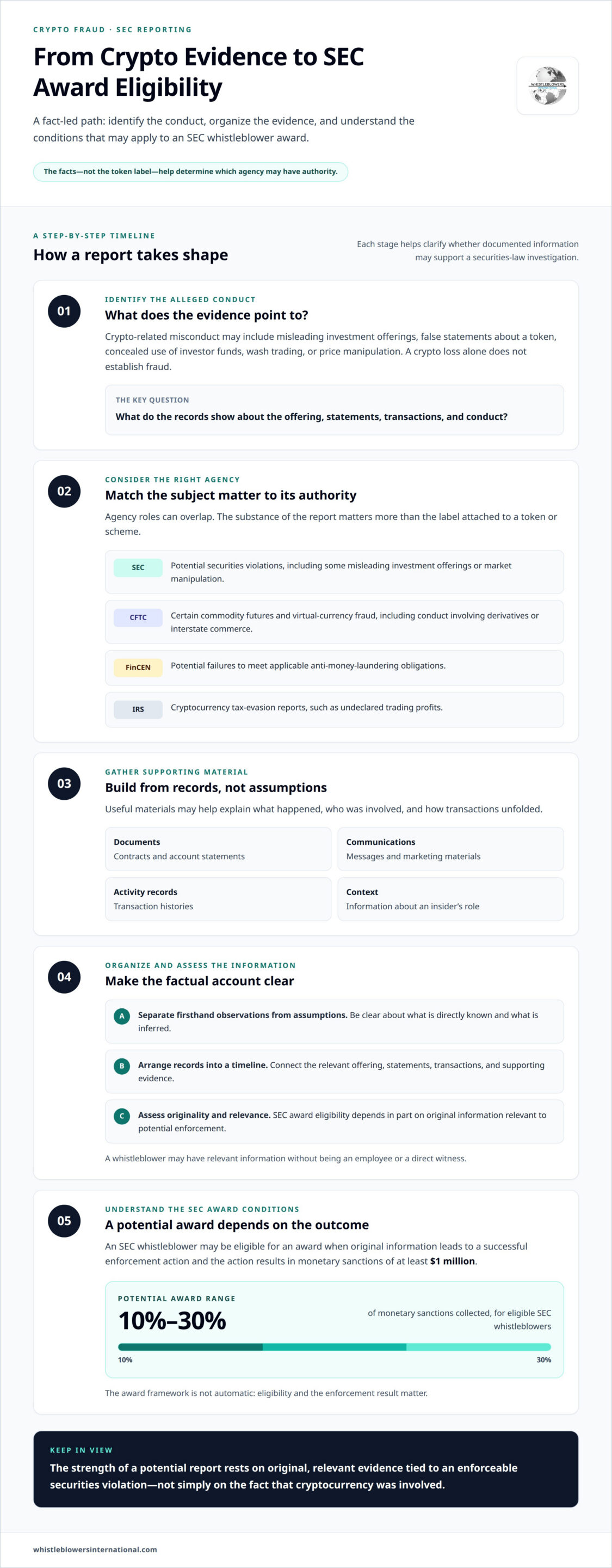
The SEC addresses potential securities violations, while the CFTC investigates certain commodity futures trading and virtual-currency fraud. FinCEN may act on failures to meet applicable anti-money-laundering obligations, and the IRS handles cryptocurrency tax-evasion reports. Agency roles can overlap, so the substance of the report matters more than the label attached to a token or scheme.
The U.S. Securities and Exchange Commission provides awards for original information leading to a successful enforcement action with monetary sanctions of $1 million or more. The U.S. Commodity Futures Trading Commission may award eligible whistleblowers 10% to 30% of monetary sanctions collected in qualifying actions. Its usual award threshold is a Commission action imposing more than $1 million in monetary sanctions, according to the U.S. Commodity Futures Trading Commission.
CFTC Jurisdiction and Rewards
The CFTC considers many cryptocurrencies, including Bitcoin, commodities. Its authority can cover virtual currencies used in derivatives contracts and fraud or manipulation involving interstate commerce. This includes certain spot commodity fraud, as well as conduct involving futures, options, or swaps. Pump-and-dump schemes and wash trading are examples of market misconduct that may warrant scrutiny.
A CFTC report should include specific, credible, timely details, with transactional or identifying information where available. The agency may consider information from people beyond company insiders, including victims and market participants who observed misconduct. A whistleblower attorney can assess whether the facts fit CFTC jurisdiction and prepare a report for the relevant program.
Retaliation Protections and Practical Risks
In the United States, SEC protections prohibit employers from discharging, demoting, suspending, harassing, or discriminating against employees for reporting crypto fraud or other securities-law violations. The CFTC program also provides confidentiality and anti-retaliation protections. These safeguards do not eliminate every personal or professional risk, so reporting strategy and careful handling of sensitive information matter.
The whistleblower process can take years and affect work and personal life. No single deadline applies to every report; timing depends on the agency and claim. Tax concerns matter too: the IRS program may apply when cryptocurrency is used to evade taxes or trading profits go undeclared. Reporting suspected tax misconduct is distinct from determining the tax treatment of any award.
What is cryptocurrency fraud?
Cryptocurrency fraud involves deception connected to digital assets, transactions, or investment claims. Examples include false statements about a token, concealed use of investor funds, wash trading, and schemes that manipulate prices. While social trading and fintech platforms like Tyrian Trade work to foster trust in modern financial markets through verified participation, deceptive schemes remain prevalent. The key question is what the evidence shows, not simply whether a cryptocurrency exchange or digital asset was involved.
A whistleblower attorney evaluates the facts and identifies records that may explain the conduct. These can include contracts, account statements, messages, transaction histories, marketing materials, and information about an insider’s role. The attorney separates firsthand observations from assumptions, organizes evidence into a clear timeline, and assesses whether the information may support a report to a federal agency. A cryptocurrency fraud whistleblower may have relevant information without being an employee or direct witness.
An attorney can explain how to prepare a report and what identifying details the relevant program requires. Anyone considering anonymous reporting should discuss the specific program’s process and identity protections with counsel before filing.
For a suspected SEC matter, counsel assesses whether the conduct may involve securities, then frames the report around the relevant offering, statements, transactions, and supporting evidence. A well-organized submission helps distinguish documented facts from conclusions. Eligibility review also considers whether the information is original and relevant to potential enforcement.
An attorney can assess whether information involving the SEC, CFTC, FTC, or FBI fits a reporting channel, then organize a factual account and supporting records for the appropriate agency. The subject matters: securities concerns differ from commodity manipulation and other suspected misconduct. A cryptocurrency fraud whistleblower can discuss these distinctions with counsel before deciding how to report.
For a state regulator or law enforcement agency, an attorney can identify the authority relevant to the alleged conduct and tailor the factual summary accordingly. If victims lost money through an exchange, contracts or transaction records may clarify what happened. Evidence of manipulation or insider involvement may point to a broader scheme, helping professionals assess the report without treating every crypto loss as fraud.
SEC enforcement and whistleblower awards
SEC awards depend on the information provided and the enforcement outcome it supports. Eligibility, the amount collected, and timely award paperwork all matter.
Potential Whistleblower Awards
According to the U.S. Securities and Exchange Commission, eligible SEC whistleblowers may receive 10 to 30 percent of monetary sanctions collected. The award calculation considers the information’s significance, assistance provided, and other factors connected to the enforcement action.
To qualify, information must be original and lead to a successful SEC action involving monetary sanctions. An attorney can assess how the evidence relates to the alleged conduct, including misleading statements about a digital asset or trading activity, and organize the submission accordingly.
The award process includes a separate application step. According to the U.S. Securities and Exchange Commission, a whistleblower has 90 days after the SEC posts a Notice of Covered Action to apply using Form WB-APP.
Reporting With or Without an Award
Reporting suspected fraud and seeking an award are related but distinct decisions. A person may provide information to support enforcement without pursuing an award. A reward claim requires meeting the applicable program’s criteria and completing its process.
For an SEC claim, an attorney can evaluate originality, document the person’s contribution, and prepare award materials. The False Claims Act has a separate framework: a qualifying whistleblower case can pay 15% to 30% of the government’s recovery. That figure does not describe SEC awards, and the appropriate route depends on the alleged misconduct.
Preserve the distinction between suspected wrongdoing, evidence, and conclusions. Transaction records, communications, and offering materials can help explain what happened and how the information supports enforcement. If an SEC Notice of Covered Action appears, the Form WB-APP deadline makes prompt attention important. Discuss an SEC whistleblower filing to assess the reporting and award issues together.
SEC whistleblower rewards for cryptocurrency securities fraud
Crypto misconduct may support an SEC reward claim when the facts point to securities fraud. The central issue is not whether an asset uses blockchain, but whether the alleged conduct falls within securities laws and whether original information contributes to enforcement. A cryptocurrency fraud whistleblower may qualify if their information meets program requirements, whether they learned of the conduct through work, investment activity, or another connection.
The SEC may treat a virtual currency as a security when it is marketed as an investment in a particular company, such as through an initial coin offering. A report might concern concealed risks in an offering, misleading statements about a project’s finances, or deceptive promotion of an investment product. Evidence should connect specific statements or conduct to investors and the potential securities violation.
Relevant cases can involve crypto asset offerings, exchanges, lending or staking products, decentralized finance platforms, non-fungible tokens, and stablecoins. For example, records showing inconsistent disclosures about customer assets may help investigators assess whether public statements misled investors. An attorney can organize documents and explain how the reported information relates to the alleged violation.
SEC and CFTC jurisdiction are distinct, although the facts can overlap. Bitcoin is considered a commodity by the CFTC, and the agency may address commodity fraud or manipulation, including certain futures activity. The label “commodity” does not determine whether a separate transaction, offering, or investment arrangement involves securities. The conduct and structure matter.
For a cryptocurrency fraud whistleblower, an SEC reward claim requires original information that leads to a successful enforcement action. The SEC’s award framework considers the information’s contribution, while any award depends on sanctions collected and program criteria. A report identifying relevant statements, transactions, and responsible entities can give investigators a clearer path to assess the allegations.
The practical takeaway is to assess the alleged investment relationship before choosing a reporting path. If the facts concern securities involving a token or platform, an SEC filing may fit. If they concern commodity futures trading or market manipulation, the Commodity Futures Trading Commission may be relevant. A careful legal assessment distinguishes these theories rather than assuming every crypto fraud claim belongs to one commission.
Choose a Clear Next Step
The next step is to bring the facts into a coherent legal assessment. A cryptocurrency fraud whistleblower can strengthen a report by distinguishing direct knowledge from inference and organizing records that explain what happened. The right path depends on the alleged conduct and the agency with authority to address it.
Piacentile & Associates LLP handles SEC Whistleblower Program Filings and IRS Whistleblower Program Filings, as well as False Claims Act and Qui Tam lawsuits. These options apply to different kinds of alleged misconduct, so the relevant question is which legal framework fits the information, not simply whether a digital asset was involved.
If you’re weighing whether to report, or how to proceed with information you already have, discuss the facts and your objectives with counsel. A focused review can help clarify the reporting route and the next procedural steps. Contact Piacentile & Associates LLP to discuss your circumstances and take a considered step forward.
Piacentile & Associates LLP and Cryptocurrency Fraud Whistleblowing
Piacentile & Associates LLP provides whistleblower legal representation, including SEC, IRS, FinCEN, and CFTC whistleblower filings, as well as False Claims Act / Qui Tam lawsuits.
If you are considering reporting suspected cryptocurrency fraud, contact Piacentile & Associates LLP to discuss which reporting option may fit your situation. The firm also handles import export customs fraud legal action.
Frequently Asked Questions
Who Can Be a Whistleblower?
A potential whistleblower may be an employee, investor, victim, or another person with useful information about suspected misconduct. Insider status isn’t always required: a market participant who observed suspicious transactions may also have relevant information. For example, a customer who noticed fabricated account statements could describe what they personally saw, while distinguishing those observations from conclusions about who was responsible.
What Evidence Is Required to Prove Fraud?
No single document proves every fraud report. Useful material may include account records, transaction details, contracts, emails, promotional statements, or a timeline connecting events. The value often lies in how records fit together: a transaction history alongside messages describing promised returns may give investigators a clearer lead. Materials protected by attorney-client privilege should not be treated as ordinary supporting documents.
What Kinds of Wrongful Conduct Are Covered by Whistleblower Reward Laws?
Coverage depends on the law and alleged misconduct. SEC matters can involve suspected securities violations; CFTC reports may concern commodity fraud or manipulation; IRS reports may involve cryptocurrency tax evasion. FinCEN matters can relate to applicable anti-money-laundering obligations. A crypto company’s activity alone doesn’t establish that a reward program applies. The facts must connect to the relevant agency’s authority and program criteria.
How Can an Attorney Help if You Suspect Misconduct?
An attorney can assess whether information may fit a whistleblower program, identify gaps in the account, and organize records into a coherent report. For example, counsel can separate firsthand knowledge from information learned through others and connect dates, communications, and transactions. This helps present the allegations clearly while preserving important context. The appropriate filing path depends on the conduct and evidence.
What Is Cryptocurrency Fraud and What Are Common Examples?
Cryptocurrency fraud involves suspected deception related to a digital asset, investment, or transaction. Examples include a token promoted with misleading claims, a pump-and-dump scheme, wash trading, or concealed risks in an offering. A falling token price alone doesn’t establish whether fraud occurred. The useful distinction is whether available records point to deceptive statements, manipulated trading, or other suspected misconduct.
Which U.S. Agencies Offer Whistleblower Rewards for Reporting Crypto Fraud?
Depending on the reported conduct, reward programs may be available through the SEC, CFTC, IRS, or FinCEN. Securities-related allegations may fit the SEC; commodity fraud or manipulation may fall within CFTC matters; suspected crypto tax evasion may be relevant to the IRS. FinCEN may be relevant to certain money-laundering violations. Agency fit depends on the facts, not simply on the use of cryptocurrency.